



Financial Markets · Beginner · 12 min read
Is Forex Trading Legal in the UK? FCA Rules and Your Rights
The legal status of forex trading in the UK, explained
Anyone resident in the UK can open an account with a forex broker and start placing trades without breaking any law, provided that broker holds the right permissions from the Financial Conduct Authority (FCA). The permitted activity covers spot forex and contracts for difference (CFDs) on currency pairs, with the authorised firm handling the regulated side of the transaction while your account operates under the retail rulebook.
Under UK law, foreign exchange dealing for investment purposes is a regulated activity. Any firm offering forex trading, margin accounts or CFDs to UK residents has to be authorised, otherwise it is breaching the Financial Services and Markets Act. For a trader, the useful question becomes whether the firm on the other side of the account holds the permissions required to serve someone in your position.
Forex trading laws in the UK draw a clear line between the two sides of a trade. As the retail trader, you are free to open and close positions, run strategies, hold overnight exposure and withdraw profits, while the licensing duty sits with the firm facilitating those trades. The same logic answers whether day trading is legal in the UK: short-term, high-frequency trading of currencies, indices or shares through an authorised broker is a permitted activity, with no legal cap on how many trades you place.
The practical consequences of this framework run through the rest of this article, shaping how much leverage you can access, what instruments you can trade, what happens if the broker fails, and what recourse you have if something goes wrong. They also explain why trading with an offshore firm, while legal from your side, places you outside the UK consumer protection perimeter.
FCA authorisation: what it means for your broker and your protection
An FCA-authorised broker is a firm that has passed the Financial Conduct Authority's vetting process and is listed on the Financial Services Register. To stay authorised, the firm must hold minimum capital, segregate client money from its own operating funds, publish risk warnings, treat customers fairly under the FCA Conduct of Business Sourcebook, and submit regular financial reporting.
For you, authorisation unlocks two consumer protections that do not exist outside the UK regulatory perimeter. The first is the Financial Ombudsman Service, a free dispute resolution body that can order a firm to compensate you if it has treated you unfairly. The second is the Financial Services Compensation Scheme (FSCS), which protects eligible deposits and investment claims up to £85,000 per firm if the broker becomes insolvent.
These protections only apply to authorised firms. According to the FCA, dealing with unauthorised firms means losing access to both the FOS and the FSCS, so if an unlicensed broker collapses or disappears with your deposit, no UK body has the legal power to compel repayment.
Authorisation also shapes how your money is held day to day. An FCA firm must keep client funds in segregated accounts at a credit institution, separate from the broker's own balance sheet. If the broker enters administration, your money is treated as client property, protected from general creditor claims, and should be returned to you ahead of the firm's other liabilities.
A few points worth checking before you open an account:
- The firm's exact legal entity name on the Financial Services Register, not just the brand name.
- The specific permissions the entity holds ("arranging deals in investments", "dealing in investments as principal").
- Confirmation that the UK entity is the one onboarding you, with no overseas affiliate handling the account.
- Where client funds are banked and how they are reconciled.
An FCA-authorised UK entity is the gold-tier counterparty for a UK resident. Any onboarding routed through an offshore sister company inside the same group should be treated as a different legal relationship, with different protections.
Leverage caps and product restrictions for UK retail traders
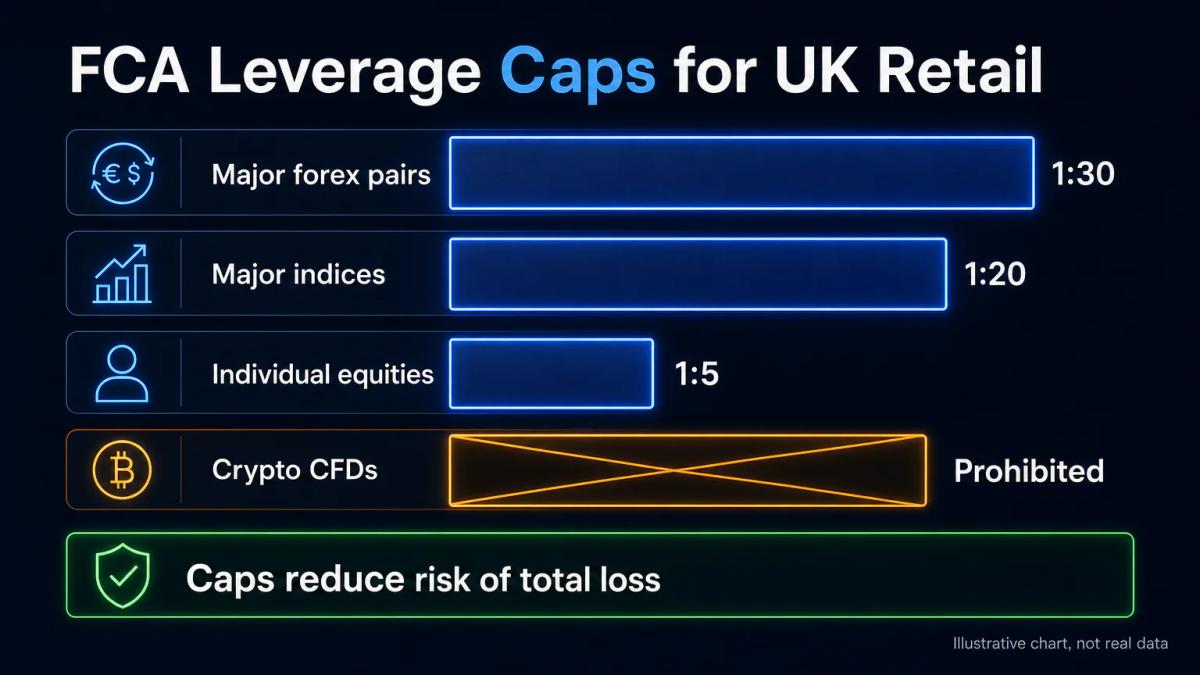
Leverage is the ratio between the position size you control and the margin you post. A 1:30 leverage means that for every £1 of your own money, you can hold £30 of exposure. The FCA caps leverage for UK retail clients by instrument category, and CFDs on cryptocurrencies are prohibited outright for retail clients.
The main retail caps break down as follows:
- Major forex pairs: 1:30
- Major indices: 1:20
- Individual equities: 1:5
- Cryptocurrency CFDs: prohibited for retail
These caps exist because leverage amplifies both gains and losses in proportion to position size. A very large share of retail accounts close at a loss in leveraged products, and the FCA designed the retail rulebook to limit the speed at which a losing account can be wiped out. According to the CFTC, two-thirds of retail forex customers at registered US dealers lost money across the Q2 2021 to Q1 2022 reporting window, giving you a sense of base rates in the asset class.
Alongside the caps, UK retail accounts come with negative balance protection, which means you cannot lose more than the funds in your trading account on a single position or event. Brokers must also apply a standardised margin close-out rule: once your account equity falls below 50% of the initial margin requirement, open positions are closed to prevent further losses.
The table below summarises the current retail limits.
| Instrument | Maximum retail leverage | Available to retail? |
|---|---|---|
| Major forex pairs (EUR/USD, GBP/USD, USD/JPY) | 1:30 | Yes |
| Non-major forex pairs, gold, major indices | 1:20 | Yes |
| Commodities other than gold, non-major indices | 1:10 | Yes |
| Individual equities | 1:5 | Yes |
| Cryptocurrency CFDs | n/a | No (prohibited) |
These limits apply at the account level with any FCA-authorised firm. They do not change based on your trading experience unless you are reclassified as a professional client.
Spot forex versus CFD forex: the legal difference
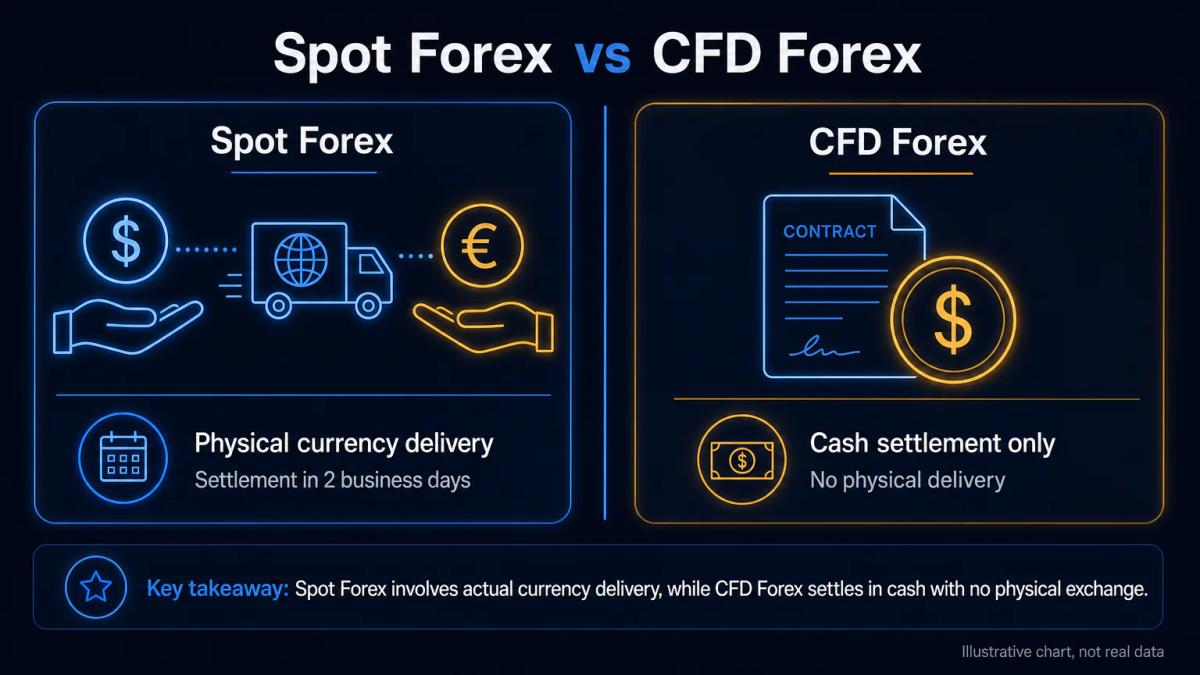
Spot forex and CFD forex are both legal in the UK, although they sit in different legal boxes. Spot forex is the direct exchange of one currency for another at the current market price, with physical delivery of the underlying currency expected within two business days. A CFD on a currency pair is a derivative contract whose value tracks the pair, settled in cash and without delivery of actual currency.
The practical difference for you is the rulebook that applies. Spot forex traded for commercial or travel purposes falls outside the FCA investment perimeter and is treated more like a currency conversion service, whereas CFD forex is a leveraged derivative that sits squarely inside the retail CFD regime, carrying the FCA leverage caps, mandatory negative balance protection, standardised risk warnings and the 50% margin close-out rule.
Most retail "forex trading" offered by UK brokers is actually CFD forex or spread betting rather than true spot delivery. The distinction becomes important when you look at tax: spread betting profits are generally outside the scope of capital gains tax and income tax for UK individuals, while CFD profits are typically subject to capital gains tax. Tax treatment depends on your personal circumstances, and the firm cannot give you tax advice.
How to verify a broker is FCA-authorised and avoid unlicensed firms
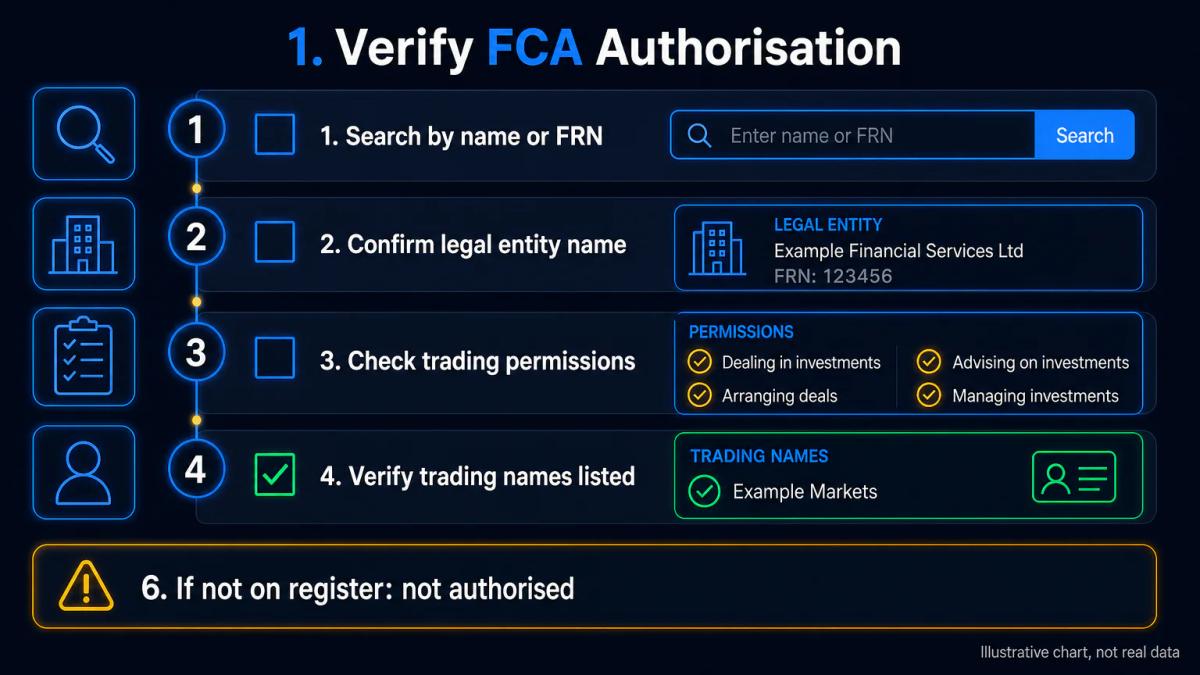
You can verify a broker's FCA status in a few minutes by searching the Financial Services Register at register.fca.org.uk. Each authorised firm has a reference number (FRN), the exact legal entity name, the permissions it holds, and a list of trading names and websites it uses. If a broker is not on the register, it is not authorised to offer forex trading to UK residents.
A short checklist for verifying a broker:
- Search the firm by name or FRN on the Financial Services Register.
- Confirm the website domain and trading name are listed on the register entry.
- Check that the permissions include dealing in investments relevant to forex and CFDs.
- Compare the address and contact details on the website against the register.
- Look for a prominent risk warning stating the percentage of retail accounts that lose money.
Suppose you find a broker advertising 1:500 leverage on EUR/USD to UK retail clients. That offer alone is a red flag, because an FCA-authorised firm cannot legally provide more than 1:30 to retail. If you then search the register and find no matching entry, you are almost certainly looking at an unauthorised firm using UK-facing marketing.
The FCA maintains a public warning list of firms known to target UK consumers without authorisation, and encourages reporting of suspicious operators. According to the FCA, the Consumer Helpline for reporting unauthorised firms is 0800 111 6768. A single call takes a few minutes and feeds directly into the warning list that protects other traders.
Clone firm scams are a specific risk worth naming. In a typical case, a fraudster copies the name, FRN and website styling of a genuine authorised firm and then routes payments to a different bank account. A simple defence is to use the contact details on the Financial Services Register entry, instead of the ones on the email or website that approached you.
Offshore brokers and UK residents: legal risks and consequences
Trading with an offshore broker that is not FCA-authorised is not a criminal offence on your side as an individual trader, since the legal obligation to be authorised sits with the firm itself. In practice, however, using an offshore broker strips away every UK consumer protection described above and leaves you with limited recourse if the firm fails or acts dishonestly.
Offshore firms frequently advertise leverage well above UK retail limits, often 1:200, 1:500 or 1:1000 on major forex pairs. The CFTC flags that leverage higher than 2 percent on major pairs and 5 percent on other pairs exceeds what is legally allowed to retail clients in the United States, and treats it as a signal of unregistered offshore operators. The same marketing playbook targets UK residents, so very high headline leverage on a UK-facing site is a strong indicator the firm sits outside any mainstream regulator.
The concrete risks of trading offshore include:
- No FSCS cover if the broker becomes insolvent.
- No access to the Financial Ombudsman Service for disputes.
- Weaker or no client money segregation rules.
- No enforceable negative balance protection.
- Limited practical ability to recover funds through foreign courts.
- Payment and withdrawal frictions, with deposits sometimes blocked by UK banks.
Tax obligations do not disappear when you move offshore. If you are UK resident for tax purposes, your trading gains remain reportable to HMRC regardless of where the broker is based. Choosing an overseas broker removes UK consumer protection, yet it leaves the UK tax liability on the trader entirely intact.
There is a middle category of firms that are regulated in a reputable third country (for example, ASIC in Australia or CySEC in Cyprus) but not FCA-authorised. Trading with them is also legal for you, but the FSCS and Ombudsman still do not apply, and your dispute route runs through the overseas regulator.
Professional trader status and how it changes your legal rights
Professional client status is an FCA category that lets you access higher leverage and trade products restricted for retail, including CFDs on cryptocurrencies. To be reclassified as an elective professional, you must satisfy at least two of the following three criteria:
- An average of ten significant trades per quarter over the previous four quarters.
- A financial instrument portfolio above €500,000.
- At least one year of professional experience in a role requiring knowledge of the transactions involved.
Reclassification works as a two-way exchange: in return for higher leverage and broader product access, you give up several of the retail protections. Specifically, these are the ones you lose or see reduced:
- Negative balance protection is no longer guaranteed.
- The standardised margin close-out rule does not apply in the same way.
- The standardised risk warnings are reduced.
You remain eligible for the Financial Ombudsman Service and FSCS in most cases, although the underlying assumption shifts, with the firm treating you as someone who understands and can bear the risks of leveraged trading.
Before requesting professional status, weigh carefully what you would be giving up. The appeal of higher leverage is also what drives the retail loss rates reported across the industry, so reclassifying purely to access leverage above 1:30 is likely to add more risk than any extra size can justify.
Recent FCA policy direction worth tracking
The FCA has steadily tightened the retail perimeter around leveraged and complex products over the last several years. The permanent ban on the sale of crypto derivatives to retail clients took effect in January 2021, formalising earlier temporary restrictions. The retail CFD rulebook, with the leverage caps and standardised risk warnings described above, has been in force since August 2019.
More recent FCA activity has focused on financial promotions. From 2023, firms promoting high-risk investments to UK consumers must apply enhanced warnings, personalised risk assessments and a 24-hour cooling-off period before a first investment with a new firm. For forex and CFD brokers, this has translated into friction at the sign-up stage: appropriateness tests, knowledge questionnaires, and clearer upfront disclosure of expected losses.
The direction of travel has stayed consistent across these waves of rulemaking. UK regulation leans towards giving the retail trader more information, more time, and lower leverage, while reserving the higher-risk product set for professional clients and institutional accounts. That is the framework you are operating inside whenever you place a forex trade from the UK.
Frequently Asked Questions
Is it legal to trade forex in the UK with an unregulated broker?
Trading with an unregulated broker is not a criminal offence for you as an individual, but the broker is breaching UK rules by offering services here without authorisation. You lose every UK consumer protection: no FSCS cover, no access to the Financial Ombudsman Service, and no enforceable client money segregation. Recovery of funds through foreign courts is slow and often impractical. The legal position is that you are allowed to trade, but you are trading without a safety net.
What happens if my FCA-regulated broker goes out of business?
If an FCA-authorised broker becomes insolvent, your money is treated as client property because the firm is required to hold it in segregated accounts separate from its own funds. These balances should be returned to you ahead of the firm's general creditors. If there is a shortfall, the Financial Services Compensation Scheme covers eligible claims up to £85,000 per firm. You submit a claim directly to the FSCS, which handles the compensation process.
Can I trade forex with leverage higher than the FCA cap if I use an offshore broker?
You can physically open an account with an offshore broker offering 1:200 or 1:500 leverage, and doing so is not illegal on your side. The offshore firm is not authorised to serve UK retail clients, so you are stepping outside the FCA perimeter voluntarily. Higher leverage magnifies losses as well as gains, and the two-thirds retail loss rate reported by the CFTC is a reminder that larger size does not translate into larger profit for most traders.
How do I know if a forex broker is really FCA-authorised?
Search the Financial Services Register at register.fca.org.uk by firm name or FRN. The entry lists the exact legal entity, authorised trading names, website domains and permissions. Confirm these match what the broker's site displays. Clone firm scams copy a real firm's details, so use the phone number and address from the register itself rather than from the website or email that approached you. If anything does not match, treat it as unverified.
Are there any forex products that are illegal for UK retail traders to trade?
Direct forex trading is not banned, but related products are. The FCA prohibits the sale of CFDs on cryptocurrencies and other crypto derivatives to UK retail clients, a permanent ban in force since January 2021. Binary options are also banned for retail clients. Beyond outright bans, the retail leverage caps mean that products offered at 1:100 or 1:500 cannot legally be sold to UK retail traders by an authorised firm, regardless of how the broker labels them.
About the authors


Put this into practice
Brokers we have reviewed
Scored on the same five dimensions. Here are three of them — the full list is on the brokers page.



Related articles

Most Volatile Stocks: How to Find and Trade Them
A practical guide for retail traders on where to find the most volatile stocks, why they swing, and how to trade them without blowing up your account.

Options Trading Explained: Calls, Puts, and Broker Approval
How options trading works for UK retail traders: calls, puts, strike prices, premiums, broker approval, risk limits, and tax reporting, in plain English.

Passively Managed Index Funds vs. Active Funds: Which Suits You Best?
A clear-eyed comparison of passively managed index funds and actively managed funds: mechanics, costs, tax drag, downturn behaviour, and how to choose.
0 comments