



Financial Markets · Beginner · 6 min read
Is Forex Trading Legal in Nigeria? SEC Rules, Brokers and Taxes
The legal status of forex trading in Nigeria, explained
Nigerian law permits residents to trade foreign exchange, provided they do so through a broker registered with the Securities and Exchange Commission (SEC) and operating in line with Central Bank of Nigeria (CBN) foreign exchange rules. Together, these two regulators set the capital requirements, client-fund protections and leverage limits that every licensed broker is expected to respect. When a trader opens an account with an unregistered platform, the firm itself falls outside this framework, and the domestic protections built into the system no longer apply.
Forex, short for foreign exchange, is the market where one currency is bought with another, usually as a contract for difference (CFD) that mirrors the price without physical delivery. Day trading, meaning opening and closing positions within the same session, is also permitted under the same framework.
How the SEC and CBN regulate forex brokers in Nigeria
The SEC licenses forex brokers as capital-market operators, while the CBN enforces foreign exchange policy and the rules on moving naira in and out of the country. Both roles overlap, so a compliant broker is one that satisfies the requirements of each regulator at the same time.
Under the Investments and Securities Act, SEC-registered firms must:
- Hold minimum paid-up capital set by the SEC for their licence category.
- Keep client money in a segregated account, separate from the firm's own operating cash, so your balance is ring-fenced if the broker fails.
- Report financials periodically and submit to SEC inspections.
- Comply with the Money Laundering (Prevention and Prohibition) Act, which requires identity checks on every client.
The CBN layer adds forex-specific controls that cover several areas, including how much foreign currency a firm is allowed to source, which channels may be used for international transfers, and the way naira conversions are priced. Because these rules shift through CBN circulars, a broker's compliance status is never fixed in time, and it benefits from a fresh review whenever policy changes.
Leverage limits and capital requirements for Nigerian forex traders
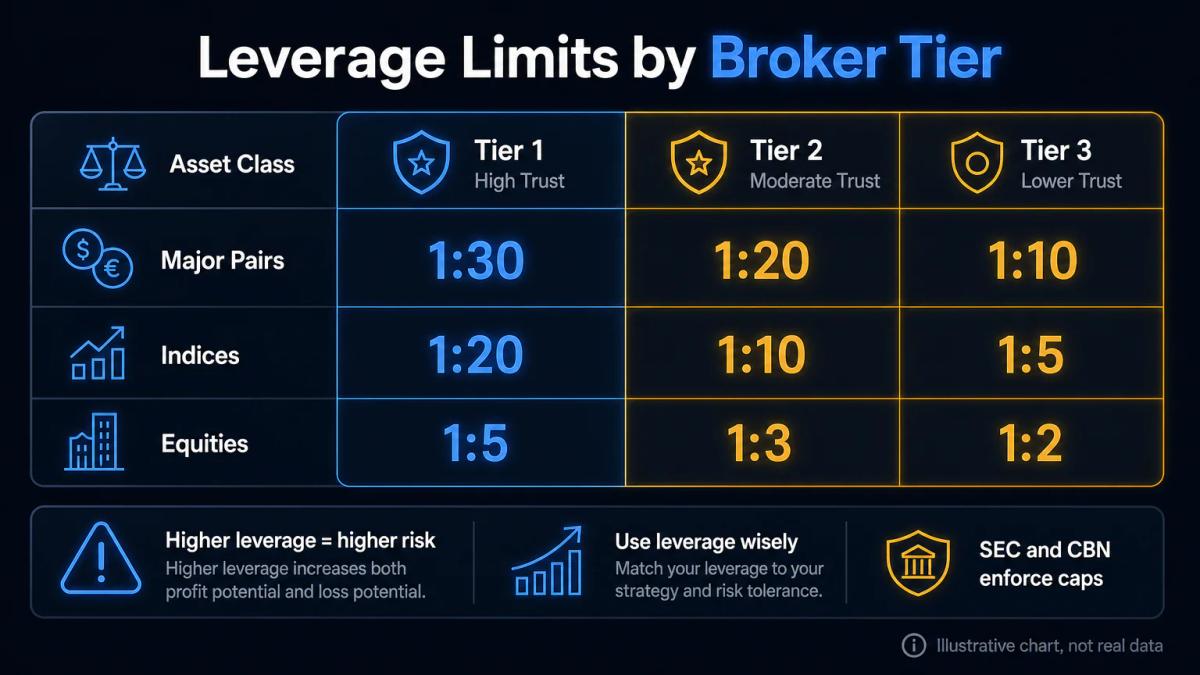
Leverage, meaning the ratio of position size to the cash you put down, is the single setting that reshapes a retail trader's risk profile more than any other. Brokers regulated inside Nigeria typically cap retail leverage well below the ceilings advertised on offshore venues, and the exact limit will depend on both the licence tier and the specific instrument being traded.
The table below contrasts the broker types a Nigerian resident can realistically open an account with. Figures reflect the common ranges published on each regulator's website; your specific broker may be stricter.
| Feature | SEC-regulated Nigerian broker | FCA-regulated UK broker | CySEC-regulated EU broker | Offshore unregulated broker |
|---|---|---|---|---|
| Typical max leverage, major FX | 1:10 to 1:50 | 1:30 | 1:30 | 1:500 or higher |
| Client fund segregation | Required | Required | Required | Not guaranteed |
| Local legal recourse in Nigeria | Yes | No | No | No |
| Minimum deposit range | $100 to $500 | $0 to $200 | $0 to $200 | Varies |
| Investor compensation scheme | SEC-administered framework | FSCS up to £85,000 | ICF up to €20,000 | None |
Imagine opening a $500 account at 1:30 leverage: the position you could control would reach around $15,000. Should the same deposit be used at 1:500, your exposure would stretch to roughly $250,000, and an adverse move of just 0.2% would be enough to wipe the balance out.
Risks of trading with unregulated brokers in Nigeria
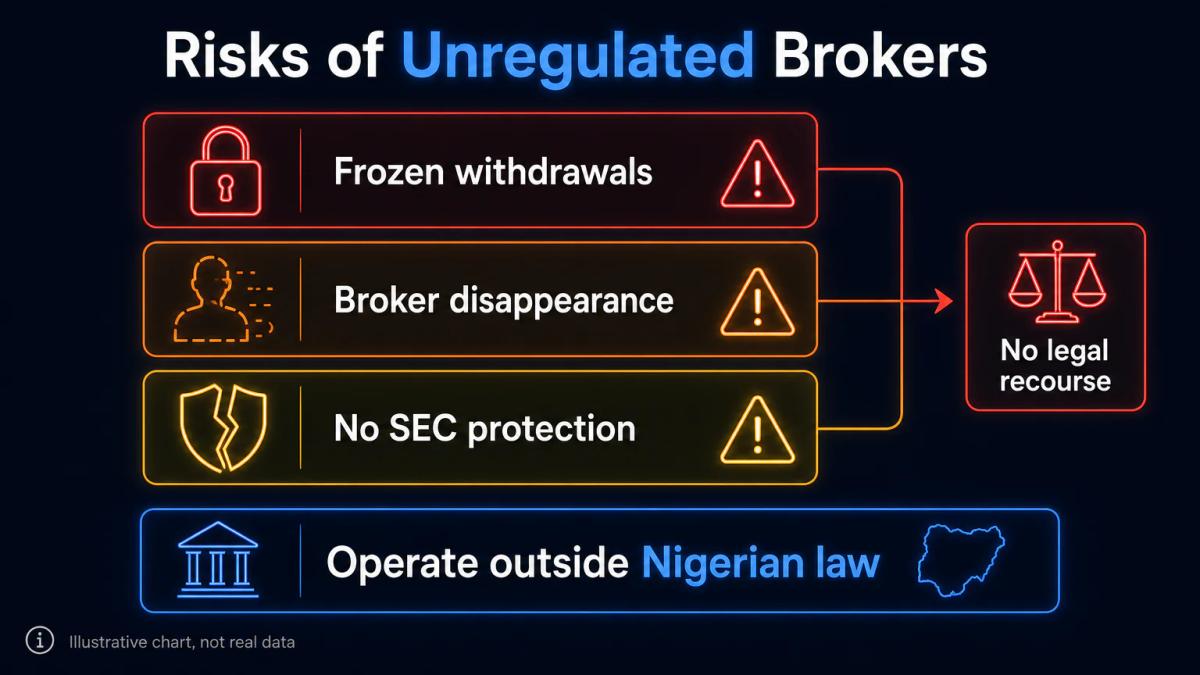
Unregulated brokers remain the single largest source of forex-related losses reported to Nigerian authorities. Their marketing tends to lean on several recurring warning signs, which traders learn to recognise over time:
- Promises of guaranteed or fixed returns on forex positions.
- Aggressive sign-up bonuses that are tied to high trading volumes before any withdrawal.
- "Account managers" who offer to place trades on your behalf in exchange for a share of profits.
When an unlicensed firm freezes a withdrawal or vanishes altogether, the SEC has no supervisory reach over it, and Nigerian courts struggle to pursue an entity incorporated in a jurisdiction without a mutual legal assistance treaty. The SEC does publish periodic public notices naming unregistered forex operators, and consulting those notices before funding an account tends to be far quicker than attempting to recover money once it has already been sent.
How to verify a broker is registered with Nigerian regulators
Verifying a broker takes under ten minutes, and the checks are best completed before any money is deposited into an account.
- Open the SEC Nigeria website and go to the Capital Market Operators (CMO) register.
- Search the broker's exact legal name as it appears on official filings, since the marketing brand shown on advertising material will not always match.
- Confirm the registration number on the SEC page matches the one shown on the broker's own site.
- Check the licence category covers brokerage or dealing in securities.
- For international brokers, repeat the step on the FCA, CySEC or ASIC register.
If a sales agent pressures you to deposit before you finish these checks, that pressure is itself the warning sign.
International brokers and dual regulation for Nigerian traders
Many Nigerian residents choose to open accounts with brokers regulated in the UK, Cyprus or Australia because of the deeper liquidity and lower spreads on offer. The trade-off tends to be jurisdictional in nature: the FCA protects clients who are onboarded to its UK entity, whereas a Nigerian client is typically onboarded to an offshore sister entity within the same group, which operates under lighter protections. Before funding an international account, it is worth confirming which group entity is actually holding your money, which regulator supervises that entity, and whether Nigerian residents are accepted under the current CBN rules on outbound transfers.
Deposit and withdrawal methods for Nigerian forex traders
Payment rails for Nigerian retail traders cluster around a few options, each with different speed and cost profiles:
- Local bank transfer in naira through a licensed broker's Nigerian account, usually settled the same day.
- Payment processors such as Paystack and Flutterwave, convenient for card funding, with processor fees.
- International wire transfer in dollars, subject to CBN limits on outbound forex.
- USDT or other stablecoin rails, offered by some offshore brokers; cheap and fast, but outside the SEC/CBN perimeter.
Forex trading income is taxable in Nigeria as part of your personal income, and it is administered jointly by the Federal Inland Revenue Service and the state revenue agencies. Good record-keeping tends to make tax season considerably easier, and traders are generally expected to:
- Keep monthly broker statements for each account held.
- Retain full deposit and withdrawal records in one central place.
- Maintain a trade log that captures entries, exits and realised results.
- Declare realised profits on the annual personal income tax return.
If a broker blocks a withdrawal, the first step is to file a written complaint directly with the firm. Should that complaint go unanswered or be rejected without a clear explanation, the matter can then be escalated to the SEC Complaints Management Framework, with account statements and all relevant correspondence attached to the submission.
This article is for general information only and does not constitute legal, tax or financial advice. Rules, licence conditions and tax treatment vary by individual circumstance and change over time, so any decision should be taken with a professional licensed in the relevant jurisdiction.
Frequently Asked Questions
Is it illegal to trade forex in Nigeria?
No. Trading forex as an individual is legal in Nigeria, provided you use a broker registered with the Securities and Exchange Commission and compliant with Central Bank of Nigeria foreign exchange rules. The illegality attaches to brokers that operate without a licence, not to retail participants.
How do I know if a forex broker is registered with the SEC in Nigeria?
Open the SEC Nigeria website and search the Capital Market Operators register under the broker's exact legal name. Confirm that the registration number on the SEC page matches the one on the broker's own site and that the licence category covers brokerage or dealing in securities.
What leverage can I use as a forex trader in Nigeria?
On SEC-regulated brokers, retail leverage on major currency pairs typically sits between 1:10 and 1:50, depending on licence tier and instrument. Offshore brokers accepting Nigerian clients often advertise 1:500 or more, but the higher ratio removes local regulatory protection.
Can I trade with an international forex broker if I live in Nigeria?
Yes, many Nigerian residents use brokers regulated by the FCA, CySEC or ASIC. Confirm which group entity actually onboards Nigerian clients, because it is usually an offshore sister entity with lighter protection than the parent regulator suggests. Also check CBN rules on outbound transfers before funding the account.
What should I do if a forex broker refuses to let me withdraw my money?
File a written complaint with the broker first, keeping copies of every reply. If the broker is SEC-registered and does not resolve the issue, escalate through the SEC Complaints Management Framework with your account statements, deposit receipts and correspondence. For offshore brokers, your main route is a complaint to the primary foreign regulator.
About the authors


Put this into practice
Brokers we have reviewed
Scored on the same five dimensions. Here are three of them — the full list is on the brokers page.



Related articles

Is Forex Trading Legal in the UK? FCA Rules and Your Rights
Forex trading is legal in the UK through FCA-authorised brokers. Understand leverage caps, product restrictions, FSCS protection and the risks of offshore firms.

Most Volatile Stocks: How to Find and Trade Them
A practical guide for retail traders on where to find the most volatile stocks, why they swing, and how to trade them without blowing up your account.

Options Trading Explained: Calls, Puts, and Broker Approval
How options trading works for UK retail traders: calls, puts, strike prices, premiums, broker approval, risk limits, and tax reporting, in plain English.
0 comments