



Financial Markets · Intermediate · 4 min read
Is Forex Trading Legal in South Africa? A Trader's Guide
The legal status of forex trading in South Africa
Retail participation in the currency market sits within a defined regulatory frame overseen by the Financial Sector Conduct Authority (FSCA), the national conduct regulator for financial services. Provided you deal with a broker that holds the right FSCA authorisation, your activity is lawful, and the regulator supervises forex and derivatives business to give retail clients a baseline of protection against misconduct and excessive risk.
The legal perimeter runs through the Financial Advisory and Intermediary Services (FAIS) Act, which requires any firm offering forex derivatives to local clients to hold a Financial Services Provider (FSP) authorisation. Trading currencies on your own account carries no criminal exposure, although once you deal with an unlicensed intermediary your statutory protections fall away. South African residents may also use offshore brokers, in which case complaints sit outside the FSCA's reach and ombud scheme.
FSCA regulation and broker licensing requirements
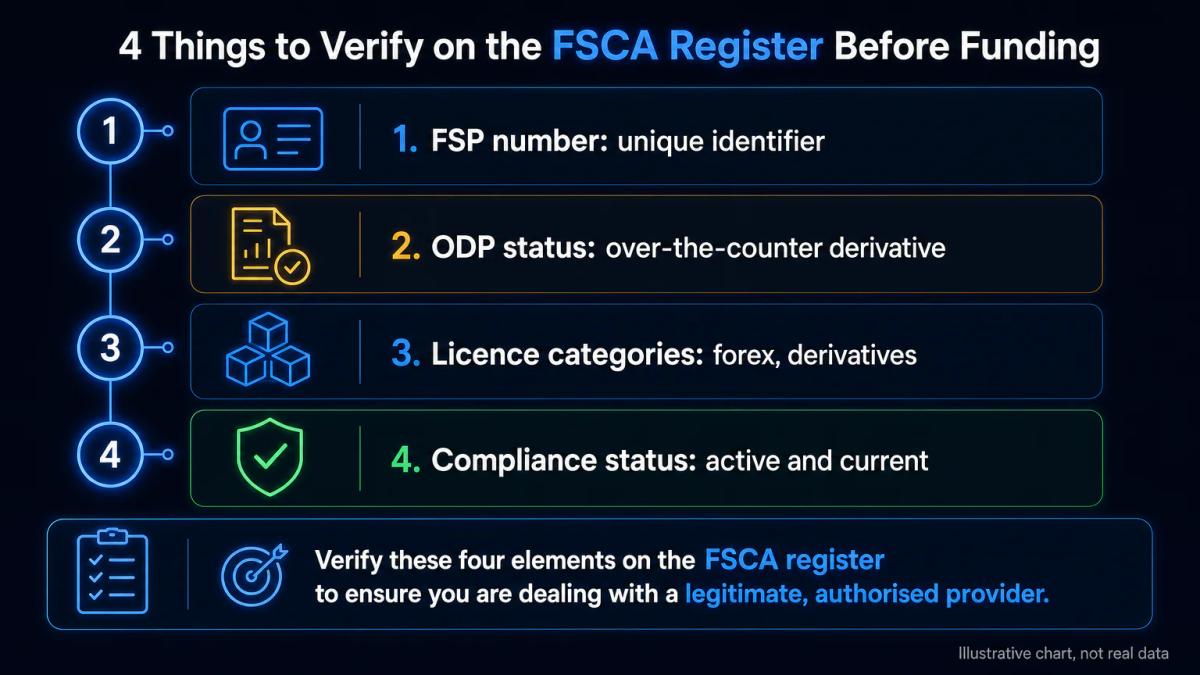
Any broker soliciting South African clients for forex derivatives must hold an active FSP licence, with ODP (Over-the-Counter Derivative Provider) status layered on top for firms that act as the counterparty to your trades. You can verify an FSP number directly on the FSCA's public register before funding an account; the entry shows licence categories, key individuals and compliance status.
| Licence element | What it means for you |
|---|---|
| FSP number | The firm is authorised under FAIS to deal with retail clients |
| ODP status | The entity can issue OTC derivatives as principal |
| Category II | Discretionary mandate: the firm trades on your behalf |
| Representatives | Named staff authorised to give advice or execute |
Where the entity onboarding you is an offshore group company rather than the local FSP, your relationship is with that foreign entity, so the FSCA's conduct rules and the FAIS Ombud route will not cover it.
Leverage limits and retail trader protections
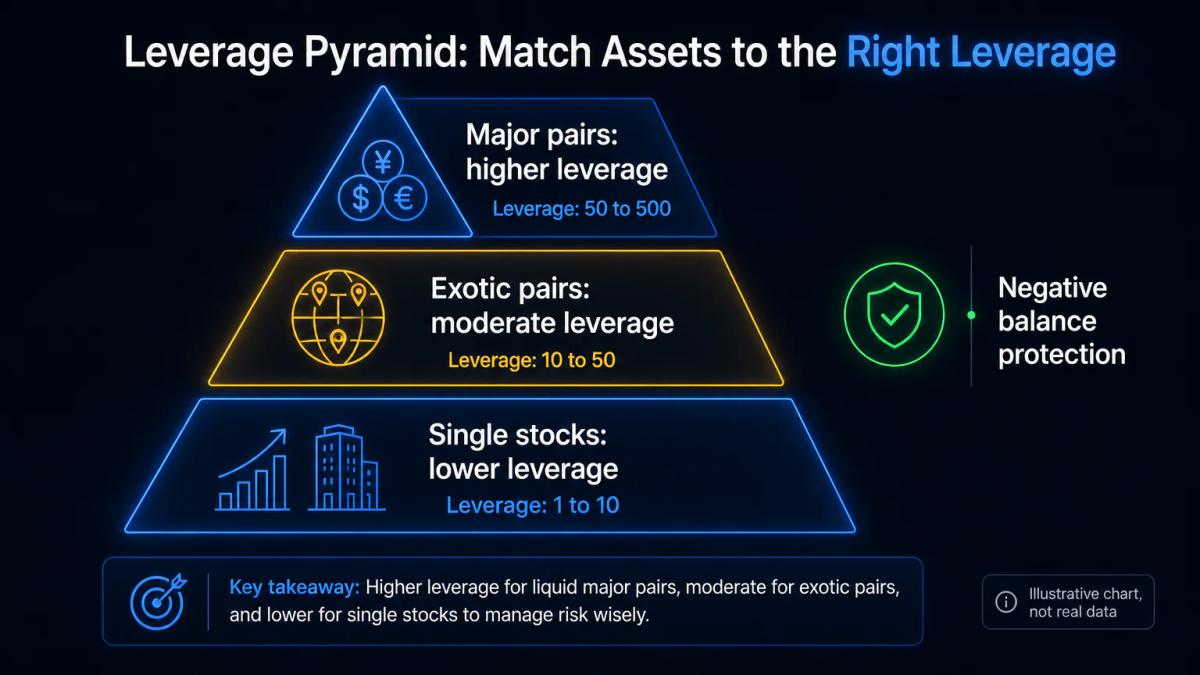
Unlike regulators in the EU or UK, the FSCA has not published a numerical leverage cap for retail forex, so maximum leverage is set by each ODP broker's internal risk policy and can run considerably higher than those European limits. Local brokers typically apply tiered leverage, with lower ratios on exotic pairs and single stocks and higher ratios on major pairs. Any advertised headline figure should be read as a ceiling for sizing purposes rather than guidance on how much leverage to actually deploy.
Retail protections that regulated brokers in South Africa commonly offer include negative balance protection (you cannot lose more than your account balance), margin close-out rules that liquidate losing positions before equity turns negative, and guaranteed stop-loss orders on selected instruments. A stop-loss is an order to close a position automatically at a chosen price to cap loss; a guaranteed version holds that price even through market gaps, usually for an added premium.
Tax obligations for forex traders
Forex trading profits are taxable in South Africa and must be declared to the South African Revenue Service (SARS).
How your profits are taxed depends on the pattern and intent of your activity. Should SARS consider you a frequent and systematic trader, your gains will typically be treated as revenue, taxed at your marginal income tax rate on the full profit. If instead you hold positions as a long-term investor, those gains fall under capital gains tax, where only a portion of the gain is included in taxable income and then taxed at your marginal rate.
Keep records of every trade:
- entry and exit prices
- dates
- position size
- fees
- swap charges
- ZAR conversion rates
Offshore account balances and foreign-sourced income still require disclosure, and the exchange-control allowances administered by the South African Reserve Bank come into play whenever you fund brokers abroad.
How to choose a regulated forex broker in South Africa
Start with the FSCA register and confirm the FSP number, ODP status and licence categories match what the broker advertises. Then work through the practical checks before you deposit:
- ZAR base-currency accounts, to avoid round-trip conversion costs on every deposit and withdrawal
- Local funding rails: EFT, instant EFT and card payments from South African banks
- Platform choice: MT4, MT5, cTrader or a proprietary platform, matched to your strategy
- Account tiers: standard spread accounts versus raw-spread plus commission, so you can model total cost per trade
- Spreads and overnight swap rates on the pairs you actually trade, including USD/ZAR
- Risk controls on offer: negative balance protection, margin close-out level, guaranteed stops
- Local client support in South African time zones, with a documented complaints route to the FAIS Ombud
A handful of recurring mistakes trip up local traders:
- oversizing positions on USD/ZAR around SARB announcements
- ignoring the swap cost of holding ZAR positions over several days
- chasing offshore brokers with headline leverage figures that leave no recourse when something goes wrong
Imagine, for instance, a trader opening a heavily leveraged USD/ZAR position minutes before a rate decision and holding it over a long weekend: the combined gap risk and accumulated swap can easily eclipse the expected move on the pair. Working through the FSCA register, confirming ODP status and modelling total trading cost up front will spare you most of these outcomes.
This article is general information and does not constitute financial, legal or tax advice. Each trader's situation differs, so consult a licensed professional in the relevant jurisdiction, whether a financial adviser, attorney or registered tax practitioner, before acting on anything described here.
Frequently Asked Questions
Do I need a licence to trade forex in South Africa as a retail trader?
No. You do not need a personal licence to trade your own money. The licensing obligation sits with the broker or intermediary: they must hold an FSCA Financial Services Provider authorisation under the FAIS Act to deal with you.
What happens if I trade with an unregulated forex broker in South Africa?
Trading itself is not illegal, but you lose the protections of South African law. The FSCA cannot act against the firm on your behalf, the FAIS Ombud cannot hear your complaint, and recovery of funds in a dispute depends entirely on the broker's home-country regime.
Are there restrictions on which currency pairs I can trade in South Africa?
There is no FSCA restriction on currency pairs for retail forex clients. You can trade majors, minors and exotics, including USD/ZAR and other emerging-market crosses. Exchange-control rules apply to how you move rand offshore to fund foreign accounts, not to the pairs themselves.
How do I report forex trading income to SARS?
Declare profits on your annual ITR12 return. Active trading income usually goes under local business or other income at your marginal rate; investment-style gains go under capital gains tax. Keep statements, trade logs and ZAR conversion records, and confirm the treatment with a registered tax practitioner.
About the authors


Put this into practice
Brokers we have reviewed
Scored on the same five dimensions. Here are three of them — the full list is on the brokers page.


Related articles

Is Forex Trading Legal in the UK? FCA Rules and Your Rights
Forex trading is legal in the UK through FCA-authorised brokers. Understand leverage caps, product restrictions, FSCS protection and the risks of offshore firms.

Most Volatile Stocks: How to Find and Trade Them
A practical guide for retail traders on where to find the most volatile stocks, why they swing, and how to trade them without blowing up your account.

Options Trading Explained: Calls, Puts, and Broker Approval
How options trading works for UK retail traders: calls, puts, strike prices, premiums, broker approval, risk limits, and tax reporting, in plain English.
0 comments