


Financial Markets · Advanced · 9 min read
Taxes on Trading Income in Nigeria: Rates, Filing, and Compliance
How trading income is taxed in Nigeria
This article is general information: Nigerian tax treatment of trading activity turns on facts specific to each trader, and you should confirm your position with a licensed tax adviser or accountant before filing.
For Nigerian-resident individuals, the Personal Income Tax Act brings active trading inside the scope of assessable income, with progressive marginal rates applied through the state revenue system. The Federal Inland Revenue Service and the relevant state tax authority treat forex, equities, and derivatives profits as part of your yearly assessable income, regardless of whether trading sits at the centre of your working life or runs alongside a salaried role. Gains on the disposal of chargeable assets fall under a separate regime, which is set out further down. Dividends and some interest flows are captured through withholding tax at source.
How a position is classified, as trading income versus a capital gain, drives the applicable rate, the deductions available to you, and the return you file. Four factors typically shape that classification:
- Frequency of trading activity
- Intention at the point of acquisition
- Holding period of the position
- Whether the overall activity has the character of a trade
Day traders, scalpers, and prop-style operators tend to sit closer to the trading-income end of the spectrum, whereas buy-and-hold equity investors generally fall within capital gains territory.
Progressive tax rates and income brackets for traders
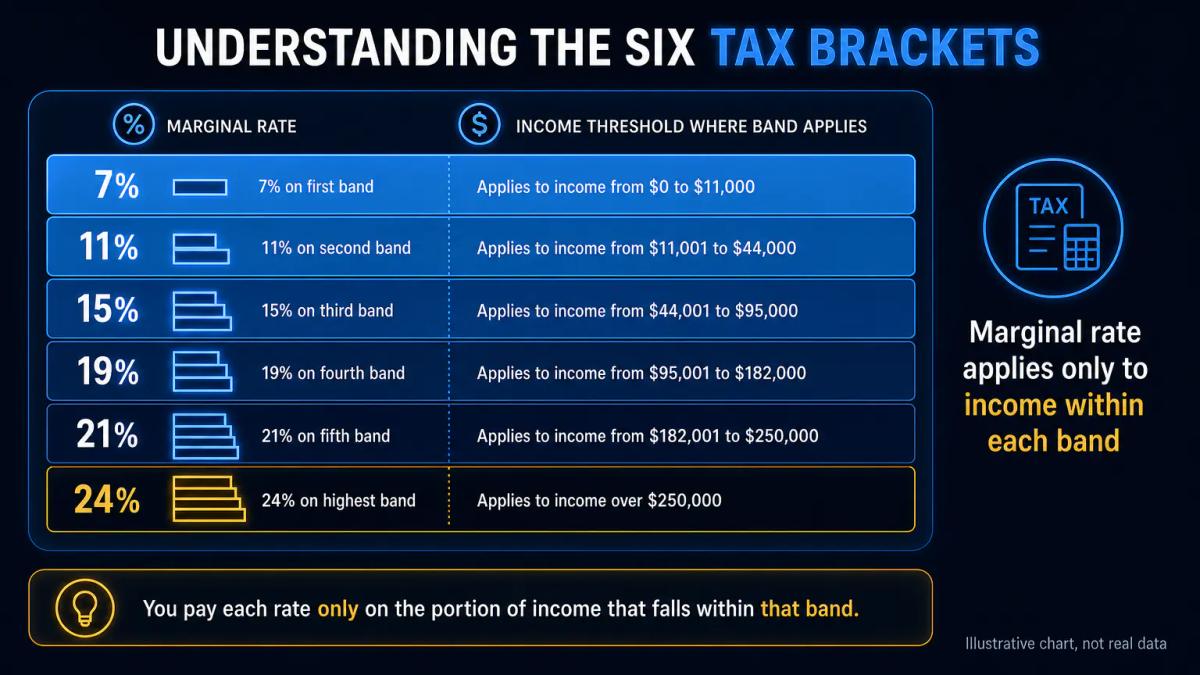
Personal income tax in Nigeria is applied on a marginal, banded basis to taxable income after reliefs and allowable deductions. The schedule under the Personal Income Tax Act (as amended) runs through successive bands:
- 7%
- 11%
- 15%
- 19%
- 21%
- 24% at the top, applied only to the slice of income above the highest threshold, not to the whole figure
Confirm the current band values with FIRS or your state tax authority before filing, as thresholds have been revised under recent reforms.
For a trader, the taxable base is net trading profit (gross profits less allowable expenses and reliefs) aggregated with other income sources such as salary, consulting fees, or rental income. Imagine a high-earning salaried professional who adds trading income on top of their day job: their marginal trading profits would be taxed entirely in the top band. By comparison, a full-time trader with no other income would step through each of the lower bands before reaching the higher ones.
| Band treatment | Applies to | Reader implication |
|---|---|---|
| Marginal rate | The slice inside each band | Only the top slice is taxed at the top rate |
| Effective rate | Total tax over total income | Always lower than the top marginal rate |
| Aggregation | All income sources combined | Trading stacks on salary; expect a higher marginal rate |
Capital gains treatment and exemption thresholds
Gains on the disposal of chargeable assets are governed by the Capital Gains Tax Act, which sets a flat 10% rate on the chargeable gain, independent of the progressive personal income tax schedule. The chargeable gain is the disposal proceeds less acquisition cost, incidental costs of acquisition and disposal, and any allowable enhancement expenditure. This treatment is separate from trading income, which is assessed under the Personal Income Tax Act at progressive marginal rates.
Shares and stocks have been treated favourably in Nigerian law for decades, with exemptions historically applying to gains on the disposal of listed equities. Under the Finance Act reforms, gains on the disposal of shares became chargeable where aggregate proceeds in a tax year exceed a defined threshold, with carve-outs for reinvestment into Nigerian companies within the same tax year. Confirm the current threshold and the reinvestment rule with FIRS, since both have moved more than once.
For a trader, the sharp question is boundary allocation. A position opened and closed within days on high turnover is unlikely to qualify for capital gains treatment, while a long-dated holding sold on a single occasion presents a stronger case. Where capital gains treatment is the goal, careful documentation of intent, holding period, and infrequency of disposal becomes central to the argument.
Allowable deductions and trading expenses

Deductions follow the general rule in the Personal Income Tax Act: expenses must be wholly, exclusively, necessarily, and reasonably incurred in the production of the income. For an active trader, that principle admits a defined list of legitimate business costs while excluding personal consumption dressed up as a business expense.
The following costs are typically deductible when properly documented and tied to the trading activity:
- Brokerage commissions, exchange fees, and clearing charges on executed trades
- Spreads and financing costs where separately itemised by the broker
- Platform and terminal subscriptions (MT4, MT5, cTrader, TradingView, Bloomberg or Reuters feeds)
- Market data subscriptions and research services actually used in the trading process
- Professional fees: tax adviser, accountant, legal counsel for trading-related work
- Interest on borrowed capital genuinely deployed in trading, with a clear audit trail
- A reasonable, apportioned share of office costs, internet, and depreciation on trading hardware
Trading losses are generally deductible against trading profits in the same year under PITA, with carry-forward of unrelieved losses subject to statutory limits. Capital losses sit under the Capital Gains Tax Act and reduce chargeable gains only. Keep contract notes, broker statements, bank records, and expense invoices for at least six years, because the quality of the paper trail is often what decides, in an audit, which deductions survive scrutiny.
Filing deadlines and compliance procedures
Resident individuals file Form A with the relevant state internal revenue service (not FIRS, which collects from companies and some specified persons) by 31 March of the year following the year of assessment. The Nigerian tax year is the calendar year. Self-employed individuals, including full-time traders, file on a direct assessment basis; employees with trading as a side activity still declare the trading income on Form A even where PAYE covers their salary.
The practical filing sequence runs through the state revenue portal or in-person submission:
- Register for a Tax Identification Number (TIN) if you do not already have one
- Reconcile broker statements, bank records, and dividend vouchers for the full calendar year
- Compute gross trading profit, deduct allowable expenses, and claim consolidated relief and pension contributions
- Separate chargeable capital gains and compute CGT at 10%
- Credit withholding tax already suffered on dividends and interest against your final liability
- File Form A, pay the balance, and retain the acknowledgement and supporting schedules
Suppose you close the tax year with gross trading profit of ₦X, allowable expenses of ₦Y, and dividend income of ₦Z net of 10% WHT. Taxable income would be computed as (X minus Y) plus the gross dividend, with the progressive bands then applied and the 10% WHT suffered credited against the total tax due. CGT on any disposals is computed separately at 10%.
Withholding tax on dividends and investment income
Dividends paid by Nigerian companies to resident individuals suffer withholding tax at 10%, deducted at source by the paying company or its registrar. Under the current regime, the 10% WHT on dividends is treated as a final tax for individuals, meaning no further personal income tax is layered on top of the net dividend received.
Interest on bank deposits and most debt instruments is similarly subject to withholding tax at source, with rates and finality rules depending on the instrument and the holder. For a trader with a diversified book, this creates a reconciliation task at year-end, because final-taxed dividend and interest flows sit outside the progressive schedule even as realised trading profits and short-dated speculative gains fold back into the main computation.
Penalties and enforcement for non-compliance

Late filing, non-filing, and underreporting carry both administrative penalties and interest on the unpaid tax at a statutory rate linked to the Central Bank of Nigeria monetary policy rate. Repeat default and deliberate evasion expose a taxpayer to criminal proceedings under the relevant tax statutes.
| Default | Typical consequence |
|---|---|
| Late filing of Form A | Fixed administrative penalty plus daily penalty for continued default |
| Underpayment of assessed tax | Interest at CBN MPR plus a spread, running from the due date |
| Failure to keep records | Separate penalty; weakens defence in audit |
| Deliberate evasion | Prosecution, higher monetary penalties, potential custodial sentence |
State revenue authorities increasingly cross-match broker data, bank transactions, and property records against filed returns. A trader who routes profits through a Nigerian bank account without filing a return should expect to hear from the authorities before long.
Tax planning strategies for different trading styles
Your trading style shapes the tax outcome, and the differences between common approaches are worth setting out in turn:
- Scalpers and intraday forex traders generate ordinary trading income that stacks on other earnings and climbs the progressive bands quickly; deduction discipline across platform fees, data, interest, and apportioned office costs is the main lever available to them.
- Swing traders with holding periods measured in weeks sit in a grey zone, where documenting intent and the infrequency of disposals strengthens any capital-gains argument on winning positions.
Two structural choices sit above the day-to-day:
- Personal name vs. a Nigerian company. Trading through a limited company brings in company income tax (CIT) at the applicable rate for the company's turnover band, plus tertiary education tax, and shifts dividend extraction into a separate layer. The company route can be efficient at scale and for reinvested profits; it adds compliance cost and is rarely worthwhile for small books.
- Cross-border positions. Nigerian residents are taxed on worldwide income. Where profits arise through a foreign broker or on a foreign exchange, double taxation relief under Nigeria's network of DTAs, or unilateral credit relief where no treaty applies, prevents the same income from being taxed twice. Keep foreign broker statements, foreign withholding certificates, and FX conversion records: without them, the credit is hard to claim.
Match the structure to the volume, the horizon, and the appetite for admin, and revisit the choice each year with a qualified adviser.
Frequently Asked Questions
Do I have to pay tax on forex trading profits in Nigeria?
Yes. Forex trading profits earned by a Nigerian resident are assessable income under the Personal Income Tax Act and are taxed at progressive marginal rates alongside any other income. This applies whether you trade through a Nigerian broker, a foreign broker, or an offshore account; residence is the trigger, not the location of the broker. You compute net profit after allowable expenses and declare it on Form A.
What is the capital gains tax rate on share sales in Nigeria?
Capital gains on chargeable disposals, including shares where the exemption does not apply, are taxed at a flat 10% on the chargeable gain under the Capital Gains Tax Act. Historically, listed shares enjoyed a broad exemption; Finance Act reforms made gains chargeable where annual disposal proceeds exceed a defined threshold, with carve-outs for reinvestment into Nigerian companies within the same tax year. Confirm the current threshold with FIRS.
Can I deduct trading losses from my taxable income in Nigeria?
Trading losses, where the activity is treated as a trade, are generally deductible against trading profits in the same year under the Personal Income Tax Act, with unrelieved losses carried forward subject to statutory limits. Capital losses are separate: they reduce chargeable capital gains under the Capital Gains Tax Act rather than ordinary income. Losses on a purely speculative, non-trade basis may not be relievable; documentation and classification determine the outcome.
What happens if I don't file my trading income tax return in Nigeria?
Non-filing attracts a fixed administrative penalty plus a daily penalty for continued default, and any unpaid tax accrues interest at a rate linked to the Central Bank of Nigeria monetary policy rate. State revenue authorities can issue best-of-judgment assessments based on available information, including bank and broker data. Repeat default or deliberate concealment can escalate to prosecution under the relevant tax statutes.
Are there tax exemptions for small traders below a certain income threshold?
The Personal Income Tax Act provides a consolidated relief allowance and specific deductions (pension, NHF, life assurance) that reduce taxable income, and recent reforms have raised the minimum tax-free band for low earners. Capital gains on share disposals also carry a de minimis annual proceeds threshold. Whether your position falls within an exempt band depends on your total income across all sources; confirm the current figures with a qualified adviser.
About the authors


Put this into practice
Brokers we have reviewed
Scored on the same five dimensions. Here are three of them — the full list is on the brokers page.



Related articles

The Crypto Market Has Matured: Here Is What Investors Are Watching Ahead of 2027
The crypto market has matured considerably, and heading into 2027 institutional investors and informed traders are tracking a different set of signals than they did a few years ago.

Trading Halts Explained: Circuit Breakers, Suspensions, and Delays
Trading halts freeze a stock, or an entire market, when volatility, news or order imbalances threaten orderly pricing. Here is how they work and what they mean for your portfolio.

Types of ETFs: a practical guide to equity, bond, commodity and specialty funds
The main types of ETFs, from broad market equity funds to leveraged and ESG options, and how to match each to your goals, costs and risk tolerance.
0 comments