


Financial Markets · Advanced · 7 min read
Taxes on Trading Income in South Africa: SARS Rules and Compliance
How trading income is taxed in South Africa
Whether SARS treats your results as ordinary revenue at your marginal rate or as capital gains on disposal depends on how the activity is characterised. That characterisation is a factual enquiry rather than something you elect, and it drives every downstream obligation:
- PAYE irrelevance
- Provisional tax exposure
- Deductibility of expenses
- Treatment of losses
The content below is general information for an advanced reader. Individual tax outcomes turn on facts, residency and the specific instrument, so verify your position with a registered tax practitioner before filing. All figures referenced come from the South African Revenue Service and the Income Tax Act 58 of 1962.
Trader versus investor: how SARS classification shapes your tax bill
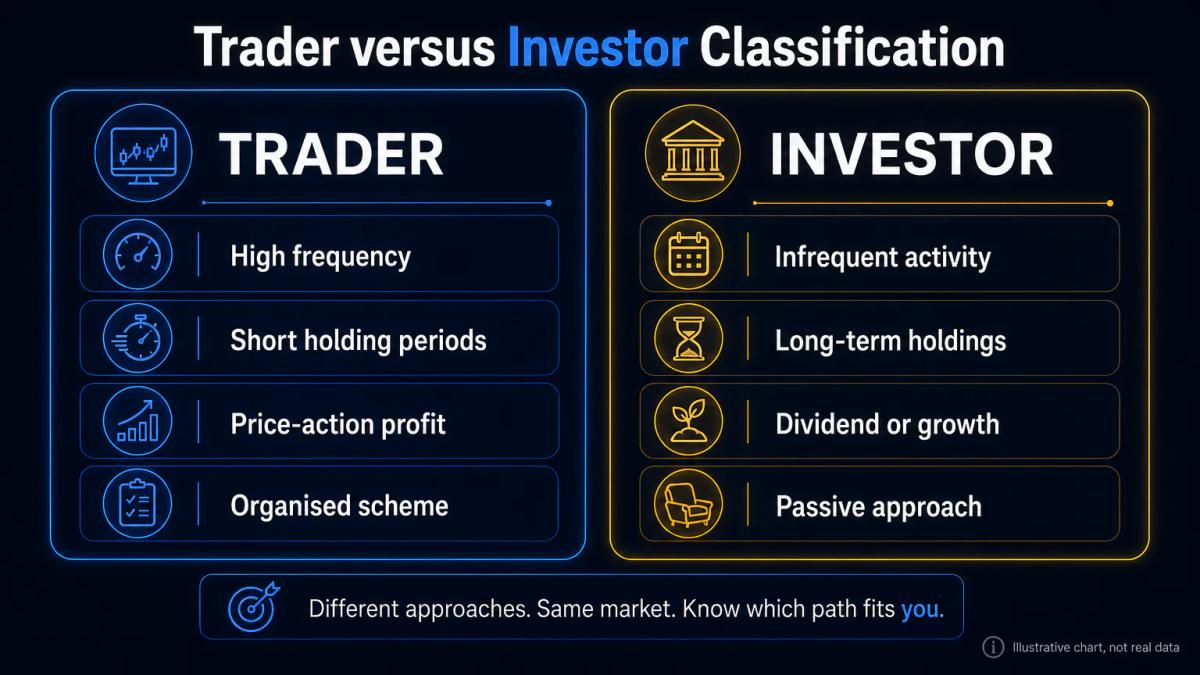
SARS applies a revenue-versus-capital enquiry grounded in case law, notably CIR v Pick 'n Pay Employee Share Purchase Trust and the Natal Estates line. The decisive factors include intention at acquisition, the scheme of profit-making, holding period, frequency and continuity of transactions, degree of organisation, and whether borrowed funds finance the activity. Short holding periods, high turnover and reliance on price action tend to indicate a trade, whereas a buy-and-hold approach driven by dividend intent generally supports a capital characterisation.
The tax consequence is material: revenue-account profits are included in gross income under section 1 and taxed at marginal rates, reaching 45% for taxable income above R1,817,000 in the 2024/25 brackets published by SARS. Capital-account gains fall under the Eighth Schedule: individuals include 40% of the net gain in taxable income, producing a top effective CGT rate of 18%, after the annual exclusion of R40,000.
| Treatment | Inclusion rate | Top effective rate (individuals) | Loss use |
|---|---|---|---|
| Revenue (trader) | 100% in gross income | 45% marginal | Set off against other income |
| Capital (investor) | 40% of net gain | 18% | Ring-fenced against capital gains |
Active forex and CFD traders almost always fall on the revenue side, whereas equities held primarily for yield are generally more defensible as capital.
SARS reporting requirements and compliance deadlines
All trading results are declared on the ITR12 for the year of assessment ending 28 February. The 2024 filing season for non-provisional individuals ran from 15 July to 21 October 2024, with provisional taxpayers filing until 20 January 2025, according to SARS. Revenue-account traders complete the local business, trade and professional income section; capital-account activity goes in the CGT schedule with per-asset base cost and proceeds.
Declaration comes down to source documents. For each closed position you need the following records:
- Trade date
- Instrument
- Entry and exit price
- Quantity
- Broker fees
- The ZAR conversion used where the account is denominated in a foreign currency
SARS accepts either the spot rate on the transaction date or the average rate published by the South African Reserve Bank, provided the chosen basis is applied consistently throughout the year. Late or incomplete returns trigger administrative penalties under section 210 of the Tax Administration Act, scaled to taxable income, with interest accruing at the prescribed rate.
Tax deductions and record-keeping for active traders
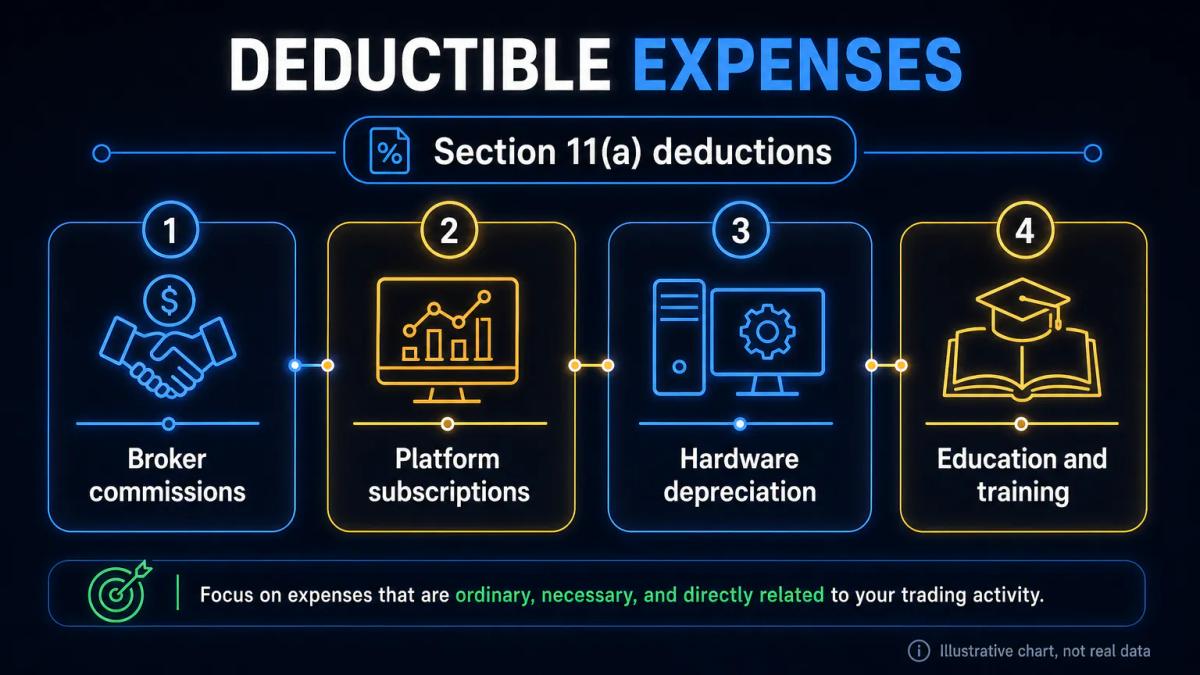
If your activity is a trade, section 11(a) read with section 23(g) allows deduction of expenditure actually incurred in the production of income and not of a capital nature. For a screen-based trader that typically includes:
- Broker commissions, spreads treated as part of the trade cost, financing charges and swap fees
- Platform and data subscriptions (TradingView, Bloomberg, exchange data)
- Dedicated hardware depreciation under section 11(e) and the Binding General Ruling schedule
- A pro-rata home office claim where section 23(b) requirements are met: a specifically equipped area used regularly and exclusively for the trade
- Professional fees paid to tax practitioners and accountants
Educational costs are deductible only where they maintain existing skills; the cost of acquiring a new skill is capital in nature and disallowed, consistent with the SARS Interpretation Note on training expenditure.
Section 29 of the Tax Administration Act requires taxpayers to retain records for five years from the date of submission, or indefinitely while an audit is open. Rather than attempting to reconstruct everything at year-end, it is far safer to export monthly broker statements as they arrive, store them unaltered, and maintain a parallel trade log that you can tie back line by line to those statements.
Suppose you run a R500,000 CFD account, pay R42,000 in commissions and R18,000 in platform and data fees across the year, and claim 15% of a R72,000 home running cost as a qualifying home office portion. Deductible expenses in that hypothetical reach R70,800 before any depreciation, applied against gross trading profit on the revenue side.
Provisional tax payments for traders with significant income
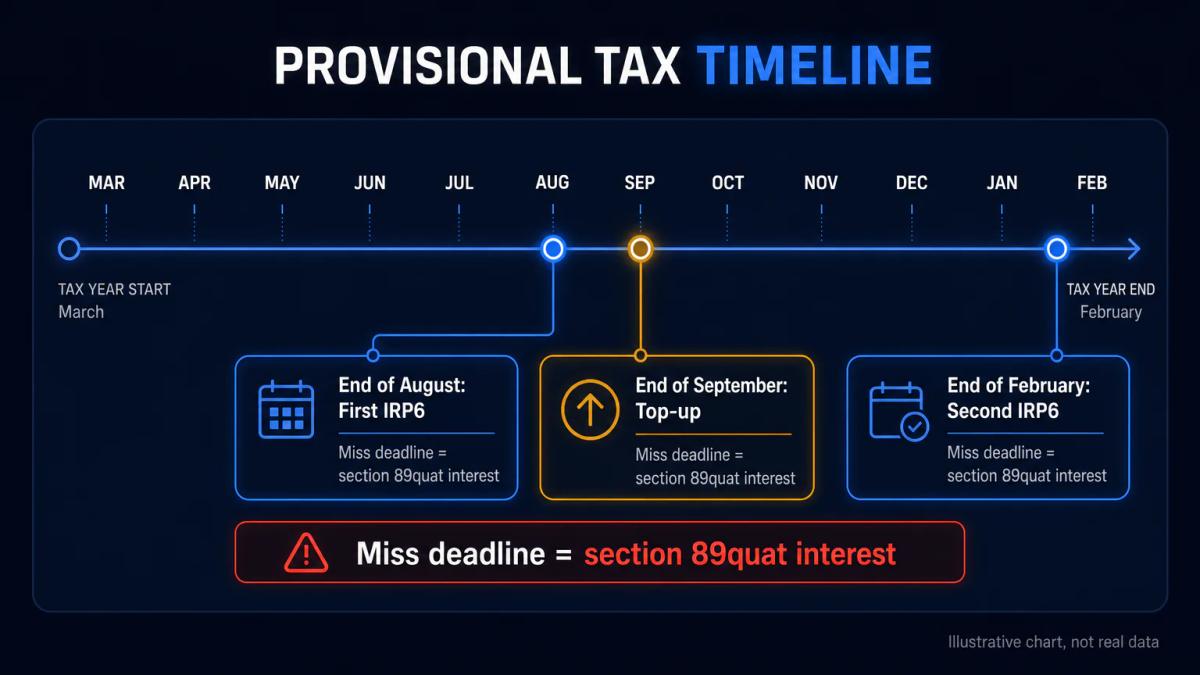
A trader with non-salary income above the thresholds in paragraph 1 of the Fourth Schedule is a provisional taxpayer. Two compulsory IRP6 submissions are due: the first by the end of August (six months into the year of assessment) and the second by the end of February. A voluntary third 'top-up' payment is available by the end of September for non-companies, used to avoid section 89quat interest where the first two estimates fell short.
Under-estimation penalties bite when taxable income exceeds R1 million and the second-period estimate is less than 80% of actual taxable income: SARS levies 20% of the shortfall. Below R1 million, the 'basic amount' safe harbour applies if the estimate is at least 90% of actual or equal to the basic amount from the last assessed return. Late payment attracts a 10% penalty under paragraph 27, with interest running at the prescribed rate from the due date.
Offshore brokers, local brokers, and tax implications
South African tax residents are taxed on worldwide income, so forex tax in South Africa follows the trader regardless of broker domicile. Offshore accounts are reportable; failure to disclose foreign financial interests triggers the understatement penalty table in section 223, which runs from 25% to 200%.
| Dimension | FSCA-regulated local broker | Offshore broker |
|---|---|---|
| Statements for SARS | ZAR-denominated, year-end tax pack common | Foreign currency, manual ZAR conversion |
| Dividend withholding | 20% DWT handled at source on JSE equities | Foreign WHT per treaty, DTA relief claimable |
| Exchange control | Within domestic allowance | Counts against the R1m single discretionary allowance and R10m foreign investment allowance with tax clearance |
| Audit friction | Low | High; onus on taxpayer |
South Africa's double taxation agreements, including those with the United Kingdom, United States and Mauritius, allow a section 6quat rebate for foreign tax paid on the same income, capped at the SA tax attributable to that foreign amount. Because the rebate operates as a credit against SA tax rather than as a deduction from income, you must retain proof of the foreign tax actually paid.
Crypto assets are defined as financial instruments in the Income Tax Act since the 2021 amendment, confirmed by SARS guidance. Disposal gains follow the same revenue-versus-capital test; mining and staking rewards are revenue on receipt at market value. Crypto-to-crypto swaps are disposals, each leg valued in ZAR.
Tax-loss harvesting and loss carry-forward rules
Revenue-account traders set assessed losses off against other taxable income in the same year under section 20, and carry the balance forward indefinitely while the trade continues. Section 20A ring-fences losses from 'suspect trades' for individuals in the top bracket where the activity shows a pattern of losses and features such as part-time involvement; the ring-fence confines the loss to future income from the same trade.
Capital losses cannot be offset against revenue income: they are ring-fenced within the CGT system and carried forward only against future capital gains.
Tax-loss harvesting on the revenue side means timing the realisation of losing positions before 28 February to compress the current-year tax base. South Africa has no formal wash-sale rule, but the general anti-avoidance provisions in sections 80A to 80L apply where a transaction lacks commercial substance and is entered into for a tax benefit. Closing and immediately reopening the same position at the same price, with no economic exposure change, is the pattern SARS will attack.
Disclaimer: this article is general information only and does not constitute tax, legal or financial advice. Every situation turns on its own facts, and you should consult a licensed tax practitioner or professional qualified in the relevant jurisdiction before acting on anything above.
Frequently Asked Questions
Do I pay income tax or capital gains tax on my forex trading profits in South Africa?
Active forex trading is almost always on revenue account, so profits are included in gross income and taxed at your marginal rate up to 45%. Capital gains treatment, at an 18% top effective rate for individuals, is defensible only where you can show long-term capital intent, infrequent trading and a buy-and-hold pattern. The classification is a SARS factual enquiry.
What records do I need to keep for SARS if I trade forex or stocks?
Keep broker statements, trade confirmations, deposit and withdrawal records, invoices for every deducted expense, home office cost evidence, and the ZAR conversion basis for foreign-currency accounts. Section 29 of the Tax Administration Act requires retention for five years from submission, longer while any audit, objection or appeal is open.
How do I know if SARS will classify me as a trader or an investor?
SARS weighs intention at acquisition, frequency and continuity of transactions, average holding period, use of leverage, degree of organisation, and whether income replaces employment income. Day trading, scalping and CFD activity point to a trade; infrequent equity purchases held for dividends point to capital. The test is applied per asset class and per account.
Can I deduct my trading losses against other income in South Africa?
Yes on revenue account under section 20, assuming you are classified as carrying on a trade. Section 20A ring-fences losses from suspect trades for top-bracket individuals where the activity shows a loss pattern and part-time character, confining the loss to future income from the same trade. Capital losses only offset capital gains.
Do I have to pay provisional tax if I trade actively in South Africa?
If your trading income exceeds the paragraph 1 thresholds of the Fourth Schedule and is not subject to PAYE, you are a provisional taxpayer. File IRP6 returns and pay by the end of August and the end of February, with an optional top-up by end-September for non-companies to avoid section 89quat interest.
About the authors


Put this into practice
Brokers we have reviewed
Scored on the same five dimensions. Here are three of them — the full list is on the brokers page.


Related articles

The Crypto Market Has Matured: Here Is What Investors Are Watching Ahead of 2027
The crypto market has matured considerably, and heading into 2027 institutional investors and informed traders are tracking a different set of signals than they did a few years ago.
Trading Halts Explained: Circuit Breakers, Suspensions, and Delays
Trading halts freeze a stock, or an entire market, when volatility, news or order imbalances threaten orderly pricing. Here is how they work and what they mean for your portfolio.

Types of ETFs: a practical guide to equity, bond, commodity and specialty funds
The main types of ETFs, from broad market equity funds to leveraged and ESG options, and how to match each to your goals, costs and risk tolerance.
0 comments