



Financial Markets · Advanced · 9 min read
Taxes on Trading Income in Canada: Capital Gains or Business Income
How Canada taxes your trading profits
Whether you owe tax on half of your profits or on every dollar depends on how the Canada Revenue Agency reads the character of your activity. That reading, set out case by case, decides whether a given disposition falls under capital gains at a 50% inclusion rate or under business income at full inclusion, with corresponding access to expense deductions and loss relief against other sources of income.
This article is general information, not tax advice. Canadian tax law is applied case by case, and any classification question, deduction or appeal should be checked with a CPA, a tax lawyer or an accountant licensed in your province before you file.
Consider a trader with $40,000 of net profits. Reported as capital gains, $20,000 enters taxable income. Classified as carrying on a business, the full $40,000 is included, although platform fees, data feeds, a reasonable share of a home-office and interest on margin become deductible. Loss treatment follows the same split: a capital loss is ring-fenced to capital gains and cannot shelter employment income, whereas a business loss can be applied against other sources in the year.
Account type is the other variable to track. Gains inside a Tax-Free Savings Account are generally sheltered, although the CRA has reassessed TFSAs where the holder's activity resembled a business and taxed the resulting gains in full. Gains inside a Registered Retirement Savings Plan grow tax-deferred and are taxed as ordinary income on withdrawal, whatever the character of the trades that produced them inside the plan.
Capital gains vs business income: which applies to you
Intent and conduct decide the classification. A pattern of buying securities for yield or long-term appreciation with occasional sales is generally treated as giving rise to capital gains under section 39 of the Income Tax Act. A pattern that resembles a trade or business falls under section 9, and the full profit becomes ordinary income.
The practical difference, side by side:
| Feature | Capital gains treatment | Business income treatment |
|---|---|---|
| Share of profit taxable | 50% inclusion rate | 100% inclusion rate |
| Rate applied | Your marginal rate on the taxable half | Your marginal rate on the full amount |
| Loss use | Offsets capital gains only | Offsets any income |
| Loss carry | Back 3 years, forward indefinitely against capital gains | Non-capital loss: back 3 years, forward 20 years |
| Expense deductibility | Limited (commissions reduce proceeds) | Broad: fees, data, software, interest, office |
| Reporting form | Schedule 3 | Form T2125 |
| TFSA eligibility | Yes, gains sheltered | At risk of CRA reassessment |
The inclusion rate for capital gains has moved in recent federal budgets, so verify the rate in force for the tax year you are filing before you compute an amount. The marginal rate itself depends on your province of residence on 31 December and on your total taxable income from all sources, not only trading.
Options trading complicates the picture. Writing covered calls on long-term holdings is often capital in character, whereas naked short options and short-dated spreads traded in volume tend to look like a business to the CRA. Crypto follows the same two-track framework under the agency's digital-asset guidance, with buy-and-hold activity treated as investment and active trading, mining or staking as a going concern treated as business.
Factors the CRA uses to classify your trading activity
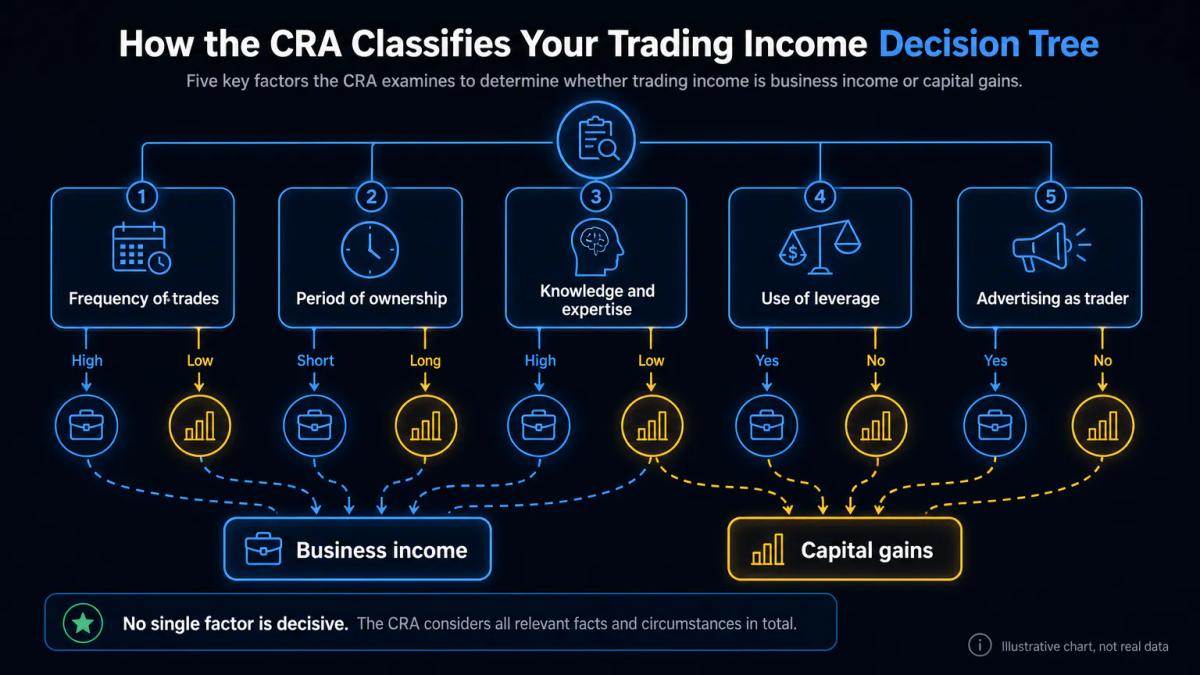
The CRA's position, set out in Interpretation Bulletin IT-479R (Transactions in Securities), is that no single factor decides the question. The agency weighs the pattern as a whole and applies the "badges of trade" developed in Canadian case law. The factors it names explicitly:
- Frequency of transactions: a high volume of trades over a short period points to business.
- Period of ownership: short holding periods point to business; multi-year holdings point to investment.
- Knowledge of the markets: specialised knowledge or a background in finance supports a business finding.
- Time spent on the activity: a substantial portion of your working time dedicated to trading supports business.
- Financing: use of margin or borrowed money to fund trades is a strong business indicator.
- Nature of the securities: speculative instruments (penny stocks, short-dated options, leveraged ETFs) support business.
- Intention: the stated and demonstrated purpose at the time of acquisition.
Suppose you place around 400 trades a year on margin, hold most positions for less than a week, maintain a Bloomberg or TradingView Pro subscription and work a day job unrelated to finance. Three of the badges (frequency, holding period, financing) point squarely at business income, and a reassessment is plausible even if you reported on Schedule 3.
Classification is not something the taxpayer elects. The CRA, on audit, applies the facts of the case and may reassess up to three years back, with longer periods available where gross negligence or fraud is alleged.
Deducting trading expenses and losses
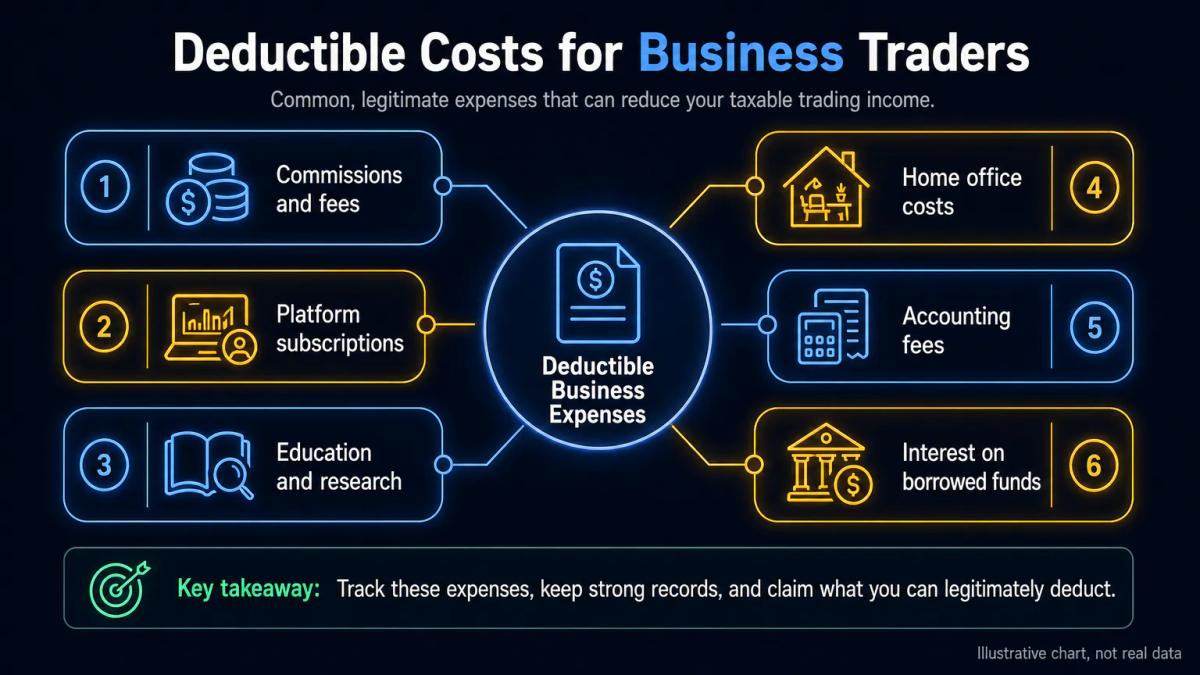
Under business treatment, deductible expenses include:
- commissions and exchange fees
- platform and data subscriptions (TradingView, eSignal, broker platform fees)
- market research and courses tied to the current activity
- a reasonable portion of home-office costs under section 18(12)
- accounting fees
- interest on money borrowed to earn trading income
Capital assets such as a dedicated computer or multiple monitors are brought into the deduction gradually through capital cost allowance, rather than expensed in full in the year of purchase.
Losses behave differently in each regime:
- Allowable capital losses: 50% of the loss, deductible only against taxable capital gains. Carry back three years, carry forward indefinitely.
- Non-capital (business) losses: fully deductible against any source of income in the year. Carry back three years, carry forward twenty.
- Superficial loss rule (section 54): if you repurchase the same security within 30 days before or after the sale, the capital loss is denied and added to the cost base of the new position.
Imagine a part-time trader classified as a business posts a $15,000 net loss for the year while earning $90,000 from employment. The $15,000 reduces taxable income to $75,000. The same loss, under capital treatment, would produce a $7,500 allowable capital loss, usable only when future capital gains appear.
Margin interest has its own treatment. Where capital treatment applies, interest on money borrowed to buy income-producing securities is deductible under section 20(1)(c), restricted to the income those securities produce. Under business treatment, the same interest is handled as a general operating expense of the trading activity.
Reporting trading income on your tax return
Capital gains flow through Schedule 3 (Capital Gains or Losses), with each disposition reported by security, proceeds, adjusted cost base and outlays. The taxable portion carries to line 12700 of the T1 return. Foreign securities also require Form T1135 if your total cost of specified foreign property exceeds $100,000 CAD at any point in the year, a threshold that frequent US-equity traders cross without noticing.
Business traders file Form T2125 (Statement of Business or Professional Activities) with the T1. The relevant lines, in the order you fill them:
- Part 1: business name (your own name is fine for a sole proprietorship), industry code and fiscal period.
- Part 3A: gross income, meaning gross trading proceeds net of commissions, or net trading gains, depending on your bookkeeping method, applied consistently year to year.
- Part 4: expenses, line by line (advertising, meals at 50%, office, supplies, telephone and utilities, professional fees, management fees, rent, maintenance, salaries, property taxes, travel, fuel, delivery, motor vehicle, insurance, interest, business taxes, office stationery, other).
- Part 5: net income, carried to line 13500 of the T1.
- Area A to D: capital cost allowance for depreciable assets used in the business.
- Part 7: business-use-of-home expenses, limited to net income (the deduction cannot create a loss, but the unused portion carries forward).
Forex traders face a specific election. Under section 39(1.1), individuals can treat the first $200 of annual net foreign-exchange gain or loss on personal transactions as non-taxable; anything above is treated according to the general rules. Active forex trading sits outside that de minimis and is handled as capital or business income like any other instrument.
Record-keeping and CRA compliance
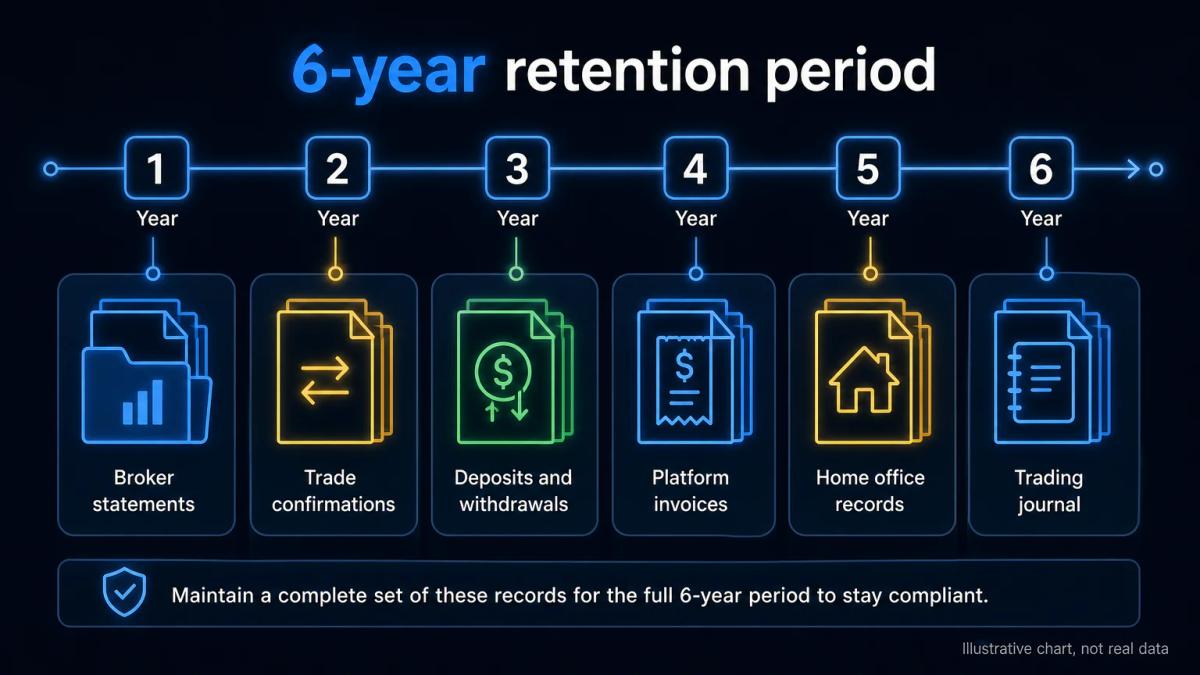
The CRA requires records to be kept for six years from the end of the tax year to which they relate (subsection 230(4) of the Income Tax Act), and longer if a notice of objection or appeal is outstanding. For a trader, that includes:
- broker statements and trade confirmations
- deposit and withdrawal records
- platform subscription invoices
- home-office measurements and utility bills
- a journal documenting the rationale for significant positions
Audit triggers that recur in CRA practice:
- Large TFSA balances built from active trading, flagged under advance income tax ruling 2018-0744981E5 and subsequent cases.
- Mismatches between T5008 slips filed by brokers and amounts reported on Schedule 3.
- Shifts between capital and business treatment year to year without a change in facts.
- Foreign brokerage accounts not disclosed on T1135.
If you disagree with a reassessment, the first step is a Notice of Objection filed within 90 days of the reassessment date; the appeals division then reviews independently. From there, the Tax Court of Canada hears disputes under the informal procedure (for amounts under $25,000 of federal tax per year) or the general procedure.
Currency gains and foreign exchange trading
Forex trading in Canada follows the same two-track test, with one wrinkle: the CRA treats each forex position as giving rise to a foreign-exchange gain or loss separate from any gain on the underlying asset when applicable. For a pure CFD or spot forex trader, that distinction collapses into a single P&L number, reported either on Schedule 3 (capital) or T2125 (business).
To declare trading profits in Canada from a forex book, convert each trade's result to Canadian dollars at the Bank of Canada exchange rate on the trade date, keep the FX rate used in your records, and reconcile to your broker's year-end statement in base currency. The T1 is filed in CAD even when the account is denominated in USD, and the conversion method must stay consistent across the year.
Frequently Asked Questions
Do I have to pay tax on trading profits in Canada?
Yes. Trading profits are taxable whether the CRA classifies them as capital gains (50% inclusion rate at your marginal rate) or as business income (100% at your marginal rate). The only shelters are gains inside a TFSA for genuinely passive activity and gains inside an RRSP, which are tax-deferred until withdrawal.
What is the difference between a capital gain and business income for traders?
A capital gain arises when you dispose of a security held for yield or long-term appreciation; only half is taxable, and losses offset only capital gains. Business income arises when your activity has the character of a trade: full profit is taxable, expenses are broadly deductible, and losses can offset any income.
How does the CRA determine if I am a trader or an investor?
The CRA applies the badges of trade from Interpretation Bulletin IT-479R: frequency of transactions, holding periods, use of leverage, time devoted to the activity, specialised knowledge, nature of the securities and your demonstrated intent. No single factor decides; the agency weighs the pattern as a whole on audit.
Can I deduct my trading losses against other income?
Only if you are classified as carrying on a trading business. In that case, non-capital losses offset any source of income in the year, carry back three years and carry forward twenty. Under capital treatment, allowable capital losses offset only taxable capital gains, with a three-year carry-back and indefinite carry-forward.
What records do I need to keep for CRA compliance?
Keep trade confirmations, broker statements, deposit and withdrawal records, platform and data invoices, home-office documentation and a journal of trade rationale for at least six years from the end of the relevant tax year, under subsection 230(4) of the Income Tax Act. If an objection or appeal is live, keep them longer.
About the authors


Put this into practice
Brokers we have reviewed
Scored on the same five dimensions. Here are three of them — the full list is on the brokers page.



Related articles

Taxes on Trading Income in India: Capital Gains, Business Income and Compliance
A practical guide to how India taxes trading profits across equities, derivatives and forex, with the compliance deadlines and record-keeping that follow.

The Crypto Market Has Matured: Here Is What Investors Are Watching in 2026
The crypto market has matured. Here is what institutional investors and informed traders are actually tracking in 2026.

Trading Halts Explained: Circuit Breakers, Suspensions, and Delays
Trading halts freeze a stock, or an entire market, when volatility, news or order imbalances threaten orderly pricing. Here is how they work and what they mean for your portfolio.
0 comments