



Financial Markets · Advanced · 9 min read
Taxes on Trading Income in India: Capital Gains, Business Income and Compliance
How India classifies and taxes your trading profits
This article is intended as general educational material and should not be read as tax advice. Rates, thresholds and schedule numbers change through the Finance Act each year, and every portfolio sits in a different filing context, so confirm the specifics with a chartered accountant or a tax lawyer before you act on anything here.
The head of income you fall under in a given financial year shapes almost every downstream question: the applicable rate, the holding-period logic, whether losses can be netted against salary, and whether a Section 44AB tax audit becomes mandatory. India's Income Tax Act stops short of drawing a bright line between an investor and a trader, so the department instead reads your conduct across the year, weighing the frequency of trades, the median holding periods, the use of borrowed capital, the volume relative to other income, and whether derivatives feature in your activity.
A delivery-based equity portfolio with occasional rebalancing is usually assessed as capital gains, while a screen built around intraday equity trades and futures and options positions is treated as business income by default. Within that business bucket the two sub-heads behave quite differently:
- Intraday equity is speculative business income.
- F&O is non-speculative business income.
The loss set-off rules governing these two buckets diverge, and that divergence is where a large share of filings go wrong.
Before you look to optimise for rate, settle the question of which head of income your activity actually falls under for the year. The same net profit of ₹5,00,000 produces materially different tax outcomes depending on whether it is assessed as capital gains, as speculative business income, or as non-speculative business income.
Short-term vs long-term capital gains: the holding period rule
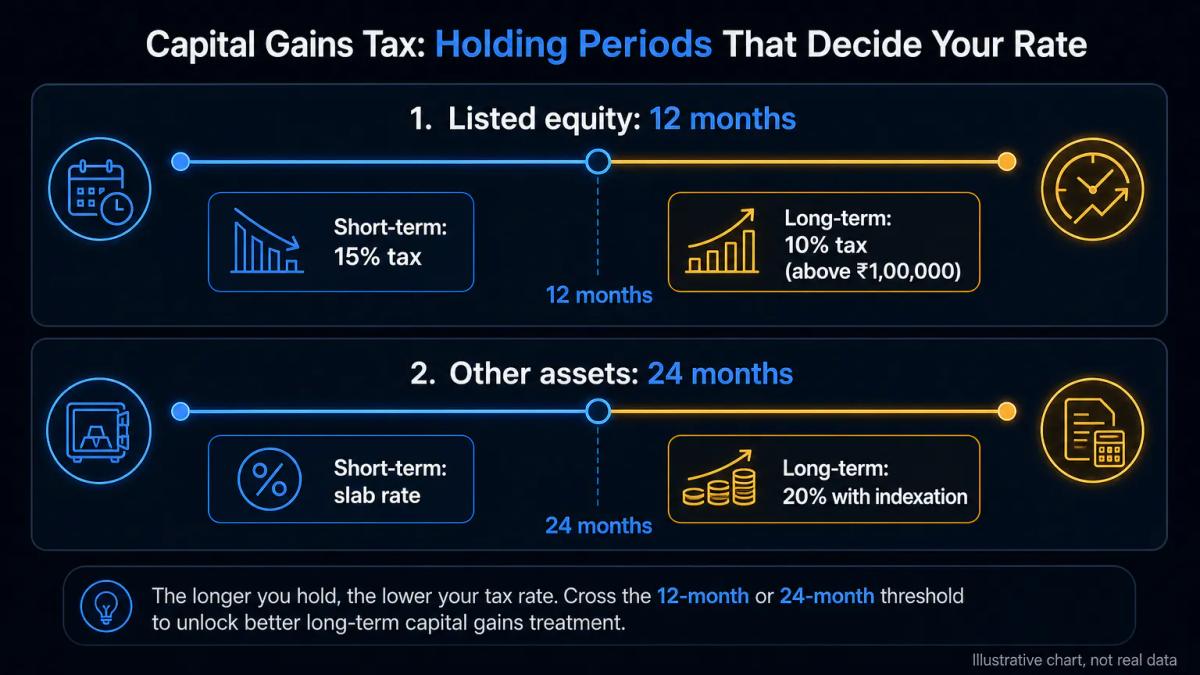
For listed equity shares and equity-oriented mutual funds, the short-term threshold runs for 12 months, which is shorter than the 24-month rule that applies to many other capital assets. Two sections then apply to listed equity where STT is paid:
- Section 111A taxes short-term gains at 15%.
- Section 112A taxes long-term gains above ₹1,00,000 per year at 10% without indexation.
For other capital assets, the long-term treatment differs:
- Unlisted shares, debt mutual funds, gold ETFs, bonds and most other capital assets: long-term threshold of 24 months (36 months for certain debt instruments depending on the holding year).
- Long-term gains at 20% with indexation under Section 112 where applicable.
Crypto is carved out: Section 115BBH taxes virtual digital asset gains at a flat 30% with no deduction other than cost of acquisition, no loss set-off against any other head, and no carry-forward of VDA losses. Forex spot and offshore CFD positions do not fit the capital-asset framework at all and are discussed below.
Suppose you hold NSE-listed equity for 10 months and realise a gain of ₹2,00,000. If STT has been paid and no other adjustments apply, Section 111A would levy tax of the order of 15% plus applicable surcharge and cess.
When the Income Tax Department classifies you as a trader
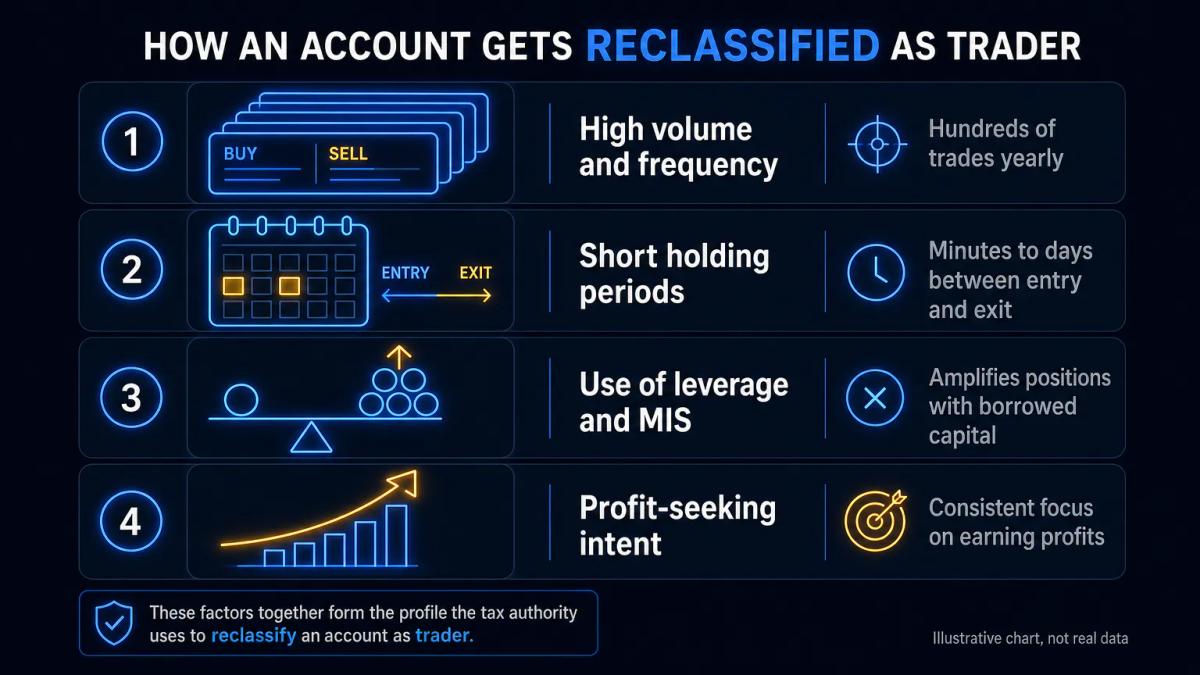
Reclassification from investor to trader turns on behaviour, and the markers the department weighs are consistent across case law:
- Volume and frequency: hundreds of trades a year, in and out of the same scrips, point to business.
- Holding period: the shorter the median holding, the stronger the business classification.
- Use of leverage: margin funding, intraday MIS orders and F&O are rarely treated as investment.
- Intention at purchase: dividend yield and long-term growth read as investment; price action and short-cycle technicals read as business.
- Books of account: if you already maintain a trading journal and P&L, you are halfway to being a business filer.
The classification of each stream is largely fixed by the nature of the activity:
- F&O income is always business income.
- Intraday equity is speculative business income.
- Delivery equity is a position you choose and apply consistently from one year to the next, without flipping opportunistically.
If your gross receipts cross the Section 44AB turnover threshold (sale value for delivery, absolute profit plus absolute loss for F&O under the ICAI guidance note), a tax audit becomes mandatory. GST registration is a separate question that arises only when you also provide taxable services such as advisory, signals or education above the GST threshold; trading in securities itself sits outside GST, because securities are excluded from the definition of goods and services.
Tax-deductible expenses for active traders
Under the business head, you can deduct every expense genuinely incurred to earn trading income. The categories a working filer typically claims:
- Brokerage, exchange fees, SEBI turnover fees, clearing charges and STT (STT is deductible when trading is business income; it is not deductible when gains are taxed as capital gains).
- Terminal and data subscriptions: TradingView, Bloomberg, exchange data feeds, broker premium plans.
- Internet and telephone bills, apportioned to trading use.
- Depreciation on computer hardware, monitors and furniture used for trading.
- Office rent or a reasonable share of home rent and electricity if a dedicated space is used.
- Professional fees: CA, tax lawyer, auditor.
- Education expenses directly tied to the trading activity, such as advanced derivatives courses.
Expenses must sit in the books with invoices and bank-trail payments; cash claims are routinely disallowed. Personal-use apportionment is where assessments bite, so keep the ratio defensible.
TDS, GST, and compliance deadlines you cannot miss
TDS on trading transactions themselves is limited: brokers do not deduct TDS on securities gains. Specific TDS does bite on crypto under Section 194S (1% on the transfer value, subject to thresholds) and on dividend income under Section 194 above the specified limit. Non-residents trading Indian securities face TDS on capital gains under Section 195.
Income tax returns for individuals with business income are generally due 31 October of the assessment year when a tax audit applies, and 31 July when it does not; these dates are reset through CBDT notifications most years, so confirm the current circular before you file. Advance tax under Section 208 applies if your total liability exceeds ₹10,000: four instalments through the year (15 June, 15 September, 15 December, 15 March). Traders routinely miss the June and September instalments and pay Section 234B and 234C interest on the catch-up.
Imagine a trader whose F&O turnover, computed under the ICAI method, comes to ₹1.2 crore while net profit sits well below 6% of turnover. A Section 44AB audit would typically be triggered in that situation, and the return would shift to the audit due date.
File a return even in a loss year, because the ability to carry business and capital losses forward depends on lodging the return within the Section 139(1) original due date, and that right is forfeited the moment the deadline slips.
Forex and derivatives: special tax rules in India
Exchange-traded F&O on NSE and BSE, including currency futures on INR pairs permitted by RBI (USD-INR, EUR-INR, GBP-INR, JPY-INR), is non-speculative business income under Section 43(5). Profits are added to total income and taxed at slab rates; losses can be set off against any head except salary in the same year, and carried forward for 8 assessment years to be set off against business income only.
Intraday cash equity is speculative business income. Speculative losses carry forward for 4 years and can only offset future speculative gains, which is a sharper restriction than most retail traders realise.
Trading foreign currency pairs on offshore brokers (unregulated-in-India platforms offering spot forex or CFDs on non-INR pairs) is a separate problem. The RBI's Liberalised Remittance Scheme does not permit margin trading of forex abroad, and FEMA restricts Indian residents to the currency pairs listed on recognised Indian exchanges. Any gains from offshore spot forex trading are taxable in India under the business head on worldwide income principles, and the FEMA exposure is independent of, and additional to, the tax question. Treat offshore forex gains as fully taxable at slab rates and raise the FEMA position with counsel before scaling the activity.
Losses, carry-forward, and how to use them strategically
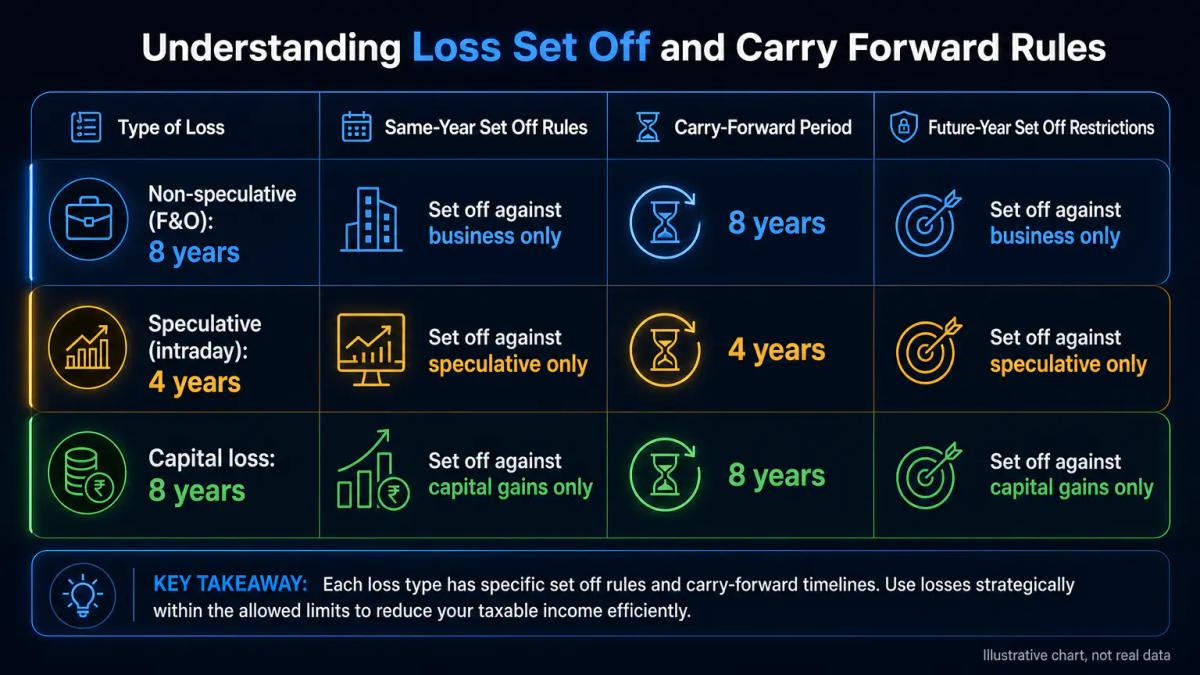
The set-off and carry-forward rules form a hierarchy that rewards disciplined filing:
| Loss type | Set off in same year against | Carry-forward years | Set off in future years against |
|---|---|---|---|
| Non-speculative business (F&O) | Any head except salary | 8 | Business income only |
| Speculative business (intraday equity) | Speculative income only | 4 | Speculative income only |
| Short-term capital loss | Any capital gain (STCG or LTCG) | 8 | Any capital gain |
| Long-term capital loss | LTCG only | 8 | LTCG only |
| Virtual digital asset loss | Nothing | Not allowed | Nothing |
Trading losses cannot be used to reduce tax on salary in any case, and attempting to net F&O losses against salary is one of the fastest ways to attract scrutiny. The carry-forward right is lost entirely if the return is filed after the Section 139(1) due date, so a loss year is the worst year to file late.
Record-keeping and documentation for tax audits
Section 44AA requires books of account for business filers, and the retention expectation is 6 years from the end of the relevant assessment year, extended where reassessment proceedings are open. The minimum working file for an active trader:
- Contract notes and consolidated ledger from each broker, month by month.
- Bank statements for every account used to fund or receive from the trading account.
- Demat holding statements at the start and end of the financial year.
- A reconciled profit and loss statement with turnover computed on the ICAI basis for F&O.
- Invoices and bank proof for every claimed expense.
- For offshore activity: foreign broker statements, Form 67 for any foreign tax credit, and documentation of the LRS remittance route used.
Assessments turn on reconciliation, so if the AIS and TIS pre-fill from the department does not match your broker P&L, the burden to explain the gap sits with you. Build the file steadily through the year, so that July becomes a review month after the groundwork has already been done.
Tax law in India changes with each Finance Act and through CBDT circulars during the year. Treat this guide as a framework and confirm every rate, threshold and due date with a qualified professional before filing.
Frequently Asked Questions
What is the difference between capital gains tax and business income tax on trading in India?
Capital gains tax applies when trades are treated as investment: short-term gains on listed equity are taxed at 15% under Section 111A, long-term gains above ₹1,00,000 at 10% under Section 112A. Business income is added to your total income and taxed at slab rates, with the right to deduct expenses but also the risk of a Section 44AB audit. F&O is always business income; intraday equity is speculative business income; delivery equity is a position you can take consistently.
How long must I hold a stock or forex position to qualify for long-term capital gains treatment in India?
For listed equity shares and equity-oriented mutual funds, the long-term threshold is 12 months; for most other capital assets including unlisted shares and gold, it is 24 months. Forex positions on recognised Indian exchanges are non-speculative business income under Section 43(5) and never qualify as long-term capital gains, regardless of holding period.
Can I claim trading losses against my salary or other income in India?
No. Trading losses, whether speculative, non-speculative business or capital, cannot be set off against salary in any year. Non-speculative business losses (such as F&O) can be set off against other heads except salary in the same year, and carried forward for 8 years to offset business income. Speculative losses can only offset speculative gains, with a 4-year carry-forward.
Do I have to pay GST on my trading income in India?
Trading in securities is excluded from the GST definition of goods and services, so your trading P&L itself is not subject to GST. GST only enters the picture if you supply taxable services alongside trading, such as advisory, signals or education, and your aggregate turnover from those services crosses the GST registration threshold.
What happens if I do not report my trading income to the Indian tax authority?
The department receives transaction data from exchanges, brokers and the AIS and TIS systems, so under-reporting is readily detected. Consequences range from Section 234A, B and C interest on unpaid tax, Section 270A penalty for under-reporting (50%) or misreporting (200%), and in serious cases prosecution under Section 276C. Failing to file in a loss year also forfeits the right to carry forward the loss.
About the authors


Put this into practice
Brokers we have reviewed
Scored on the same five dimensions. Here are three of them — the full list is on the brokers page.



Related articles

The Crypto Market Has Matured: Here Is What Investors Are Watching in 2026
The crypto market has matured. Here is what institutional investors and informed traders are actually tracking in 2026.

Trading Halts Explained: Circuit Breakers, Suspensions, and Delays
Trading halts freeze a stock, or an entire market, when volatility, news or order imbalances threaten orderly pricing. Here is how they work and what they mean for your portfolio.

Types of ETFs: a practical guide to equity, bond, commodity and specialty funds
The main types of ETFs, from broad market equity funds to leveraged and ESG options, and how to match each to your goals, costs and risk tolerance.
0 comments