



Financial Markets · Beginner · 9 min read
When Does the Market Open? Hours by Exchange, Asset Class, and Time Zone
The standard US market open and why session timing shapes execution
Every US trading day follows the same clock: the NYSE and Nasdaq run their regular session from 9:30 a.m. to 4:00 p.m. Eastern Time, Monday through Friday, with pre-market from 4:00 a.m. ET and after-hours out to 8:00 p.m. ET. Where those three windows really differ is in execution quality, and traders who ignore the boundaries between them tend to be surprised by price gaps, volatility spikes, and fills that land nowhere near the last quote they saw.
The regular session, sometimes called the cash session, is where the vast majority of shares change hands and where the reference closing price of the day gets set. Orders placed before 9:30 a.m. ET queue for the opening auction, a mechanism that matches accumulated buy and sell orders at a single opening price. For example, sending a market order (an instruction to buy or sell at the best available price) at 9:29 a.m. under the impression that trading is already live can leave you with a fill several cents away from the price you had in mind.
NYSE and Nasdaq: identical hours, different liquidity profiles
Both the New York Stock Exchange and Nasdaq run on the same schedule, 9:30 a.m. to 4:00 p.m. ET, Monday through Friday. What differs is how the two venues match trades and where liquidity concentrates during the session.
The NYSE uses a hybrid model that combines electronic matching with a designated market maker on the trading floor, who oversees the opening and closing auctions for each listed stock. This model tends to attract institutional block trades (large orders executed in one go) during the middle of the session, when volatility is lower.
Nasdaq is a fully electronic order book, with competing market makers posting bids and offers. It typically shows higher retail participation and faster fills in the first and last hour of the day, when volume peaks.
For a beginner, the practical takeaway is simple:
| Venue | Session | Matching model | Where volume concentrates |
|---|---|---|---|
| NYSE | 9:30 a.m. to 4:00 p.m. ET | Hybrid, with designated market makers | Open, close, and mid-session block trades |
| Nasdaq | 9:30 a.m. to 4:00 p.m. ET | Fully electronic order book | First hour and last hour |
A stop loss (an order that closes your position if the price moves against you by a set amount) placed just before the open can trigger on a wide quote before real liquidity arrives.
Pre-market and after-hours trading windows
These extended sessions operate through electronic communication networks (ECNs), which are private venues that match buyers and sellers directly without going through the primary exchange auction (see the standard US market open section for exact times).
Extended hours let you react to earnings announcements, macro data releases, and overnight news from Asia or Europe before the regular session opens, which is their main appeal. On the structural side, fewer participants are online during those windows, so the bid-ask spread (the gap between the highest buy price and the lowest sell price) widens noticeably, and a single large order can move the price several per cent.
Most brokers restrict extended-hours orders to limit orders (orders that execute only at a specified price or better) and refuse market orders for these sessions. That restriction exists because a market order in a thin book can fill at a price you never intended.
The closing auction at 4:00 p.m. ET sets the official daily close for index calculation, ETF pricing, and derivatives settlement. Trades printed in after-hours sessions do not change that reference price, even when they move materially away from it. Any price you see in after-hours quotes therefore remains indicative for overnight positions, and the official mark-to-market stays anchored to the 4:00 p.m. print.
Market closures: weekends, federal holidays, and early closes
| Closure type | Details |
|---|---|
| Weekends | Saturday and Sunday |
| Federal holidays | New Year's Day, Martin Luther King Jr. Day, Presidents' Day, Good Friday, Memorial Day, Juneteenth, Independence Day, Labor Day, Thanksgiving, and Christmas Day. When a holiday falls on a Saturday, the market usually closes the preceding Friday; when it falls on a Sunday, the following Monday. |
| Early closes | Day after Thanksgiving and Christmas Eve: NYSE and Nasdaq close at 1:00 p.m. ET instead of 4:00 p.m. Pre-market runs as normal on those days, but after-hours ends at 5:00 p.m. ET. If you day-trade around those dates, the shorter session compresses volume into fewer hours and can inflate volatility in the final 30 minutes before the early close. Check your broker's holiday calendar in December and around US Thanksgiving, because settlement and margin rules can shift too. |
Time zone conversions and daylight saving time shifts
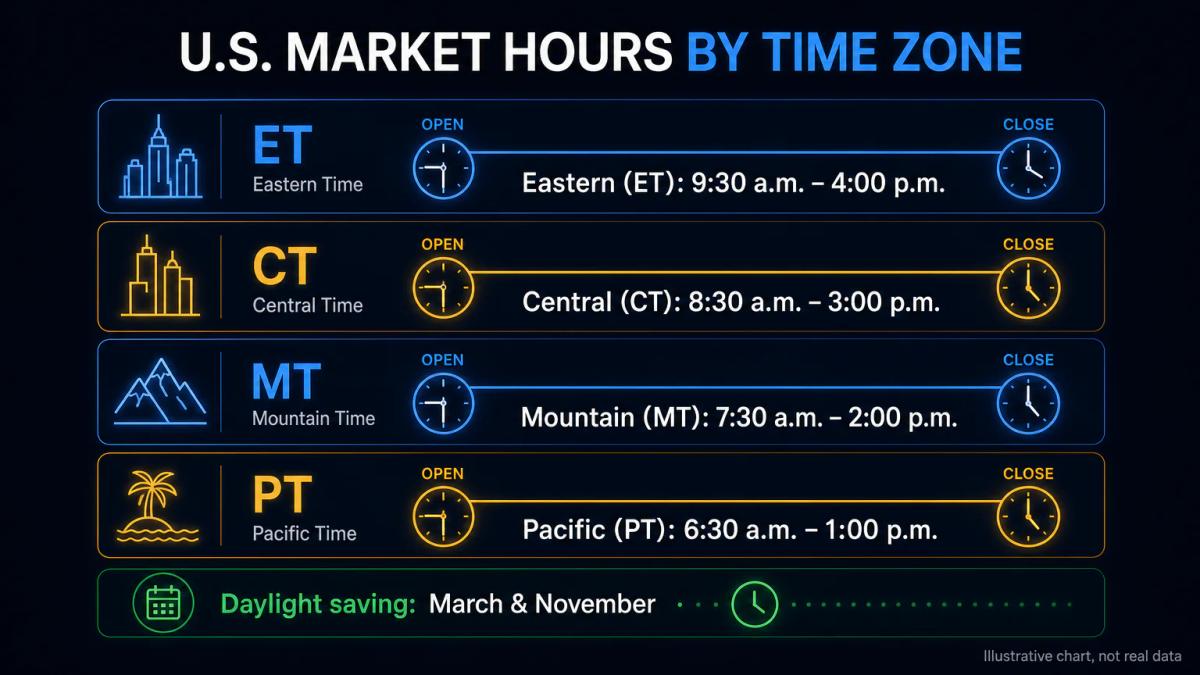
The 9:30 a.m. ET open converts into the following local times across the US:
- Central Time: 8:30 a.m., with the full regular session running to 3:00 p.m. CT.
- Mountain Time: 7:30 a.m., closing at 2:00 p.m. MT.
- Pacific Time: 6:30 a.m., closing at 1:00 p.m. PT.
| Zone | Market open (regular session) | Market close |
|---|---|---|
| Eastern (ET) | 9:30 a.m. | 4:00 p.m. |
| Central (CT) | 8:30 a.m. | 3:00 p.m. |
| Mountain (MT) | 7:30 a.m. | 2:00 p.m. |
| Pacific (PT) | 6:30 a.m. | 1:00 p.m. |
| London (GMT/BST) | 2:30 p.m. GMT / 1:30 p.m. BST | 9:00 p.m. / 8:00 p.m. |
Daylight saving time transitions in the US happen on the second Sunday of March and the first Sunday of November. Europe shifts one or two weeks apart, so for a short period each spring and autumn the London to New York offset changes from five hours to four, or vice versa. If you trade from outside the US, put both dates in your calendar.
How market hours differ by asset class: bonds, commodities, and futures
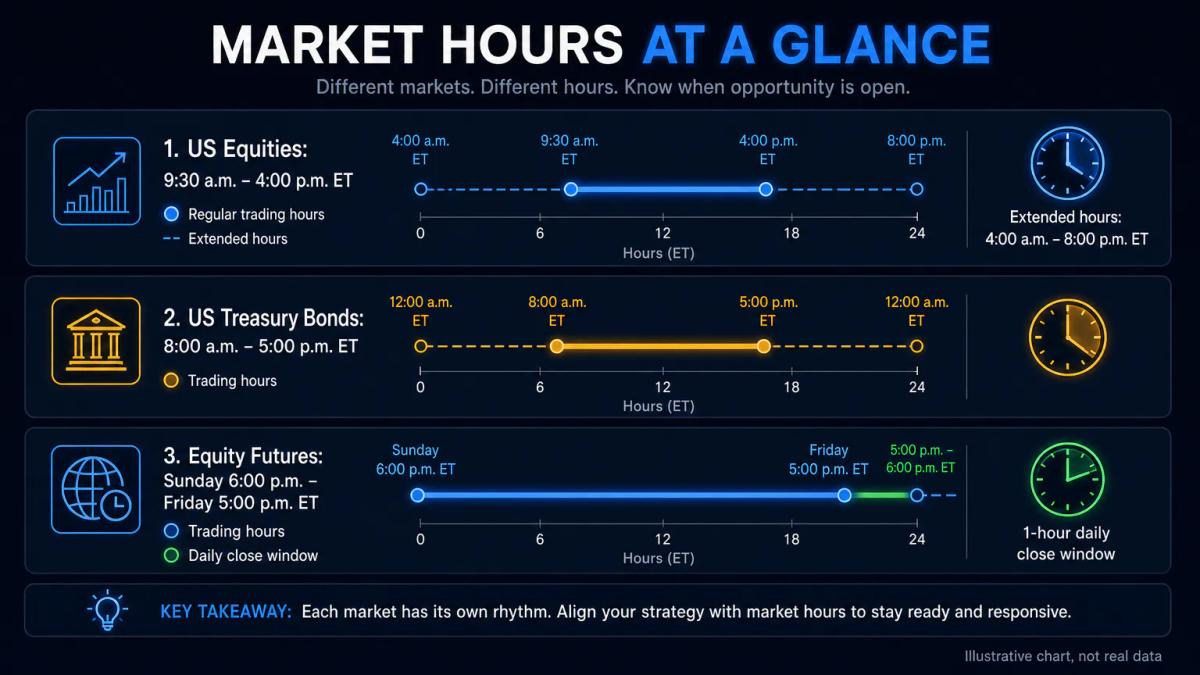
Asset classes trade on very different clocks, and getting familiar with those calendars is one of the first steps for anyone diversifying beyond equities.
| Asset class | Regular hours | Notes |
|---|---|---|
| US equities | 9:30 a.m. to 4:00 p.m. ET | Extended hours 4:00 a.m. to 8:00 p.m. ET |
| US Treasury bonds (secondary) | 8:00 a.m. to 5:00 p.m. ET | Traded over the counter through dealers |
| Equity index futures (CME) | Sunday 6:00 p.m. to Friday 5:00 p.m. ET | One-hour daily break at 5:00 p.m. ET |
| Crude oil, gold futures | Sunday 6:00 p.m. to Friday 5:00 p.m. ET | Same near-24-hour cycle as index futures |
| Spot forex | Sunday 5:00 p.m. ET to Friday 5:00 p.m. ET | Rolls across Sydney, Tokyo, London, New York |
| Spot crypto | 24/7 | No official close; liquidity dips on weekends |
The interbank forex market opens on Sunday at 5:00 p.m. ET, when the Sydney session comes online, and stays open until Friday at 5:00 p.m. ET. Because forex is a decentralised over-the-counter market rather than a single exchange, there is no closing auction: liquidity simply rotates around the globe as Sydney, Tokyo, London, and New York take over from each other.
Crypto spot markets run continuously with no official close, but liquidity thins noticeably at weekends, when institutional desks are offline.
International stock market hours and global trading sessions
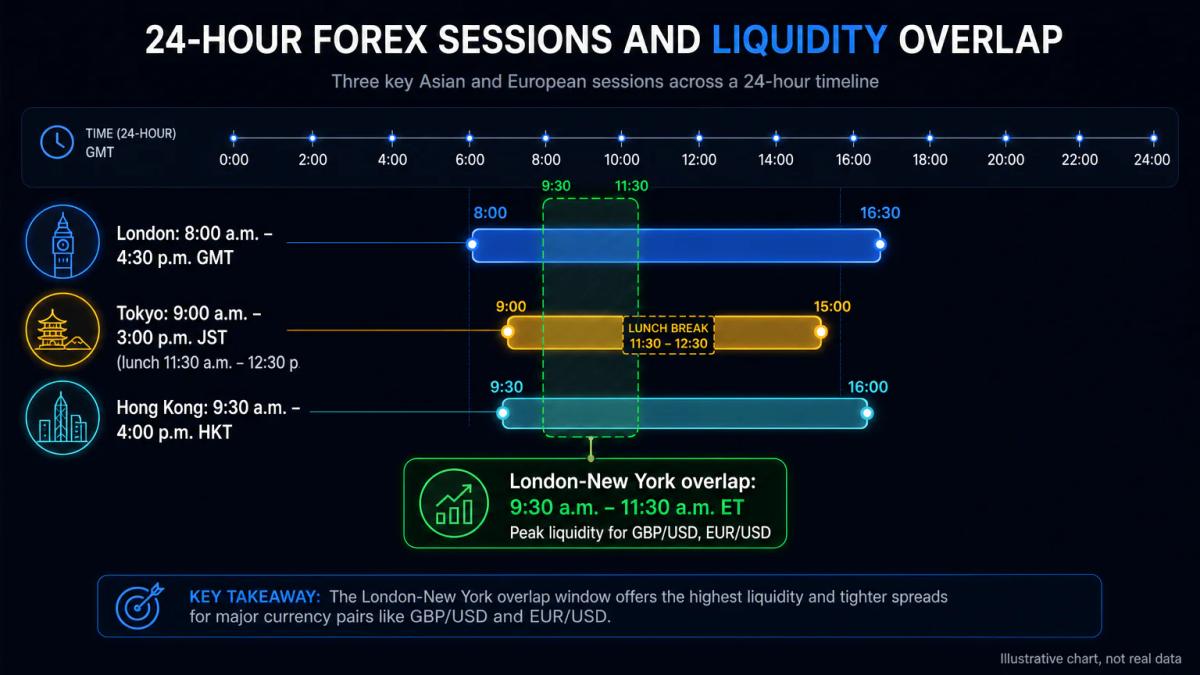
The London Stock Exchange opens at 8:00 a.m. GMT and closes at 4:30 p.m. GMT. The Tokyo Stock Exchange opens at 9:00 a.m. JST with a lunch break from 11:30 a.m. to 12:30 p.m., then closes at 3:00 p.m. JST. The Hong Kong Stock Exchange runs 9:30 a.m. to 4:00 p.m. HKT, also with a midday break.
Two overlaps in the global calendar are worth marking on your own screen:
- London and New York overlap for the first hours of the US session, from 9:30 a.m. to 11:30 a.m. ET, which is when currency pairs such as GBP/USD and EUR/USD see their highest turnover of the day.
- Tokyo and Hong Kong overlap through the Asian afternoon, concentrating liquidity in AUD/JPY and cross-Asia pairs.
| Exchange | Local open | Local close | ET equivalent (open) |
|---|---|---|---|
| London (LSE) | 8:00 a.m. GMT | 4:30 p.m. GMT | 3:00 a.m. ET |
| Tokyo (TSE) | 9:00 a.m. JST | 3:00 p.m. JST | 7:00 p.m. ET (previous day) |
| Hong Kong (HKEX) | 9:30 a.m. HKT | 4:00 p.m. HKT | 8:30 p.m. ET (previous day) |
| Frankfurt (Xetra) | 9:00 a.m. CET | 5:30 p.m. CET | 3:00 a.m. ET |
ET equivalents shift by one hour when the US, the UK, or Europe change to and from daylight saving time.
Best times to trade within market hours for optimal execution
Within the US regular session, three distinct windows shape volume and volatility, each with its own character:
- Opening hour (9:30 a.m. to 10:30 a.m. ET): the highest volume of the day, the tightest bid-ask spreads on liquid names, and the largest price moves as overnight orders clear. Scalpers and momentum day traders tend to concentrate their activity in this window.
- Midday lull (roughly 11:00 a.m. to 2:00 p.m. ET): quieter conditions, with volume dropping, spreads on less liquid stocks widening, and prices often chopping sideways. This window suits swing traders adjusting positions without moving the price against themselves, and it tends to be less friendly to strategies that need tight fills across many trades.
- Closing hour (3:00 p.m. to 4:00 p.m. ET): volume rebuilds as institutions rebalance and index funds execute end-of-day flows, and volatility rises again into the closing auction. Traders working index ETFs or large-cap stocks find deep liquidity here, though the last five minutes can see sharp moves as the auction imbalance publishes.
Frequently Asked Questions
What time does the US stock market open and close?
The regular session on the NYSE and Nasdaq runs from 9:30 a.m. to 4:00 p.m. Eastern Time, Monday through Friday. Pre-market trading is available from 4:00 a.m. ET and after-hours trading from 4:00 p.m. to 8:00 p.m. ET through electronic communication networks.
Can you trade before 9:30 a.m. ET, and if so, what are the risks?
Yes, pre-market trading opens at 4:00 a.m. ET. The main risks are wider bid-ask spreads, thinner liquidity, and larger price gaps around earnings or news. Most brokers accept only limit orders in this window to protect you from filling at an extreme price.
Does the stock market open on holidays, and when does it close early?
The market is closed on nine US federal holidays plus Good Friday. On the day after Thanksgiving and on Christmas Eve, the NYSE and Nasdaq close early at 1:00 p.m. ET, with after-hours ending at 5:00 p.m. ET the same day.
How do I convert market open time to my local time zone?
9:30 a.m. ET equals 8:30 a.m. Central, 7:30 a.m. Mountain, and 6:30 a.m. Pacific. In London it is 2:30 p.m. GMT or 1:30 p.m. during British Summer Time. Remember that US and European daylight saving transitions do not line up, so the offset shifts twice a year.
What is the difference between regular trading hours and extended hours?
Regular hours run 9:30 a.m. to 4:00 p.m. ET on the primary exchange auction with the highest liquidity and the official closing price. Extended hours run 4:00 a.m. to 9:30 a.m. and 4:00 p.m. to 8:00 p.m. ET on ECNs, with thinner books, wider spreads, and limit-order-only rules at most brokers.
About the authors


Put this into practice
Related articles
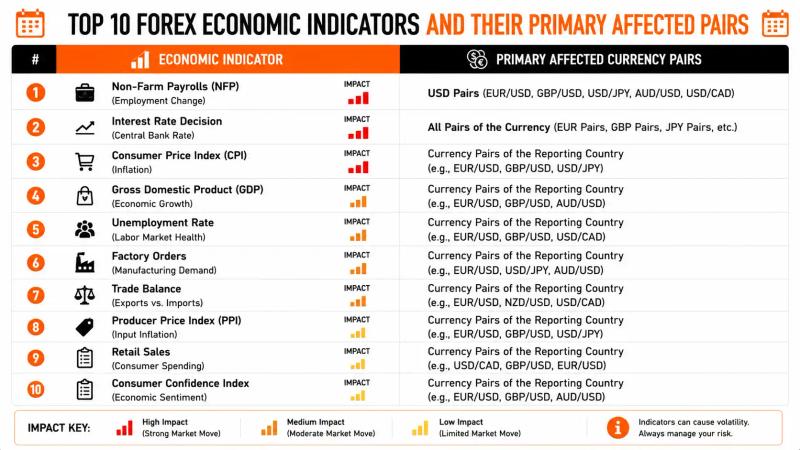
10 Economic Indicators Every Forex Trader Should Track
Learn which 10 economic indicators move forex markets, why each one matters, and how to use an economic calendar to trade smarter.
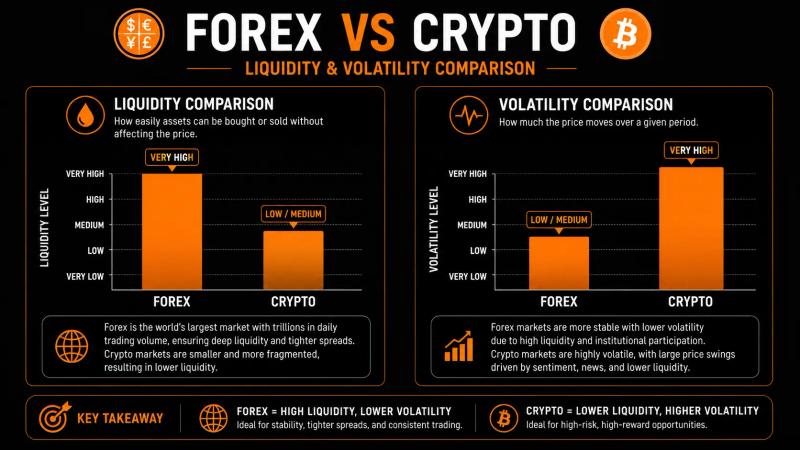
Forex vs Crypto: Which Market Has Better Risk-Adjusted Opportunities for Retail Traders?
Compare forex vs crypto on volatility, liquidity, regulation, and cost to find which market offers better risk-adjusted opportunities for you.

10 Forex Broker Red Flags to Watch Before Choosing a Forex Broker
Learn the 10 forex broker red flags that signal fraud or malpractice. Includes a step-by-step verification checklist and regulatory database links.
0 comments