



Risk Management · Beginner · 13 min read
What is a Ponzi scheme in trading: how to spot and avoid it
The mechanics: how new money props up old returns
A Ponzi scheme in trading is a fraudulent operation that recycles capital: the money paid out to earlier investors comes straight from deposits made by newer ones, with little or no genuine trading profit involved. Dashboards display steady gains, small withdrawal requests are honoured on time, and that visible performance becomes the main engine for attracting fresh deposits. Survival of the scheme depends on a single, fragile condition, which is that new money keeps arriving faster than existing clients ask to be paid out.
The label comes from Charles Ponzi, who according to the SEC duped investors in the 1920s with a postage stamp speculation scheme. His operation set the template every modern variant still follows: a plausible-sounding edge, polished account statements, early withdrawals honoured in full, and a tight circle of enthusiastic recruiters pulling in friends and family.
In a trading context, the cover story is tailored to the market the operator is pitching. Common pitches include a proprietary algorithm trading major forex pairs, a market-making desk said to capture spread, a crypto staking programme, or an arbitrage engine running between exchanges. Clients log in to a dashboard, watch a balance that only ticks upward, and may even receive genuine withdrawals during the first few weeks. Behind the interface, however, the reality is usually one of two things: no trading at all, or a tiny token position whose results have nothing to do with the balance shown.
Two features distinguish a Ponzi from a merely poor trading product.
- The first is that the published returns originate from incoming deposits rather than from any market activity.
- The second is that the operator controls the ledger entirely, which means clients cannot independently verify a trade, a counterparty, or a custodian.
Once those two conditions are in place, the arithmetic of collapse is already decided, even if the actual unravelling is still months or years away.
To trade with a firm's capital, compare the best prop firms and how their evaluations work.
Why Ponzi schemes collapse: the mathematics of unsustainable growth
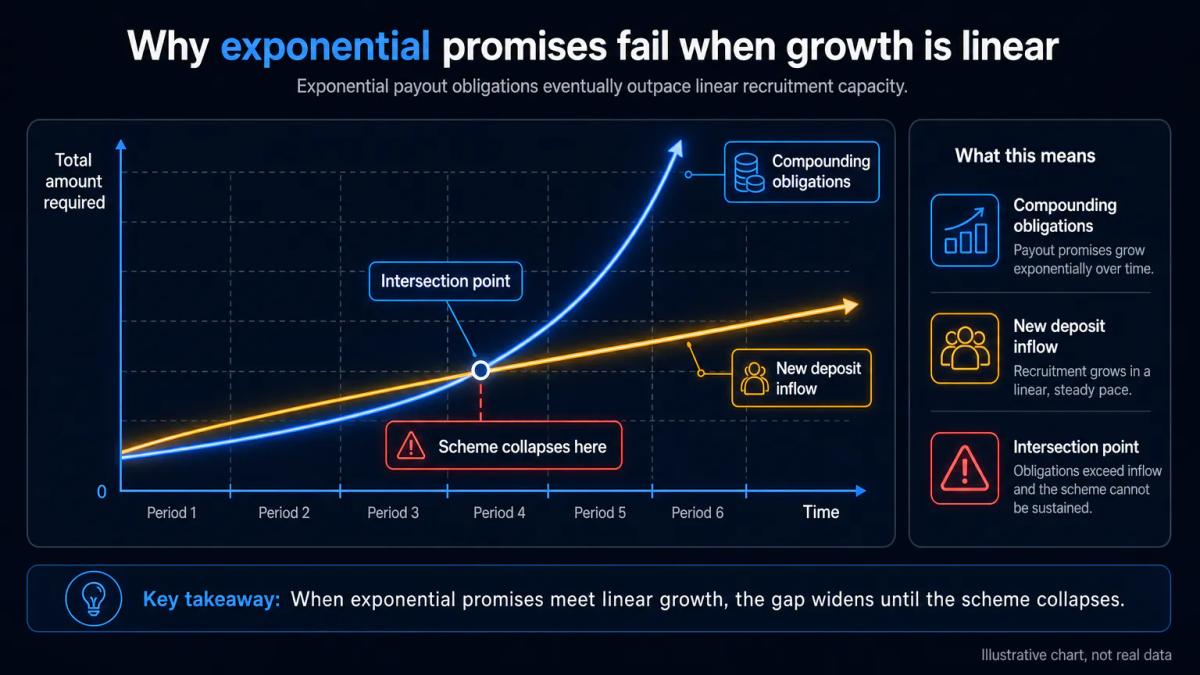
Every Ponzi scheme eventually runs out of money because the obligations it creates grow faster than any realistic flow of new deposits. Imagine an operator promising 2% a month: the headline balance owed to existing clients roughly doubles every three years before a single new recruit is counted. Keeping up with that compounded figure requires incoming deposits to accelerate at the same pace, which is simply not how human recruitment behaves in practice. As the pool of plausible targets thins, inflows slow, and the gap between promises and reality widens.
Three events typically trigger the unravelling:
- A large client requests a full withdrawal and cannot be stalled with excuses about compliance checks or market conditions.
- Press coverage, a regulator warning, or a social media thread spreads doubt and triggers a cluster of withdrawal requests at the same time.
- A macro shock, a crypto drawdown, or a banking problem interrupts the inflow of new deposits for a few weeks.
Once one of these happens, the operator faces a simple choice:
- freeze withdrawals,
- invent a technical issue, or
- disappear.
The freeze itself tends to confirm the suspicion, more clients file requests, and the ledger of promised balances becomes unpayable within days. Court filings in later prosecutions usually show that the trading accounts, where any exist at all, hold only a tiny fraction of the stated client equity.
This underlying arithmetic is the reason legitimate funds publish audited statements, segregate client money, and quote variable returns tied to a benchmark. A product that cannot vary and cannot be audited is, in effect, a product spending its own future.
Red flags: what to watch for in trading platforms and investment offers
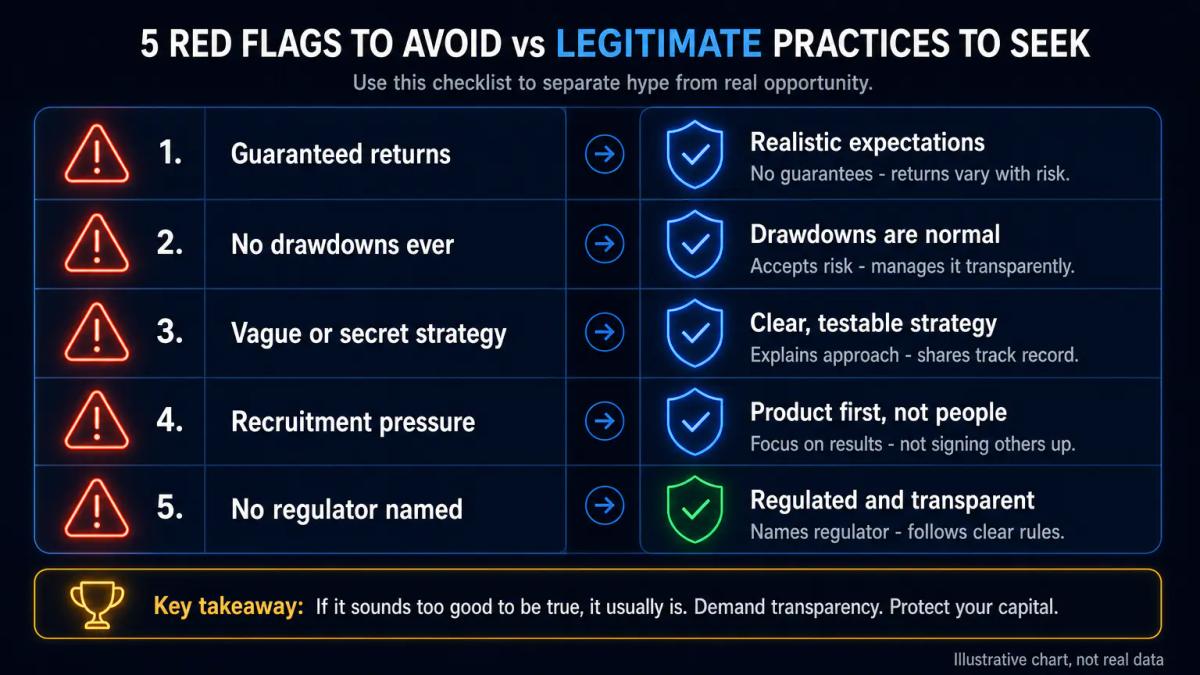
Most Ponzi schemes in trading share a recognisable pattern of promises and operational choices. Learning that pattern tends to be more useful than memorising case names, because the same signals keep reappearing across forex rooms, crypto staking apps, copy-trading platforms, and private managed accounts.
| Red flag | What a legitimate operator does instead |
|---|---|
| Guaranteed monthly returns regardless of market conditions | Publishes variable performance with drawdowns and benchmarks |
| Pressure to recruit friends or family, often with referral commissions | Pays no recruitment commission; growth is organic or through regulated marketing |
| Strategy described as proprietary, secret, or too complex to explain | Discloses the asset class, instruments, and general approach |
| No named regulator, or a regulator in a jurisdiction you cannot verify | Lists an authorisation number on a regulator's public register |
| Withdrawals only through the platform's own wallet or token | Uses bank transfers to an account in the client's name, or regulated custodians |
| Dashboard shows a straight upward equity curve | Equity curve has losing days, weeks, or months |
| Audited statements unavailable or signed by an unknown firm | Audited by a recognised accounting firm, with reports accessible |
Two softer signals tend to round out the list, and both are worth flagging separately:
- Testimonial-heavy marketing. The pitch leans on glowing testimonials, often from accounts posting large round-number gains and lacking any verifiable identity.
- Urgency during onboarding. The sign-up flow pushes a closing window, a limited slot, or a tier that supposedly fills within hours. Legitimate brokers compete on cost, execution, and regulation, and they rarely rely on a countdown clock.
A stop loss (a pre-set exit price that caps your loss on a trade) and a drawdown (the fall from a capital peak to the trough before a new peak) are both normal parts of real trading. A product that denies the existence of either is less a market strategy than an accounting fiction dressed up in trading vocabulary.
Imagine a signal provider advertising 8% a month, flat, with no losing month in two years, and paying a 10% commission on every friend you bring in. Should you deposit $5,000 under those terms, the arithmetic implies your balance would exceed $12,500 within twelve months with zero down days, while the operator pays out $500 to whoever recruited you. No regulated forex or crypto manager publishes a curve of that shape, and the structure itself tends to serve as its own warning.
Ponzi schemes versus pyramid schemes: the key difference
Ponzi and pyramid schemes both pay old participants with new participants' money, yet the entry point and the sales story differ in important ways. A Ponzi scheme sells an investment proposition: capital is handed over in the expectation of a return from trading, interest, or arbitrage, and the operator pretends to generate that return. A pyramid scheme sells membership instead, requiring a joining fee or starter pack, with earnings tied chiefly to recruiting new members below you who pay the same fee.
One practical consequence is that a pyramid tends to collapse faster. Almost every pound entering the system is a recruitment fee, so the pool of plausible new members has to double at every level, and six or seven levels of doubling is enough to exhaust a national market. Ponzi schemes, by contrast, can run for a decade or more, since withdrawals stay relatively rare while the headline return still looks attractive.
In trading, hybrids are common: a copy-trading platform may charge a subscription (pyramid-like) while also claiming to generate returns from trades (Ponzi-like). The regulatory treatment is similar in most jurisdictions: both are fraud, both trigger criminal charges, and both leave clients at the back of a long creditor queue when the operation is wound up.
How to report a suspected scheme and what happens next
If you suspect that a trading operation is a Ponzi, report it to the financial regulator in the jurisdiction where the operator claims authorisation and in the jurisdiction where you live. Reports from clients serve as a primary source of leads for enforcement teams, and early reports significantly improve the chance that assets can be frozen before they are moved offshore.
The main channels for English-speaking retail clients are:
- United Kingdom, Financial Conduct Authority (FCA): use the consumer helpline or the online reporting form on fca.org.uk. The FCA maintains a warning list of unauthorised firms and a register of authorised firms you can search before you report.
- United States, Securities and Exchange Commission (SEC): submit a tip through the SEC's online complaint form at sec.gov. The SEC's whistleblower programme can also apply if you have inside information.
- United States, Commodity Futures Trading Commission (CFTC): forex and commodity-related schemes fall under CFTC jurisdiction; file at cftc.gov. The CFTC runs a parallel whistleblower programme.
- European Union, ESMA and national regulators: ESMA coordinates across the bloc, but you file with the national regulator (BaFin in Germany, AMF in France, CNMV in Spain, CySEC in Cyprus, and so on).
- Australia, Australian Securities and Investments Commission (ASIC): report through asic.gov.au; ASIC also keeps a public register of licensed firms.
After filing, hold on to every document you can: contracts, deposit confirmations, screenshots of balances, chat logs, and the names of anyone who introduced you. Regulators typically acknowledge receipt, open a confidential investigation, and may come back to you later for witness evidence. Where assets can be identified, courts may issue a freezing order within days or weeks, while criminal referrals to prosecutors (the Serious Fraud Office in the UK, the Department of Justice in the US) take considerably longer. Avoid posting the operator's name publicly before you have filed, since premature disclosure can prompt them to move funds.
Criminal penalties and investor recovery: what operators face
Ponzi scheme operators generally face a combination of charges that reflect both the fraud itself and the way the money was moved. Typical counts include securities fraud, wire fraud, mail fraud, and money laundering; where client funds crossed borders, tax offences are often added. Sentences in the United States for large schemes have historically run to decades of federal imprisonment, and courts can order restitution orders alongside asset forfeiture to the government. In the United Kingdom, prosecutions under the Fraud Act 2006 and the Proceeds of Crime Act 2002 similarly combine custodial sentences with confiscation orders.
Recovery for clients proceeds along three parallel tracks:
- Asset tracing and seizure: investigators follow deposits through banks, exchanges, and corporate shells. Recovered assets are pooled and distributed to victims pro rata, usually through a court-appointed receiver, trustee, or liquidator.
- Civil restitution: victims can be named in the court order and receive a share of recovered funds. That share is calculated from net deposits (money paid in minus money withdrawn), rather than from the fictitious balance the platform displayed.
- Compensation schemes: these apply only to authorised firms. The UK's Financial Services Compensation Scheme (FSCS) protects clients of FCA-authorised firms up to a per-person limit, and the US SIPC covers clients of registered broker-dealers in certain circumstances. An unauthorised Ponzi operator sits outside these schemes by definition, which is why licensing checks before deposit carry such weight.
Realistic recovery rates typically amount to a fraction of lost capital rather than the full sum, and the process can stretch over several years. Clients who withdrew more than they deposited (so-called net winners) may even be required to return part of their withdrawals to the pool for fair distribution.
Due diligence checklist: verifying a broker or trading service
Before moving money to any trading platform, run through the same short set of checks every time. The whole process takes under an hour and filters out the clear majority of fraudulent operations.
- Find the regulator claim on the broker's site. The firm should name a specific regulator and a specific authorisation number, usually in the footer or legal section.
- Open the regulator's public register. Search the firm name and the number directly on the regulator's website: FCA Financial Services Register for the UK, FINRA BrokerCheck and SEC IAPD for the US, the ASIC Professional Registers for Australia, and the equivalent national registers in the EU.
- Match the entity name exactly. Scammers often clone the name of a legitimate firm with a one-letter difference. Confirm the address, the directors, and the website domain match the register entry.
- Check the warning lists. The FCA, ASIC, SEC, CFTC and ESMA all publish lists of unauthorised firms and clone warnings. Should the broker appear on any of them, treat that as a reason to walk away.
- Read the client money policy. Legitimate brokers hold client funds in segregated accounts at named tier-one banks and disclose the arrangement in the terms of business.
- Confirm leverage caps match the jurisdiction. Under FCA rules, retail leverage is capped at 30:1 on major forex pairs, 20:1 on major indices, and 5:1 on individual equities, and CFDs on cryptoassets are prohibited for UK retail clients. A broker offering 500:1 to a UK retail client is not FCA-authorised for that service.
- Request audited financials. A regulated firm will have audited accounts filed with Companies House, the SEC, or an equivalent registry. If no accounts exist for a firm claiming to manage client money, that absence should be treated as disqualifying.
Keep a one-page record of each check with dates and screenshots. If the broker later disputes a complaint, that record is useful evidence for the regulator.
Ponzi schemes in crypto and forex: sector-specific vulnerabilities
Forex and cryptocurrency attract Ponzi operators for structural reasons. Both markets trade around the clock, both involve concepts (leverage, staking, liquidity provision) that retail clients find hard to verify, and both include segments with weak or absent regulation. In combination, these factors let a fraudster borrow the vocabulary of a real market without having to accept any of its disclosure obligations.
The common vectors in these sectors are:
- Unregistered forex signal services and managed accounts. The operator claims to trade a client's account through a power of attorney or a copy-trading link, charges a performance fee, and reports fictitious gains. Because the account appears to be in the client's name, verification feels unnecessary, but the power of attorney gives the operator full withdrawal rights.
- High-yield crypto staking or lending platforms. Advertised yields of 1% a day, 20% a month, or guaranteed APYs well above regulated money-market rates are a near-certain indicator. Real staking rewards vary with the protocol and rarely reach double-digit annualised returns without equivalent volatility and lock-up risk.
- Token-wrapped Ponzi structures. The operator issues a native token whose price is controlled by the platform; new deposits in stablecoin or fiat are converted into the token at an inflated rate, and the token functions as the ledger of fictitious returns. When withdrawals rise, the token price collapses to zero.
- Leveraged copy-trading rooms. A room sells access to a star trader whose live account appears to show triple-digit annual returns on high leverage. Behind the scenes the account is often demo, selectively edited, or quietly funded with incoming subscription fees that get presented as trading profits.
- Arbitrage bots between exchanges. A classic cover story claims that a bot exploits price differences between crypto exchanges. In reality, arbitrage spreads are tiny, highly competitive, and absorbed by professional market makers, so a retail product promising steady arbitrage returns is almost certainly selling something quite different.
The defensive principle holds across both sectors. When a product cannot show segregated custody at a named regulated institution, an authorisation on a public register, and audited performance, its headline returns function as marketing rather than evidence. Any figure appearing on a platform-controlled dashboard is best treated as unverified until an independent source confirms it.
Prop firms enforce strict risk rules on daily loss and maximum drawdown: see how in our Blue Guardian review.
Frequently Asked Questions
What is the difference between a Ponzi scheme and a legitimate trading fund?
A legitimate trading fund is authorised by a named regulator, publishes variable performance with real drawdowns, holds client money in segregated accounts at tier-one banks and files audited accounts. A Ponzi scheme pays returns from new deposits, keeps the ledger inside its own platform, and cannot show independent custody, audited financials or an entry on a public regulator register.
How can I verify that a forex or crypto broker is regulated and not running a Ponzi scheme?
Find the regulator claim on the broker's website, open the regulator's public register directly (FCA Financial Services Register, FINRA BrokerCheck, SEC IAPD, ASIC Professional Registers or the equivalent EU national register) and match the entity name, authorisation number and address exactly. Then check the regulator's warning list for the firm name and any clone alerts, and confirm leverage caps and client money rules match the jurisdiction.
What should I do if I suspect I have invested in a Ponzi scheme?
Stop sending further funds, request a withdrawal in writing and keep every reply, contract, screenshot and chat log. Report the operator to your national regulator (FCA, SEC, CFTC, ASIC or the relevant EU authority) and, if the loss is large, to the police or specialist fraud unit such as Action Fraud in the UK. Do not publicise the firm's name before filing, so the operator cannot move funds in advance.
Are there any early warning signs that a trading platform is unsustainable?
Yes. A straight upward equity curve with no losing periods, headline returns far above regulated benchmarks, strong referral commissions, pressure to recruit, withdrawals routed only through the platform's own wallet or token, and vague descriptions of the strategy are all early warnings. The absence of audited statements and of a client money segregation policy is a stronger signal than any single return figure.
Can I recover my money if I have been a victim of a Ponzi scheme?
Partial recovery is possible but rarely full. Court-appointed receivers trace and seize remaining assets and distribute them pro rata, based on net deposits (money in minus money out) rather than the fictitious balance shown on the platform. If the operator was authorised, compensation schemes such as the UK FSCS or US SIPC can top up recovery within their limits; unauthorised operators fall outside those protections, which is why pre-deposit verification is decisive.
About the authors


Put this into practice
Brokers we have reviewed
Scored on the same five dimensions. Here are three of them — the full list is on the brokers page.



Related articles

Cognitive Bias in Trading: How Mental Blind Spots Hurt Your Results
Learn how cognitive biases like confirmation bias and loss aversion affect your trading decisions. Discover practical techniques to recognize and overcome them.

Common Trading Mistakes and How to Avoid Them
Learn the most common trading mistakes that cost beginners money. Discover how to identify and avoid these errors to protect your capital and improve results.

Forex Risk Management: How to Protect Your Trading Capital
A practical guide to forex risk management: position sizing, stop losses, hedging, FCA leverage caps and the psychology that keeps your rules intact.
0 comments