



Risk Management · Beginner · 11 min read
Forex Risk Management: How to Protect Your Trading Capital
What forex risk management is and why it protects your capital
Forex risk management is the practice of identifying, measuring and controlling the financial exposure that comes from currency price movements. It combines position sizing (how much you commit per trade), stop losses (orders that close a losing trade automatically) and hedging to limit how much capital you can lose on any single trade or over any period.
For a retail trader, this is not theoretical. Leverage in the foreign exchange market amplifies both wins and losses, and a single unmanaged position can wipe out weeks of gains. What separates traders who survive their first year from those who close the account tends to come down to discipline when a trade goes against them, more than any particular skill at reading charts.
According to the FCA, a high share of retail investor accounts lose money when trading CFDs, and forex is one of the most-traded CFD underlyings. That number reflects the base rate you are trading against, and it exists largely because most losses come from oversizing, ignored stops and unmanaged leverage, rather than from any particular difficulty in reading the market.
Risk management turns forex from a game of prediction into a game of survival. The objective is straightforward: still be trading next quarter, with capital intact, regardless of how any individual read plays out.
To trade with a firm's capital, compare the best prop firms and how their evaluations work.
Types of currency exposure you face
Currency exposure comes in three distinct forms, and confusing them leads to the wrong control being applied. Understanding how spreads, slippage and execution quality affect your transaction costs is essential when calculating real-world risk, since each form of exposure interacts with cost differently.
- Transaction risk is the realised profit or loss when you close a trade: the pip difference (a pip is the smallest standard price move in a pair, usually 0.0001) between entry and exit, multiplied by your position size.
- Translation risk is the unrealised gain or loss on positions you still hold, which moves with every tick and affects your margin.
- Economic risk is the longer-term erosion of your edge when structural currency moves, rate differentials or capital flows change the behaviour of the pairs you trade.
| Exposure type | What it measures | Typical control |
|---|---|---|
| Transaction risk | Realised loss on a closed trade | Stop loss, position sizing |
| Translation risk | Unrealised loss on open positions | Margin monitoring, trailing stops |
| Economic risk | Structural change in a pair's behaviour | Strategy review, diversification |
A retail trader with a swing position in GBP/USD faces all three at once: the eventual close (transaction risk), the daily mark-to-market swings (translation risk) and the drift in Bank of England versus Federal Reserve policy that changes how the pair behaves in the first place (economic risk). The Bank for International Settlements, in its Triennial Central Bank Survey, reports that daily foreign exchange turnover runs into the trillions of US dollars, with much of that volume driven by institutions hedging exactly these three exposures.
Naming the exposure you are actually running is the first honest step before choosing a tool to control it.
Position sizing and stop-loss placement
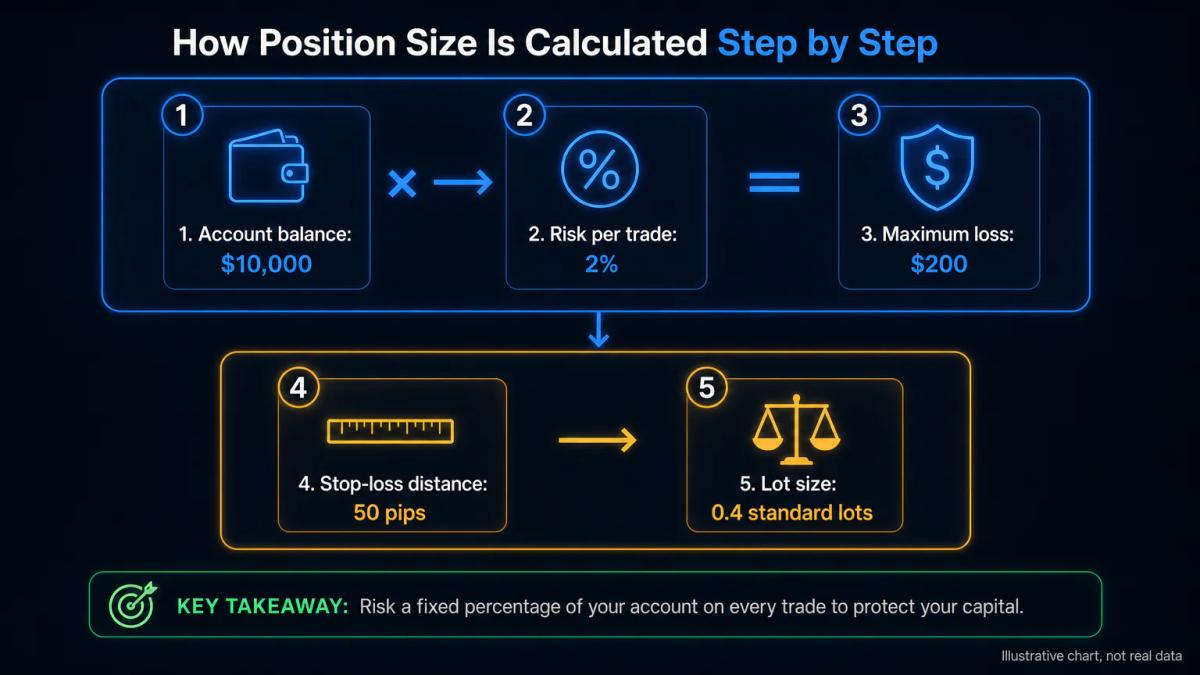
Position sizing means calculating how many units or lots (a standard lot is 100,000 units of the base currency) you trade so that the maximum loss on that trade stays inside a fixed slice of your account, usually 1 to 2 percent. A stop loss is a resting order that closes the position automatically when the price moves against you by a set amount, locking in that maximum loss before hesitation takes over.
The arithmetic is simple, and it should be written down before the trade rather than after. Take an account of $10,000 with a risk per trade of 1 percent: you are willing to lose $100 on this position. If your stop is 25 pips away on EUR/USD, and each pip on a standard lot is worth roughly $10, you can trade 0.4 lots. Change the stop distance, and the size adjusts to keep the risk envelope fixed at $100.
| Account size | Risk per trade (1%) | Stop distance | Approx. position size (EUR/USD) |
|---|---|---|---|
| $2,000 | $20 | 20 pips | 0.10 lots |
| $10,000 | $100 | 25 pips | 0.40 lots |
| $25,000 | $250 | 40 pips | 0.62 lots |
| $50,000 | $500 | 50 pips | 1.00 lots |
Stop placement is where beginners most often fail. A stop belongs at the price level that invalidates your trade idea, so that being wrong on the idea and being wrong on the trade become the same event. If your entry only makes sense above a support level, the stop sits below that level, and the position size adjusts to fit. Tightening the stop to reduce loss while keeping the size large produces the same trade with worse odds.
Take profit orders (resting orders that close a winning trade at a preset level) sit on the other side. A common rule places them at a distance of at least twice the stop distance, so that even a 40 percent win rate produces a positive expectancy. What compounds an account over time is expectancy across many trades rather than the accuracy of any single one.
The same principle applies across all types of trading, whether day trading, swing trading or scalping.
Hedging techniques and when to use them
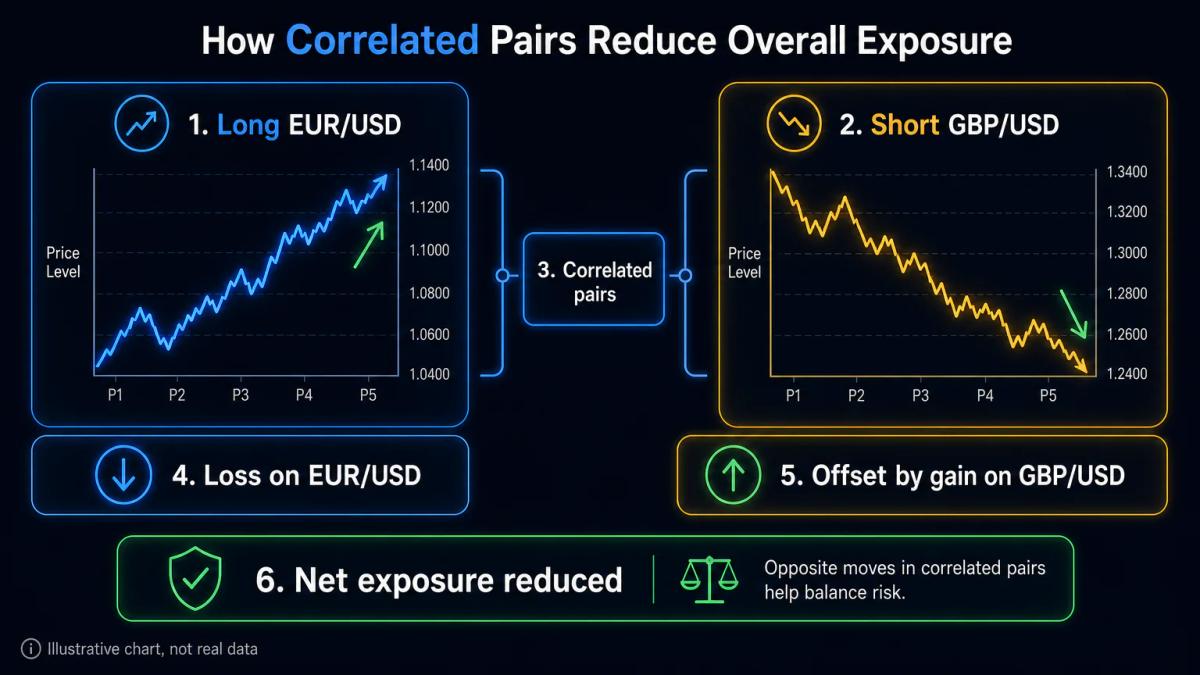
Hedging means opening a second position that profits if the first loses, offsetting part or all of the exposure. In forex, retail traders typically reach for one of three approaches:
- Direct offset: holding a long and a short in the same pair, which most regulated brokers now net out automatically.
- Correlated pair hedge: for example, going long EUR/USD and short GBP/USD when the two pairs move together.
- Currency option: a contract that pays out if the pair moves beyond a strike, in exchange for a premium paid upfront.
Hedging is not free. Each approach carries its own costs that need to be weighed against the exposure being covered:
- The spread on the offsetting instrument.
- The swap (overnight financing) on any position held past the daily rollover.
- For options, an upfront premium regardless of whether the option is exercised.
- Before opening the hedge, run the total cost against the loss you would take without it.
| Hedge type | Typical cost | When it makes sense |
|---|---|---|
| Correlated pair short | Spread + swap on both legs | Short-term event risk on one leg |
| Currency option | Premium paid upfront | Defined-risk cover into a known event |
| Cash reduction (partial close) | Spread on the closed portion | Simplest and often cheapest |
For most retail accounts, the cheapest hedge is simply closing part of the position. Cutting size by half achieves the same reduction in exposure as a full offsetting hedge, without paying two spreads and two swaps. Full hedges tend to earn their cost around known catalysts, such as a central bank meeting, a scheduled non-farm payroll release, or a referendum, where the objective is to keep the underlying view intact while neutralising a specific event window.
Monitoring and adjusting your risk controls
Risk management is an ongoing discipline rather than a one-time setup. Positions move, correlations shift and small overnight losses compound into a drawdown (the fall from a capital peak to the trough before a new peak) that can quietly breach your rules. A daily review should cover:
- Total open exposure across all positions.
- Margin usage as a percentage of equity.
- Correlation between open trades.
- The running loss against your daily and weekly limits.
A workable dashboard, whether it lives in your MT5 terminal, a cTrader watchlist or a plain spreadsheet, tracks four numbers:
- Open risk: the sum of distances to stops in currency terms.
- Free margin available on the account.
- Daily profit and loss to date.
- Correlated positions: the count of open trades tied to the same driver.
When any two of the four cross a preset limit, stop opening new trades until the picture clears. Applied without exception, this rule prevents the single worst outcome for a retail account: adding trades into a losing day because the screen still shows buying power. Many traders automate this enforcement using trading bots and Expert Advisors to enforce daily loss limits and position caps.
A weekly review looks further back. You check whether your average loss is drifting above your risk-per-trade rule, whether your win rate is holding, and whether the pairs you trade are still behaving the way your strategy assumes. If GBP/USD suddenly correlates 0.9 with EUR/USD when your model expects 0.6, holding both is one position, not two.
Regulatory leverage limits and compliance
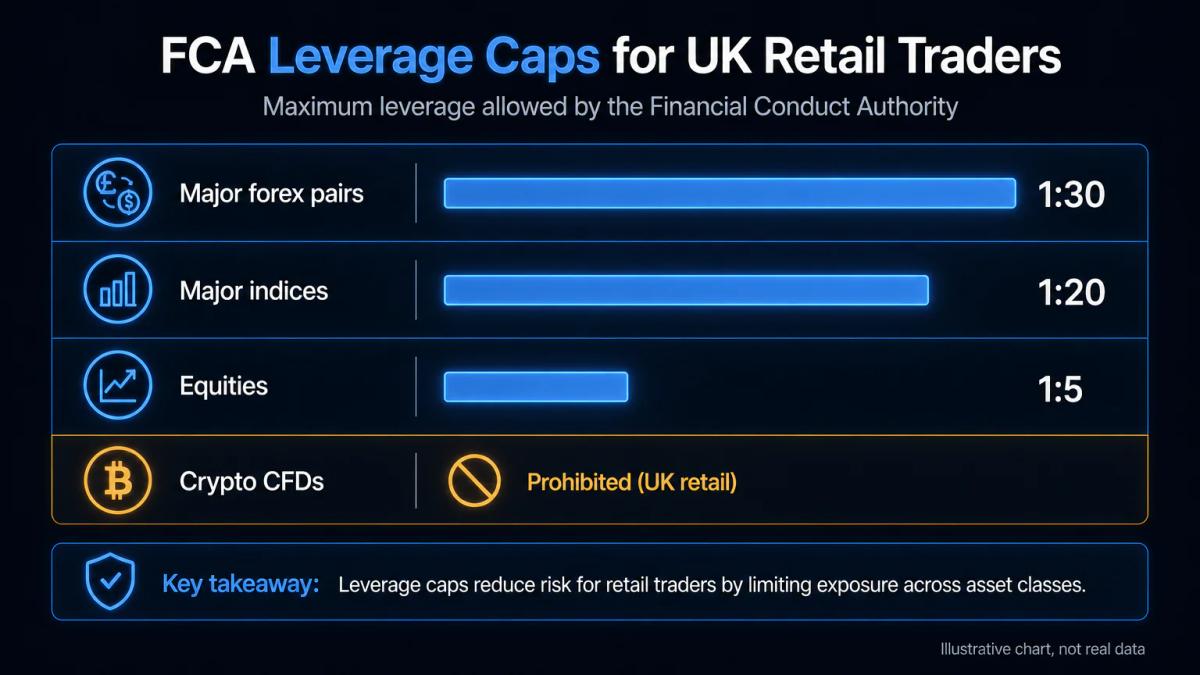
Leverage caps are the built-in risk control you inherit whether you want them or not. For UK retail clients, the Financial Conduct Authority sets the following maximums:
- 1:30 on major forex pairs.
- 1:20 on major indices and non-major forex pairs.
- 1:10 on commodities other than gold.
- 1:5 on individual equities.
- A full prohibition on the sale of crypto CFDs to retail consumers.
The European Securities and Markets Authority applies the same framework across the EU. When selecting a broker, comparing forex brokers by their regulatory status and leverage offerings will help ensure you get the protections your jurisdiction requires.
| Asset class | UK retail cap (FCA) | EU retail cap (ESMA) |
|---|---|---|
| Major FX pairs | 1:30 | 1:30 |
| Non-major FX, gold, major indices | 1:20 | 1:20 |
| Other commodities, non-major indices | 1:10 | 1:10 |
| Individual equities | 1:5 | 1:5 |
| Crypto CFDs | Prohibited for retail | 1:2 (varies) |
A UK-authorised entity onboarding UK retail clients under an FCA licence represents the gold standard for compliance, with negative balance protection, standardised risk warnings and the leverage caps above all enforced by the regulator. Brokers such as Admirals operate under full FCA authorisation and meet these standards. Some brokers offer higher leverage through offshore group entities, and going that route strips those protections away. In the United States, the Commodity Futures Trading Commission and the National Futures Association cap retail forex leverage at 1:50 on majors and 1:20 on minors, with mandatory reporting on the broker side.
Psychological discipline and behavioural risk
The largest risk in a retail account tends to be the trader rather than the market: what happens to your own rules once a trade begins going against you. Fear pulls you towards closing winners early, while greed pushes in the opposite direction, widening a stop, adding to a losing position, or taking a setup outside your plan because the last one worked. These reactions are predictable, and they defeat every technical control on this page if left unchecked.
The defence is a written trading plan, drafted when you are calm and consulted when you are not, covering at minimum:
- The setups you take.
- Risk per trade.
- Daily loss limit.
- The hard rule for the day after breaching the limit.
Traders who journal every trade, recording the entry reason, stop, size, exit and any mistake, tend to catch drift within days rather than months.
One mechanical rule is worth a thousand promises to yourself: a broker-side daily loss limit that closes the platform when hit. If your broker offers it on MT4, MT5 or cTrader, turn it on. Discipline that has to be summoned in the moment tends to fail under pressure, whereas discipline the software enforces holds regardless of how you feel that day.
Tools and platforms for risk tracking
Most brokers offer built-in risk tools on MT4, MT5 and cTrader that show margin usage, open exposure and drawdown in real time. MT5 and cTrader both expose these metrics through their APIs, so you can script a custom alert or export positions to a spreadsheet for cross-account tracking. Expert Advisors (EAs, automated scripts that run on MT4 and MT5) can enforce a maximum daily loss, cap the number of open trades, or auto-close positions when correlation breaches a threshold.
| Platform | Native risk view | Automation route |
|---|---|---|
| MT4 | Margin, equity, floating P&L | Expert Advisors (MQL4) |
| MT5 | Margin, exposure by symbol, drawdown | Expert Advisors (MQL5), API |
| cTrader | Margin, net exposure, risk per trade | cAlgo (C#), Open API |
Multi-account traders and copy-trading users benefit from a consolidated view that a single terminal cannot give. Whether you build it in a spreadsheet or licence a third-party risk dashboard, the requirement is the same: one screen, updated live, that shows total risk across every account before you place the next trade.
Frequently Asked Questions
How do I calculate the right position size for my forex trades?
Decide the maximum you will lose on the trade, usually 1 to 2 percent of your account. Divide that figure by the distance from your entry to your stop loss, expressed in pips, multiplied by the pip value for a standard lot. The result is the position size in lots. If your account is $10,000, your risk is 1 percent, your stop is 25 pips and each pip is worth $10 per lot, you trade 0.4 lots.
What is the difference between a stop loss and a take profit order?
A stop loss is a resting order that closes your position when the price moves against you by a set amount, capping your loss. A take profit is a resting order that closes your position at a preset gain, locking in the win before the market reverses. Both are set at entry and both remove the need to react manually to every tick.
Can I hedge my forex positions without paying extra fees?
No. Every hedge involves at least the spread on the offsetting trade, and any position held past the daily rollover incurs a swap charge. Options add an upfront premium. The cheapest way to reduce exposure is usually to close part of the position, which pays only the spread on the closed portion. Reserve full hedges for known event windows where the cost is worth the protection.
What leverage should I use if I am a beginner forex trader?
Use the lowest leverage that lets you trade the position size your risk rules allow. On an FCA-regulated account, majors are capped at 1:30, but nothing forces you to use the maximum. Many experienced retail traders operate at an effective 1:5 or 1:10, which still allows meaningful position sizes while keeping margin usage well below the level where a normal drawdown triggers a margin call.
How often should I review and adjust my risk management rules?
Monitor open exposure and daily loss every trading day. Review your rules formally each week, looking at whether your average loss is drifting above your risk-per-trade limit and whether correlations between your open pairs still match your assumptions. Rewrite the rules only after a full month of data, not after a single bad day or a single lucky run.
About the authors


Put this into practice
Related articles

Hedging Strategies in Trading: How to Protect Positions
Learn how hedging strategies help traders manage risk. Explore options, pairs trading, and diversification techniques with practical guidance.

How to Create a Risk Management Strategy: A Step-by-Step Guide
Learn how to create a risk management strategy step by step. Build a risk plan with clear rules to protect your trading capital.

How to Find the Right Risk-Reward Ratio for Your Trades
Learn how to calculate risk-reward ratio, understand what makes a good RRR, and choose the right ratio for day trading or swing trading strategies.
0 comments