



Trading Strategies · Beginner · 10 min read
Types of Trading Explained: Day Trading, Swing Trading and Scalping
The three main holding periods that define how you trade
There are many different types of trading, and discovering which one suits your psychology, your preferences and your skills early on is critical to become a successful trader.
These trading types are grouped by how long you hold a position:
- Day trading (minutes to hours, always closed before the session ends)
- Swing trading (days to a few weeks)
- Scalping (seconds to a few minutes).
Each style demands different capital, screen time and discipline to work in practice.
Holding period is the single variable that reshapes everything else.
- A shorter horizon means more trades, higher sensitivity to spreads and slippage (the difference between the buy and sell price quoted by your broker), tighter stop losses (a preset order that closes a losing position at a defined price) and more decisions per hour.
- A longer horizon means fewer trades, wider stops, exposure to overnight financing costs (called swap or rollover) and greater tolerance for news that lands outside your screen time.
These three labels are not the only ones you will see. Position trading holds for months and blends with investing; algorithmic trading automates any of the three styles through code.
This article stays on the three retail traders actually pick between when starting out.
| Style | Typical holding period | Chart timeframe | Trades per week | Main cost driver |
|---|---|---|---|---|
| Scalping | Seconds to minutes | 1-minute, tick charts | 50 to 500+ | Spreads and commissions |
| Day trading | Minutes to hours | 5-minute to 1-hour | 5 to 40 | Spreads and slippage |
| Swing trading | Days to weeks | 4-hour and daily | 1 to 10 | Overnight swap and gaps |
Putting this into practice means opening an account: start with the best forex brokers our team reviewed.
Day trading: capturing intraday price moves
Day trading means opening and closing every position within the same trading session, so you never carry exposure overnight. You work off intraday charts, typically the 5-minute, 15-minute and 1-hour, and trade the volatility (the size and speed of price movement) that shows up around session opens, economic releases and volume spikes.
A typical day trading setup uses technical analysis: chart patterns and moving averages and volume study to identify a directional move that could last from twenty minutes to a few hours. You size the position so a stop loss placed a few pips (a pip is the fourth decimal in most forex pairs, the smallest standard price increment) or a few cents away costs a fixed percentage of the account, often 0.5% to 1% per trade.
The attraction is clear: no overnight risk, no swap fees and full control over when you are exposed. The cost is time and mental load. You need to be at the screen through your chosen session, whether that is the London open, the New York open, or the London-New York overlap when major forex pairs move fastest.
According to the FCA, most retail investor accounts lose money when trading CFDs, and the regulator requires every FCA-authorised broker to display the exact loss percentage on its own site. That statistic captures a broad population, not day traders specifically, but the direction is clear: intraday styles amplify both edges and mistakes.
Day trading suits you if you can dedicate at least two to four focused hours a day, tolerate a fast decision rhythm, and are comfortable with a working process rather than a passive investment.
Swing trading: riding multi-day trends
Swing trading holds positions for several days to a few weeks, aiming to capture one leg of a larger trend rather than every wiggle inside a session. You work primarily off the 4-hour and daily charts and combine technical levels, support and resistance with swing trading signals, moving averages, trendlines, with an eye on the fundamental calendar: central bank meetings, earnings, macro releases.
A swing trade typically enters near a defined technical level, uses a stop loss placed on the other side of that level, and targets a price two to four times the risk. Because stops are wider (measured in dozens or hundreds of pips rather than a handful), position sizes are smaller for the same account risk, and screen time drops sharply. Many swing traders check charts once or twice a day, at session open and close.
The trade-off is overnight exposure. You will pay or receive swap on positions carried past the daily rollover, and a headline over the weekend can gap the market past your stop. Swing traders manage this with smaller size, diversification across uncorrelated instruments, and by avoiding positions into scheduled high-impact events.
According to the Bank for International Settlements Triennial Survey (2022), average daily turnover in the global foreign exchange market reached $7.5 trillion, with the London session accounting for the largest share. That depth is what lets a swing trader enter and exit at expected levels on major pairs without moving the price.
Swing trading suits you if you have a demanding day job or you prefer fewer, higher-conviction decisions. It is the style with the lowest screen-time demand of the three, at the cost of holding through more uncertainty.
Scalping: profiting from small, frequent moves
Scalping opens and closes positions in seconds to a few minutes, aiming to collect a handful of pips per trade, dozens or hundreds of times per session. You need very tight spreads, low commissions, fast execution and, in most cases, a broker that permits high-frequency order flow.
The mechanics are unforgiving. If your typical target is 5 pips and the spread on EUR/USD is 1 pip, one-fifth of every winning trade is paid to the broker before you start. That is why scalpers gravitate to ECN or raw-spread accounts (accounts that pass through interbank pricing and charge a fixed commission instead of marking up the spread) and to instruments with the deepest liquidity and lowest spreads: EUR/USD, USD/JPY, index futures like the E-mini S&P 500, and the largest single-stock names.
Leverage matters more here than in any other style. Because you are targeting small moves, position sizes are large in notional terms even when account risk per trade is modest. For UK retail clients, the FCA caps leverage at 1:30 on major forex pairs, 1:20 on non-major indices and gold, and 1:5 on individual equities, and it prohibits CFDs on cryptocurrencies for retail clients entirely.
Scalping suits you if you have low-latency internet, a reliable platform, sharp reflexes and, above all, the discipline to close losers instantly. It is the least forgiving style for anyone who hesitates on the exit.
How to match a trading type to your profile
Your choice depends on four inputs: time available, capital available, emotional tolerance for drawdowns (a drawdown is the fall from a capital peak to the trough before a new peak), and the quality of your execution setup. Match the style to your constraints, not the other way around.
| Factor | Scalping | Day trading | Swing trading |
|---|---|---|---|
| Screen time per day | 2-6 hours, continuous | 2-4 hours, session-based | 15-30 minutes |
| Realistic starting capital | £5,000+ (retail CFD) | £2,000+ (retail CFD), $25,000 for US pattern day traders | £500+ |
| Trades per week | 50-500+ | 5-40 | 1-10 |
| Emotional load | Very high | High | Moderate |
| Execution requirement | Low-latency, ECN account | Reliable platform | Standard retail platform |
A reader working full-time in another job should not start with scalping: the setup cost is real and the mistakes are expensive. Swing trading is the natural entry point for part-time traders because it separates decision-making from execution: you can plan a trade in the evening and place resting orders that trigger during the next session.
Capital matters differently by style. In the United States, the SEC and FINRA define a pattern day trader (PDT) as an account executing four or more day trades within five business days in a margin account, and require the account to maintain at least $25,000 in equity. That rule does not apply outside the US, but it changes what US-based day traders can realistically start with.
Capital, leverage, and regulatory constraints by type
Regulation shapes every style differently, and the biggest variables are minimum capital, maximum leverage and instrument access. UK retail clients open accounts with the FCA-authorised entity of a broker group; that entity is bound by the FCA's product intervention rules for CFDs, which took full effect in August 2019.
Under those rules, an FCA-authorised broker offering CFDs to UK retail clients must cap leverage at 1:30 on major forex pairs, 1:20 on major indices and gold, 1:10 on non-major indices and commodities, 1:5 on individual equities, and it must not offer CFDs on cryptocurrencies to retail clients at all. Negative balance protection is mandatory on a per-account basis. ESMA imposes materially the same caps across the EU.
| Instrument | FCA retail leverage cap | Practical impact |
|---|---|---|
| Major forex (EUR/USD, GBP/USD) | 1:30 | Suits all three styles |
| Major indices (FTSE 100, S&P 500) | 1:20 | Common for day and swing |
| Non-major indices, gold | 1:20 | Common for swing |
| Non-major commodities | 1:10 | Swing-friendly |
| Individual equities | 1:5 | Larger capital needed |
| Crypto CFDs | Prohibited for UK retail | Not available |
Offshore entities within the same broker group often advertise leverage of 1:200 or higher, but a UK resident onboarded through an offshore entity gives up FCA protections, including negative balance protection and access to the Financial Ombudsman Service. Check the entity name on the client agreement, not the marketing site.
Tax treatment also splits by style. HMRC classifies most retail CFD and forex trading profits as capital gains for UK individuals, with an annual exempt amount that has been reduced in recent tax years. Spread betting profits are, at present, exempt from Capital Gains Tax for UK individuals under HMRC's current guidance. Frequent traders can, in some circumstances, be assessed as trading income; confirm your position with a qualified accountant.
Technical analysis, psychology, and execution speed
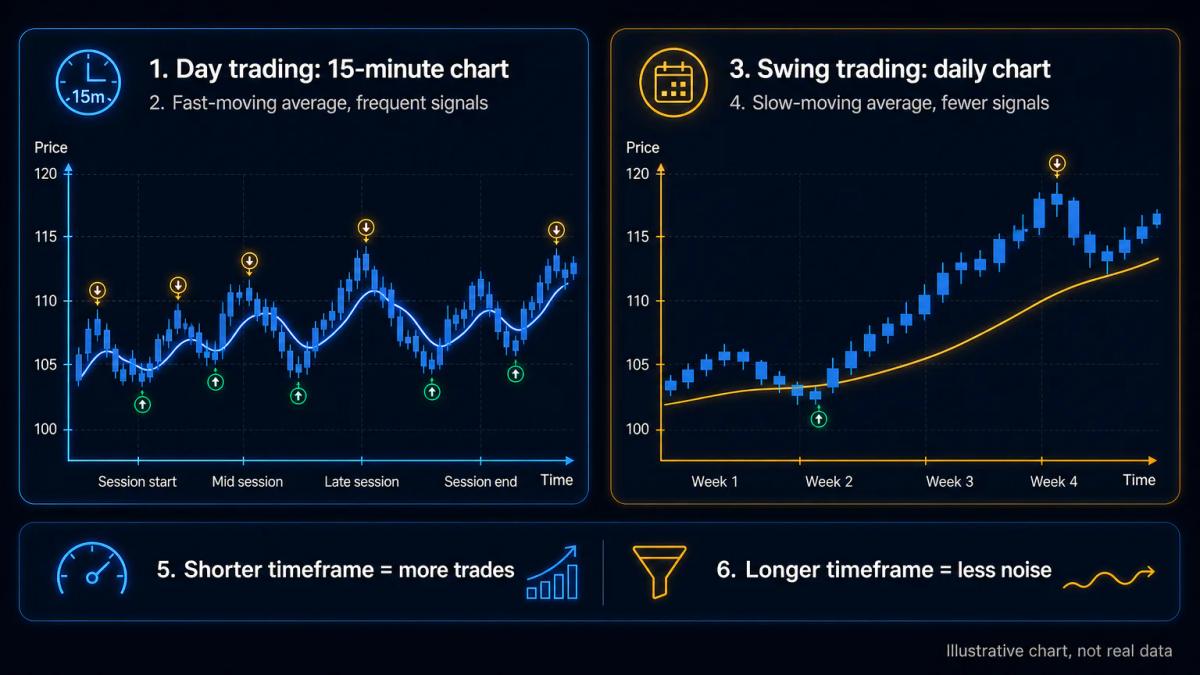
Day traders and scalpers live inside technical analysis: candlestick patterns, volume-weighted average price, order flow, moving averages on short timeframes. Swing traders use the same tools on daily charts but weight fundamental context more heavily; a central bank decision or an earnings release can invalidate a chart setup overnight.
Execution speed scales inversely with holding period. A scalper needs the platform to fill at the quoted price within milliseconds; slippage (the difference between the price you clicked and the price you filled) of two pips destroys a five-pip target. A day trader tolerates a pip or two of slippage on a fifty-pip move. A swing trader entering on a daily close cares far more about the level than the fill.
Psychology divides along the same axis. Scalping demands the fastest decisions, the tightest stops and the shortest recovery time between trades: one hesitation on an exit can wipe an hour of gains. Day trading demands sustained focus across a session and the discipline to stop trading when the plan is done, not when you feel like more. Swing trading demands patience: holding through days of adverse movement inside a trend you still believe in, without cutting the position out of boredom.
All three share the same core discipline: pre-defined entry, pre-defined stop loss, pre-defined position size, and a written rule for when you stop trading for the day, week or month. Style choice picks the tempo; the rules underneath do not change.
Frequently Asked Questions
What is the minimum account size needed to start day trading versus swing trading?
In the US, FINRA's pattern day trader rule requires at least $25,000 equity in a margin account for anyone placing four or more day trades in five business days. Outside the US, there is no regulatory minimum, but a workable day trading account on CFDs typically starts at £2,000 to £5,000 so that 1% risk per trade covers realistic stop distances. Swing trading works from as little as £500 because wider stops mean smaller position sizes for the same risk.
Can I switch between day trading and swing trading on the same account?
Yes, most retail brokers allow both on a single account, and many traders combine them: a swing position on the daily chart alongside intraday trades on the same or different instruments. The constraint is margin: overnight positions in swing trades tie up equity that is then unavailable for day trades. Keep a written rule that separates the two books, or you will end up managing swing trades on intraday emotion.
Which trading type is best for beginners with limited time?
Swing trading is the natural entry point for part-time beginners. You can analyse the daily chart in the evening, place resting entry, stop and target orders, and let them execute during the next session without watching the screen. Scalping is the worst starting choice: it demands the fastest execution, the tightest cost structure and the most trained reflexes, so mistakes accumulate quickly for anyone still learning the basics.
How do tax reporting and holding-period rules differ across trading types?
In the UK, HMRC generally treats retail CFD and forex trading profits as capital gains for individuals, with an annual exempt amount that applies regardless of holding period. Spread betting profits are, at present, exempt from Capital Gains Tax under HMRC's current guidance. Frequent, systematic trading can be assessed as trading income in some cases. In the US, the IRS distinguishes short-term gains (held one year or less, taxed at ordinary income rates) from long-term gains, so scalping, day trading and most swing trading fall into the short-term bracket. Confirm your specific position with a qualified accountant.
What are the main differences in stop-loss placement between scalping and swing trading?
A scalper places stops a few pips or a handful of ticks from entry, often just beyond the last minor swing on a 1-minute chart, and accepts that the market noise itself can stop them out. A swing trader places stops on the other side of a structural level on the daily or 4-hour chart, often 50 to 200 pips away on major forex pairs, and sizes the position much smaller to keep the same 0.5% to 1% account risk per trade.
About the authors


Put this into practice
Brokers we have reviewed
Scored on the same five dimensions. Here are three of them — the full list is on the brokers page.



Related articles
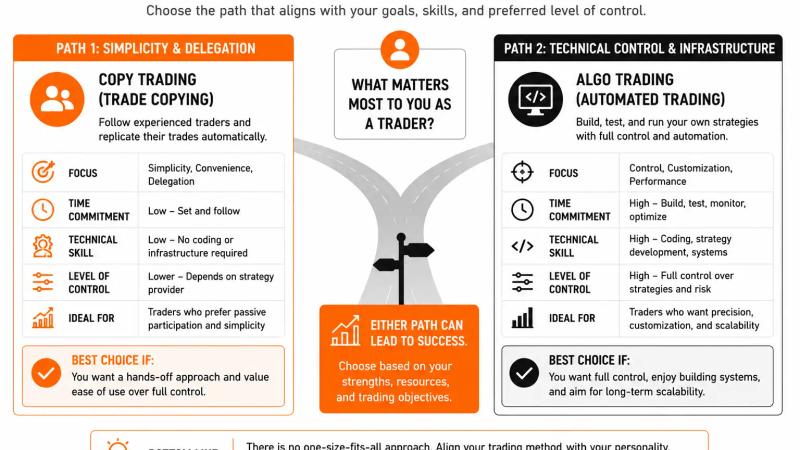
Copy Trading vs Algo Trading: Which Has the Better Risk Profile?
Discover how copy trading and algo trading differ in risk profile, who controls the risk, and which approach suits your trading style.

5 Trading Strategies That Work Across Multiple Asset Classes
Discover trading strategies that work across forex, stocks, indices, and commodities; with clear guidance on how to adapt each one.
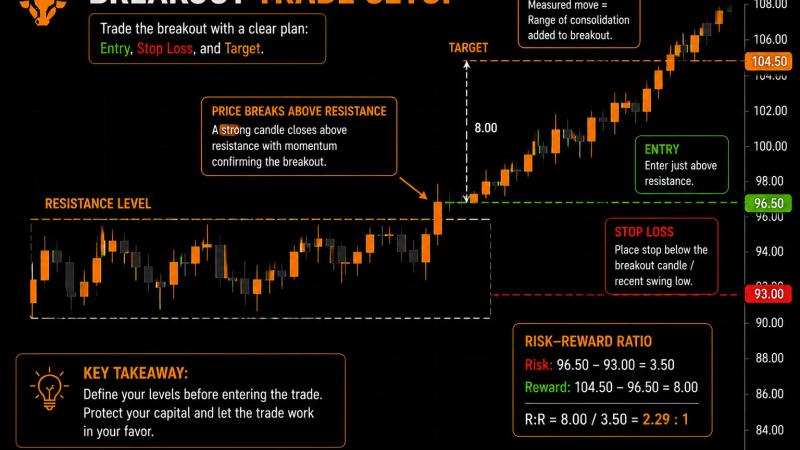
Breakout Trading Strategy: How to Identify Real Breaks From False Ones
Learn the breakout trading strategy and how to spot real breaks from false ones using volume, confirmation, and clean entry rules that protect your capital.
0 comments