



Trading Strategies · Intermediate
Breakout Trading Strategy: How to Identify Real Breaks From False Ones
A breakout trading strategy is a method for entering the market the moment price escapes a level it has been stuck behind, and this article shows you how to do it without getting trapped.
By the end, you will be able to qualify a breakout, using volume, candle closes, and a retest, before you risk a single dollar on it.
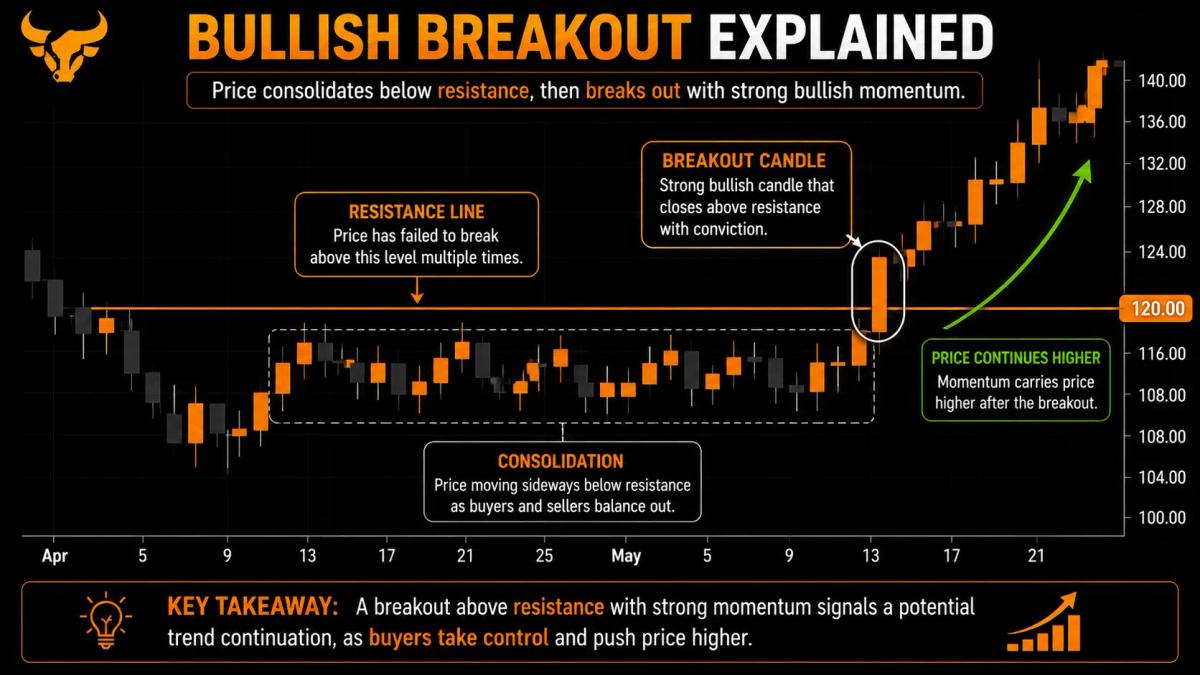
What a Breakout Actually Is
Price spends most of its life trapped. It bounces between levels, coils inside ranges, and tests the same ceiling over and over until something finally gives. A breakout is the moment price pushes through one of those boundaries and starts a fresh move in that direction.
Picture a level as a fence around a field. As long as price stays inside, its behaviour is reasonably predictable. The breakout is the animal clearing the fence, and the only question that matters is whether it is really running free or just leaning on the rail before it settles back down.
Answering that starts with knowing where these levels form in the first place. Understanding support and resistance levels is foundational to reading breakouts correctly.
The Three Levels Breakouts Form Around (Support, Resistance, Range)
Breakouts happen at structural levels. There are three worth recognising:
- Resistance: a ceiling where price has repeatedly stalled and turned lower. A break above it is a bullish breakout.
- Support: a floor where price has repeatedly bounced. A break below it is a bearish breakout, sometimes called a breakdown.
- Range: a sideways zone bounded by support below and resistance above. Price chops between the two until it escapes one side.
The cleaner and more tested a level is, the more a break through it means. A line touched four separate times carries far more weight than one drawn through a single candle.
Run this strategy on a solid platform — see the best forex brokers.
Why Most Breakouts Fail
Few things sting like watching price blast through a level, pull you in, then snap straight back the other way. It happens constantly, and it is rarely bad luck. There are mechanical reasons breakouts fail, and once you understand them, you stop taking the bait so often.
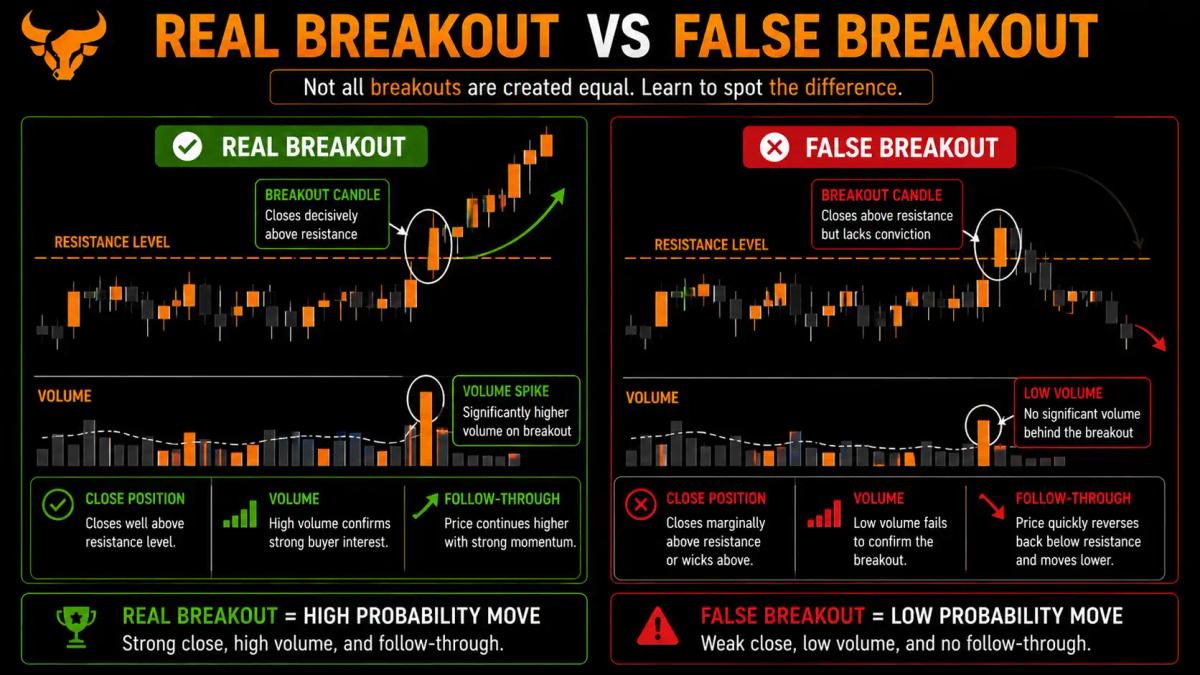
A breakout needs follow-through to survive. Clearing a level is only the first step. If buyers or sellers stop pressing, the move stalls and the level reasserts itself. Two situations cause this more than any others.
Liquidity Grabs and Stop Hunts
Round numbers and obvious highs are exactly where stop-loss orders pile up. Below an obvious support sits a cluster of sell stops. Above an obvious resistance sits a cluster of buy stops. Larger participants know where that liquidity rests, and price often spikes just past the level to trigger those stops, fills sizeable orders against the rush, then reverses.
Low Participation and Thin Volume
A breakout is only as strong as the conviction behind it. When price clears a level on weak volume, it usually means very few traders actually care about the move at that price. Thin conditions produce some of the most unreliable breaks you will ever see.
How to Confirm a Real Breakout
Confirmation is what separates a trade from a guess. Three signals do most of the work here, and the more of them that line up, the more weight the break deserves.
Volume Confirmation
Volume is the breakout's vital sign. A genuine break is usually carried by a clear rise in volume. When price clears a level but volume stays flat or fades away, treat the move with suspicion.
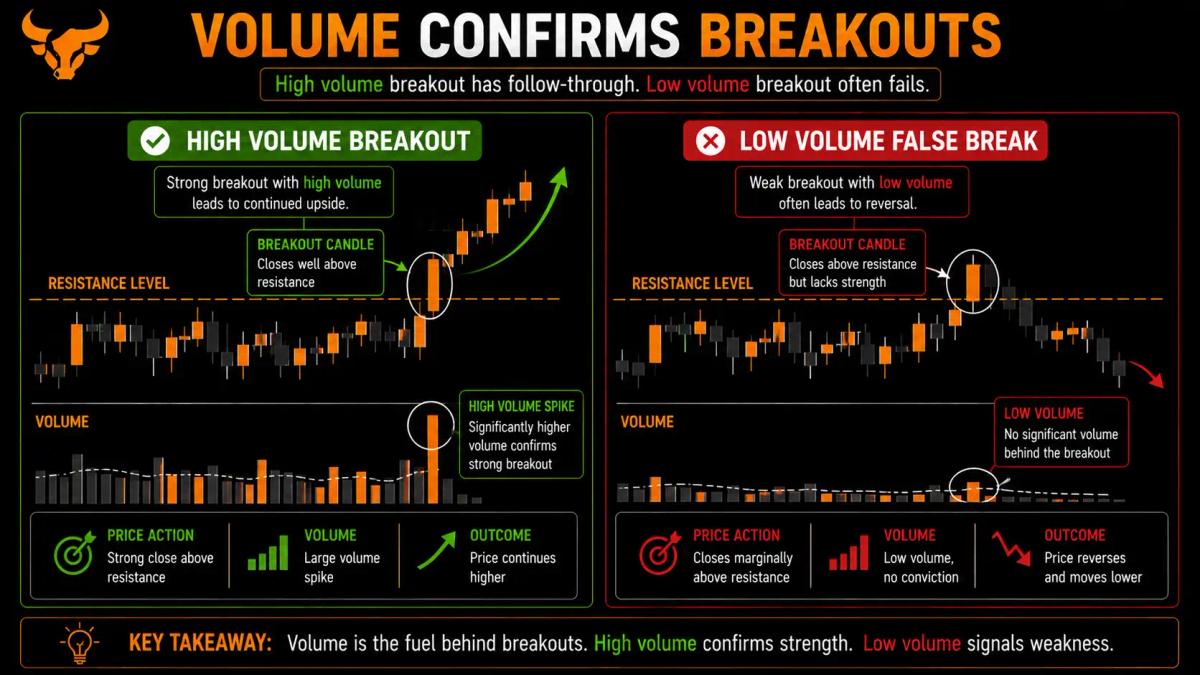
Candle Close Beyond the Level
A wick poking past a level means nothing on its own. What matters is whether the candle actually closes beyond the level on your chosen timeframe. A close is a commitment, and a wick is just a probe.
Retest and Hold
The cleanest confirmation often arrives after the break rather than during it. Price frequently breaks a level, then circles back to tap it from the other side before continuing. Old resistance becomes new support, and old support becomes new resistance.
Spotting a False Breakout Before It Traps You
By now the shape of these failures should feel familiar. A handful of warning signs tend to appear before a breakout collapses, and learning to read them early keeps you out of the worst traps.
Warning Signs of a Fakeout
- Volume that fails to expand as price clears the level
- A long wick that pushes past the level then closes back inside it
- No follow-through after the initial push
- A break into empty space, with no clear level for price to run toward
- Suspicious timing, where the break appears at an odd or thinly traded moment
Building the Entry, Stop, and Target
A confirmed breakout still needs a plan around it. Here is how the three pieces fit together.
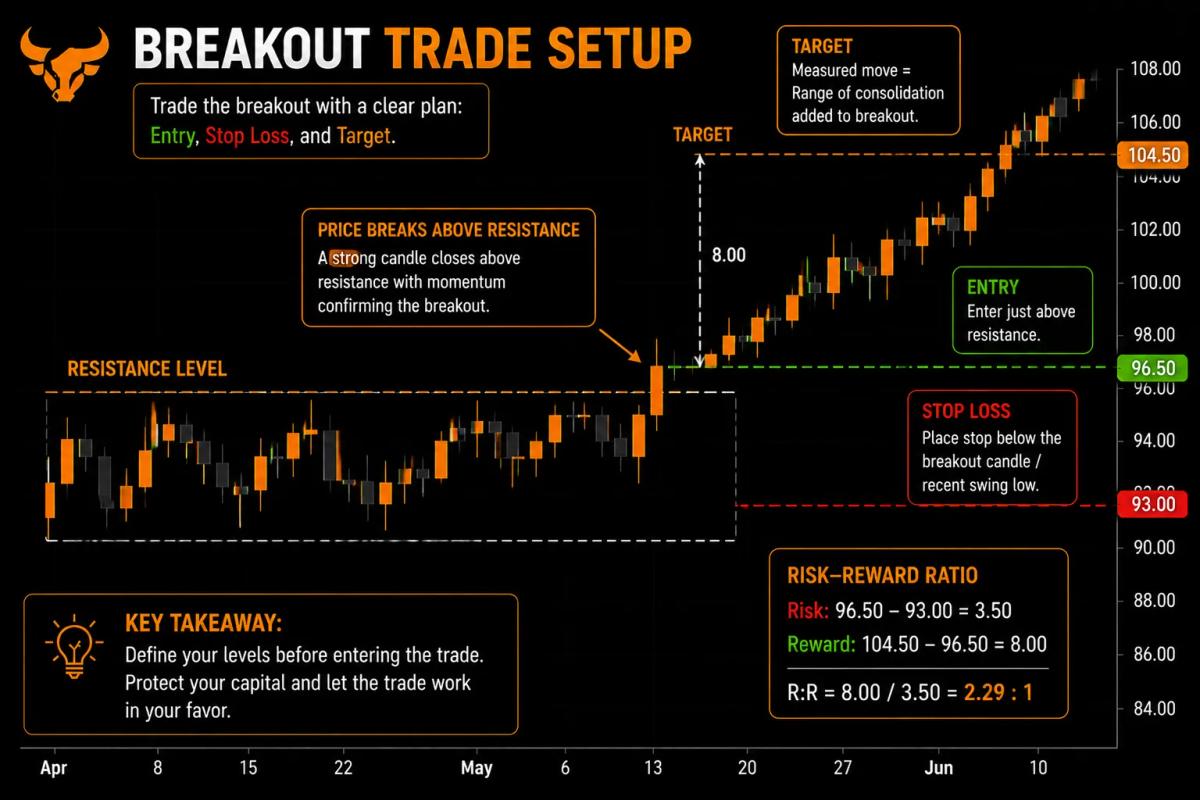
Entry Timing Options (Aggressive vs Confirmed)
An aggressive entry means buying on the candle close beyond the level. You get the best price and capture the fullest part of the move, but you also carry the highest exposure to a fakeout.
A confirmed entry means waiting for a successful retest. Your risk is lower and the point of invalidation is clearer, though you will occasionally miss breakouts that never come back to retest.
Stop Placement
Place your stop where the breakout is proven wrong. Managing risk on each trade means anchoring your stop to structure and respecting it. The market does not care about your discomfort, only about whether the level still holds.
Setting a Realistic Target
Anchor your target to structure rather than to a number you would like to hit. Check your risk-to-reward before you commit.
Range Breakouts in Forex
Forex spends enormous stretches of time going nowhere, and that is precisely what makes range breakouts so relevant to currency traders. A pair can drift sideways for hours during a quiet session, then resolve sharply when a major session opens and real volume arrives.
Common Mistakes That Turn Breakout Trading Into Guesswork
- Chasing the break instead of waiting for confirmation
- Ignoring volume and candle closes
- Trading weak or barely tested levels
- Moving the stop once the trade goes against you
- Overtrading low-quality setups
- Skipping the risk-to-reward check entirely
Trading carries a real risk of loss. Use these concepts to inform your own decisions, manage your position sizes carefully, and never risk capital you cannot afford to lose.
Frequently Asked Questions
What is the most reliable way to confirm a breakout?
Combining a candle close beyond the level with a clear rise in volume and a successful retest gives you the strongest case. No single signal is enough on its own.
How do I know if a breakout is real or a fakeout?
A real breakout shows expanding volume, a decisive close, and follow-through. A fakeout shows flat volume, a long rejection wick, and an almost immediate reversal.
Should I enter on the breakout or wait for a retest?
Waiting for a retest generally lowers your risk and gives you a clearer point of invalidation. You trade a slightly worse entry price for a cleaner read on the move.
Where should I place my stop?
Just beyond the broken level, or beyond the retest swing if you entered on the retest.
Do breakout strategies work in forex?
Yes, particularly range breakouts that form during quiet sessions and resolve when a major session opens.
About the authors


Put this into practice
Related articles

Algorithmic Trading Guide: Strategies, Software & How to Get Started
Learn in this algorithmic trading guide how it works, explore strategies, compare platforms, and follow a step-by-step framework to build your first algorithm.

Arbitrage Trading Guide: What It Is, How It Works, and Key Strategies
Arbitrage trading guide: Learn what it is, how it works, key strategies like crypto and merger arbitrage, and whether retail traders can realistically profit.

Best Time to Trade Forex: Optimal Hours by Strategy
Match your strategy to the right forex session: when scalpers, swing traders, and position traders each find their edge across the 24-hour cycle.
0 comments