



How to Trade · Beginner · 10 min read
How to Become a Trader: A Practical Roadmap for Retail Traders
The core path: what becoming a trader actually means
Becoming a trader means learning to buy and sell financial assets with a written plan, strict risk rules, and the discipline to follow them when money is on the line. Most retail traders start part-time on a demo account (simulated, funded with virtual money), then move to small real-money positions once they can execute without emotion.
The path is less glamorous than social media sells it. You are opening a retail brokerage account, funding it yourself, and owning every trade outcome. A retail trader is an individual trading personal funds through a broker; an institutional trader is an employee managing client or firm capital. For most readers, retail is the only realistic path, and it is a skill-building project measured in years.
Putting this into practice means opening an account: start with the best forex brokers our team reviewed.
Assess whether you're ready: the honest self-check
You are ready to become a trader when you have capital you can afford to lose, a realistic view of how long skill-building takes, and the temperament to stick to a plan through losing streaks. Most retail traders underestimate both the time and the emotional cost, and the regulator has data on the outcome.
According to the FCA, most retail investor accounts lose money when trading CFDs, a warning UK-authorised brokers are required to display on their websites. A CFD (contract for difference) is a leveraged product where you speculate on price movement without owning the underlying asset. That warning is not marketing copy; it is a supervisory finding.
Before you open an account, work through four honest questions:
- Can you lose 100% of your trading capital without affecting your rent, bills, or family security
- Can you commit at least 8 to 12 hours a week for the first 6 months to study and practice
- Can you follow a written rule when your instinct screams the opposite
- Do you have a stable income from another source while you learn
If you answer no to any of these, delay opening a live account. Trading rewards patience and punishes urgency. The people who succeed usually treat their first year as tuition, not income.
What you need before you start trading
You need six things before your first real trade: a regulated broker, a trading platform, a funded account that meets the minimum deposit, a written risk framework, a demo account to practice on, and a clear grasp of your jurisdiction's rules on leverage and tax.
For UK residents, choose a broker authorised by the Financial Conduct Authority (FCA). You can verify authorisation on the FCA Register. Offshore entities of the same group brand (Cayman, Seychelles, Vanuatu) do not carry the same client protections, so the onboarding entity matters as much as the brand name.
| Requirement | What it means | Typical starting point |
|---|---|---|
| Regulated broker | FCA-authorised UK entity, checked on the FCA Register | Gold tier: FCA-authorised |
| Platform | MT4, MT5, cTrader, or the broker's proprietary web app | MT4 or MT5 for forex; TradingView for charting |
| Minimum deposit | The smallest balance the broker accepts to open a live account | $100 to $500 for most retail brokers |
| Risk framework | Written rules for position size, stop loss, and daily loss limit | 1% to 2% risk per trade |
| Demo account | Simulated account with virtual funds | 4 to 8 weeks minimum |
| Tax awareness | Understanding HMRC's treatment of your trading | Records from trade one |
A stop loss is a pre-set order that closes your position at a defined loss to cap the damage. Position size is the amount of the asset you buy or sell, calculated so that hitting your stop loss costs only a fixed percentage of your account.
Core skills and behaviours that separate traders from speculators
Traders develop three technical skills: reading price action and charts, sizing positions to match their risk tolerance, and executing trades without second-guessing. The single behaviour that matters most is discipline: following your plan when you are losing, and stopping when you are winning.
Developing these trading skills is what separates consistent traders from those who burn out or lose capital quickly.
Price action is the study of how price moves on the chart, using candles, support and resistance zones, and trend structure to make decisions. Position sizing is the calculation that ties each trade back to your account risk rule: if your account is $2,000 and you risk 1% per trade, your maximum loss on any single trade is $20, and the distance from entry to stop loss determines the lot size.
Beyond the mechanics, three behaviours decide who survives:
- Journal every trade. Record entry, exit, size, reason, and emotion. Review weekly.
- Accept losses as a cost of business. A losing trade that followed the plan is a good trade.
- Stop trading on tilt. Set a daily loss limit (typically 3% of the account) and log off when you hit it.
Psychological resilience is not optional. A drawdown (the fall from a capital peak to the trough before a new peak) of 10% to 20% is normal even for competent traders. If losing that much would push you into panic-selling or revenge trading, your position sizes are too large or your capital base is too small.
The FCA's warning that most retail CFD accounts lose money is, at its root, a psychology story: strategy failure is rarer than emotional failure.
The step-by-step progression from beginner to active trader
Start by learning market structure and basic chart reading on free educational material published by regulators and exchanges. Open a demo account with an FCA-authorised broker you can compare and paper-trade for at least 4 to 8 weeks.
Once you are consistently profitable on demo, deposit a small amount of real capital, trade micro-lots (the smallest position size, typically 0.01 of a standard lot), and track every trade in a journal. Only increase position size after 3 months of real-money profitability.
A practical progression looks like this:
| Phase | Duration | Focus | Capital at risk |
|---|---|---|---|
| 1. Foundations | 4 to 8 weeks | Market structure, order types, one platform | $0 (study only) |
| 2. Demo trading | 8 to 12 weeks | Execute a written strategy on a demo account | $0 (virtual) |
| 3. Micro live | 3 to 6 months | Real money, smallest possible size | $100 to $500 |
| 4. Scaling up | 6 to 12 months | Gradual size increases after proven consistency | Only increase after a 3-month profitable track record |
| 5. Active trader | 12+ months | Full plan, journaling, regular review | Sized to your risk framework |
Do not skip phases. The temptation to fund a live account in week 2 is the single most expensive mistake in retail trading. A demo account gives you the same charts, spreads (the gap between the bid and the ask price), and execution behaviour as live, minus the emotional load. Prove you can execute mechanically before you attach money to the outcome.
During live phases, keep a written trading plan on your desk: instruments you trade, session hours, entry rules, exit rules, position size formula, and daily loss limit. If a trade does not fit the plan, you do not take it.
If day trading isn't your fit: alternative paths
If you lack the time or temperament for day trading, swing trading (holding positions for days or weeks based on medium-term trends) or position trading (holding for weeks to months) may suit you better. Both require far less screen time and less emotional stamina than intraday trading, though they demand patience through longer drawdowns.
Alternatively, index investing through low-cost ETFs (exchange-traded funds that track a market index) or a workplace pension removes the need for active trading altogether. Not everyone should trade. If your goal is long-term wealth rather than the craft of trading itself, buying and holding a diversified index fund has a stronger evidence base and a lower failure rate than active retail trading, as the FCA's repeated warnings on CFD outcomes make clear.
Regulatory and tax reality: what you must know
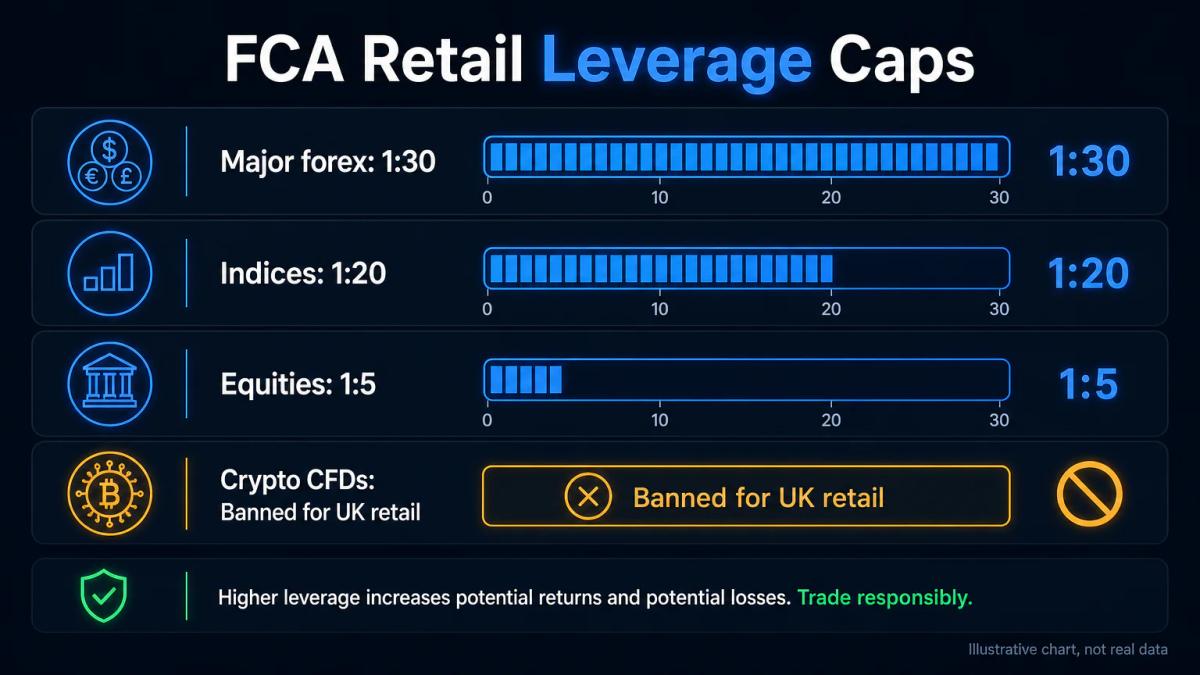
In the UK, retail traders face leverage caps set by the FCA under rules aligned with the earlier ESMA framework. Leverage lets you control a position larger than your deposit; the cap is the maximum ratio allowed.
| Asset class | FCA retail leverage cap |
|---|---|
| Major forex pairs (EUR/USD, GBP/USD, USD/JPY) | 1:30 |
| Non-major forex, gold, major indices | 1:20 |
| Other commodities, non-major indices | 1:10 |
| Individual equities | 1:5 |
| Cryptoassets (CFDs) | Prohibited for UK retail clients |
The FCA banned the sale of crypto derivatives and CFDs on cryptoassets to UK retail consumers with effect from January 2021.
Tax rules also apply from your first trade. HMRC treats most retail trading profits under Capital Gains Tax or, depending on activity, as income. Spread betting on financial markets is currently exempt from Capital Gains Tax and Stamp Duty for UK residents, but CFD profits are not. Keep dated records of every trade, deposit, withdrawal, and fee: HMRC can request them and the burden of proof sits with you. If you are unsure of your status, consult a UK-qualified tax adviser before your first live trade.
Common beginner mistakes and how to sidestep them
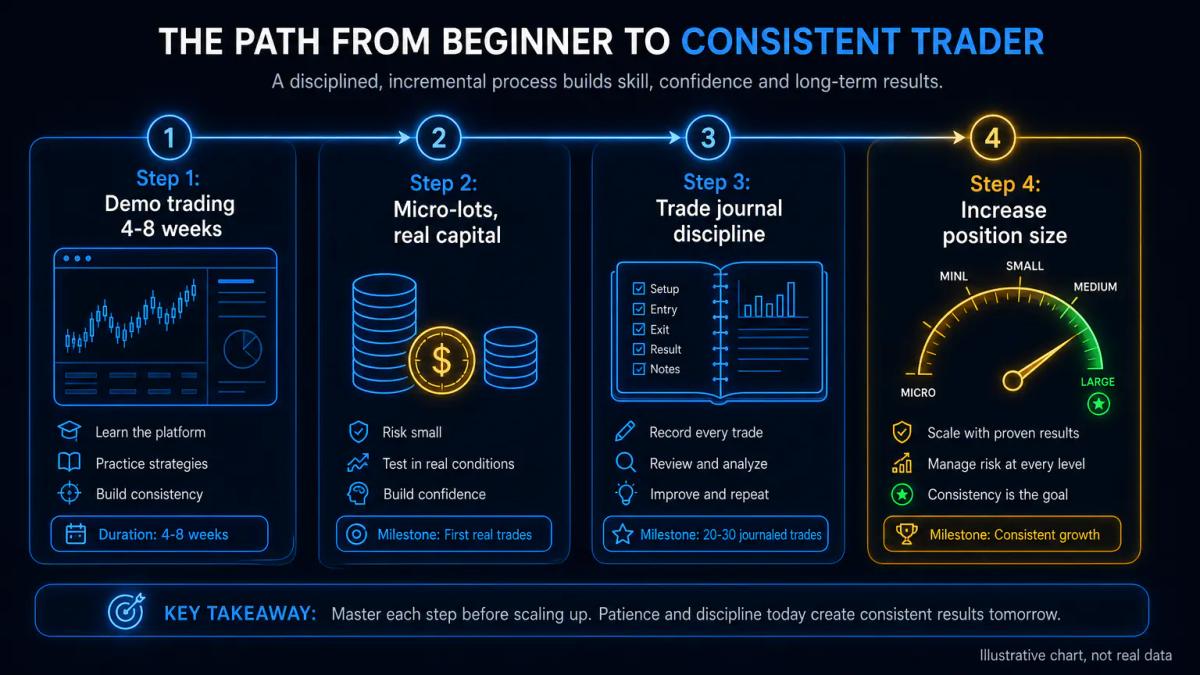
New traders skip the demo phase, over-leverage their account, trade without a plan, and chase losses. The fastest way to avoid these is to commit to 8 weeks of demo trading, set a maximum risk per trade of 1% to 2% of your account, and keep a trade journal from day one.
The five costliest mistakes and their fixes:
- Using maximum leverage. Fix: risk a fixed percentage per trade, not a fixed lot size.
- No stop loss. Fix: every order carries a stop loss set before entry.
- Revenge trading after a loss. Fix: a hard daily loss limit that closes the platform.
- No journal. Fix: log entry, exit, size, and reason for every trade the same day.
- Chasing signals from social media. Fix: one written strategy, tested on demo, no exceptions.
FCA: UK-authorised CFD brokers are required to display a warning that most retail investor accounts lose money when trading CFDs, and CFDs on cryptoassets are prohibited for UK retail clients.
HMRC: UK retail traders must keep records of trades, deposits, withdrawals, and fees, and report chargeable gains or trading income according to their tax status.
This content is general information and not advice: every situation needs checking with a licensed professional in the relevant jurisdiction.
Frequently Asked Questions
How long does it take to become a profitable trader?
For most retail traders, consistent profitability takes 12 to 36 months of dedicated study and practice, not weeks. The FCA has published warnings that most retail CFD accounts lose money, which reflects how long the learning curve actually is. Expect 4 to 8 weeks of foundational study, 8 to 12 weeks of demo trading, and 3 to 6 months of small live trades before you consider scaling up your position sizes.
Do I need a degree or formal qualification to become a trader?
No. Retail trading through a regulated broker has no formal qualification requirement in the UK. Institutional roles at banks and hedge funds do require degrees and often FCA-regulated qualifications such as the CFA or the CISI Investment Operations Certificate, but these apply to employees trading client money, not to individuals trading their own capital.
What is the minimum amount of money I need to start trading?
Most FCA-authorised retail brokers accept minimum deposits between $100 and $500. That is enough to open an account, but it is not enough to trade meaningfully while respecting a 1% per-trade risk rule. A more realistic starting balance for learning with real money is $1,000 to $2,000, funded only with money you can afford to lose in full.
Can I become a trader while working a full-time job?
Yes, but day trading rarely fits around a 9-to-5. Swing trading, holding positions for days or weeks, and position trading, holding for weeks or months, both suit people with full-time jobs because they require less screen time. You review charts before or after work and set orders that execute while you are away.
What is the difference between a trader and an investor?
A trader buys and sells frequently, often using leverage, aiming to profit from short-term price movements over minutes, days, or weeks. An investor buys assets to hold for years, aiming to profit from long-term growth, dividends, or interest. The tax treatment, capital requirements, and psychological demands are very different, and HMRC may classify the two activities differently.
About the authors


Put this into practice
Related articles

How to Buy ETFs: A Step-by-Step Guide for Retail Traders
A practical guide to buying ETFs: from opening a brokerage account and choosing the fund to placing your first order, managing fees, and rebalancing.

How to Day Trade for a Living: A Realistic Roadmap
A practical roadmap to day trading for a living: capital, rules, risk limits, broker selection, tax reporting and the daily routine that separates survival from a blown account.

How to Find Stocks to Day Trade: A Practical Screening Approach
A practical, beginner-friendly framework for screening day trading stocks by volume, volatility, chart patterns, sector strength, and broker tools.
0 comments