



How to Trade · Beginner · 10 min read
How to Buy ETFs: A Step-by-Step Guide for Retail Traders
The mechanics of buying an ETF
Buying an ETF means purchasing shares of a fund that tracks an index, commodity, or basket of assets through a brokerage account, exactly as you would buy individual stocks. You place an order during exchange hours, the shares settle in your account, and you own a diversified holding from the first trade. This simplicity is why ETFs have become the default entry point for retail traders learning how to buy ETFs.
An ETF (exchange-traded fund) is a pooled investment vehicle whose shares are listed on a stock exchange and change hands throughout the trading day. Unlike a mutual fund, which prices once per day after the close, an ETF quotes a live price. When you buy one share, you gain fractional exposure to every underlying holding: a single share of a global equity ETF can hold pieces of 1,500 companies. That instant diversification is the mechanical advantage that draws first-time buyers.
If you still need a broker, our guide to the best forex brokers compares the regulated options side by side.
Opening a brokerage account and funding it
Before you can buy an ETF, you need a brokerage account and cash to trade with. Most brokers let you open an account online in under thirty minutes by verifying your identity, tax residency, and a funding source. UK residents typically use a General Investment Account (GIA) or a Stocks and Shares ISA; EU residents open a securities account with a local or pan-European broker.
Under FCA rules, a UK broker must complete Know Your Customer (KYC) checks before your account goes live. You will upload a photo ID, a proof of address dated within three months, and answer an appropriateness questionnaire that gauges your experience. Once approved, you fund the account by bank transfer, debit card, or, at some brokers, an existing ISA transfer.
The table below shows account features you should compare when picking where to buy ETFs in the UK and EU.
| Feature | UK Stocks & Shares ISA | UK General Investment Account | EU Securities Account |
|---|---|---|---|
| Annual tax wrapper | £20,000 contribution limit | None | Varies by country |
| Capital gains treatment | Tax-free growth | Subject to CGT | National CGT rules |
| Dividend treatment | Tax-free | Subject to dividend tax | National withholding |
| Typical minimum deposit | £1 to £100 | £1 to £100 | €0 to €500 |
| Custody model | Nominee | Nominee | Nominee or direct |
Always confirm the entity onboarding you: an FCA-authorised UK entity gives you access to the Financial Services Compensation Scheme (FSCS) up to £85,000 per person per firm.
Choosing the right ETF for your goals
Selecting an ETF depends on your investment objective, risk tolerance, and time horizon. You need to understand what the fund tracks, its total expense ratio, its trading volume, and whether it fits the portfolio you already hold. This is the stage where most beginners rush, and it is the stage that matters most for how to invest $1,000 sensibly, as the same principles of diversification and goal-setting apply at any scale.
Start with the underlying index. A fund labelled "MSCI World" holds around 1,500 large and mid-cap stocks from 23 developed markets; an "S&P 500" ETF holds only US large caps; an "MSCI Emerging Markets" ETF concentrates in China, India, Taiwan, South Korea, and Brazil.
Each answer maps to a very different risk profile. According to the European Securities and Markets Authority (ESMA), UCITS ETFs must publish a Key Information Document (KID) that spells out risk, cost, and past performance in a standardised format: read it before you buy. Understanding the difference between passively managed index funds and active funds will help you choose the right replication approach for your needs.
Next, check the replication method. A physical ETF actually buys the underlying stocks; a synthetic ETF uses a swap contract with an investment bank to deliver the index return. Synthetic funds can be cheaper but add counterparty risk, the risk that the swap provider fails to pay.
Finally, check liquidity. Look at the average daily volume and the bid-ask spread, the gap between the highest price a buyer will pay and the lowest a seller will accept. A wide spread on a thinly traded ETF quietly costs you every time you trade.
For international and emerging market exposure, retail traders typically choose broad UCITS funds domiciled in Ireland or Luxembourg, which offer favourable tax treatment on US dividends thanks to a 15% withholding rate rather than 30%.
Placing your first ETF order

Once you have chosen an ETF and funded your account, you place an order through your broker's platform by entering the ETF ticker, the number of shares, and your order type. A market order executes immediately at the current best price; a limit order executes only if the price reaches the level you specify. For a beginner buying a liquid, large-cap ETF, either works; for a smaller or overseas-listed fund, a limit order protects you from paying too much.
Be deliberate about the trading window. ETFs typically show wider spreads in the first fifteen minutes after the open and the last few minutes before the close, when the underlying stocks are pricing in overnight news. Trading in the middle of the session gives you tighter execution.
| Order type | How it works | Best used for |
|---|---|---|
| Market | Fills instantly at the best available price | Liquid ETFs with narrow spreads |
| Limit | Fills only at your price or better | Thin ETFs, overseas listings, disciplined entries |
| Stop | Triggers a market order once a stop price is hit | Managing downside on a held position |
After you confirm, the trade executes and appears in your account as an open position, typically within seconds. Settlement, when legal ownership transfers, follows two business days later on a T+2 basis across UK and EU exchanges.
Understanding ETF fees and hidden costs

Every ETF charges a total expense ratio (TER), the annual percentage fee deducted from the fund's assets, and you also face trading commissions, bid-ask spreads, currency conversion, and tax that erode returns. Knowing these upfront is central to how to trade ETFs cost-effectively.
A TER of 0.20% on a £10,000 holding costs £20 per year, taken directly from the fund's net asset value: you never see the charge on a statement.
When comparing options, reviewing the best S&P 500 ETFs can show you how expense ratios vary across similar funds. Compare that to an actively managed fund at 1.50%, which costs £150 on the same balance. Over twenty years, that gap compounds into thousands of pounds.
Trading commissions vary by broker. Some UK brokers charge a flat £3 to £10 per trade; some EU brokers charge zero commission but widen the spread instead. Watch for FX conversion fees when buying a USD-denominated ETF from a GBP account: a typical retail conversion costs 0.25% to 1.50% each way.
FCA: UK-authorised firms must disclose all costs and charges, including one-off, ongoing, and transaction costs, so that a retail investor can understand the total impact on returns.
Tax adds a further layer. In the UK, ETFs held in a General Investment Account trigger capital gains tax on disposal above the annual exempt amount and dividend tax on distributions, while ETFs inside a Stocks and Shares ISA grow tax-free.
HMRC treats non-UK-domiciled ETFs without "reporting status" as offshore income funds, taxed at your marginal income rate rather than at capital gains rates: always check the reporting-status list before buying a foreign-domiciled fund. In most EU jurisdictions, capital gains and dividends on ETFs are taxed under national rules; some countries, such as Germany, apply a partial exemption for equity ETFs.
Investing versus trading ETFs: which path for you
Investing in ETFs means buying and holding for years to capture long-term growth and dividends; trading ETFs means buying and selling frequently to profit from short-term price moves. Understanding the types of traders and their strategies will help you decide which approach suits your goals and lifestyle. The choice changes your tax treatment, your strategy, and the platforms and tools you need.
A buy-and-hold investor pays the TER, occasional rebalancing commissions, and capital gains tax only when selling. The compounding maths favours patience: reinvested dividends and a low expense ratio do most of the work.
A trader treats ETFs as tactical instruments, using sector, country, or leveraged ETFs to express short-term views. This path multiplies costs: every round trip incurs a spread, a commission, and a taxable event. Leveraged and inverse ETFs reset daily and can decay in value if held for more than a few days, even when the underlying index moves as expected.
| Dimension | Investing | Trading |
|---|---|---|
| Holding period | Years to decades | Minutes to weeks |
| Primary cost | TER | Spreads, commissions, taxes |
| Platform need | Basic brokerage or ISA | Advanced platform with charting |
| Tax profile | CGT on disposal, ISA-shelterable | Frequent taxable events |
| Typical instrument | Broad index ETFs | Sector, country, leveraged, inverse ETFs |
For UK retail clients, note that FCA leverage caps do not apply to owning ETF shares outright, but they do cap leverage on any CFDs written on ETFs at 1:5 for equity-style exposure.
Common beginner mistakes when buying ETFs
New ETF buyers chase past performance, ignore expense ratios, trade too frequently, or fail to diversify across asset classes and geographies. Each mistake has a clear fix, and spotting them early saves real money.
Chasing performance means buying whichever ETF topped the leaderboard last year. The fund that led in one cycle rarely leads in the next; a single-country or single-sector ETF can drop 40% in a bad year while a broader global index falls 15%. Ignoring the TER compounds the damage: a 0.75% fund and a 0.15% fund tracking the same index deliver noticeably different results over ten years.
Over-trading turns a low-cost vehicle into an expensive one. Knowing how many trades per day you should make helps you stay disciplined: every round trip pays a spread and a commission, and, outside an ISA or equivalent wrapper, generates a taxable disposal. Finally, holding five ETFs that all track the S&P 500 is not diversification: it is concentration in disguise. Check the underlying holdings, not just the fund names.
Monitoring and rebalancing your ETF holdings
After you buy ETFs, review your holdings on a set schedule, typically every six or twelve months, to ensure they still match your target allocation and risk profile. Rebalancing, the process of selling overweight positions and buying underweight ones, keeps the portfolio disciplined and prevents drift.
If your target is 70% global equities and 30% bonds, a strong equity year can push the mix to 80/20 without you doing anything. Rebalancing sells the excess equities and buys bonds to restore 70/30, mechanically enforcing "sell high, buy low". Inside an ISA, rebalancing is tax-free; in a taxable account, use new contributions to top up the underweight sleeve first to defer disposals.
This content is general information and not advice: every situation needs checking with a licensed professional in the relevant jurisdiction.
Frequently Asked Questions
What is the difference between buying an ETF and buying individual stocks?
Both trade on an exchange and settle the same way, but a single ETF share gives you fractional ownership of every underlying holding in the fund. A share of a global equity ETF may expose you to 1,500 companies; a share of a single stock exposes you to one. ETFs charge an expense ratio; individual stocks do not.
Can I buy ETFs with a small amount of money, like £100?
Yes. Most UK and EU brokers accept minimum deposits from £1 to £100 and let you buy a single ETF share or, at some brokers, a fractional share. Watch dealing commissions carefully: a £5 commission on a £100 trade is a 5% upfront cost that a broker offering commission-free ETF trades would avoid.
How long does it take for an ETF purchase to settle in my account?
Execution is near instant during market hours. Legal settlement follows on a T+2 basis, meaning ownership transfers two business days after the trade date. You can still see the position in your account immediately and, at most brokers, sell it before settlement completes.
What are the tax implications of buying and selling ETFs?
In a UK Stocks and Shares ISA, gains and dividends are tax-free. In a General Investment Account, gains above the annual CGT exemption are taxable and distributions attract dividend tax. Foreign-domiciled ETFs without HMRC reporting status are taxed as offshore income at your marginal income tax rate, which is usually harsher than CGT.
Which platforms offer the lowest fees for buying ETFs in the UK?
Costs split into platform fees, dealing commissions, and FX conversion. Some FCA-authorised brokers charge zero commission on ETF trades but recover costs through spreads or FX markups; others charge £3 to £10 per trade but offer tighter execution. Compare the total cost of a realistic trade, not any single fee line, and confirm FSCS protection covers your holdings.
About the authors


Put this into practice
Brokers we have reviewed
Scored on the same five dimensions. Here are three of them — the full list is on the brokers page.

Related articles

How to Choose a VPS for Trading: Latency, Specs, and Setup
A working guide to picking a trading VPS: specs, latency to broker servers, uptime SLAs, cost structure, security, and platform setup.

How to Day Trade for a Living: A Realistic Roadmap
A practical roadmap to day trading for a living: capital, rules, risk limits, broker selection, tax reporting and the daily routine that separates survival from a blown account.
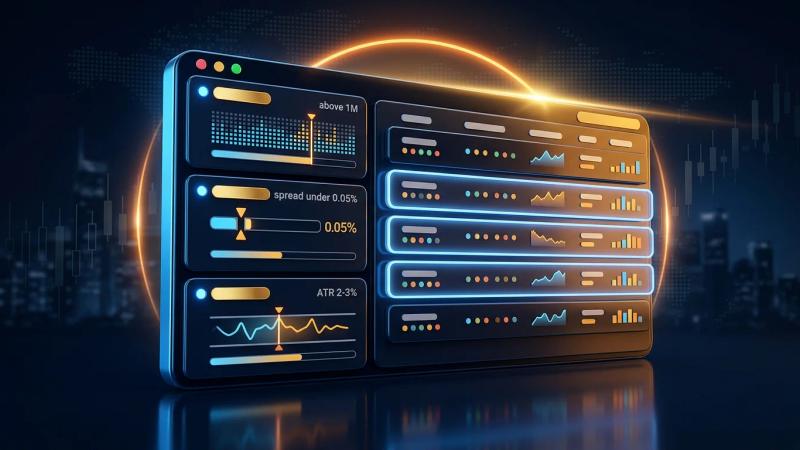
How to Find Stocks to Day Trade: A Practical Screening Approach
A practical, beginner-friendly framework for screening day trading stocks by volume, volatility, chart patterns, sector strength, and broker tools.
0 comments