



The core strategy: spreading $1,000 across asset types
Investing $1,000 means dividing it among different asset classes (stocks, bonds and cash equivalents) rather than putting it all in one place.
Diversification, owning uncorrelated assets so one loss does not sink the whole portfolio, reduces the chance that a single bad pick wipes out your capital. A typical beginner split is 60% equities, 30% fixed income, 10% cash, adjusted for your risk tolerance and time horizon.
The $1,000 figure matters less than the habit. A single stock picked well can outperform, but you have no way to know in advance which one.
Spreading the money across a broad equity fund, a bond fund and a cash buffer accepts the average market return in exchange for a much smaller chance of catastrophic loss.
That trade-off is the entire logic of a diversified portfolio and passive income strategy, and it matters more on small capital than large, because you have less room to recover from a mistake.
This article works through the questions you should answer first, the roles that bonds and equities play, three concrete portfolio models, how to actually buy the funds, whether to invest the money at once or in tranches, what the fees will cost you, and the behavioural traps that quietly erode small portfolios.
Before you invest: four questions to answer first
Before deploying $1,000, answer four questions honestly.
- First, what is the goal: an emergency fund, retirement in thirty years, or a house deposit in three.
- Second, what is your time horizon: money you need in under two years should not sit in equities, because a bad year can leave you selling at a loss.
- Third, what is your risk tolerance: how much of a paper decline you can watch without selling.
- Fourth, do you already have an emergency fund separate from this $1,000.
That last question is the one most first-time investors skip. If a car repair or a lost month of income would force you to sell your portfolio at the worst possible time, the $1,000 is not really invested: it is a buffer wearing a costume.
A common rule of thumb is three to six months of essential expenses in an easily accessible savings account before any long-term investment starts. If you do not have that, the highest-return use of your first $1,000 is often the savings account, not the market.
The account you invest through matters too.
- In the UK, a Stocks and Shares ISA (Individual Savings Account) shelters gains and dividends from tax up to an annual allowance; a SIPP (Self-Invested Personal Pension) adds tax relief on contributions but locks the money until pension age.
- In the US, a Roth IRA plays a similar sheltering role. A standard taxable brokerage account is more flexible but leaves gains exposed. For a $1,000 long-term investment, the tax-sheltered wrapper is usually the right default.
Fixed income vs. equities: what each does in a $1,000 portfolio
Fixed income and equities do different jobs, and a portfolio needs both.
Fixed income means bonds (loans to governments or companies that pay interest), bond funds (a basket of many bonds), and cash-like instruments such as money market funds. It provides stability and predictable income, but lower long-run growth.
Equities means stocks (part-ownership of companies), stock funds and ETFs (exchange-traded funds, which are baskets of stocks that trade like a single share). They offer higher long-term growth in exchange for sharper short-term drops.
According to the Bank of England's Millennium of Macroeconomic Data, UK equity total returns have exceeded government bond returns over most long holding periods since 1900, at the cost of larger interim drawdowns, a drawdown being the fall from a portfolio peak to its next trough. That is the fundamental risk premium: you accept the volatility of equities and, on average and over long periods, you are compensated for it.
For $1,000, the split depends on when you need the money and how you react to losses.
- A conservative investor, or one with a horizon under five years, might weight bonds and cash 50 to 60% and equities 40 to 50%.
- An aggressive investor with a twenty-year horizon might reverse that, holding 80% or more in equities.
There is no universally correct answer, only one that fits your goal and your tolerance. The mistake to avoid is a mismatch: aggressive allocations with a two-year horizon, or bond-heavy allocations for a thirty-year retirement account.
Bank of England, Millennium of Macroeconomic Data: Long-run UK equity total returns have exceeded government bond returns over most multi-decade holding periods since 1900, with larger interim drawdowns.
Three portfolio models for different risk profiles
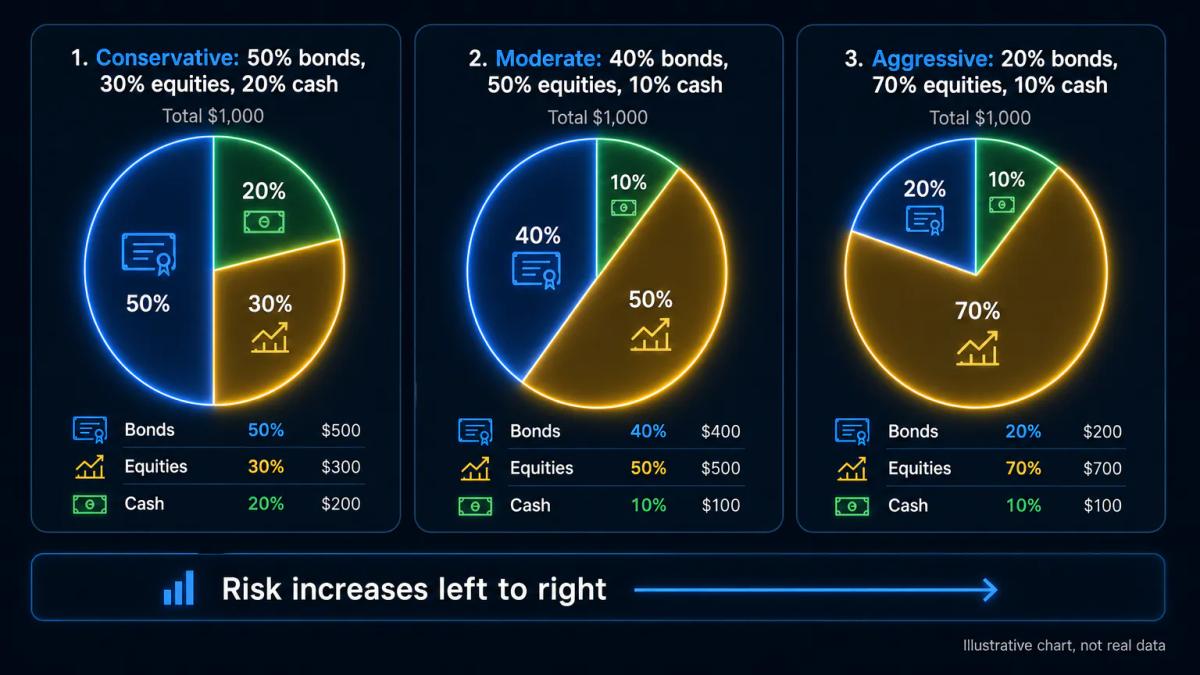
Three concrete models cover most beginners.
Understanding the differences between day trading, swing trading and scalping helps you see how risk profiles map to holding periods.
- A conservative $1,000 portfolio prioritises capital preservation: 50% in a broad bond fund, 30% in a diversified equity ETF (often a dividend-focused or global equity fund), 20% in cash or a money market fund.
- A moderate portfolio balances growth and stability: 60% equities, 30% fixed income, 10% cash.
- An aggressive portfolio targets long-run growth: 80% equities, 15% bonds, 5% cash.
| Model | Equities | Fixed income | Cash | Suited to |
|---|---|---|---|---|
| Conservative | 30% ($300) | 50% ($500) | 20% ($200) | Short horizon (under 5 years) or low tolerance for losses |
| Moderate | 60% ($600) | 30% ($300) | 10% ($100) | Medium horizon (5-15 years), average tolerance |
| Aggressive | 80% ($800) | 15% ($150) | 5% ($50) | Long horizon (15+ years), high tolerance |
Inside each slice, favour breadth over cleverness. The equity portion is usually a single global equity ETF or an S&P 500 tracker plus a broad international fund; the bond portion is a total bond market fund or a short-duration government bond fund.
This is where the $1,000 investor gains the most: five well-chosen funds cover thousands of underlying securities. Trying to hand-pick individual stocks on this capital simply concentrates risk without any offsetting information advantage, which is why stock selection criteria matter less for beginners than fund selection does.
Alternatives such as REITs (real estate investment trusts, listed funds that hold property), commodities or peer-to-peer lending can play a small diversifying role, but they are not the base of a first portfolio. A 5 to 10% REIT slice inside the equity portion is defensible; peer-to-peer lending, with its credit risk and illiquidity, is not a natural fit for a $1,000 starter and is best deferred until the core portfolio is in place.
Practical deployment: index funds, ETFs, and fractional shares
With $1,000, three vehicles do most of the work: index mutual funds, ETFs and fractional shares. All three let you own a diversified basket without needing to pick individual stocks, and all three are compatible with modern low-cost brokerages that have no minimum account size.
| Vehicle | What it is | Typical minimum | Fee range | Best use for $1,000 |
|---|---|---|---|---|
| Index mutual fund | A fund that tracks an index (e.g. FTSE All-Share), priced once per day | Often $0-$100 at major brokers | 0.03-0.20% annual | Core equity or bond holding in a tax-sheltered account |
| ETF | An index-tracking fund that trades like a stock throughout the day | Price of one share, or one fractional share | 0.03-0.25% annual | Flexible core holding; easy to buy in small amounts |
| Fractional share | A slice of a single ETF or stock, bought by dollar amount | $1-$5 at most brokers | Same underlying fund fee | Deploying exact percentages of a $1,000 split |
Fractional shares are the practical unlock. Before they existed, a $300 allocation to an ETF trading at $450 per share was impossible without leftover cash. Now you buy $300 of that ETF and own two-thirds of a share. That lets you hit your target allocation to the dollar, which matters when the whole portfolio is $1,000.
Confirm before opening the account that the broker offers fractional shares in the ETFs you plan to hold, because coverage varies.
Dollar-cost averaging: spreading your $1,000 over time
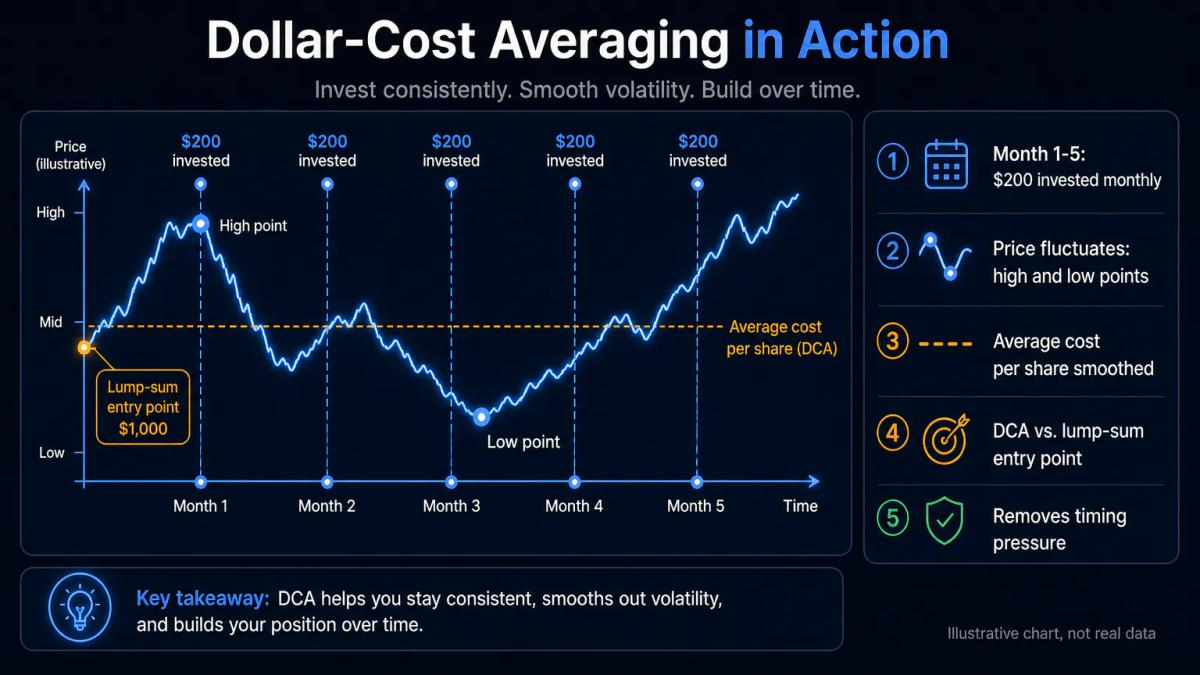
Instead of investing all $1,000 at once, dollar-cost averaging (DCA) means investing a fixed amount at regular intervals: for example $200 on the first of each month for five months.
When prices are high, your fixed sum buys fewer shares; when prices are low, it buys more. Over the period, your average purchase price is smoothed, and you remove the pressure of trying to pick a market bottom.
The evidence on lump-sum versus DCA is not one-sided. Historically, lump-sum investing has outperformed DCA more often than not, because markets rise more years than they fall and time in the market compounds. DCA's real value is behavioural: it makes it easier to actually start, and much easier to keep going after a bad month.
For a first-time investor who has never watched a portfolio drop, that reliability is often worth the small expected-return cost.
Fees and costs: why they matter on a small investment
Fees compound just like returns, in the wrong direction.
A 1% annual fee on $1,000 is only $10 in year one, but over thirty years at a 7% gross return, that 1% cuts the ending balance by roughly a quarter compared with a 0.1% fund.On a $1,000 stake, the difference between a 0.05% index fund and a 0.75% actively managed fund is not trivial: it is the biggest single decision most beginners get to make.
Trading commissions, foreign-exchange fees on non-domestic ETFs, account fees and platform fees all sit alongside the fund's own charge. A commission-free broker that charges 1% for currency conversion on every USD purchase can be more expensive than a broker with a flat $1 trade fee.
On $1,000, keep total annual costs under about 0.30% of the portfolio and avoid any product that clips a percentage of assets for advice you are not using. The MonkeyTrade broker comparison tool can help you evaluate total costs across platforms.
Common mistakes to avoid when investing your first $1,000
Retail investors make the same handful of mistakes, and they are behavioural before they are analytical.
Chasing recent winners is the most common: buying the fund or stock that just doubled, which usually means buying near a peak. Panic-selling in a downturn is its mirror: locking in losses after a fall the portfolio was designed to absorb.
Both are driven by recency bias, weighting the last few weeks as if they predicted the next decade, and loss aversion, feeling a loss roughly twice as sharply as an equivalent gain.
Automate contributions so the decision is made once. Set a written allocation and rebalance on a fixed schedule, once or twice a year, rather than reacting to headlines.
Small portfolios do not need frequent rebalancing: rebalancing more than annually mostly generates trading costs and, in a taxable account, taxable events.
Analysis paralysis in trading is another common trap: ignore individual-stock picks from social media, avoid leveraged products, and resist the urge to check the balance daily, because most of what you see on a daily chart is noise the strategy is meant to ride through.
Frequently Asked Questions
Should I invest $1,000 all at once or spread it over time?
Historically, lump-sum investing has beaten dollar-cost averaging more often than not, because markets rise more years than they fall. The real case for spreading $1,000 over three to six months is behavioural: it reduces the sting of buying just before a drop and makes it easier to stay invested. For a first-time investor with no prior experience of watching a portfolio decline, the smaller expected-return cost of dollar-cost averaging is usually worth paying.
What is the best investment for $1,000 for a beginner with no stock market experience?
A low-cost, broadly diversified index fund or ETF held inside a tax-sheltered account is the standard starting point. A single global equity ETF plus a broad bond fund covers thousands of securities across many countries and sectors, with annual fees typically between 0.05% and 0.20%. Avoid individual stock picks, leveraged products and any fund charging more than about 0.30% a year on this size of capital.
How much can $1,000 grow over 10 or 20 years if invested in index funds?
Growth depends on the return you actually earn, which nobody can promise. As a mechanical illustration, $1,000 compounding at 5% a year becomes about $1,629 in 10 years and $2,653 in 20 years; at 7%, it becomes about $1,967 in 10 years and $3,870 in 20 years. Actual outcomes vary widely with market conditions, fees and taxes, and past returns are not a guarantee of future ones.
Do I need a separate brokerage account or can I use my bank to invest $1,000?
Most retail banks offer some investment product, but the range of funds is often narrower and the fees higher than at a dedicated online broker. For $1,000, a low-cost brokerage that supports fractional shares, offers a tax-sheltered wrapper (ISA or SIPP in the UK, IRA in the US) and charges no or minimal account fees will usually keep more of your return in the portfolio.
What fees should I expect when investing $1,000, and how do they affect returns?
Watch four fee layers: the fund's annual charge (0.03-0.75% depending on the fund), trading commissions, currency-conversion fees on foreign-listed ETFs, and any platform or account fee. A 1% total annual cost on $1,000 is $10 in year one, but compounded over 30 years at a 7% gross return, that 1% can reduce the ending balance by roughly a quarter compared with a 0.1% low-cost fund.
About the authors


Put this into practice
Brokers we have reviewed
Scored on the same five dimensions. Here are three of them — the full list is on the brokers page.


Related articles
How to Invest in Bonds: A Practical Guide for Retail Investors
A practical guide to investing in bonds: understand types, ratings, interest rate risk, laddering, tax efficiency, and how to compare bond funds with direct purchases.
Passive Income for Beginners: A Realistic Guide to Your First Stream
Passive income for beginners explained: startup costs, timelines, tax rules by jurisdiction, risk assessment and the automation tools that keep streams running.

Popular American ETFs and Their European Equivalents
Can't buy SPY or QQQ in Europe? Find the closest UCITS ETF for each major US fund, with costs, tickers, and key differences explained.
0 comments