



Financial Markets · Beginner · 6 min read
Best S&P 500 ETFs: US and European options compared
What makes an S&P 500 ETF worth buying
The best S&P 500 ETFs track the 500 largest US companies with low fees, high liquidity, and minimal tracking error.
An ETF (a fund whose shares trade on an exchange like a stock) gives you instant diversification across sectors with a single holding, and the cheapest options charge under 0.05% annually. That combination, broad exposure plus rock-bottom cost, is what separates a keeper from a mediocre fund.
The expense ratio (the annual fee the fund deducts from your returns) tells you the ongoing cost. Assets under management signal scale. Average daily volume shows how easily you can buy and sell. Tracking difference (the gap between the fund's return and the index it copies) reveals how faithfully the manager does the job.
Understanding the S&P 500 index
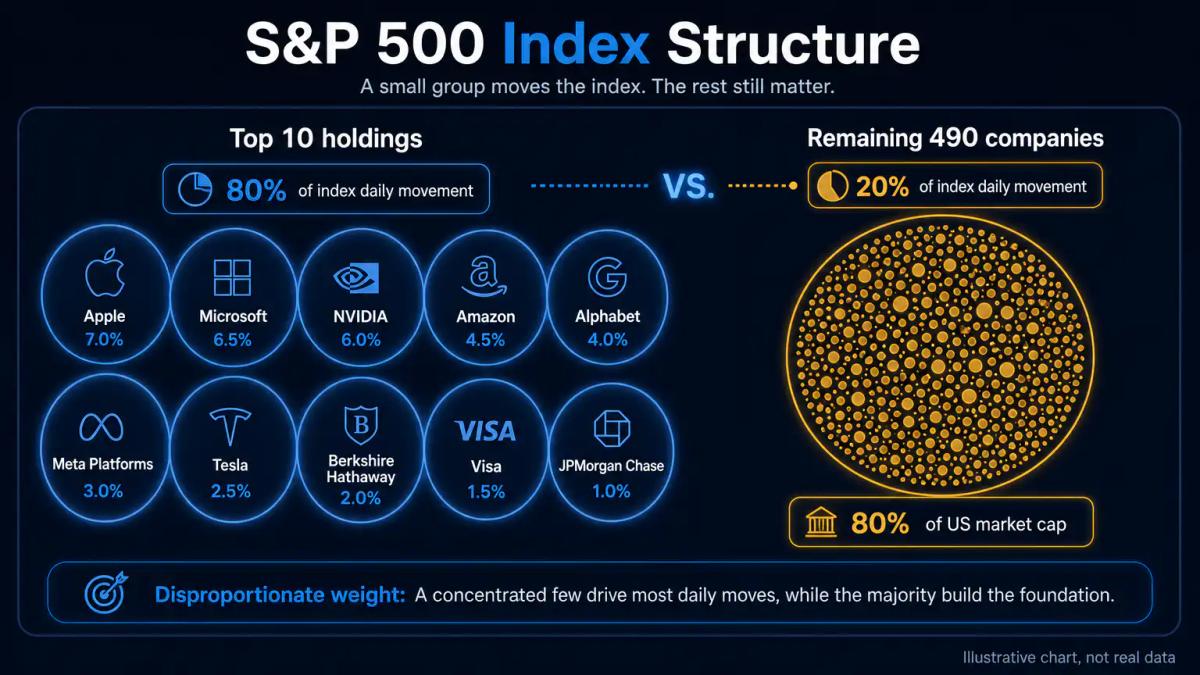
The S&P 500 is a market-cap-weighted index of 500 large-cap US companies maintained by S&P Dow Jones Indices. Market-cap weighting means bigger companies get bigger slots: the top 10 holdings typically drive a disproportionate share of the index's daily move.
According to S&P Dow Jones Indices, the S&P 500 covers approximately 80% of available US equity market capitalisation, which is why it functions as the default benchmark for US stocks.
The index is rebalanced quarterly and includes a committee-driven review, not a purely mechanical rule.
US-listed versus European-listed S&P 500 ETFs
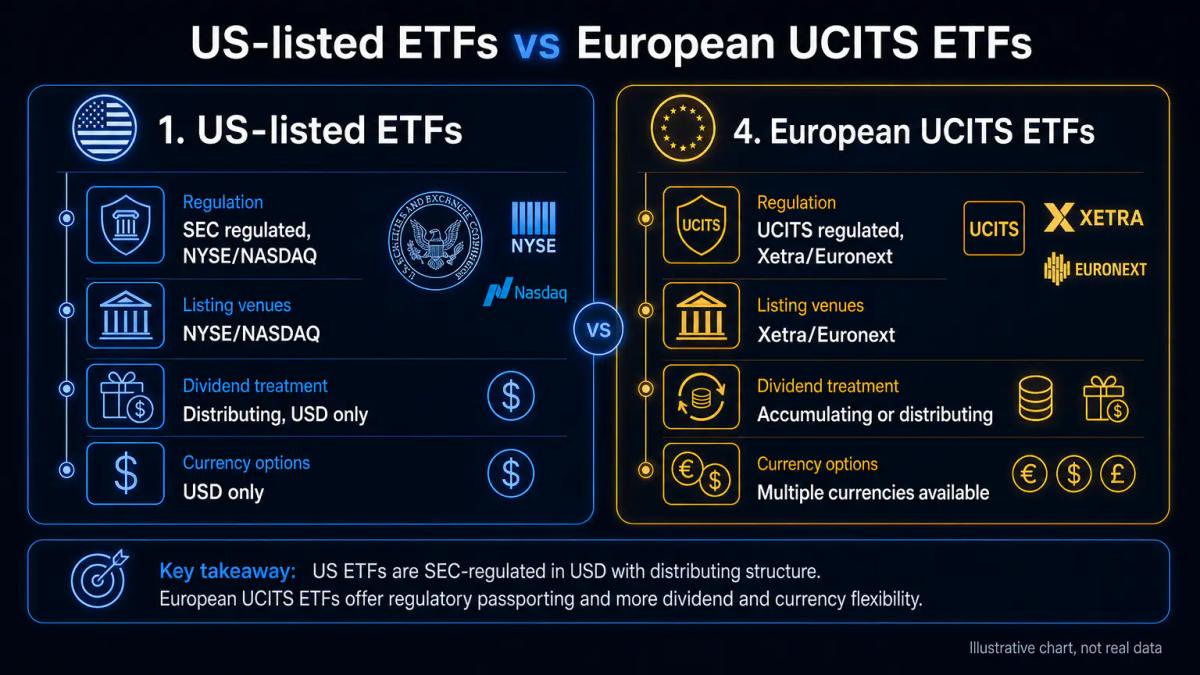
US-listed S&P 500 ETFs trade on NYSE Arca or NASDAQ and are regulated by the Securities and Exchange Commission (SEC).
European-listed versions trade on Xetra, Euronext, or the London Stock Exchange and comply with UCITS, the EU regulatory framework for retail-friendly funds, with most domiciled in Ireland or Luxembourg.
The practical differences go beyond geography.
- US funds are usually distributing (they pay dividends into your account) and priced only in US dollars.
- UCITS versions frequently offer accumulating share classes (dividends are reinvested inside the fund automatically) and multiple currencies, including GBP-denominated and EUR-denominated lines.
Access matters too. UK retail clients generally cannot buy US-listed ETFs on execution-only platforms because those funds do not publish a Key Information Document (KID) under UK/EU PRIIPs rules. According to the Financial Conduct Authority (FCA), firms selling packaged retail products to UK retail investors must provide a compliant KID.
In practice, that pushes most UK and EU retail traders toward UCITS versions by default, which is why understanding how a taxable brokerage account works and its regulatory constraints is essential for non-US investors.
Top S&P 500 ETFs available in the United States
Three funds dominate US listings by size and liquidity.
| Ticker | Fund name | Expense ratio | Distribution | Replication |
|---|---|---|---|---|
| VOO | Vanguard S&P 500 ETF | 0.03% | Distributing | Full |
| IVV | iShares Core S&P 500 ETF | 0.03% | Distributing | Full |
| SPY | SPDR S&P 500 ETF Trust | 0.0945% | Distributing | Full |
VOO and IVV are the cheapest options for buy-and-hold accounts. SPY, the oldest S&P 500 ETF (launched in 1993), carries a higher fee but has the tightest bid-ask spread (the gap between the buy and sell price) and the deepest options market, which is why active traders and institutions often prefer it.
If you plan to hold for years, the fee gap compounds: on a $10,000 position over 20 years, roughly 0.06% per year of extra cost becomes meaningful. This is why passive income for beginners emphasises the compounding effect of low-cost, buy-and-hold vehicles.
Full replication means the fund actually owns all 500 stocks in their index weights, so tracking error stays low.
S&P 500 ETF options for European investors
UCITS versions offer the same exposure with structural tweaks that suit non-US residents.
| Ticker | Fund name | Expense ratio | Share class type |
|---|---|---|---|
| CSPX | iShares Core S&P 500 UCITS ETF | 0.07% | Accumulating |
| VUSA | Vanguard S&P 500 UCITS ETF | 0.07% | Distributing |
| VUAG | Vanguard S&P 500 UCITS ETF | 0.07% | Accumulating |
| SXR8 | iShares Core S&P 500 UCITS ETF | 0.07% | Accumulating (Xetra line) |
All of these are Ireland-domiciled, which matters for tax: Ireland-domiciled funds benefit from a 15% US withholding tax on dividends under the US-Ireland treaty, versus 30% for many other domiciles.
Currency hedging is optional. Hedged share classes (usually marked GBP Hedged or EUR Hedged) neutralise the USD exposure for an extra 0.05% to 0.15% annual cost.
If your spending currency is GBP and you plan to sell within a few years, hedging removes FX swings; for long horizons, most retail investors accept the currency exposure to avoid the drag.
How to choose the right S&P 500 ETF for you
Start with your tax residency, because it filters out most options before you compare fees. UK and EU residents almost always end up in UCITS funds. US residents pick from VOO, IVV, or SPY based on whether they trade options or simply hold.
A beginner's checklist using stock selection criteria:
- Is the fund UCITS or SEC-registered, and which am I allowed to buy through my broker.
- Accumulating or distributing: do you want automatic reinvestment or cash dividends.
- Expense ratio: aim for under 0.10%.
- Currency: match the share class to your account currency if possible.
- Liquidity: check that average daily volume comfortably exceeds your order size.
Sector concentration is worth naming. Technology stocks make up a large share of the S&P 500, so a single fund is not truly diversified across the global economy. Some investors pair it with an international equity ETF or a small-cap fund.
Final considerations before investing
S&P 500 ETFs are passive, buy-and-hold vehicles; they do not require active trading or timing.
Full replication ETFs hold all 500 stocks, while some competing funds use sampling (holding a representative subset) or swap-based methods (a contract with a bank that delivers the index return). Full replication is the cleanest for most retail accounts.
Check three practical items before you buy:
- Whether your broker charges commissions on ETF trades.
- Whether the fund is eligible inside your tax-advantaged wrapper (ISA in the UK, IRA or 401(k) in the US).
- Whether the platform supports fractional shares if the price per unit is high.
For US accounts, tax-loss harvesting (selling a losing position to offset gains, then buying a similar fund) is easier with two near-identical ETFs like VOO and IVV. UCITS investors face wash-sale rules that vary by country, so check locally.
ESG variants exist for investors who want to exclude tobacco, weapons, or fossil fuels: iShares S&P 500 ESG UCITS ETF (ticker SNPE on some venues) is one example, though the underlying index differs slightly from the standard S&P 500.
Frequently Asked Questions
What is the difference between VOO, IVV, and SPY?
VOO (Vanguard) and IVV (iShares) charge 0.03% annually and are structured as open-end funds, which allows internal dividend reinvestment. SPY (State Street) charges 0.0945% and is a unit investment trust, so it must hold dividends as cash until distribution. SPY has the deepest options market and tightest spreads, which is why active traders prefer it; long-term holders usually pick VOO or IVV for the lower fee.
Can European investors buy US-listed S&P 500 ETFs directly?
Most retail investors in the UK and EU cannot. Under PRIIPs rules, a fund sold to retail clients must provide a Key Information Document, and US-listed ETFs do not produce one in the required format. Professional clients can access US-listed ETFs through some brokers, and UCITS versions (CSPX, VUSA, VUAG) give retail investors equivalent S&P 500 exposure with EU-compliant paperwork.
Do S&P 500 ETFs pay dividends?
Yes. The underlying 500 companies pay dividends, and the ETF passes them on. Distributing share classes pay the cash into your brokerage account, usually quarterly. Accumulating share classes, common in UCITS funds, reinvest the dividends inside the fund automatically, which compounds returns without you placing extra trades. Choose based on whether you want income or automatic reinvestment.
What is the expense ratio and why does it matter?
The expense ratio is the annual percentage the fund deducts from its assets to cover management, admin, and operational costs. On a $10,000 investment, a 0.03% ratio costs $3 per year; a 0.09% ratio costs $9. The gap looks trivial but compounds over decades: for a buy-and-hold strategy, always compare expense ratios first, then check liquidity and tracking difference.
Is currency hedging necessary for European investors buying S&P 500 ETFs?
It depends on your horizon and spending currency. Hedged share classes remove the USD/EUR or USD/GBP exchange rate swings but add 0.05% to 0.15% in annual cost. For short holding periods or if you plan to withdraw in EUR or GBP soon, hedging protects you from currency losses. For a 10+ year horizon, most retail investors skip hedging because the extra cost outweighs the smoothing benefit.
About the authors


Put this into practice
Brokers we have reviewed
Scored on the same five dimensions. Here are three of them — the full list is on the brokers page.



Related articles
Bull vs Bear Market: Understanding Market Cycles
Learn the key differences between bull and bear markets, how to identify market cycles, and strategies traders use in each phase.

Central Bank Forex Impact: How Monetary Policy Moves Currency Markets
A trader-focused guide to how central bank policy shapes currency values, from interest rate differentials and QE to forward guidance and intervention.

Crypto Trading Explained: Spot, Leverage, and Regulatory Considerations
How crypto trading works for retail: spot versus leverage, FCA restrictions on crypto CFDs for UK clients, fee structures, HMRC reporting, and platform selection.
0 comments