



How to Trade · Intermediate · 7 min read
How to build a trading bot: setup, security and cost reality
What trading bots do and why they matter
A trading bot is software that executes buy and sell orders automatically based on rules you define, running around the clock without emotion or fatigue.
It connects to your broker or exchange through an API (a technical bridge that lets one program send instructions to another), monitors price and indicators in real time, and places trades when your conditions are met.
The appeal for retail traders is consistency: the bot follows the plan you wrote when you were calm. It also captures opportunities across sessions you cannot watch.
Automation, though, does not create edge. If your strategy loses money by hand, it will lose money faster on autopilot. Developing your trading skills is the foundation; the bot is a delivery mechanism.
Putting this into practice means opening an account: start with the best forex brokers our team reviewed.
No-code vs custom-built bots: which path suits you
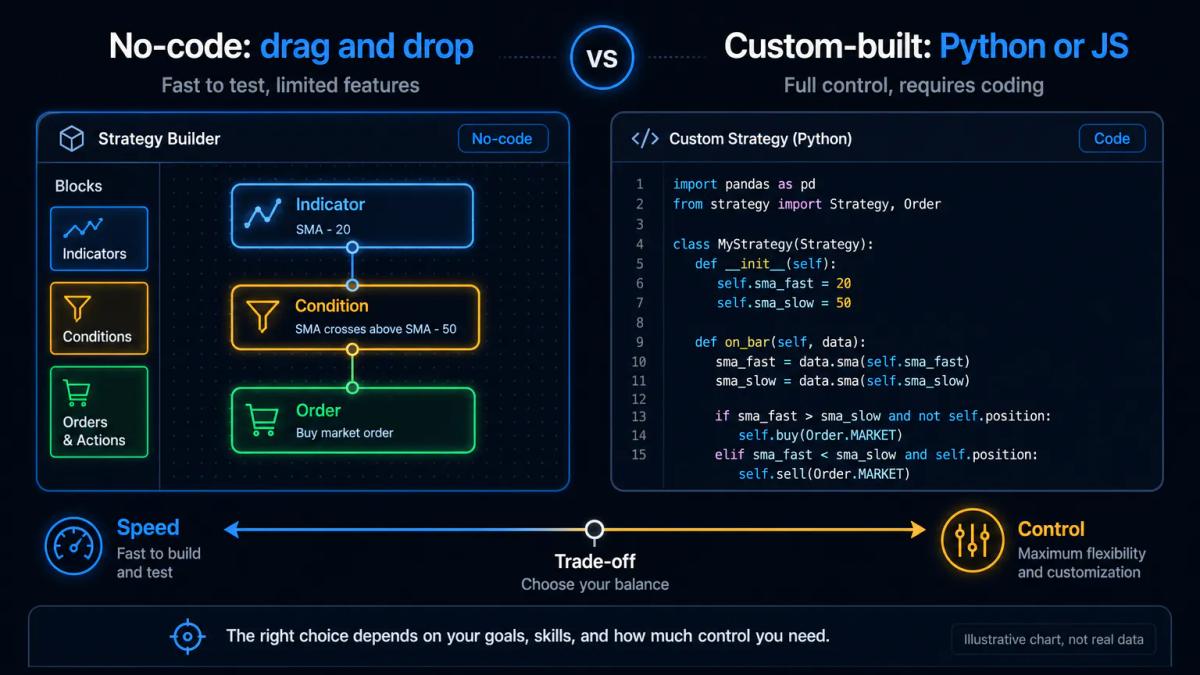
No-code platforms let you assemble a bot by clicking and dragging pre-built blocks: an indicator, a condition, an order type. Custom-built bots demand coding, usually in Python or JavaScript, but they impose no ceiling on what your strategy can do. The trade-off is speed against control.
No-code suits traders who want to test an idea this weekend and iterate without learning syntax. Custom-built suits traders who need features the platform does not expose: fractional position sizing, multi-leg logic, custom risk filters, or integration with a non-standard data feed.
| Feature | No-code platform | Custom-built (Python) |
|---|---|---|
| Setup time | Hours | Days to weeks |
| Coding required | None | Intermediate |
| Strategy flexibility | Limited to platform blocks | Unlimited |
| Typical monthly cost | £10 to £100 subscription | £5 to £50 cloud hosting |
| Backtesting | Built in | You build or import a library |
| Debugging when it breaks | Vendor support | Your own logs and skill |
Many traders start no-code to validate a concept, then port the winning logic to custom code once they need finer control or lower running cost.
Setting up your first bot: API connection and strategy design
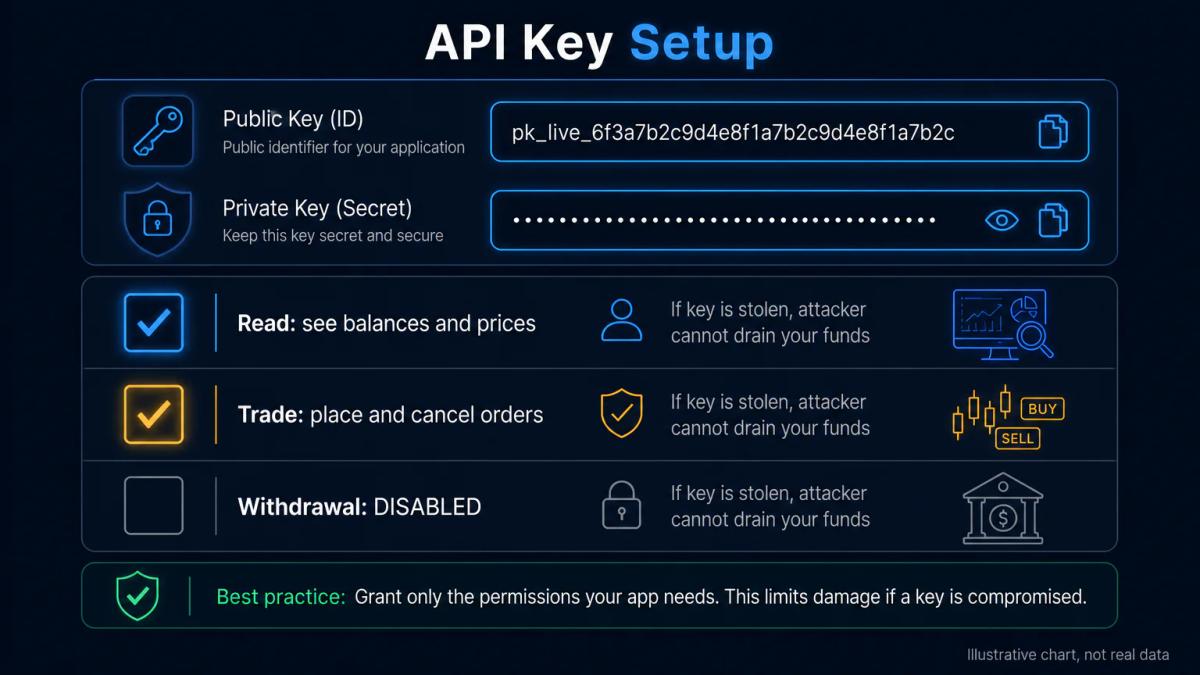
Begin by generating an API key inside your exchange or broker account. An API key is a pair of secret strings, a public identifier and a private secret, that lets a third-party program act on your account within limits you set. Configure two permissions only: read (to see balances and prices) and trade (to place and cancel orders).
Never enable withdrawal on a bot key. If the key is stolen, the attacker can trade badly but cannot drain your funds.
Paste the key into your bot platform's connection screen, or, for custom code, load it from an environment variable rather than typing it into the source file. Confirm the bot can read your balance before you let it place a single order.
Next, define the strategy in explicit rules. Choose an entry signal: a moving average crossover (when a short-term average crosses a longer one), an RSI (Relative Strength Index, a momentum gauge from 0 to 100) threshold, or a MACD divergence (a gap between price direction and momentum).
Set exit rules: a profit target as a percentage or price level, and a stop-loss (a preset order that closes the trade at a maximum loss you accept). Specify position size as a fixed cash amount or a percentage of equity, and cap the number of open trades. Write these rules down in plain English before you code them.
If you cannot describe the strategy in one paragraph, the bot cannot execute it either.
Backtesting and paper trading: proving your bot works first
Backtesting runs your strategy against historical price data and reports how it would have performed. Paper trading, sometimes called demo trading, executes the bot on live prices using simulated money. Both are non-negotiable before real capital touches the market.
A clean backtest hides real-world frictions. Slippage (the gap between the price you expected and the price you got), exchange fees, and market regime change can flip a winning backtest into a losing live run. Paper trade for at least a few weeks across different market conditions, calm and volatile, trending and ranging.
Compare the paper results to the backtest: if they diverge sharply, your model is missing something, usually execution cost or a data assumption. Only then move to a small live size.
Security, monitoring, and common failure points
Protect your API keys as you would a password to your bank. Use a read-only key while you are testing signals and a separate trade-enabled key, with withdrawal disabled, once you go live. Store secrets in environment variables or a dedicated secrets manager. Never commit them to a public code repository; leaked keys are scraped from GitHub within minutes.
Monitor the bot daily. Check the log for errors, confirm it is still connected to the exchange, and glance at the equity curve. Set an alert on unexpected drawdown (the fall from a capital peak to the trough before a new peak) so you know within minutes if something has gone wrong.
Common failures repeat across every retail setup:
| Failure | Typical cause | Preventive step |
|---|---|---|
| API disconnection | Broker maintenance or network drop | Auto-reconnect with retry limit |
| Duplicate orders | Bot restart without state check | Persist open orders to disk |
| Insufficient balance | Fees eroded margin | Reserve buffer above min margin |
| Strategy misfires | Market regime shifted | Regime filter and monthly review |
| Silent failure | Bot crashed but no alert | Health check pings a monitor |
Assume the bot will fail; design so failure is loud, not silent.
Cost, profitability, and regulatory reality
Running a bot is not free. No-code platforms charge £10 to £100 per month depending on features and data access. Custom code needs cloud hosting, typically £5 to £50 per month on a small virtual server. Every trade pays the broker or exchange fee, usually 0.1% to 0.5% on crypto venues and a spread plus commission on CFDs.
Profitability follows the strategy, not the software. A losing edge automated more efficiently still loses; the bot only removes hesitation and fatigue. Understanding how to calculate ROI helps you track net return after all fees, hosting, and platform costs before you call a bot profitable.
UK retail traders face specific rules. According to the FCA, CFDs on cryptoassets are banned for retail consumers, so a bot running crypto trading CFDs on a UK-authorised broker will not accept your account.
For CFDs on other assets, FCA leverage caps apply: 30:1 on major forex pairs, 20:1 on major indices, and 5:1 on individual equities. Your bot must size positions within these limits.
If you are onboarded by an offshore group entity outside FCA authorisation, those caps may not apply on paper, but the consumer protections that come with the FCA licence also fall away. Check which entity holds your account before you assume the rules match the marketing.
Avoiding scams and unrealistic promises
Courses and signal services that promise guaranteed returns, doubled accounts, or 'easy' passive income from bots are red flags. No automation removes market risk; anyone claiming otherwise is selling a story, not a system. Legitimate educators teach strategy design, statistics, and code; they do not sell turnkey money machines behind a paywall.
Before you buy a bot or a course, ask three questions.
- Is the live performance independently verified, for example through a public track record on a third-party audit platform?
- Does the seller hold a regulatory licence if they are giving investment advice, and can you verify it on the FCA register?
- Can you inspect the strategy logic, or is it a black box you must trust on faith?
When evaluating any trading service, learning how to evaluate a prop firm teaches you the same due diligence questions: verification, regulation, and transparency. Open-source bots from established developer communities are often a safer entry point than paid closed products, because the code is public and the failure modes are documented.
Frequently Asked Questions
What exactly are trading bots and how do you use them?
Trading bots are programs that connect to your broker or exchange through an API and place orders automatically when your defined conditions are met. You use one by writing or selecting a strategy, connecting an API key with trade permission but no withdrawal rights, backtesting the logic on historical data, paper trading it on live prices, and only then deploying with real capital in small size.
Can you build a trading bot without coding experience?
Yes. No-code platforms let you assemble entries, exits, and risk rules from pre-built blocks and connect them to your exchange without writing a line of code. The trade-off is that you are limited to what the platform exposes; if your idea needs custom indicators, unusual position sizing, or non-standard data, you will eventually hit a wall and need to move to Python or similar.
How do you know if your trading bot is actually profitable?
Measure net return after every cost: platform subscription, hosting, spread, commission, and slippage. Run the bot on a small live size for enough trades to be statistically meaningful, not just a lucky week. Compare live results to the backtest and paper trade; if live results are much worse, execution cost or a broken assumption is eating the edge.
What are the most common reasons trading bots fail?
The frequent causes are API disconnections during broker maintenance, duplicate orders after a restart with no state persistence, insufficient margin after fees, silent crashes with no alert, and strategy logic that stops working when the market regime changes from trending to ranging or vice versa. Robust logging, health checks, and a monthly review catch most of these before they become expensive.
Is it legal to use a trading bot in the UK?
Using a bot on your own account is legal, but the underlying trading is regulated. According to the FCA, CFDs on cryptoassets are banned for UK retail consumers, and CFDs on other assets are subject to leverage caps of 30:1 on major forex, 20:1 on major indices, and 5:1 on single equities. Your bot must respect these limits at any FCA-authorised broker.
About the authors


Put this into practice
Related articles

Market Structure Shift: How to Identify and Trade Reversals
A practical guide to trading the market structure shift: swing points, confluence with order blocks and FVGs, multi-timeframe checks, and risk sizing.

Options Backtesting: How to Test Strategies Before You Trade
A practical walkthrough of options backtesting: how to configure a test, read the metrics that matter, and avoid the mistakes that inflate historical returns.

Python Trading: Build, Backtest and Deploy Automated Strategies
A practical guide to Python trading for retail: from Pandas dataframes to live broker APIs, with risk sizing, backtest realism and deployment hygiene.
0 comments