



How to Trade · Advanced · 6 min read
Python Trading: Build, Backtest and Deploy Automated Strategies
What Python trading is and why retail traders use it
Python trading is code that automates market analysis, signal generation, order routing and post-trade logging through Python libraries and broker APIs.
Where manual chart-watching relies on attention and mood, a Python workflow replaces both with reproducible logic: you backtest a strategy across years of tick data, deploy it on a demo account, and monitor executions from a single script.
Emotion largely disappears from entries and exits because rules are compiled rather than felt, and once the logic is written it scales across instruments and timeframes without adding screen time. Because every trade lands on disk with its entry, size, slippage and exit, post-mortems become an exercise in reading the ledger rather than reconstructing memory.
Where you trade shapes results as much as the strategy itself; see the best forex brokers and their conditions.
Core Python libraries for market data and analysis
For retail Python trading, the working stack stays narrow and has changed little in a decade. Pandas is the workhorse for OHLC (open, high, low, close) time-series manipulation, covering resampling, rolling windows and merges across symbols, while NumPy sits underneath and delivers vectorised arithmetic on price arrays that runs orders of magnitude faster than plain Python loops.
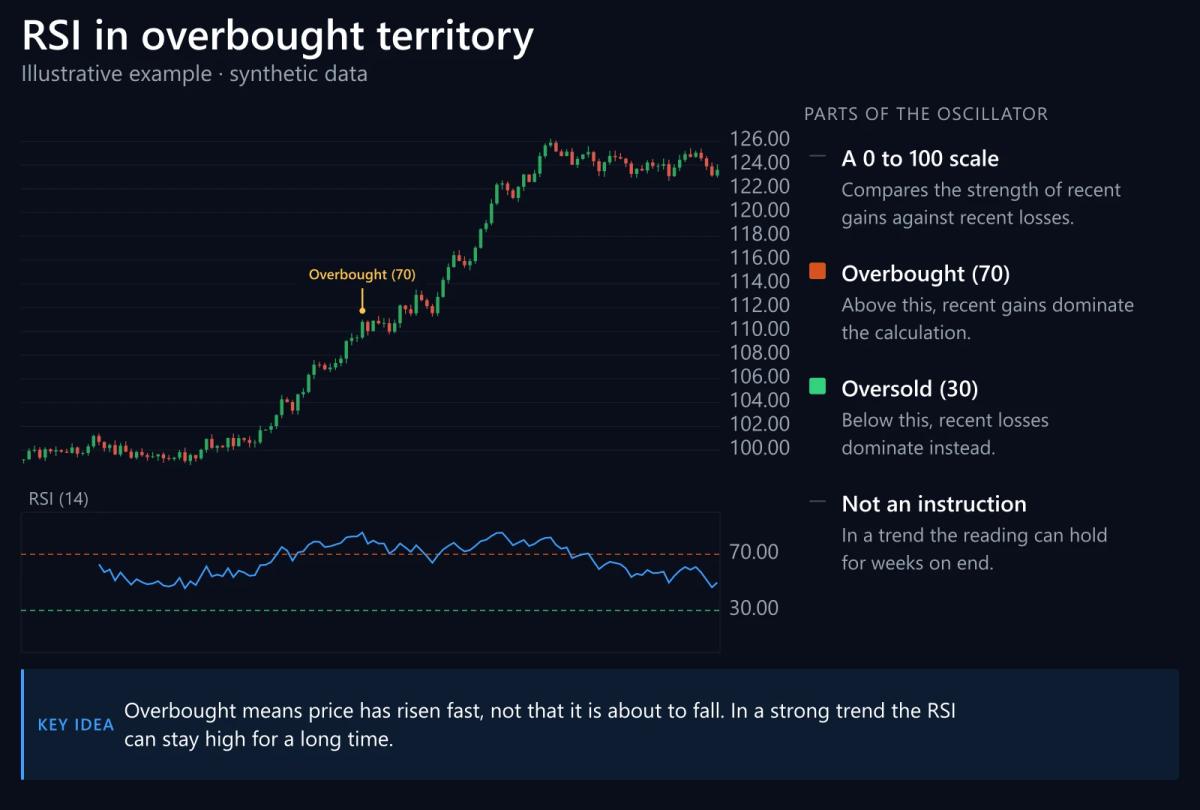
Charting is split between Matplotlib for static output and Plotly for interactive views of price and indicator series. Around this core, TA-Lib and pandas-ta expose the standard indicator library (RSI, MACD, ATR, Bollinger Bands) as vectorised functions you can apply to strategies like the EMA crossover strategy.
Polars is gaining traction for data structures beyond dataframes, especially where dataset size or lazy evaluation becomes a constraint.
| Library | Primary use | When to reach for it |
|---|---|---|
| Pandas | Time-series wrangling | Resampling, joins, rolling stats |
| NumPy | Numerical arrays | Vectorised P&L, matrix ops |
| pandas-ta / TA-Lib | Indicators | RSI, ATR, MACD without reimplementing |
| Backtrader / VectorBT | Backtesting | Event-driven vs vectorised loops |
| MetaTrader5 / ccxt | Broker connectivity | MT5 accounts and crypto exchanges |
Fetching live and historical price data
Data enters the pipeline through a broker API or a public feed. For MT5 accounts, the official MetaTrader5 Python package returns bars and ticks directly into a DataFrame; for crypto, ccxt normalises endpoints across dozens of exchanges; for equities and ETFs, yfinance and Alpha Vantage cover daily and intraday history at retail latencies.
Store every response in a Pandas DataFrame indexed by a UTC timestamp, then persist it as Parquet for repeat use, since Parquet is smaller than CSV and preserves dtypes.
Rate limits deserve real attention: batch symbol requests, cache aggressively, and back off on HTTP 429. For live loops, WebSocket streams tend to be the safer choice compared with REST polling, because polling leaves gaps between bars whenever the request cadence drifts.
A backtest is a function that consumes historical bars and returns a trade ledger plus an equity curve. Encode entry and exit rules as pure functions of price and indicator state, then apply them bar by bar (event-driven, as Backtrader does) or by vectorised signal columns (as VectorBT does).
Realism cannot be treated as optional here, so subtract commission per lot, model a spread proxy from bid-ask history, and apply a slippage assumption sized to your instrument's typical fill.
Before touching any parameter, split data into in-sample and out-of-sample windows. Walk-forward analysis, which refits parameters on rolling windows and tests on the next unseen slice, remains the minimum defence against curve fitting.
A worked skeleton using pandas-ta:
import pandas as pd, pandas_ta as ta
df['ema_fast'] = ta.ema(df['close'], length=20)
df['ema_slow'] = ta.ema(df['close'], length=50)
df['signal'] = (df['ema_fast'] > df['ema_slow']).astype(int).diff()
df['ret'] = df['close'].pct_change() * df['signal'].shift().ffill()
equity = (1 + df['ret'] - 0.0002).cumprod() # 2 bps cost per bar in position
Position sizing belongs inside a function rather than a spreadsheet cell that someone has to remember to update.
Fixed fractional sizing is the retail default: size = (equity * risk_pct) / (stop_distance * pip_value).
For a £10,000 account risking 1% with a 25-pip stop on EURUSD (pip value ≈ $10 per standard lot), the formula returns 0.4 lots.
Encode a hard daily loss cap and a per-trade cap as class attributes on your strategy object, so the limits live in one place rather than as magic numbers scattered through the code.
When you scale to a £100,000 funded trading account, the same principles apply, though drawdown rules and profit targets are often set by the prop firm. FCA retail leverage caps apply if you trade a UK-authorised entity: 1:30 on major FX, 1:20 on major indices, 1:5 on equities, and CFDs on crypto are prohibited for UK retail. Your stop distance, together with your risk budget, is what should determine size, regardless of the maximum leverage the broker happens to allow.
Live execution introduces failure modes a backtest never sees. Authenticate via API key or MT5 login, then wrap every order call in a retry with exponential backoff for transient errors and add an idempotency check by client order ID so a reconnect cannot cause duplicated fills. Every request and response should land in a rotating log file and a structured store (SQLite is enough for retail volumes), and your script needs to handle partial fills, rejected orders and mid-session disconnects explicitly, reconciling broker-side positions with its internal state on every restart.
Run a heartbeat that pings both the broker and your own process, and if either misses a beat, either close positions or fire an alert. Deploy on a small demo size, then a small live size, before scaling up. Some traders use platforms such as prop firms that support TradingView for their execution infrastructure, although direct API connections via Python remain the most flexible approach. Placing a VPS in the same region as the broker's server cuts round-trip latency to single-digit milliseconds.
The recurring failure modes are cheaper to name in advance than to rediscover with real money. Overfitting parameters to a single historical window produces beautiful equity curves that die on the first live week, which is why walk-forward and out-of-sample holdouts belong in every workflow.
Ignoring commissions, spread and slippage inflates backtest returns by figures large enough to flip a strategy from profitable to negative once fees are applied. Look-ahead bias, using a bar's close price to decide a trade taken at the same bar's open, is the silent killer of naive vectorised backtests, and the fix is to shift signals by one bar before computing returns. Deploying untested code live, without paper-trading and without logging, tends to guarantee a debugging session under P&L pressure.
Understanding how many day traders are successful, and why, can help you avoid these traps and set realistic expectations before you scale, so fix every one of these before adding size.
FCA: For UK retail clients, maximum leverage is 1:30 on major FX pairs and 1:5 on individual equities, and CFDs referencing cryptoassets are prohibited.
Frequently Asked Questions
Do I need to be a professional programmer to write trading code in Python?
No. Comfort with Pandas dataframes, functions, and a broker API client is enough for a working retail system. What separates viable code from a curiosity is engineering hygiene: version control, tests on the sizing and signal functions, and logs that survive a crash. Complexity in the strategy itself rarely pays; complexity in the infrastructure around it usually does.
What is the difference between backtesting and live trading in Python?
Backtesting replays historical bars through your rules and returns an equity curve; it assumes clean data and instant fills. Live trading sends real orders through a broker API and must handle latency, partial fills, rejected orders, disconnections and rate limits. A strategy that passed a rigorous walk-forward test can still lose live money if the execution layer is naive about slippage, spread widening around news, or reconnect logic.
How do I avoid overfitting my trading strategy to historical data?
Split data into in-sample and out-of-sample windows before you touch any parameter, and only look at out-of-sample results once. Use walk-forward analysis: refit parameters on a rolling window and evaluate on the next unseen slice. Prefer strategies with few parameters and a stable performance surface: if a small change to one input collapses returns, the edge is a data artefact, not a market inefficiency.
Can I use Python to trade crypto, forex, and stocks on the same platform?
You can use the same codebase, but not usually the same broker. The ccxt library abstracts crypto exchanges; MetaTrader5 or cTrader Open API covers FX and CFDs; Interactive Brokers or Alpaca expose equities. Wrap each broker in a common interface (get_bars, submit_order, get_positions) so the strategy layer stays broker-agnostic. Remember the FCA prohibits crypto CFDs for UK retail, so venue choice depends on your regulator.
What happens if my Python trading script crashes during a live session?
Open positions remain at the broker regardless of your script's state, which is why you need a startup routine that reads current positions from the broker and reconciles them with the last known state on disk. Persist orders and fills with client order IDs so restarts do not resend the same order. A supervisor process (systemd, Docker restart policy, or a watchdog script) should relaunch the bot and alert you through email or a messaging webhook.
About the authors


Put this into practice
Brokers we have reviewed
Scored on the same five dimensions. Here are three of them — the full list is on the brokers page.



Related articles

Stock Selection Criteria: How to Pick Stocks to Trade
How to build a repeatable stock selection process using fundamentals, charts, screeners and risk rules that fit your time horizon.
Trading Days 2026: Full Market Calendar and Holiday Schedule
Complete trading days 2026: 251 NYSE/NASDAQ trading days, all market holidays, early-close sessions, and global exchange schedules to plan around.

Useful TradingView Plugins: Which Ones Actually Improve Your Analysis
Which TradingView plugins deserve a slot on your chart, how to install and backtest them, and when a custom Pine Script beats anything in the public library.
0 comments