



How to Trade · Beginner · 9 min read
How to Trade Oil Futures: A Step-by-Step Guide for Retail Traders
The mechanics of oil futures contracts
To trade oil futures, you buy or sell a standardised contract that obliges you to exchange a fixed quantity of crude oil at a set price on a future date. One standard contract represents 1,000 barrels of crude, and a micro contract represents 100 barrels. You profit or lose from the price difference between entry and exit; almost all retail positions are closed before expiry, so physical delivery does not happen.
A futures contract (a legally binding agreement to transact at a future date) trades on a regulated exchange, not with the broker as counterparty. The two main venues are the New York Mercantile Exchange (NYMEX), part of the CME Group, and the Intercontinental Exchange (ICE) in London.
According to the CME Group, WTI Crude Oil is one of the world's most actively traded commodity contracts by daily volume, which gives you tight bid-ask spreads (the gap between the best buy and sell prices) and reliable execution.
Each contract has a fixed tick size: a $0.01 move on a standard WTI contract equals $10 of profit or loss. That mechanical clarity is why futures matter for a beginner who wants to know exactly what a trade costs before opening it.
Choosing where to trade matters as much as the strategy; see the best forex brokers and their conditions.
Why retail traders use oil futures
Retail traders use oil futures for three concrete reasons: liquidity, transparent pricing, and the ability to go short as easily as long. Because the contracts trade on regulated exchanges, every fill happens against a central order book, not against a dealing desk quoting its own price. You see the same tick that a bank or hedge fund sees.
The second reason is leverage. Leverage lets you control a large notional position with a small margin deposit, so a modest account can take a meaningful position in a barrel of crude. That same feature amplifies losses, which is why position sizing matters more than any entry signal.
Finally, futures let you express a bearish view without borrowing anything. Selling to open a contract is procedurally identical to buying to open. Compared with oil ETFs, which can suffer from tracking error and roll cost (the price of moving from an expiring contract into the next month), futures give you the underlying exposure directly.
WTI and Brent crude: the two main contracts
WTI (West Texas Intermediate) and Brent are the two benchmark crude oil futures. WTI trades on NYMEX, prices US inland crude, and settles physically at Cushing, Oklahoma. Brent trades on ICE, prices North Sea crude, and settles financially against the Brent Index. Both are quoted in US dollars per barrel.
The two contracts move in tight correlation because global crude is a fungible commodity, but they diverge when regional factors matter. A US pipeline outage widens the Brent-WTI spread; a North Sea platform shutdown narrows it.
| Feature | WTI Crude | Brent Crude | Micro WTI |
|---|---|---|---|
| Exchange | NYMEX (CME) | ICE Europe | NYMEX (CME) |
| Contract size | 1,000 barrels | 1,000 barrels | 100 barrels |
| Tick value | $10 per $0.01 | $10 per $0.01 | $1 per $0.01 |
| Settlement | Physical (Cushing, OK) | Financial | Financial |
| Trading symbol | CL | B | MCL |
| Primary users | US refiners, funds | European refiners, funds | Retail, small accounts |
As a beginner, you do not need to pick a favourite yet. Follow whichever contract your broker offers with the tightest spread and the deepest order book during your local trading hours.
Setting up your trading account and choosing a broker
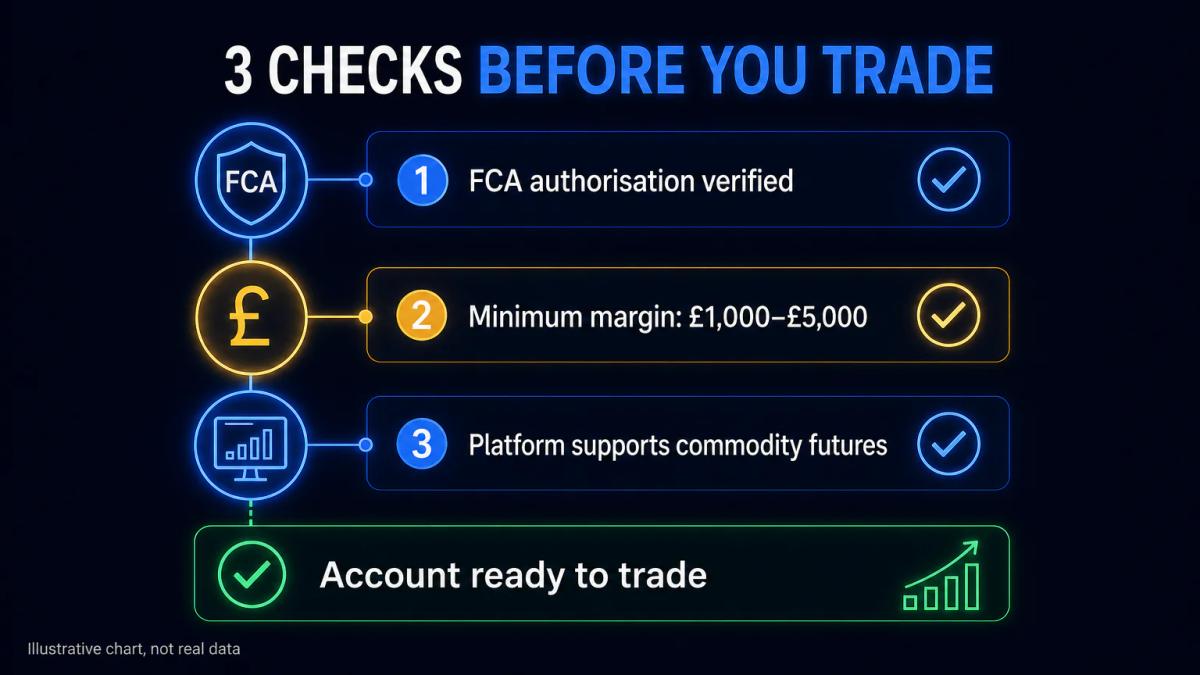
To trade oil futures from the UK, you need a brokerage account with direct futures access, enough margin to hold at least one micro contract, and a platform that supports commodity futures. Typical retail minimums sit between £1,000 and £5,000, though micro contracts let you start with less capital at risk per trade.
Regulation is the first filter. For UK retail clients, look for a firm authorised by the Financial Conduct Authority (FCA); the FCA Register lets you verify the entity's status and permissions before you deposit. Where the group also runs offshore entities, check which entity actually onboards you: the licence on your account documents is the one that matters, not the group logo.
The second filter is product access. Not every FCA-authorised broker offers direct exchange-traded futures; some route retail clients into CFDs (contracts for difference) that reference the futures price instead of the contract itself. CFDs and futures are different products with different tax treatment, different margin rules and different counterparty risk. Confirm which you are actually buying.
| Broker check | What to verify | Where to look |
|---|---|---|
| Regulator | FCA authorisation for UK retail | FCA Register |
| Product | Exchange-listed futures vs CFD | Product terms sheet |
| Platform | MT5, cTrader, or proprietary | Broker platform page |
| Fees | Commission per lot, exchange fees | Fee schedule |
| Margin | Initial and maintenance margin | Contract specification |
Once your account is funded, request the contract specification document for CL, B, or MCL, and read the margin schedule before placing a trade.
Leverage, margin, and position sizing
Oil futures typically offer leverage of 10:1 to 20:1 through exchange margin requirements, meaning a standard WTI contract worth roughly $75,000 in notional value requires a few thousand dollars of initial margin. Initial margin is the deposit the exchange demands to open a position; maintenance margin is the lower threshold you must keep to avoid a margin call.
A one-dollar move against you on a standard contract costs $1,000, so an account with $5,000 of equity can be wiped out by a small unfavourable move if the position is not sized correctly.
Use a fixed risk-per-trade rule. Most professional risk desks cap risk per trade at 1% to 2% of account equity. On a £5,000 account at 1% risk, you can lose £50 on any single trade before you are stopped out. Work backwards from that figure:
- Choose your stop loss distance in dollars (say $0.50 on WTI).
- On a micro contract, $0.50 equals $50 of loss.
- That fits a £50 risk budget (roughly), so one micro contract is your size.
Stop losses (pre-set exit orders that close a losing trade automatically) are not optional in a leveraged product. Overleveraging is the primary reason retail futures accounts fail.
Micro contracts versus standard contracts
Micro oil futures represent 100 barrels instead of 1,000, so every mechanic scales by a factor of ten. A $0.10 price move on a micro WTI contract is worth $10; the same move on a standard contract is worth $100. For a beginner, that ten-fold reduction in dollar risk per tick is the difference between a survivable learning curve and a wiped-out account.
Micros are also useful for scaling into positions. You can build exposure in three or four micro increments as a trade confirms, rather than committing to a single standard contract on entry. The CME Group launched Micro WTI (ticker MCL) specifically to widen retail access to the crude oil market, and the contract trades on the same order book infrastructure as the standard contract, so pricing and execution quality are equivalent.
Charting, technical analysis, and entry signals
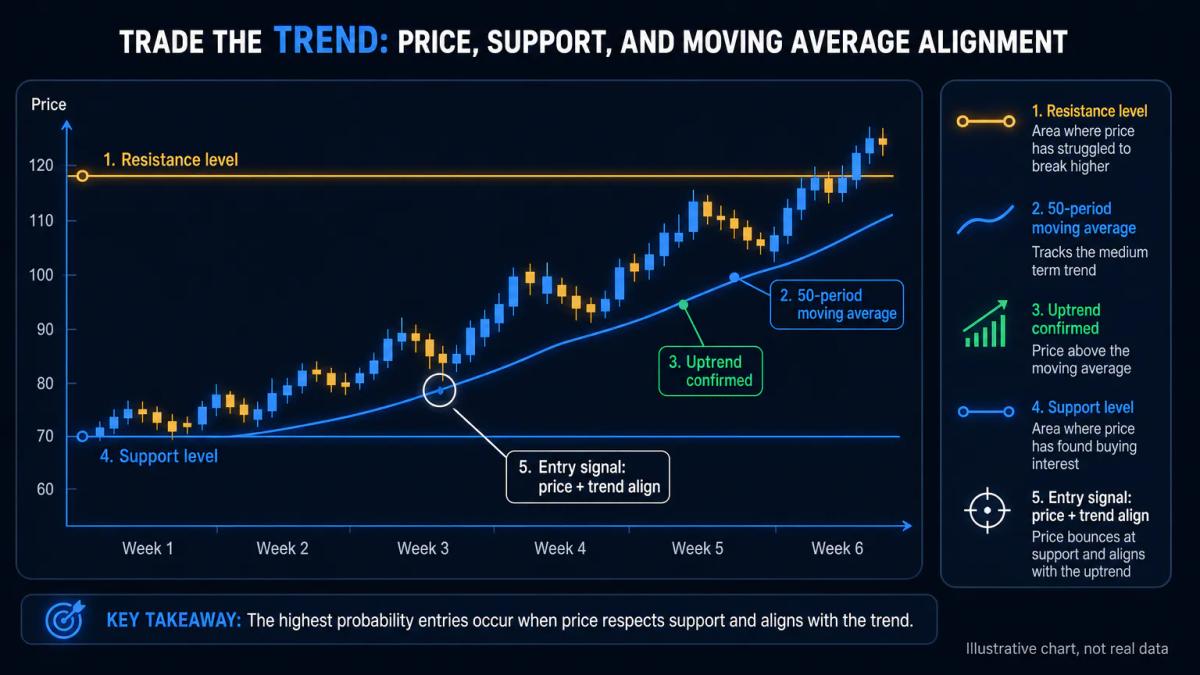
Charting for oil futures follows the same logic as any liquid market: identify the trend, mark support and resistance, and only take entries that offer more reward than risk. TradingView and most broker platforms (MT5, cTrader) stream real-time futures data if you subscribe to the exchange feed; without a paid feed you will see delayed prices, which is unusable for execution.
- Start with a clean chart on the daily and 4-hour timeframes.
- Mark the most recent swing highs and lows as horizontal levels.
- Add a 20-period and 50-period moving average to define trend direction: price above both, sloping up, is an uptrend.
Common entry setups for crude include:
- Breakouts above a well-defined resistance level, confirmed by rising volume.
- Pullbacks to a rising 20-period moving average in an established uptrend.
- Divergence between price and the Relative Strength Index (RSI), a momentum oscillator that ranges from 0 to 100 and flags exhaustion above 70 or below 30.
Avoid the low-liquidity window between the NYMEX close and the Asia open, when spreads widen and stop hunts are common. The most active session for WTI is the overlap between London afternoon and New York morning, which is when order book depth is greatest and slippage lowest.
Seasonal patterns and geopolitical factors
Crude oil prices follow recurring seasonal demand cycles. Northern hemisphere winter lifts heating oil and distillate demand; the US summer driving season lifts gasoline demand and, indirectly, WTI. Spring and autumn are shoulder seasons with softer demand and, historically, lower realised volatility.
The US Energy Information Administration (EIA) publishes weekly petroleum status reports every Wednesday, and those releases routinely produce the sharpest intraday moves of the week.
Geopolitics compounds the seasonal signal. OPEC+ production meetings, sanctions regimes, and supply disruptions in producing regions can shift the Brent-WTI spread within hours. According to the International Energy Agency, unplanned supply outages are a recurring driver of short-term price spikes.
[EIA]: The Weekly Petroleum Status Report releases US crude oil inventories every Wednesday at 10:30 a.m. ET, and inventory surprises are among the most consistent intraday volatility events in WTI.
On backtesting: before risking capital, run your rules on at least three to five years of historical daily and intraday data using your platform's strategy tester or a dedicated tool.
Track win rate, average win versus average loss, and maximum drawdown (the peak-to-trough fall in equity). A strategy that looks profitable on a single year of data usually is not.
Frequently Asked Questions
What is the minimum account balance required to trade oil futures?
There is no single minimum set by the exchange, but brokers typically require £1,000 to £5,000 to open a futures account and hold at least one contract's initial margin. Micro contracts (MCL) let you start with less capital at risk per trade, since one tick is worth $1 rather than $10. Whatever the broker minimum, size positions from a risk budget of 1% to 2% of equity per trade, not from account minimums.
Can I trade oil futures on weekends, or are there specific market hours?
WTI and Brent futures do not trade on Saturdays or Sundays. WTI on CME Globex trades nearly 24 hours from Sunday evening to Friday afternoon US time, with a short daily maintenance break. Brent on ICE follows a similar near-24-hour schedule. Liquidity concentrates during the London afternoon and New York morning overlap; overnight sessions carry wider spreads and thinner order books.
How do I calculate profit and loss on an oil futures position?
On a standard WTI contract, each $0.01 move equals $10 of profit or loss because the contract represents 1,000 barrels. On a micro contract (100 barrels), $0.01 equals $1. Multiply the price move by the tick value and by the number of contracts. Subtract commissions and exchange fees to reach net profit or loss. Overnight positions may also carry a financing or roll cost depending on your broker.
What are the tax implications of trading oil futures as a retail trader?
For UK individuals, gains on exchange-traded futures are generally chargeable to Capital Gains Tax, with the annual exempt amount and the prevailing CGT rate applying. CFDs on oil are treated similarly under current HMRC rules, and spread bets on oil are typically exempt from CGT but not eligible for loss relief. Treatment depends on your facts and circumstances; consult current HMRC guidance or a tax adviser.
How do I backtest an oil futures strategy before risking real money?
Use your platform's strategy tester (MT5 has a built-in one, TradingView offers Pine Script backtesting) on at least three to five years of historical daily and intraday data. Record win rate, average win versus average loss, maximum drawdown, and the number of trades. Then run the same rules forward on a demo account for a month or two before committing capital. A strategy that fails a demo period rarely succeeds live.
About the authors


Put this into practice
Brokers we have reviewed
Scored on the same five dimensions. Here are three of them — the full list is on the brokers page.


Related articles

How to build a trading bot: setup, security and cost reality
From API keys to backtesting, cost analysis to FCA rules, here is what setting up a trading bot actually involves for UK retail traders.

Market Structure Shift: How to Identify and Trade Reversals
A practical guide to trading the market structure shift: swing points, confluence with order blocks and FVGs, multi-timeframe checks, and risk sizing.

Options Backtesting: How to Test Strategies Before You Trade
A practical walkthrough of options backtesting: how to configure a test, read the metrics that matter, and avoid the mistakes that inflate historical returns.
0 comments