



Trading Strategies · Beginner · 12 min read
Best Time to Trade Forex: Optimal Hours by Strategy
The smallest trading window with the biggest opportunity
The best time to trade forex depends on your strategy and risk tolerance, not just when the market is open.
The London-New York overlap, from 13:00 to 17:00 GMT, concentrates the largest share of daily volume into four hours, giving scalpers the tightest spreads and swing traders their cleanest breakouts. Position traders can enter at almost any hour if they respect news releases and weekend gaps.
A session is a block of hours when a major financial centre is open and its local banks are quoting prices. Four centres set the rhythm: Sydney, Tokyo, London and New York. The spread, which is the small gap between the buy and sell price you pay to your broker, moves with these sessions. So does slippage, which is the difference between the price you clicked and the price you actually got.
Understanding what is liquidity in trading: spreads, slippage, and execution is essential because these costs directly affect your profitability across different sessions.
Three arguments run through this piece.
- First, session hours matter less than session overlaps.
- Second, the economic calendar reshapes the ideal window several times a week.
- Third, your own performance data, sorted by hour, beats any generic recommendation.
According to the Bank for International Settlements Triennial Survey, London remains the single largest FX trading centre by turnover, which is why the London open and the London-New York overlap dominate liquidity discussions.
Putting this into practice means opening an account: start with the best forex brokers our team reviewed.
Four sessions, four different trading environments
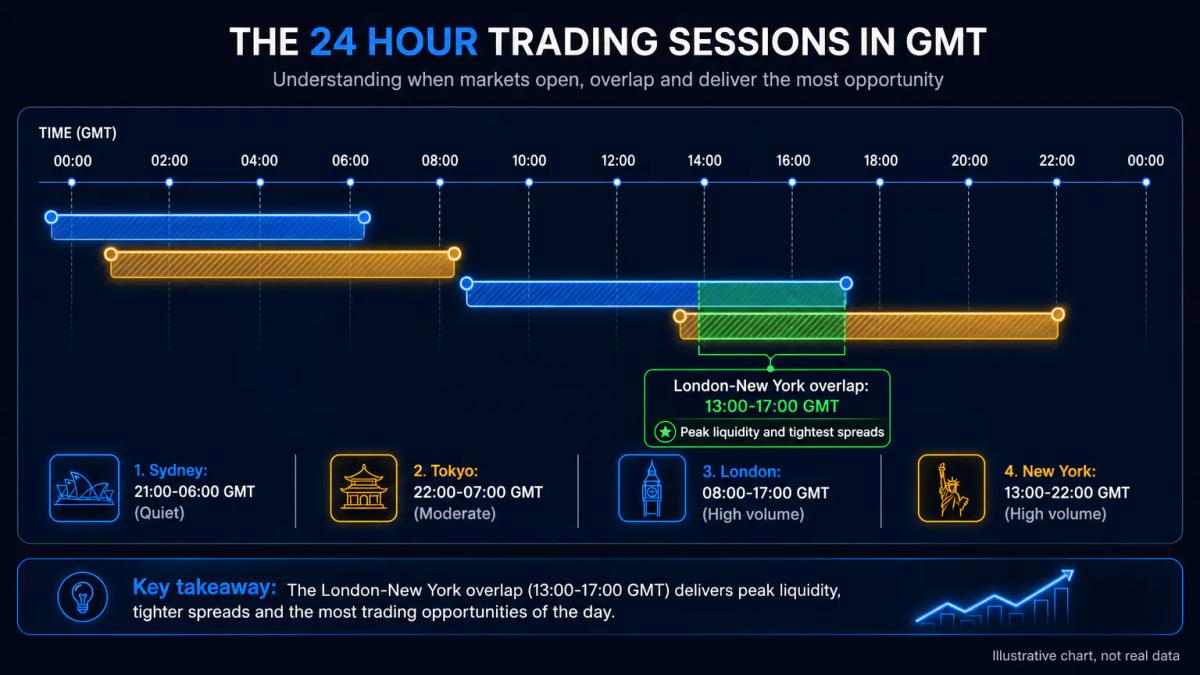
Forex trades across four overlapping sessions, each with a distinct personality.
- Sydney runs roughly from 21:00 to 06:00 GMT.
- Tokyo from 22:00 to 07:00 GMT.
- London from 08:00 to 17:00 GMT.
- New York from 13:00 to 22:00 GMT.
Times shift by an hour when daylight saving changes in the UK and the US at different dates in spring and autumn, so the overlap window is not fixed to the minute year-round.
The Sydney session is the quietest. Liquidity, meaning how easily large orders can be filled without moving the price, is thin. Spreads on many pairs widen.
The Tokyo session brings in JPY crosses and AUD pairs, and price action tends to respect ranges more than in London. According to the Bank of Japan, Tokyo is the third largest FX centre by turnover, which is enough to move the yen but not enough to sustain strong trends on EUR/USD.
| Session | GMT hours | Liquidity | Typical behaviour | Best-suited pairs |
|---|---|---|---|---|
| Sydney | 21:00-06:00 | Low | Range-bound, wide spreads | AUD/USD, NZD/USD |
| Tokyo | 22:00-07:00 | Medium | Range and breakout on JPY | USD/JPY, AUD/JPY |
| London | 08:00-17:00 | High | Trend and breakout | EUR/USD, GBP/USD, EUR/GBP |
| New York | 13:00-22:00 | High | News-driven, continuation | USD pairs, USD/CAD |
London is where the trend day is born. Order flow from European banks, corporate hedgers and institutional desks concentrates in the first two hours, and EUR/USD, GBP/USD and EUR/GBP move with the most character.
New York adds US data, US-listed equity flows and a second surge of activity around the 13:30 GMT release window. When both are open together, the market is at its most efficient and most brutal.
Why overlap hours matter more than session hours
Volume and spreads shift dramatically when two major sessions overlap. The London-New York overlap, from 13:00 to 17:00 GMT, is the deepest and tightest window of the day for EUR/USD, GBP/USD and USD/JPY. Deep means many buyers and sellers are quoting at once, so a market order fills close to the price you saw. Tight means the spread narrows, often to fractions of a pip on major pairs at a competitive broker.
That efficiency has a price: speed. Price moves faster during overlap hours because more participants are reacting to the same information at once. If your stop loss, the price at which your broker automatically closes a losing trade, sits too close to the entry, an overlap-hour spike will take you out before your idea has time to work.
Understanding leverage trading mistakes: how to avoid blowing your account is critical here, because according to the FCA, a majority of retail CFD accounts lose money, and part of that loss profile is tied to undersized stops in high-volatility windows.
The Tokyo-London overlap, roughly 08:00 to 09:00 GMT, is smaller but useful. It marks the London open, when European liquidity floods in and yesterday's Asian range often breaks. This is a favourite window for breakout traders on EUR/USD and GBP/USD. The Sydney-Tokyo overlap adds little: both are relatively thin, and combining them does not produce the depth that London or New York bring on their own.
Scalping, swing trading, and position trading: which session fits
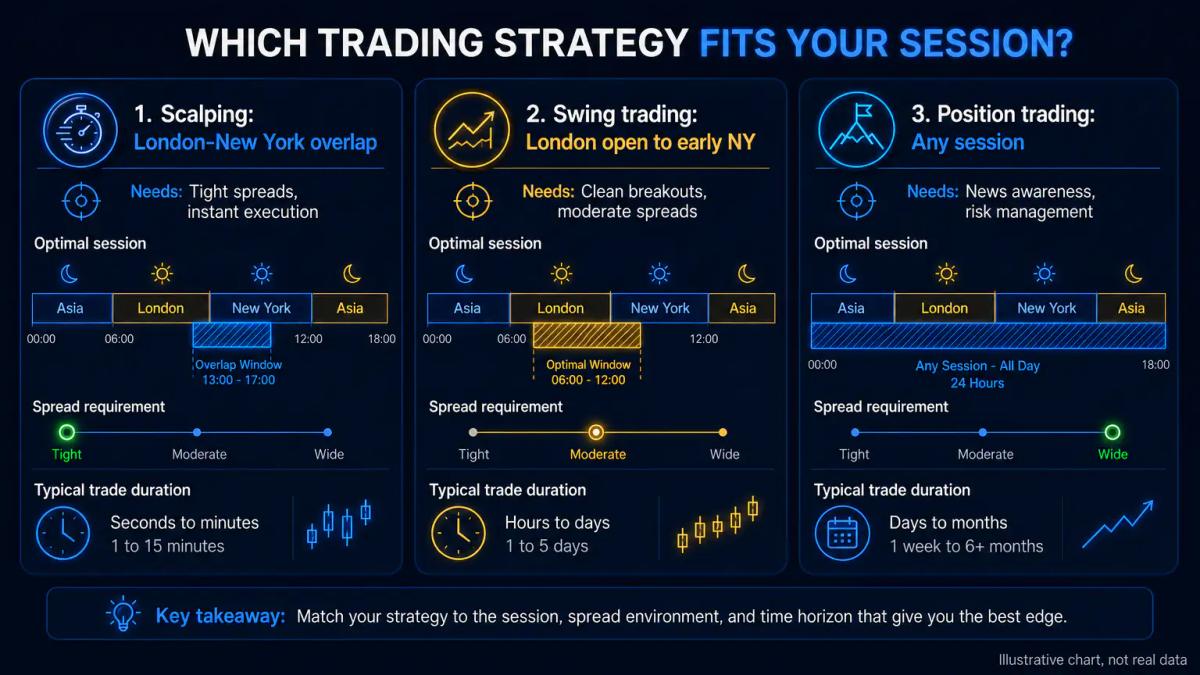
Different strategies want different sessions. Scalping, which is opening and closing trades within seconds or minutes to capture a handful of pips, needs the tightest possible spread and instant execution. That points at the London-New York overlap on EUR/USD, GBP/USD and USD/JPY. Outside that window, the spread eats too much of the average trade to make scalping viable for most retail accounts.
Swing trading, which is holding positions from a day to a couple of weeks to catch a larger move, has more flexibility. A typical swing entry uses the London open at 08:00 GMT or the New York open at 13:00 GMT, because those are the times when a genuine directional move is most likely to start rather than fade.
Learning about forex swing trading signals: how to read, evaluate and use them helps you identify these optimal entry windows and time your positions correctly. The trade is then held through one or several sessions, and you do not need to be at the screen during the Asian session.
Position trading, which is holding for weeks or months on a macro view, is almost session-agnostic. What matters is not the entry hour but the weekend gap risk and the schedule of central bank meetings.
| Strategy | Typical holding time | Best session to enter | Main cost sensitivity |
|---|---|---|---|
| Scalping | Seconds to minutes | London-New York overlap | Spread and slippage |
| Day trading | Minutes to hours | London open, NY open | Spread and news timing |
| Swing trading | 1 day to 2 weeks | London or NY open | Overnight swap fees |
| Position trading | Weeks to months | Any session | Swap fees, gap risk |
Swap, which is the interest adjustment applied when you hold a position overnight, is a real cost for swing and position traders and is usually charged around 22:00 GMT. Trading a strategy against the wrong session means paying costs that quietly compound: a scalper working the Sydney session on GBP/JPY, for example, is fighting a wider spread on every trade. Test your strategy on the session that matches its holding time, not on whichever hours you happen to be free.
Economic calendar events reshape the best trading time
Major economic releases override normal session patterns. US non-farm payroll, or NFP, released at 13:30 GMT on the first Friday of each month, produces the largest scheduled volatility spike in forex. The European Central Bank rate decision, the Bank of England rate decision and US Consumer Price Index, or CPI, releases do the same on their days. During these minutes, spreads widen, slippage rises, and the pair you were quietly trading in a range can move 50 to 100 pips in seconds.
For a beginner, the safest rule is to know the schedule and decide in advance whether you are trading the news or standing aside. Trading the news means accepting that your stop may be filled at a worse price than you set. Standing aside means closing exposure or reducing size before the release. The economic calendars published by central banks, the Federal Reserve, the ECB, the Bank of England, and by national statistics offices, the Office for National Statistics in the UK and the Bureau of Labor Statistics in the US, give you the exact release times.
According to the FCA, retail CFD losses are concentrated in accounts using high leverage and small stops, which is exactly the profile that gets punished during news releases. Leverage, which is the multiplier your broker applies to your deposit, is capped for UK retail clients at 30:1 on major forex pairs, 20:1 on major indices, 5:1 on individual equities, and CFDs on cryptocurrencies are prohibited for UK retail. Even at 30:1, a 50-pip news spike against a full-size position can wipe out a meaningful share of your account.
Research on how many day traders are successful: what the data shows reveals that retail losses cluster during high-volatility windows like news releases. The best time to trade on release days is often ten minutes after the print, once the initial spike has cleared and the spread has normalised.
Spreads, slippage, and costs across the trading day
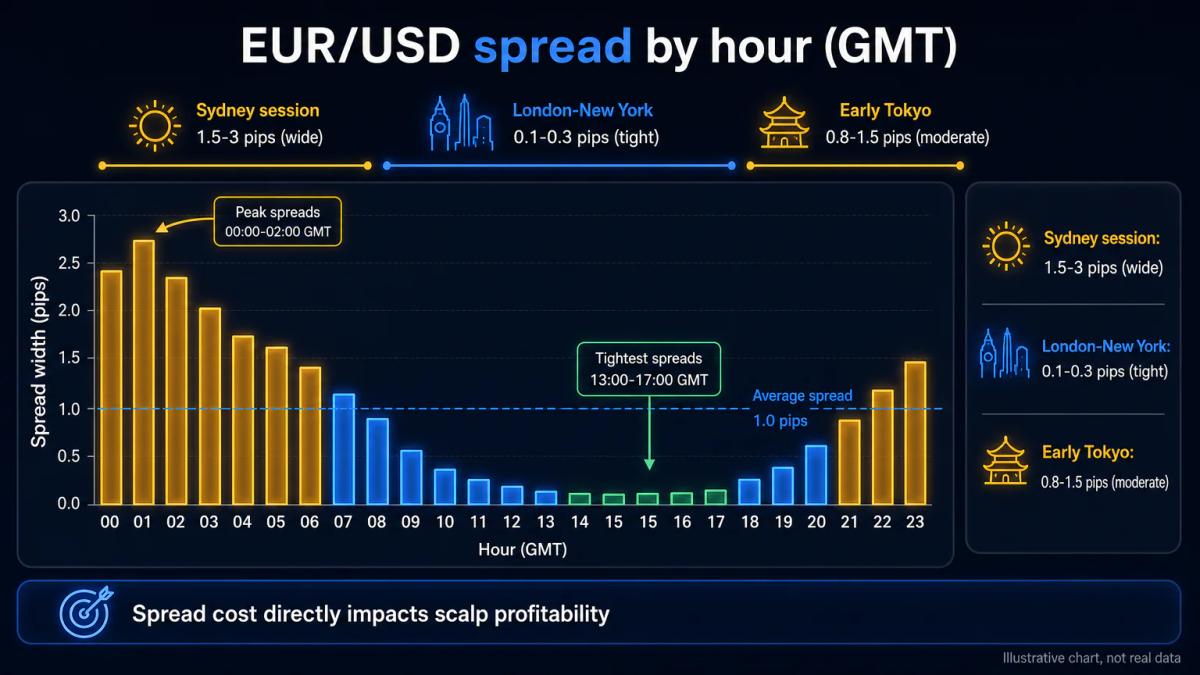
Your entry cost changes with the hour, even at the same broker. Spreads on EUR/USD at a competitive ECN-style broker can tighten to a fraction of a pip during the London-New York overlap and widen to two or three pips during the Sydney session on the same account. On exotics such as USD/TRY or USD/ZAR, the difference between overlap hours and Asian hours can be an order of magnitude. Commission, which is a flat per-lot fee some brokers charge instead of, or in addition to, a marked-up spread, does not change with the hour, but the spread portion does.
Slippage rises at three predictable moments: the Sydney open at 21:00 GMT, the London open at 08:00 GMT and scheduled news releases. At those times, the price your platform shows and the price your order actually fills at can diverge. For a scalper aiming for five pips of profit, two pips of slippage is a strategy killer.
| Time window (GMT) | Typical EUR/USD spread | Slippage risk | Cost verdict for scalping |
|---|---|---|---|
| 22:00-06:00 (Asia) | Wider | Medium at open | Unfavourable |
| 08:00-12:00 (London) | Tight | Elevated at open | Favourable after 08:30 |
| 13:00-17:00 (Overlap) | Tightest | High on news | Favourable off-news |
| 17:00-22:00 (NY late) | Widening | Medium | Neutral |
Read your broker's spread history if it publishes one, and record your own fills for a fortnight. When comparing brokers, use compare forex brokers to check their published spread data, as the average spread quoted on a broker's website is often measured during overlap hours, which flatters the number.
Seasonal patterns and holiday effects on trading times
Liquidity is not constant across the year. Northern Hemisphere summer, roughly late July through August, thins London and New York volume as institutional desks operate on holiday cover. Ranges compress on some days and false breakouts multiply on others, because a smaller order can push the price further than usual. Year-end, from mid-December through the first week of January, brings a similar thinning, punctuated by sharp position-squaring moves.
Asian holidays affect the Tokyo session. Golden Week in Japan, in late April and early May, and Chinese New Year, in late January or February, both reduce Asian liquidity and can leave JPY and AUD pairs drifting in tight ranges until London opens. US public holidays such as Thanksgiving and Independence Day close the US bond and equity markets while forex technically stays open, but the New York session on those days is a shadow of itself. Good Friday and Easter Monday do the same in the UK and much of Europe.
The practical adjustment is simple: expect wider spreads, expect breakouts to fail more often, and reduce position size rather than trading normally into thin liquidity. Retail traders often underestimate this and treat August like April. It is not.
Your trading performance by session: what the data shows
The most useful table you can build is your own. Sort every trade you have taken in the last three months by the hour of entry, and calculate win rate, average profit and average loss for each hour.
Some traders discover they win consistently at the London open and give it all back after 20:00 GMT, when fatigue and thin liquidity meet. Others find their edge is really only in the first hour of the New York session.
According to the FCA, most retail CFD accounts lose money, and one common contributor is trading during hours that do not suit either the strategy or your attention span. Emotional trading tends to cluster in two windows: late-session revenge trades after a losing day, and news-release chases where you jump in after the move has already happened.
Bank for International Settlements Triennial Survey: London is the largest FX trading centre in the world by daily turnover, which is why the London session and the London-New York overlap dominate liquidity across the major pairs.
The honest answer to when to trade is: the session where your own data says you make money after costs, in the pairs where your strategy has an edge, on the days when the calendar is not against you. Everything else is noise.
Frequently Asked Questions
What is the most active forex trading session for retail traders?
The London-New York overlap from 13:00 to 17:00 GMT is the most active window, with the tightest spreads and deepest liquidity on major pairs such as EUR/USD, GBP/USD and USD/JPY. Order flow from European and US institutions concentrates here, which makes it the natural session for scalping and short-term day trading.
Should I trade forex during the London-New York overlap if I am a beginner?
The overlap has the best costs, but also the fastest price movement. As a beginner, you can trade this window on a small position size with a stop loss that respects normal volatility, but avoid the exact moment of scheduled news releases such as 13:30 GMT US data. Practice on a demo account first to see how quickly stops can be hit.
How do economic calendar events affect the best time to trade forex?
Major releases such as US non-farm payroll, ECB and BoE rate decisions, and CPI prints produce sharp volatility spikes that override normal session behaviour. Spreads widen, slippage rises, and price can move 50 to 100 pips in seconds. Many retail traders prefer to stand aside until ten minutes after the release, when conditions normalise.
Why do spreads widen during certain forex trading sessions?
Spreads reflect how many participants are quoting prices at any moment. During the Sydney session, fewer banks and market makers are active, so the gap between buy and sell prices widens. During the London-New York overlap, thousands of participants compete, so the spread on major pairs can tighten to a fraction of a pip. News releases briefly widen spreads even at overlap hours.
Can I make money trading forex during low-liquidity sessions like Sydney?
It is possible but harder. Wider spreads eat into short-term profits, and ranges tend to dominate, which favours mean-reversion strategies over trend or breakout systems. If your only available hours are Sydney or early Tokyo, focus on AUD and NZD crosses, keep position size small, and account for the higher cost of entry in your risk calculation.
About the authors


Put this into practice
Brokers we have reviewed
Scored on the same five dimensions. Here are three of them — the full list is on the brokers page.



Related articles

Dollar-Cost Averaging Explained: Mechanics, Benefits and Real Performance Data
How dollar-cost averaging works, when it beats lump-sum investing, and how to apply it to stocks, ETFs and crypto with tax and automation in mind.

EMA Crossover Strategy: Setup, Signals and Execution
A plain-English guide to the EMA crossover strategy: how the fast and slow EMAs interact, which period pairs to pick, and how to size and manage each trade.

How to Trade Momentum Stocks: Entry, Exit, and Risk Rules
A plain-English guide to trading momentum stocks: how to screen, when to enter on pullbacks or breakouts, where to exit, and how to size positions safely.
0 comments