



How to Trade · Beginner · 8 min read
How Many Trades Per Day Should You Make? A Beginner's Guide
The right number depends on your strategy and account size
Many beginner traders make a common mistake: they believe the more they trade, the better. However, how many trades per day you should execute depends on your trading strategy, account balance, win rate, and whether you are classified as a pattern day trader under FINRA rules.
There is no single optimal number: the answer lies in matching your trade frequency to a plan you can execute consistently, without emotional pressure or overtrading.
Beginners often assume that more trades mean more profit. In practice, the opposite is common. Every trade you take carries a spread (the difference between the buy and sell price that the broker keeps), a commission where applicable, and a real risk of loss. If your edge (the statistical advantage your setup gives you over random entries) is small, executing 30 trades a day multiplies costs faster than it multiplies gains.
Understanding what is liquidity in trading and how spreads affect your profitability is essential to this calculation. The right count is the one your rules, your capital and your regulator all permit at the same time.
If you still need a broker, our guide to the best forex brokers compares the regulated options side by side.
Understanding the pattern day trader rule and its limits
If you trade a US margin account (an account where the broker lends you money to buy securities), the pattern day trader rule shapes how many trades you can make. According to the U.S. Securities and Exchange Commission (Investor.gov), FINRA defines a pattern day trader as any customer who executes 4 or more day trades within five business days, provided those day trades represent more than 6% of total trades in the account over the same period.
A day trade means buying and selling (or shorting and covering) the same security on the same trading day: same day trades are the exact activity FINRA counts. Once you are flagged as a pattern day trader, the account must hold at least $25,000 in equity, according to the U.S. Securities and Exchange Commission (Investor.gov), and can only trade on margin.
This framework is changing. According to the U.S. Securities and Exchange Commission (Investor.gov), FINRA's new intraday margin rules take effect on June 4, 2026, with a transition period of up to 18 months, until October 20, 2027, for brokerage firms that need more time to comply.
How different trading styles shape your daily trade count
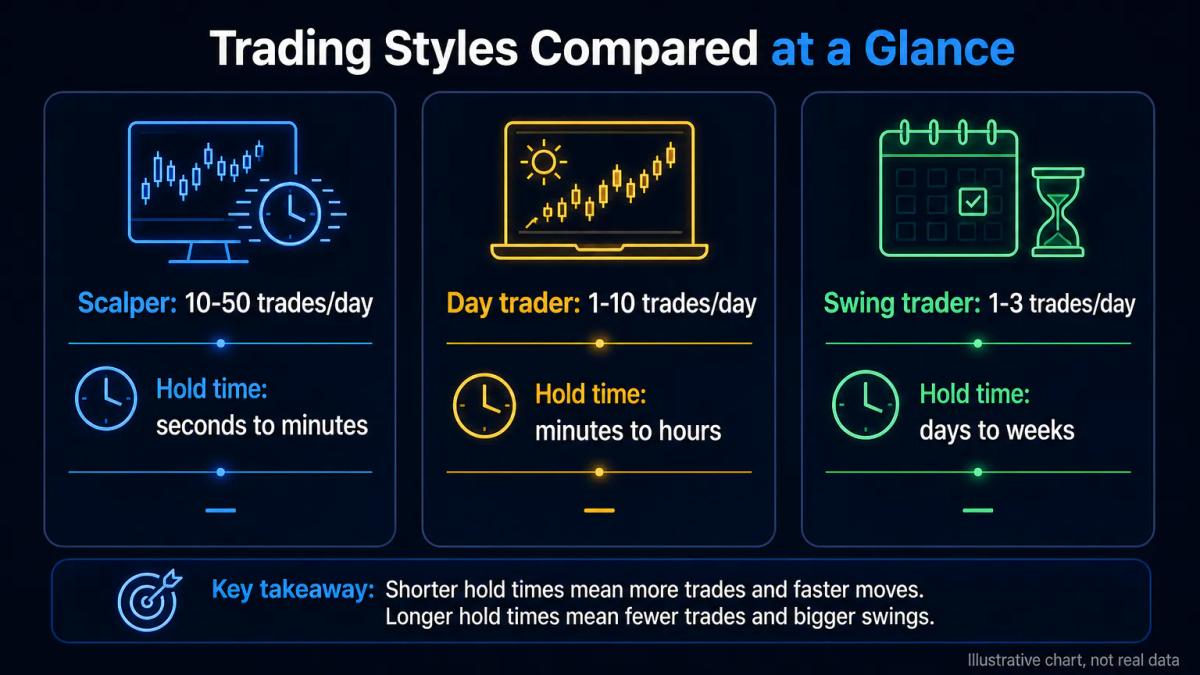
Your trading style is the strongest predictor of how many trades you should place.
Three styles dominate retail trading, and each carries a different natural frequency.
- A scalper looks for tiny price moves lasting seconds or minutes.
- A day trader holds for minutes to hours and closes everything before the session ends.
- A swing trader holds positions overnight, sometimes for days or weeks, aiming to capture larger moves with fewer decisions.
| Style | Typical trades per day | Typical hold time | Typical trades per week |
|---|---|---|---|
| Scalping | 10 to 50 | Seconds to minutes | 50 to 250 |
| Day trading | 1 to 10 | Minutes to hours | 5 to 50 |
| Swing trading | 0 to 3 | Hours to days | 1 to 10 |
How many trades you can make in a week is really a question about style. A scalper who takes 30 trades a day may place 150 in a week and still be inside plan. A swing trader who takes six trades in a week is well within plan too. What matters is not the raw number but whether each trade is a valid setup under written rules.
Learning about types of trading explained: day trading, swing trading and scalping can help you align your frequency with your chosen approach.
Beginners should default to the lower end of each range. Fewer trades give you time to journal, review the chart afterwards, and see whether your entry criteria actually held. If you cannot explain, in one sentence, why each trade was taken, the count is too high for your current skill.
Practical framework: matching trade frequency to your edge
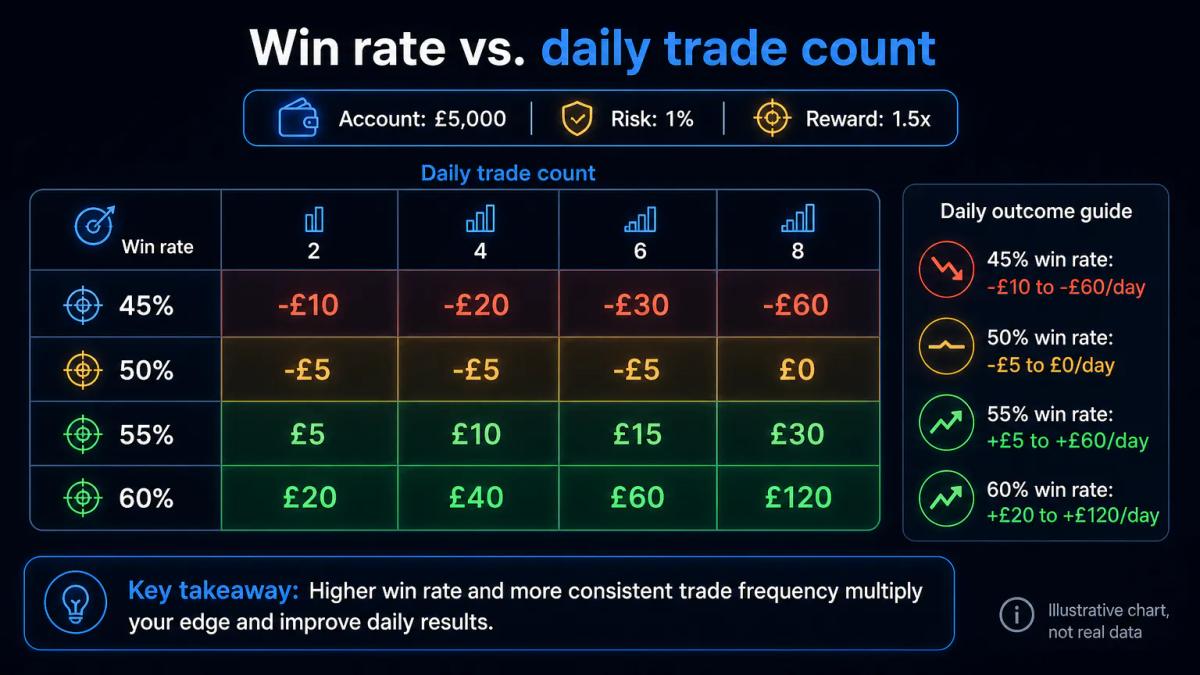
To decide your daily trade count, work from two numbers: your win rate (the percentage of trades that end in profit) and your risk per trade (the percentage of the account you are willing to lose on any single position).
A worked example makes this concrete: Assume a £5,000 account, 1% risk per trade (£50), and a reward-to-risk ratio of 1.5 (a winner earns £75, a loser costs £50).
| Win rate | Trades per day | Expected daily result |
|---|---|---|
| 45% | 5 | 45% x 5 x £75 minus 55% x 5 x £50 = £31.25 |
| 55% | 5 | 55% x 5 x £75 minus 45% x 5 x £50 = £93.75 |
| 55% | 15 | 55% x 15 x £75 minus 45% x 15 x £50 = £281.25 |
| 40% | 15 | 40% x 15 x £75 minus 60% x 15 x £50 = minus £0.00 |
Two lessons stand out.
- First, higher trade counts amplify whatever your edge is, positive or negative. A losing system loses faster, not slower, at 15 trades a day.
- Second, transaction costs are missing from the table on purpose: add spread and commission of, say, £3 per round trip, and the 15-trades-a-day row loses £45 daily even before results.
Before raising your count, prove the edge exists at a lower count. Trade the same setup 50 times, journal every entry and exit, calculate the real win rate, and only then decide whether more frequency helps or hurts.
Fatigue also matters: most retail traders make sharper decisions in the first two hours of a session than in the sixth.
The dangers of overtrading and how to avoid them
Overtrading is executing more trades than your strategy or account size justifies. It is usually emotional, not analytical. Common triggers include boredom during quiet market hours, frustration after a losing trade, and the urge to recover a drawdown (the fall from a capital peak to the trough before a new peak) inside a single session. Each of these pushes you into setups that do not meet your rules.
Understanding analysis paralysis in trading and its opposite, impulsive overtrading, helps you recognize when emotion is driving your decisions.
The cost is threefold.
- Transaction costs stack up on every trade.
- Your win rate falls because you are entering marginal setups.
- Your emotional bandwidth erodes, which makes the next legitimate setup harder to execute cleanly.
Retail traders who blow up an account rarely do so on one bad trade: they do so through 20 small forced trades in an afternoon.
A simple audit protects you. Write your daily trade limit on paper before the market opens. When you hit it, close the platform. Review your last 40 trades once a fortnight and flag every trade that broke your rules. If the flagged share exceeds 20%, cut your daily limit by half until it recovers.
Account size, broker rules, and jurisdiction matter
Rules from your regulator, and terms from your broker, put a hard ceiling over your strategy.
- In the UK, FCA leverage caps for retail clients are 1:30 on major forex pairs, 1:20 on major indices, 1:5 on individual equities, and CFDs on cryptocurrencies are prohibited outright for UK retail.
- In the EU, ESMA applies the same headline caps.
- In Australia, ASIC uses the same 1:30 forex cap for retail.
- In the US, the pattern day trader rule requires $25,000 minimum equity for anyone flagged, according to the U.S. Securities and Exchange Commission (Investor.gov).
Check two things before you fix a daily trade count.
- First, the broker's margin call and stop-out levels: these can force positions closed before your own stop loss triggers.
- Second, whether your local tax authority treats frequent trading as a trade or a business, which changes how gains are taxed.
In the UK, HMRC applies a badges of trade test; in the US, the IRS has a trader tax status classification with strict frequency and intent criteria.
Building a sustainable daily trade plan
Write your plan the night before or during the pre-market hour. It should state: target trade count, maximum trade count, instruments you are watching, setups that qualify, and a maximum daily loss that closes the platform. Keep it short enough to read in 30 seconds.
Track every session in a journal with six columns: date, instrument, setup name, risk, result, and whether the trade followed your rules. After two to four weeks, compare planned trade count to actual, and win rate on rule-compliant trades to win rate on rule-breaking trades. The gap is usually large, and it tells you exactly where to trim.
Adjust downward the moment overtrading appears: revenge trades, unlisted setups, or trades taken after the maximum daily loss. Adjust upward only after 100 documented trades at the current count show a positive, stable edge. Frequency is a lever, not a goal.
Frequently Asked Questions
What is overtrading and why is it dangerous for retail traders?
Overtrading is placing more trades than your strategy or account size justifies, usually driven by boredom, frustration, or the urge to recover a loss. It is dangerous because transaction costs pile up, your win rate drops when you enter marginal setups, and emotional fatigue makes the next real setup harder to execute. Small forced trades destroy more accounts than single large mistakes.
How do I know if I am classified as a pattern day trader under FINRA rules?
According to the U.S. Securities and Exchange Commission, you are a pattern day trader if you execute four or more day trades within five business days in a margin account, and those day trades represent more than 6% of your total trades in that period. If flagged, you must hold at least $25,000 in equity until the new FINRA intraday margin framework takes effect on June 4, 2026.
Can I execute more trades per day if I use a different broker or trade from outside the US?
Yes. The pattern day trader rule only applies to US margin accounts. UK retail clients trade under FCA rules with leverage caps of 1:30 on major forex, 1:20 on indices, 1:5 on equities, and no CFDs on crypto. EU clients face similar ESMA caps. Different jurisdictions do not remove risk: they change which limits shape your trade count.
What is a realistic daily trade count for a beginner with a small account?
For a beginner, one to three trades per day is realistic. That count gives you enough repetitions to learn from, keeps transaction costs manageable on a small account, and lets you journal every trade in depth. Raise the count only after 100 documented trades show a stable, positive edge at the current frequency.
How do I track whether my daily trade frequency matches my actual edge?
Keep a journal with six columns per trade: date, instrument, setup, risk, result, and whether the trade followed your written rules. After 40 to 100 trades, compare win rate on rule-compliant trades to rule-breaking trades. If the compliant win rate is materially higher, cut your daily limit to the count that produced those trades.
About the authors


Put this into practice
Brokers we have reviewed
Scored on the same five dimensions. Here are three of them — the full list is on the brokers page.



Related articles

How Much Should You Invest in Stocks: A Framework for Your Situation
Deciding how much to invest in stocks is a personal calculation. Anchor it to your income, obligations, timeline and risk tolerance rather than settling on a fixed figure.

How to Become a Trader: A Practical Roadmap for Retail Traders
A step-by-step guide to becoming a retail trader in the UK: capital, platforms, FCA leverage caps, tax duties, and the discipline that separates traders from gamblers.

How to Buy ETFs: A Step-by-Step Guide for Retail Traders
A practical guide to buying ETFs: from opening a brokerage account and choosing the fund to placing your first order, managing fees, and rebalancing.
0 comments