



How to Trade · Beginner · 9 min read
How Much Should You Invest in Stocks: A Framework for Your Situation
The core principle: anchor to a percentage of income
How much you should invest in stocks depends on your income, financial obligations, and time horizon rather than a universal dollar figure. Most personal-finance frameworks suggest allocating somewhere between 10 and 20% of your disposable income (what remains after tax, essentials and debt payments) to stock investments, and the right percentage inside that band comes from your own numbers.
A fixed dollar amount can be misleading once you consider context: investing $500 a month is aggressive on a $2,500 take-home income and fairly modest on a $10,000 one. Anchoring to a percentage of income lets your contributions scale with reality, so they rise when you earn more, ease off when a mortgage or a child changes the picture, and stay honest during a pay cut. It also stops you copying a figure you read online that was calibrated for somebody else's balance sheet.
A stock (an ownership share in a listed company) is a long-duration asset whose price swings weekly while its expected return arrives across years. That gap between short-term noise and long-term outcome is precisely why anchoring to a percentage of income tends to serve investors well: it keeps you contributing steadily even when the price of what you are buying moves against you.
If you still need a broker, our guide to the best forex brokers compares the regulated options side by side.
Assess your financial foundation first
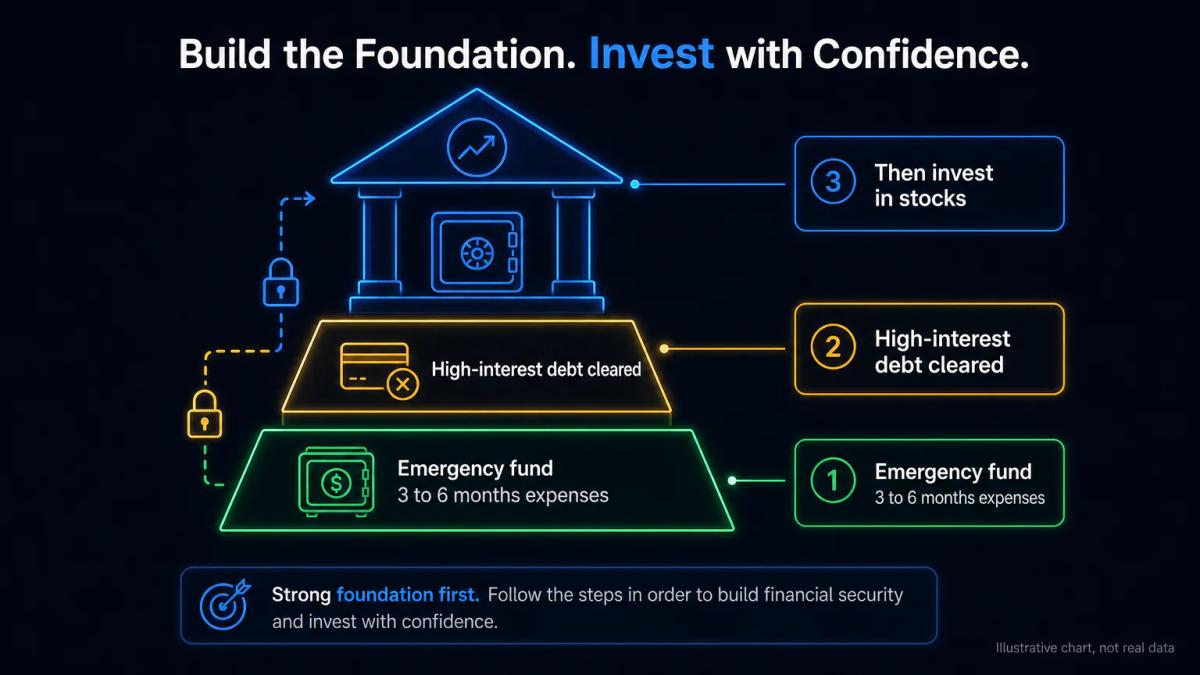
Before any money reaches a brokerage account, two foundations need to be in place. The first is an emergency fund covering three to six months of essential expenses; the second is any high-interest debt (typically credit cards and unsecured personal loans above 8 to 10% APR) either cleared or on an aggressive repayment schedule. Treat these as prerequisites rather than preferences, because they are what stops a job loss, a broken boiler, or a medical bill from forcing you to sell shares at the worst possible moment.
The emergency fund belongs in an instant-access savings account rather than in stocks, because its role is to provide stability rather than return. A stock portfolio that drops 30% in a bear market (a sustained decline of 20% or more from a recent peak) is a normal event, and if you are forced to withdraw during that drop, the paper loss becomes permanent. According to the FCA, most retail investors who trade CFDs on shares lose money, which underlines the same principle at the speculative end: capital you cannot afford to lose does not belong in equities.
High-interest debt behaves like a guaranteed negative return on your money. Paying off a card charging 22% APR is functionally the same as earning 22% risk-free on that balance, and no diversified stock portfolio reliably beats that hurdle. Clearing expensive debt before you begin investing gives every subsequent contribution a much cleaner runway.
In practice, that gives you a simple running order:
- Clear the expensive debt (credit cards, unsecured loans above 8 to 10% APR).
- Keep the mortgage on its normal schedule.
- Begin investing in stocks.
How to know how much to invest: the 50/30/20 rule and beyond
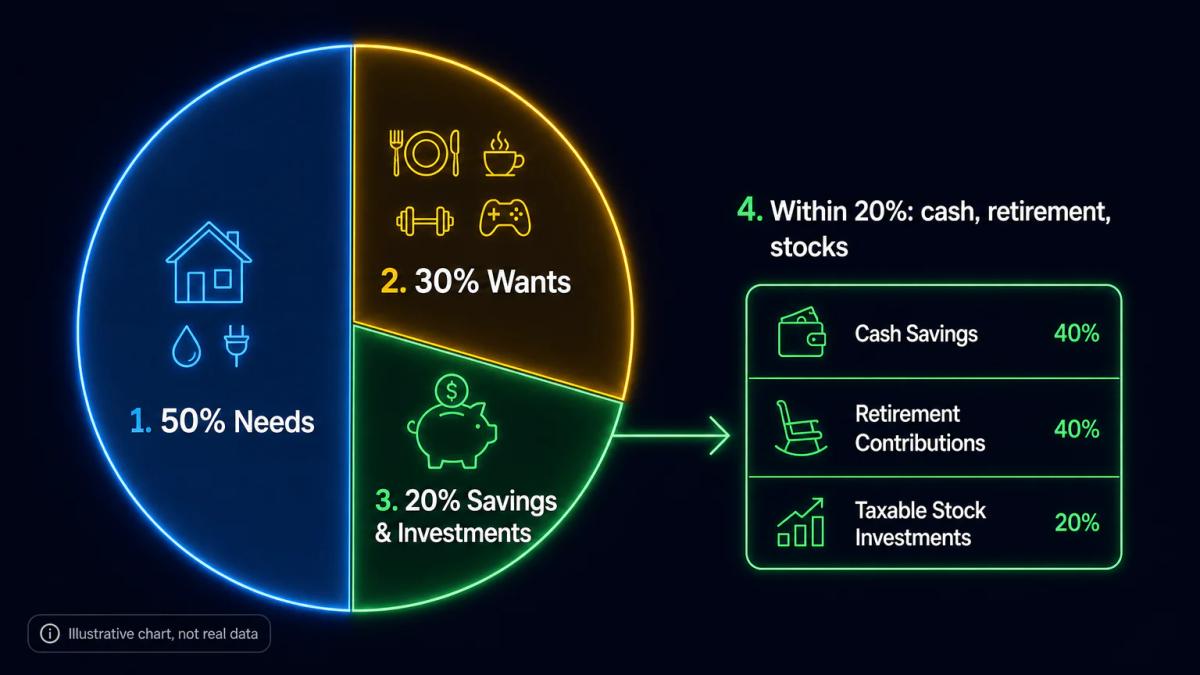
The 50/30/20 rule is the simplest budgeting framework for locating your investable surplus. It divides after-tax income into three buckets:
- 50% to needs: rent or mortgage, utilities, groceries, insurance and minimum debt payments.
- 30% to wants: dining, subscriptions, holidays and hobbies.
- 20% to savings and investments: cash savings, retirement contributions and taxable stock investments.
Within that 20% bucket, you decide the split between cash savings, retirement contributions and taxable stock investments.
A worked example clarifies the arithmetic. On an after-tax income of $3,500 a month, the 20% bucket comes to $700. If your emergency fund is already full, one plausible split of that $700 looks like this:
- $200 into a pension or 401(k).
- $200 into a stocks and shares ISA or brokerage account.
- $300 into short-term goals such as a house deposit, a wedding or a car.
If the emergency fund is not yet built, the entire $700 goes to cash until it is.
Treat the rule as a starting point that you adapt to your circumstances. High earners often push the savings figure well above 20%, because their needs do not scale linearly with income, while lower earners or people with dependents may only reach 5 to 10% for a period, and that is perfectly reasonable: consistency at 5% will outperform a heroic 25% that collapses after two months. The important thing is that the percentage is deliberate, written down, and automated.
One beginner mistake worth naming is treating whatever is left at the end of the month as the investment, because money that has not been moved on payday tends to be spent in the intervening weeks. Set the transfer to your investment account on the day after you are paid so the decision is already made.
Match your investment amount to your time horizon
Your investment timeline shapes how much you can reasonably put into stocks. Longer horizons tend to tolerate larger allocations and deeper drawdowns, while shorter timelines call for smaller, more conservative amounts. A rough guide by horizon:
- Under 5 years: money you will need soon generally should not sit in stocks at all.
- 5 to 10 years: a mixed portfolio blending stocks, bonds and cash tends to fit this window.
- 10 years or more: money you will not touch for a decade or longer can carry a heavy equity weighting.
According to SEC Investor.gov, a 7 to 10% annual return is a useful estimate for long-term diversified US stock investments, based on historic averages. That figure only materialises if you actually hold through the downturns, which is why horizon length is so important. A 20-year horizon has room for two or three bear markets and can still deliver the compound outcome, whereas a three-year horizon leaves very little margin, so a badly timed drop can easily leave you with less capital than you started with just as you need it.
Practical monthly investment amounts by situation
Your monthly stock investment depends on your income, existing savings and stated goals. The table below shows realistic ranges once the emergency fund is in place and high-interest debt is cleared. Figures assume a 15 to 20% total savings rate, with roughly half directed to stocks.
| Annual gross income | Monthly stock investment (typical range) | Suggested account priority |
|---|---|---|
| £25,000 | £80 to £150 | Stocks and shares ISA |
| £40,000 | £200 to £350 | ISA, then workplace pension match |
| £60,000 | £300 to £500 | Pension match, ISA, taxable |
| £90,000 | £600 to £1,000 | Pension, ISA, taxable |
| £120,000+ | £1,000 to £2,000+ | Pension, ISA, taxable, review annual allowance |
The ranges are wide on purpose. A £40,000 earner with no dependents and low rent will sit near the top of the band, while the same earner supporting a family in an expensive city will sit closer to the bottom, and both outcomes are perfectly valid answers. Start where the numbers actually allow, automate the transfer, and lift the amount by 1 to 2 percentage points each time you get a pay rise.
Lifestyle inflation is the quiet enemy of a stock portfolio, so try to capture pay rises before they turn into new fixed costs.
Dollar-cost averaging: investing systematically over time
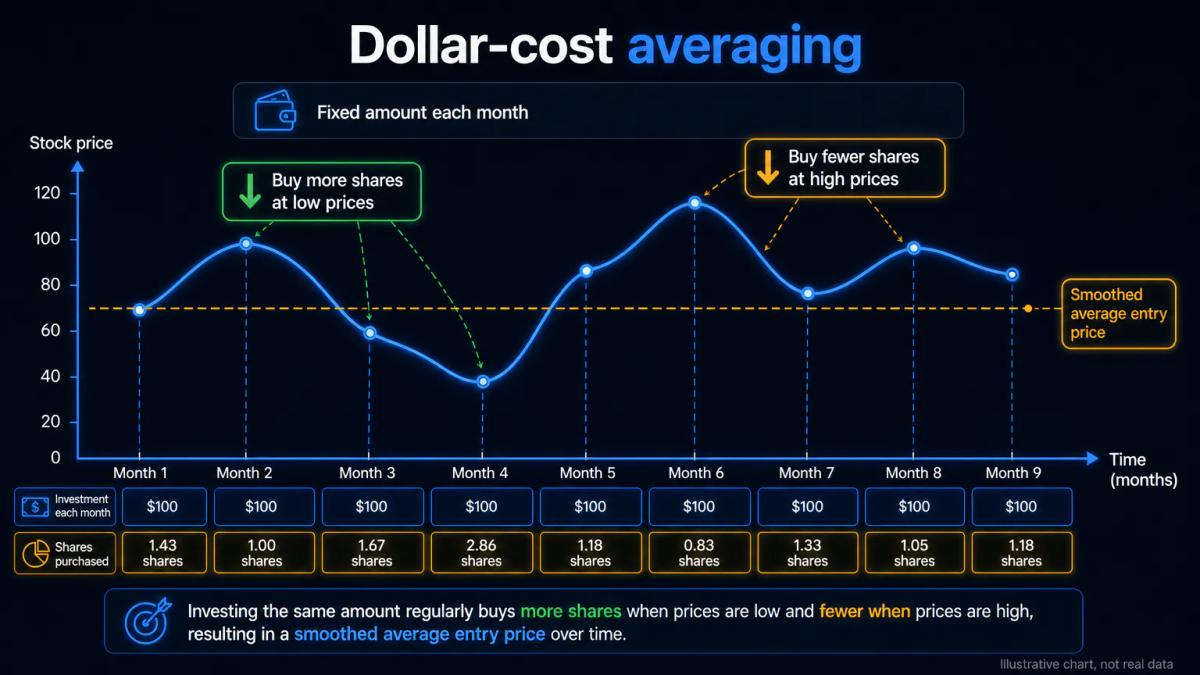
Dollar-cost averaging means investing a fixed amount at regular intervals (typically monthly), regardless of the market price on that day. You buy more shares when prices are low and fewer when prices are high, which smooths your average entry price and removes the pressure to guess the right moment.
According to SEC Investor.gov, a hypothetical 7% average annual return applied to regular monthly contributions over 40 years produces the standard compounding illustration used in retirement planning. The engine of that outcome is the monthly habit itself rather than any single well-timed entry. A trader who tries to time entries typically underperforms a disciplined contributor who buys on the first working day of every month, largely because attempts at timing tend to miss recovery rallies while capital sits in cash.
Beginners benefit twice: the mechanical rule removes emotion, and the small individual amounts make a market drop feel like an opportunity to buy at a discount rather than a personal loss. Understanding [how many trades per day you should make] can help you avoid the temptation to overtrade and stick to your systematic plan.
Adjust your allocation as your life changes
Your investment amount should shift with major life events. A pay rise, a new mortgage, the arrival of a child, the ending of a debt, a career change, or approaching retirement all change the percentage that makes sense. Set a fixed review date once a year, usually at the tax year boundary, and a triggered review whenever any of those events happen.
Rebalancing works on two levels at once. At the contribution level, you are asking whether the monthly amount still matches your income and obligations, while at the portfolio level, you are checking whether the split between stocks, bonds and cash has drifted from your target: a strong stock year can push a 70/30 portfolio to 80/20 and quietly raise your risk.
Trim the overweight side back to target once a year, or whenever a holding drifts more than 5 percentage points from its plan, and try to do this inside a tax-advantaged account so you avoid triggering a taxable event.
Tax-efficient accounts and geographic diversification
Where you invest carries almost as much weight as how much you invest. Tax-advantaged accounts preserve returns that would otherwise leak away to HMRC or the IRS. In the UK, a stocks and shares ISA shelters up to £20,000 per tax year from capital gains and dividend tax, and a SIPP or workplace pension adds tax relief on the way in. In the US, a 401(k) captures employer matching (an immediate return you will not beat elsewhere) and an IRA extends tax-advantaged capacity further. According to SEC Investor.gov, Trump Accounts, tax-advantaged investment accounts for US citizens under age 18, launch on July 4, 2026, adding a new option for parents planning long-horizon contributions.
Geographic diversification is the second lever you can pull. A UK investor holding only FTSE 100 shares ends up concentrated in a small handful of sectors, most obviously:
- Energy.
- Banks.
- Mining.
- Consumer staples.
A globally diversified index fund (a low-cost fund that tracks a broad basket of world stocks) spreads exposure across developed and emerging markets and reduces the impact of any single country underperforming for a decade. Exploring [passively managed index funds versus active funds] can help you decide which approach aligns with your investment philosophy and time commitment.
This content is general information and not advice: every situation needs checking with a licensed professional in the relevant jurisdiction.
Frequently Asked Questions
How do I assess my personal finances to define my investment amounts?
List your after-tax monthly income, then subtract fixed needs (housing, utilities, insurance, minimum debt payments), variable essentials (food, transport) and current savings goals. What remains is your investable surplus, which you can sanity-check against the 50/30/20 framework: if your needs already exceed 60% of income, your investable percentage will be smaller, and that is a realistic starting point to build from. Before directing any of that surplus into stocks, confirm the emergency fund covers 3 to 6 months of essentials.
What if I have irregular income or freelance work? How much should I invest then?
Base your monthly investment on your lowest expected income month across the past 12 months rather than your average, then set an automatic transfer at that conservative level and top the account up manually in stronger months. Freelancers also benefit from a larger cash buffer, typically 6 to 12 months of expenses rather than 3 to 6, because income gaps are longer and less predictable. Keep tax reserves in their own account, separate from both the emergency fund and the investment account.
Should I invest a lump sum or spread it out over time?
For a windfall such as an inheritance, a bonus or a house sale surplus, historical data on long horizons tends to favour investing the lump sum in one go, because markets rise more often than they fall. Behaviourally, most beginners find that unbearable, so a common compromise is to split the lump sum into 6 or 12 equal monthly tranches and automate the contributions. For regular income, dollar-cost averaging monthly is the default choice, because it matches the natural cadence of your pay.
How often should I review and adjust how much I am investing in stocks?
Schedule a fixed annual review, usually at the start of the tax year, together with a triggered review whenever a major life event changes your income or obligations, such as a job change, a house purchase, a new child, a divorce or approaching retirement. At each review, check whether the monthly amount still fits your income, whether your portfolio has drifted more than 5 percentage points from its target allocation, and whether your time horizon has shortened enough to warrant reducing equity weighting.
About the authors


Put this into practice
Related articles

How to Become a Trader: A Practical Roadmap for Retail Traders
A step-by-step guide to becoming a retail trader in the UK: capital, platforms, FCA leverage caps, tax duties, and the discipline that separates traders from gamblers.

How to Buy ETFs: A Step-by-Step Guide for Retail Traders
A practical guide to buying ETFs: from opening a brokerage account and choosing the fund to placing your first order, managing fees, and rebalancing.

How to Day Trade for a Living: A Realistic Roadmap
A practical roadmap to day trading for a living: capital, rules, risk limits, broker selection, tax reporting and the daily routine that separates survival from a blown account.
0 comments