



How to Trade · Beginner · 11 min read
How to Day Trade for a Living: A Realistic Roadmap
The core reality: what day trading for income actually means
Day trading for a living involves executing multiple trades within a single session to generate income from short-term price movements, and closing every position before the market shuts. To make it work you need consistent profitability, disciplined risk management, and enough capital to absorb losing streaks while meeting your jurisdiction's regulatory minimums. Most retail traders find this considerably harder than it appears on a chart at the weekend.
You are competing against institutional algorithms that price liquidity in microseconds, and you pay a spread (the gap between the buy and sell price) plus commissions on every trade you place. Before you break even, the market has to move in your favour by more than the combined transaction cost of getting in and out. On a $25,000 account with tight stops, a handful of poor decisions in the same week can quietly erase a month of gains.
The psychological cost sits alongside the financial one, and it tends to be the first thing that breaks. When your rent depends on this week's trades, your judgement compresses under the pressure: you hold losers too long and cut winners too early, then repeat the loop the next morning. The people who make day trading work treat it as a job with fixed hours, written rules, and measurable output, and they steer well clear of any framing that resembles a lottery ticket. Everything that follows in this article assumes that framing: a business you build slowly, with rules that survive contact with a bad Monday morning.
Putting this into practice means opening an account: start with the best forex brokers our team reviewed.
Is it possible? Success rates and what the data shows
Earning a living from day trading is possible, and the base rate for reaching that outcome remains unforgiving. Peer-reviewed studies of retail day traders in equities and futures consistently find that only a small minority produce net profits after costs across a sustained period, and an even smaller fraction earn more than a median salary from the activity. Every regulator in a major market publishes a variant of the same warning about retail speculation carrying a high probability of loss over time.
According to the FCA, most retail investor accounts lose money when trading CFDs (contracts for difference, leveraged derivatives that track an underlying market). US and Australian regulators publish similar figures in the 70 to 80 percent range depending on the product being measured. What these numbers point to consistently, regardless of the exact percentage in any given study, is that day trading is an activity where the average participant ends up subsidising the successful minority.
The traders who cross into the profitable minority tend to share several observable traits. Most spend between six and twenty-four months practising a defined method before they scale capital in any meaningful way, and they keep a written trading plan that they can actually follow when the session gets ugly. Every trade is logged, losers get reviewed together on a weekly basis, and adding size to recover a bad day is treated as a rule break rather than a heroic decision. They also accept that a winning month is a distribution of small wins offset by bounded losses, rather than a run of clean victories. If sitting inside that routine for a year without a stable paycheck sounds intolerable, the odds are unlikely to tilt in your favour.
What it takes: the skills, mindset, and resources you need
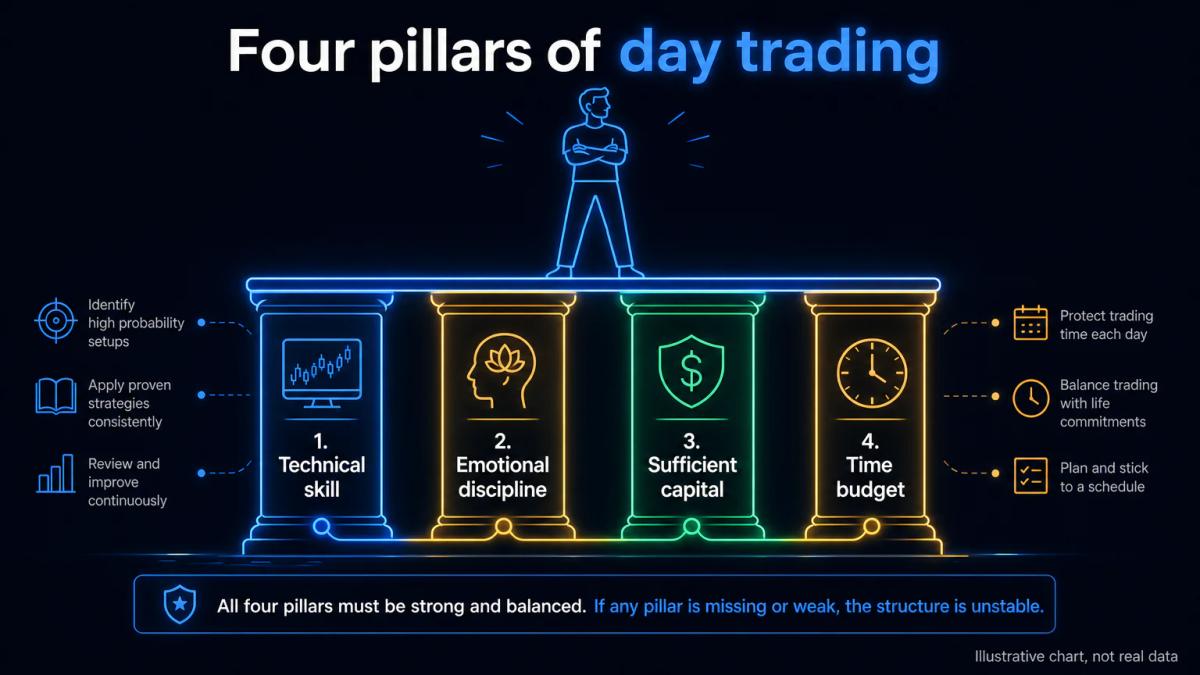
Day trading for a living rests on four pillars:
- Technical skill
- Emotional discipline
- Sufficient capital
- A genuine time budget.
Miss any one of them and the remaining three cannot realistically compensate for the gap.
Technical skill is your ability to read price action, size a position appropriately for the volatility in front of you, and place a stop loss (a preset order that closes a losing trade at a defined level). Discipline is what allows you to follow that same plan on a morning when you are already down $400 by ten o'clock and the temptation is to double the next entry.
The physical constraints on the operation come from capital and time, both of which are unforgiving in different ways. Undercapitalised traders end up taking oversized risk to hit their income targets, and that combination mathematically guarantees ruin over enough trades. Traders who underbudget their time will miss the setups that only appear in the first and last hour of the session, which is where much of the day's edge tends to live. The table below sets a realistic floor for each pillar.
| Pillar | What it looks like | Realistic minimum |
|---|---|---|
| Technical skill | Can identify a setup, define entry, stop and target in advance | 6 months of screen time and journaled trades |
| Emotional discipline | Follows written rules after a loss, does not add size to recover | Demonstrated across at least 200 live trades |
| Starting capital | Enough to risk 1 percent per trade and still cover 6 months of expenses | $25,000 for US pattern day traders, plus separate living costs |
| Time commitment | Present at the desk for the full session, plus prep and review | 4 to 8 hours per trading day |
| Tools | Reliable broker, charting platform, stable connection | MT4, MT5, cTrader or TradingView, plus a wired connection |
| Temperament | Treats losses as data, not identity | Verifiable in a journal, not self-reported |
If you cannot check every row honestly, closing the gap becomes your first project before any live capital is at risk.
Step-by-step: how to build a day trading operation
Build the operation before you scale the capital behind it. A sensible first phase runs three to six months of structured education: read two or three respected books on price action and risk, take one paid course from a trader with a verifiable track record, and paper trade (simulated trading with no real money) a defined strategy for at least ninety sessions. Paper trading is where you find out how wide the gap is between knowing a rule and executing it when the tick starts moving.
Next, open a brokerage account that fits your jurisdiction. In the US, the pattern day trader rule requires a $25,000 minimum equity balance if you cross the threshold defined by the SEC. According to SEC Investor.gov, a customer is defined as a pattern day trader when they execute four or more day trades within five business days, provided those day trades exceed more than 6% of total trades in the margin account over the same period. In the UK, a retail account is subject to FCA leverage caps rather than a fixed minimum, but you still need working capital plus a living buffer.
Write the trading plan before you fund the account. The plan should name the markets you will trade (for example EUR/USD, S&P 500 futures, or FTSE 100 CFDs), the timeframes involved, the exact entry and exit rules, the maximum loss per trade, and the daily loss limit that stops you out for the day. Once the account is live, execute at the smallest position size your broker allows, log every trade with entry, exit, reason and outcome, and review the log every weekend without exception. Treat the first six months of live trading as evidence-gathering about whether the plan survives contact with your own psychology, with any income being a secondary consideration.
Money management and position sizing for survival
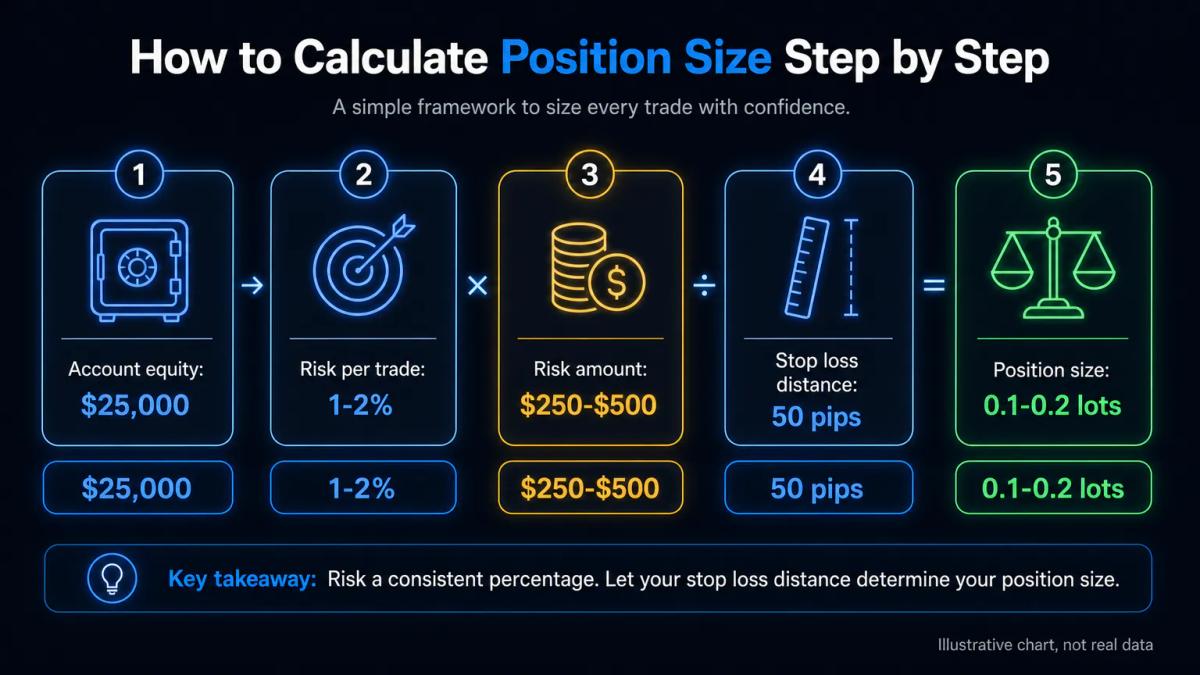
Money management is what decides whether a bad week becomes a footnote in the journal or an eviction notice on the fridge. The industry-standard rule is to risk no more than 1 to 2 percent of account equity on any single trade, which on a $25,000 account translates to $250 to $500 of risk per position, where risk equals the distance from entry to stop loss multiplied by position size. When a sensible stop cannot fit inside that risk budget, the trade is simply too big for the account.
Set a daily loss limit before you sit down, typically 3 to 5 percent of account equity, which comes out at $750 to $1,250 on a $25,000 account. When you hit that limit, close the platform and go and do something else for the rest of the day. Enforcing this rule consistently is what separates a normal losing day from revenge trading (piling on larger trades to recover a loss quickly), which is the mechanism behind most blown retail accounts. A weekly loss limit of 6 to 8 percent gives you a useful second brake operating on the same principle.
Position sizing also has to respect the leverage caps that apply to you. Under the FCA, UK retail clients can access maximum leverage of 1:30 on major forex pairs, 1:20 on major indices, 1:5 on individual equities, and CFDs on cryptoassets are prohibited for retail entirely. Treat those headline numbers as a ceiling rather than something to aim for, because sizing to the ceiling turns a routine 2 percent adverse move into an immediate margin call.
Regulatory rules, taxes, and broker selection
Regulation shapes what you can trade, how much leverage you get, and how you report profits. In the US, the SEC's pattern day trader rule sets the $25,000 minimum described above. According to SEC Investor.gov, the trigger is four or more day trades within five business days, where those day trades represent more than 6% of total trades in the margin account over the same period. Drop below $25,000 and your broker will restrict day trading until you top up.
In the UK, FCA rules govern retail CFD and spread bet trading. Leverage is capped by asset class: 1:30 on major forex, 1:20 on major indices and gold, 1:10 on other commodities and non-major indices, 1:5 on individual equities, with CFDs on cryptoassets banned for retail clients altogether. UK residents who open an account with a group's offshore entity fall outside FCA protection, so it is worth verifying which entity onboards you and under which licence before you fund anything. An FCA-authorised entity sits at the top of the regulatory hierarchy for UK retail, while offshore entities generally carry weaker recourse if something goes wrong down the line.
Taxes are jurisdiction-specific and unavoidable. In the UK, HMRC generally treats CFD profits as capital gains and spread betting gains as tax-free for individuals, but frequent trading can be reclassified as income; check with a UK tax adviser. In the US, the IRS treats most day trading gains as short-term capital gains taxed at ordinary income rates, unless you qualify for trader tax status. In Australia, the ATO usually treats active traders' profits as ordinary income. In every case, keep the full trade log: regulators and tax authorities expect it.
Broker selection follows the same logic. The table below is the minimum comparison framework.
| Criterion | What to check | Why it matters |
|---|---|---|
| Regulator | FCA, ASIC, CySEC, SEC, or offshore | Determines your legal protection and leverage caps |
| Commission and spread | Round-trip cost per lot or per share | You pay it on every trade, it compounds fast |
| Execution | Slippage on stops, requotes, latency | Bad execution converts winning strategies into losing ones |
| Platform | MT4, MT5, cTrader, TradingView, proprietary | Must match your strategy and asset class |
| Deposit and withdrawal | Methods, currencies, processing time | Access to your capital is not optional |
Common pitfalls and how to avoid them
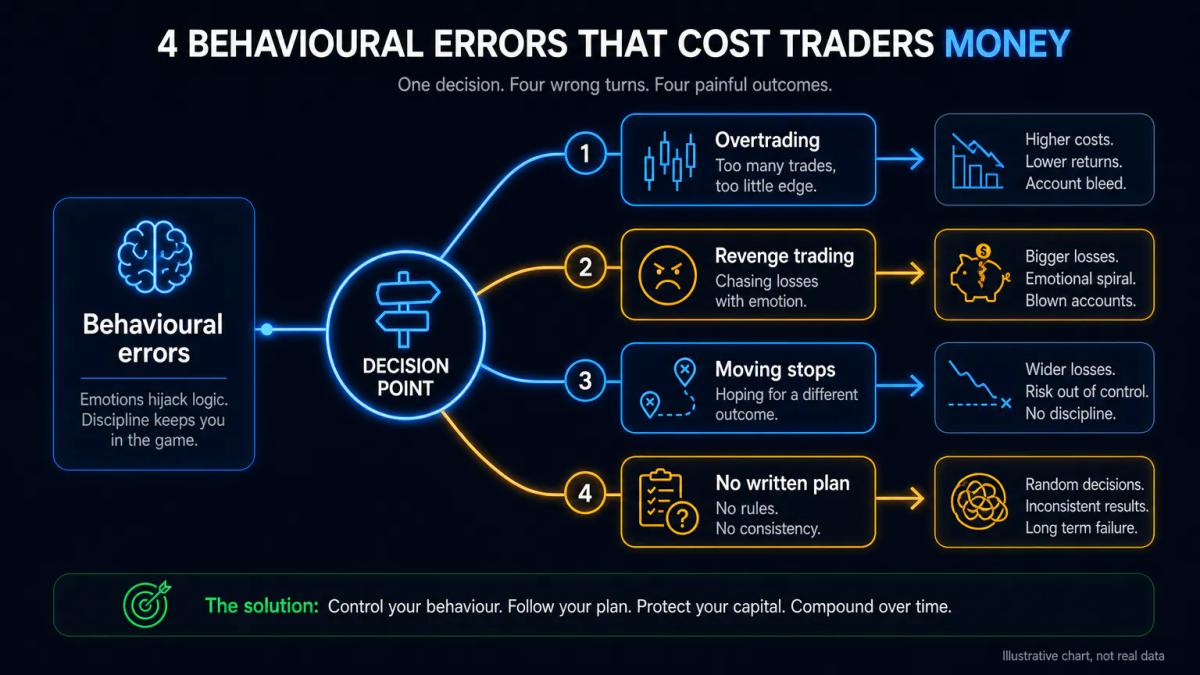
Most blown accounts die from the same short list of mistakes: overtrading (taking trades to feel productive rather than because a valid setup appeared), revenge trading (doubling size after a loss to recover fast), ignoring the stop loss (moving it further away because you are sure the market is about to turn), and trading with no written plan at all (entering on a chat-room tip or a gut feeling). Every one of these sits on the behavioural side of the ledger rather than the technical one, which is the reason additional education tends to leave them largely untouched.
The countermeasures for these behaviours are almost entirely procedural. Write the rules the evening before, in full sentences, covering which setups qualify, the maximum risk per trade, the daily loss limit, and the exact action you will take if you hit it during the session. Use price alerts instead of watching the screen for hours at a stretch, since boredom tends to generate trades that never existed in the plan. Every loss should be treated as one data point inside a wider distribution rather than a verdict on your competence, and the place to review it is the journal at the weekend rather than the next trade thirty seconds later.
The weekly review is the single highest-leverage habit in the whole operation. Open the journal every Sunday, tag the losses by cause (setup failure, execution error, rule break, market conditions), and count how many of them were rule breaks rather than the market simply not cooperating. When more than 10 percent of trades in a month fall into the rule-break bucket, the underlying issue is a discipline one, and no additional indicator on the chart will help you close the gap.
The daily routine and time commitment
Day trading demands active attention throughout the session and a genuine full-time commitment for as long as you are in front of the market. You need to be at the desk during the session you trade, which typically runs 4 to 8 hours depending on the market you focus on. For London equities that means 8 a.m. to 4.30 p.m. UK time, while New York futures traders tend to work around the high-liquidity windows near the US open and close. Missing the opening hour to answer email is a reliable way to miss the day's clearest setups.
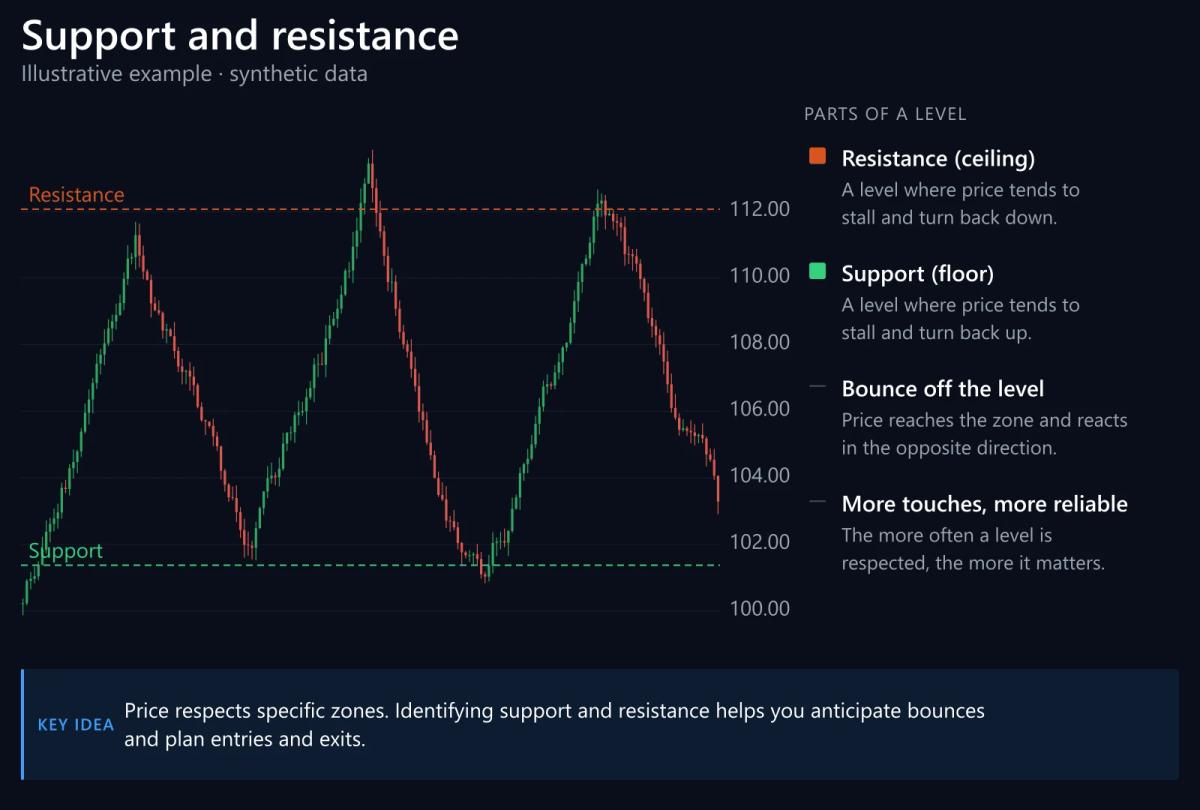
A workable routine breaks into three blocks either side of the session. Before the open, review overnight news, mark support and resistance on your key charts, confirm the economic calendar, and set alerts across your watchlist so nothing needs constant attention. During the session itself, execute only the setups already defined in your plan, manage open positions with the stop sitting live in the market, and log each trade as soon as it closes rather than at the end of the day. After the close comes the review: tag each trade by outcome and cause, update the weekly totals, and prepare tomorrow's watchlist while today's context is still fresh. Trying to run this routine alongside a full-time job is extremely difficult in practice, because reacting to setups and managing risk in real time is not something you can do from a meeting room.
SEC Investor.gov: A customer is defined as a pattern day trader when they execute four or more day trades within five business days, provided those day trades exceed more than 6% of total trades in the margin account over the same period.
This content is general information and not advice: every situation needs checking with a licensed professional in the relevant jurisdiction.
Frequently Asked Questions
How much money do you need to start day trading for a living?
In the US, the SEC pattern day trader rule requires a $25,000 minimum in a margin account once you cross the four-day-trades-in-five-business-days threshold. In the UK there is no fixed regulatory minimum, but a realistic working figure is $25,000 to $50,000 of trading capital, plus six to twelve months of living expenses held separately. Undercapitalised traders take oversized risk to hit income targets, which mathematically leads to ruin over enough trades.
What is the pattern day trader rule and how does it affect me?
According to SEC Investor.gov, a customer is defined as a pattern day trader when they execute four or more day trades within five business days, provided those day trades exceed six percent of total trades in the margin account over the same period. Once flagged, your broker requires a minimum equity of $25,000 to continue day trading in a US margin account. Drop below and day trading is restricted until you top the account up.
How long does it take to become profitable as a day trader?
Realistic timeframes are 12 to 24 months of dedicated practice before consistent profitability, and often longer before profits are large enough to replace a salary. Plan for three to six months of paper trading, then six to twelve months of live trading at the smallest position size while you validate your plan. Traders who compress this timeline by scaling capital early tend to blow the account and start over.
What markets are best for day trading: forex, stocks, or indices?
The best market is the one whose hours, volatility, and cost structure fit your life and account. Forex majors offer 24-hour access and tight spreads but low intraday range; US equities need the $25,000 pattern day trader minimum and offer strong setups; index futures and CFDs like the S&P 500 or FTSE 100 give focused hours and clear liquidity windows. Pick one, master it for at least a year, then consider adding a second.
Can you day trade part-time while working another job?
It is extremely difficult. Day trading rewards presence at the open and close, real-time risk management, and undivided attention; a full-time job removes all three. Swing trading, where positions are held for days to weeks, fits a part-time schedule far better. If you must combine, restrict yourself to one clearly defined setup, use hard stop losses in the market, and expect worse results than a full-time trader running the same strategy.
About the authors


Put this into practice
Related articles

How to Find Stocks to Day Trade: A Practical Screening Approach
A practical, beginner-friendly framework for screening day trading stocks by volume, volatility, chart patterns, sector strength, and broker tools.

How to Start Trading for Beginners: A Step-by-Step Guide
Learn how to start trading for beginners with this easy guide. Covers account setup, your first trade, risk management, and the key factors that move markets.

How to Trade Oil Futures: A Step-by-Step Guide for Retail Traders
A practical walkthrough of how to trade oil futures: WTI and Brent contracts, margin, position sizing, charting setup and seasonal drivers.
0 comments