



How to Trade · Beginner · 10 min read
How to Find Stocks to Day Trade: A Practical Screening Approach
The core criteria for day trading stocks
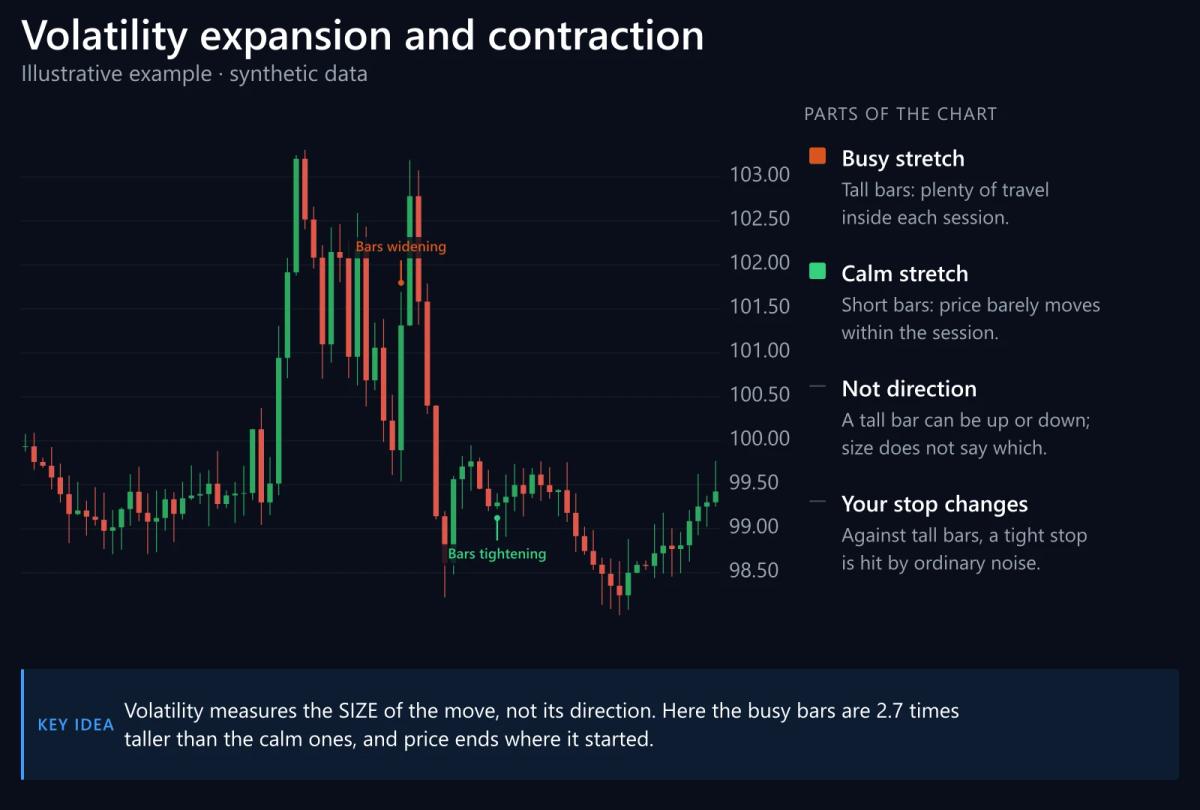
Day-tradeable names sit at the intersection of three conditions that a stock has to satisfy simultaneously before it earns a place on your watchlist:
- High daily volume, at least 1 million shares traded, so there is always a counterparty on the other side of your order.
- Tight bid-ask spreads, ideally under 0.05% of the share price, so the round-trip cost of entering and exiting does not eat your edge.
- Intraday volatility of roughly 2% to 5% between the day's high and low, so there is enough range to place a stop and a profit target inside a single session.
Anything below these thresholds and you cannot enter and exit within one session without giving away edge to slippage and execution costs.
Each of the three criteria addresses a different execution problem. Volume gives you counterparties, so when you want to sell there are buyers on the tape and your exit price does not drift against you. Tight spreads keep the round-trip cost of entering and exiting small enough that a 1% move actually reaches your account rather than being clipped by market makers. Volatility gives you something to capture, because a stock that moves only 0.3% intraday leaves no room to fit a stop loss (a preset exit that caps your loss) and a profit target on the same trade.
Beginners often start with the S&P 500's most active names because they usually satisfy all three at once. According to the U.S. Securities and Exchange Commission, day trading is defined as buying and selling the same security within a single trading day, and the SEC classifies anyone executing four or more such round trips within five business days in a margin account as a pattern day trader, which triggers the $25,000 minimum equity rule discussed later.
Putting this into practice means opening an account: start with the best forex brokers our team reviewed.
Screening for volume and liquidity
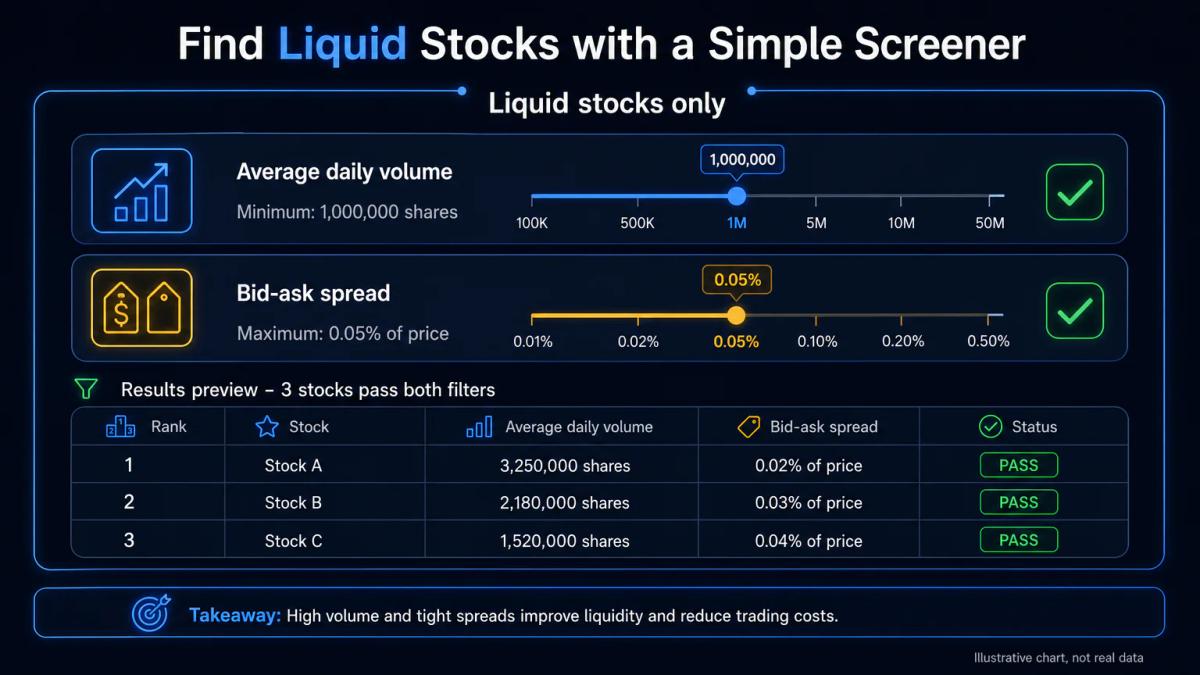
Use your broker's native stock screener or a free tool such as TradingView's stock screener to filter the universe down to tradeable names. Set the first filter to average daily volume above 1 million shares over the past 30 days. This alone removes the bulk of the market and leaves you with names where you can move in and out without materially affecting the price.
Add a second filter for the bid-ask spread. Liquid large-caps typically show spreads of one or two cents on a £100 share, which is under 0.05%. Anything wider means the market maker charges you more to trade the name, and that cost compounds across dozens of trades a week. A useful sanity check: if the spread is wider than 10% of your expected profit per trade, the name is probably not worth trading intraday.
A third filter is price. Stocks under $5 are often marginable at lower ratios, quote in wider percentage spreads, and see erratic tick behaviour. Most beginners are better served by names priced between $20 and $500. Above that, share size shrinks and position sizing (calculating how many shares to buy for a given risk in dollars) becomes a fractional-share problem your broker may not fully support.
| Filter | Threshold | Purpose |
|---|---|---|
| Average daily volume | > 1,000,000 shares | Counterparties on demand |
| Bid-ask spread | < 0.05% of price | Low round-trip cost |
| Share price | $20 to $500 | Manageable position sizing |
| Market cap | > $2 billion | Reduces manipulation risk |
Identifying volatility and price range
Liquidity alone does not pay you: a highly liquid stock that trades in a 0.4% band all day gives you nothing to work with. Measure volatility with the Average True Range (ATR), an indicator that averages the true daily range (high minus low, adjusted for gaps) over a lookback window, typically 14 days. For a $100 stock, an ATR of $2 to $3 (roughly 2% to 3%) is a healthy intraday range for beginner setups. Finding and trading the most volatile stocks requires balancing this range against your risk tolerance and position size.
Stocks in the news tend to run hotter than their ATR suggests. Earnings releases, U.S. Food and Drug Administration decisions for biotech names, and macroeconomic prints such as U.S. non-farm payrolls or the U.S. Consumer Price Index can multiply a stock's usual range for a session or two. According to the Bureau of Labor Statistics, the CPI is released monthly on a schedule published in advance, so you can plan which sessions are likely to see elevated volatility in rate-sensitive names.
A practical routine: every evening, pull a list of tomorrow's earnings, scheduled economic releases, and any known corporate events, then cross-reference against your liquidity-screened universe. Names that appear on both lists become your watchlist for the next session. This kind of preparation turns news-driven volatility from a random risk into a planned opportunity, and leaves you with fewer than 10 names to focus on rather than the entire market.
Using technical analysis and chart patterns
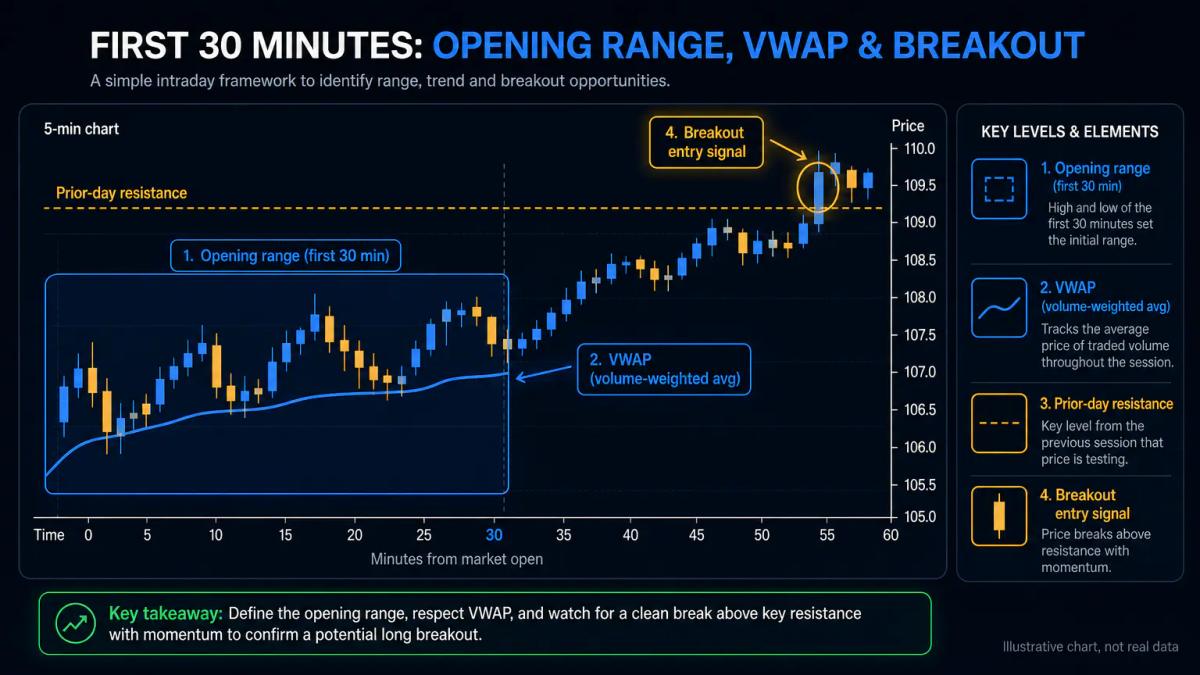
Once a stock passes the liquidity and volatility filters, price action and technical analysis help you time the entry. Stick to a small set of high-probability patterns on the 5-minute and 15-minute charts: opening range breakouts, pullbacks to the volume-weighted average price (VWAP), and reversal candles at prior-day support or resistance.
An opening range breakout takes the high and low of the first 15 or 30 minutes of trading and buys a close above the high or shorts a close below the low. VWAP is the average price weighted by volume from the market open, and it acts as a fair-value line institutions defend during the session. Trading a pullback to VWAP in the direction of the prevailing trend is one of the cleanest beginner setups because the level is unambiguous and shared by other traders.
Anchor every entry to a stop loss placed at a technical level rather than at a round dollar figure. If the setup is a breakout above the opening range high, the stop belongs a few cents below that level, because a return there means the setup has failed. Your position size follows from the stop distance: risk a fixed fraction of account equity per trade, typically 0.5% to 1%, so that a losing streak cannot compound into a drawdown you would struggle to recover from.
Sector rotation and market breadth signals
Stocks rarely trend against their sector, and sectors rarely trend against the broader market. Before choosing individual names, check which sectors are leading on the day using sector ETFs (exchange-traded funds that track a basket of stocks). A stock inside the day's strongest sector has a tailwind, whereas a strong-looking chart inside a weak sector often fails. The four sector ETFs a beginner should keep on the screen every session are:
- XLK for technology.
- XLE for energy.
- XLF for financials.
- XLV for healthcare.
Market breadth measures how many stocks are participating in a move. The NYSE advance-decline line, published by the New York Stock Exchange, counts the difference between advancing and declining issues and reveals whether an index rise is broad-based or driven by a handful of mega-caps. A rising index paired with negative breadth is a warning signal, because narrow momentum tends to reverse, which becomes a real problem when your intraday long is fighting a broader sell in mid-caps.
Build a simple pre-market routine of three steps:
- Check overnight index futures to gauge the tone of the session.
- Note which sector ETFs are gapping up or down against their prior close.
- Filter your liquidity-screened watchlist to names inside the leading sector.
This alignment step alone removes many of the trades that look attractive in isolation but fail because they were fighting the tape.
Paper trading and backtesting before live trading
Before risking real capital, run your screening rules and entry setups on a demo account for at least two weeks and, in parallel, backtest them on historical data. Learning how to day trade for a living includes mastering the demo workflow, the screener, the chart pattern recognition, and the order entry without losing money. Two weeks is a minimum; a full month covers a wider variety of market conditions.
Backtesting means applying your rules to past price data and recording every hypothetical trade the rules would have produced. Most charting platforms, including TradingView, include a bar-replay feature that lets you step through history one candle at a time, so you cannot accidentally see the future. Record every trade in a spreadsheet with entry, stop, target, outcome, and the reason for the trade, and once you have logged around 50 trades you have a distribution large enough to draw early conclusions from.
Judging the sample on win rate alone can mislead you, because many profitable intraday strategies win less than half the time yet still deliver strong returns thanks to a reward-to-risk ratio above 2:1. The two metrics to focus on are total profit after realistic costs (commissions and the average slippage you observed on your demo fills) and the maximum drawdown, meaning the largest fall from a capital peak to the trough before a new peak, which should be small enough that you would keep trading through it without losing conviction.
Broker tools and platform considerations
The platform you trade on decides whether your screening work translates into fills. For stock day trading, MetaTrader 4 and MetaTrader 5 are secondary choices because they were built primarily for forex and CFDs (contracts for difference, derivatives that track the underlying price without owning the share). Prefer a broker's native equities platform or a professional tool such as TradingView Pro that connects to a supported broker for direct order entry.
Understanding self-directed brokerage accounts helps you evaluate which platform and broker structure best suits your workflow.
Evaluate any platform on four points:
- Real-time Level 2 data, meaning the full order book alongside the best bid and offer.
- Scanner speed, so that a watchlist rebuilt mid-session updates before the setup has passed.
- Order routing options, including access to specific ECNs and control over marketable versus non-marketable orders.
- Commission structure: per-share commissions tend to suit larger trades in cheap stocks, while flat per-trade commissions tend to suit smaller, more frequent trades in higher-priced names.
UK retail clients dealing in U.S. shares should also confirm which group entity is onboarding them and under which licence, because an FCA-authorised UK entity offers stronger client-money protections than an offshore group entity of the same brand.
Tax and wash-sale rules for frequent traders
Day trading is a tax-heavy activity, and beginners routinely underestimate the drag. In most jurisdictions, gains on positions held less than a year are taxed as short-term and, in the United States, at ordinary income rates: according to the Internal Revenue Service, short-term capital gains are taxed at the same rates as wages. In the United Kingdom, HMRC treats frequent share trading gains as capital gains in most retail cases, subject to the annual allowance and current CGT rates published on gov.uk.
The wash-sale rule is the second trap for active traders. According to the Internal Revenue Service, if you sell a security at a loss and buy the same or a substantially identical security within 30 days before or after the sale, the loss is disallowed and added to the cost basis of the replacement position. For an active day trader, this can defer losses across dozens of trades and produce a tax bill that does not match your net cash outcome, so track every trade in a dedicated spreadsheet or trade-journalling tool from day one and consult a tax professional in your jurisdiction before scaling up.
U.S. Securities and Exchange Commission: A pattern day trader is any customer who executes four or more day trades within five business days in a margin account, and must maintain at least $25,000 in equity in that account on any day on which day trading occurs.
This content is general information and not advice: every situation needs checking with a licensed professional in the relevant jurisdiction.
Frequently Asked Questions
What is the minimum volume a stock should have for day trading?
One million shares of average daily volume over the past 30 days is a practical floor. Below that, bid-ask spreads widen, fills drift against you on larger orders, and single institutional orders can jerk price outside your technical setup. Highly active large-caps often trade 10 to 50 million shares a day and are the easiest names for a beginner to work with.
How do I know if a stock is volatile enough to day trade?
Check the 14-day Average True Range. For a $100 stock, an ATR of $2 or more (roughly 2%) is enough room to place a stop and a profit target on the same intraday trade. Also flag names with an earnings release, an economic data event, or a corporate catalyst in the next session, as they typically expand their normal range.
Can I day trade stocks with less than $25,000 in my account?
In a U.S. margin account, no more than three day trades per five business days without triggering pattern day trader status, which requires $25,000 minimum equity according to the SEC. Cash accounts have no such rule but restrict you to unsettled funds. UK retail traders using an FCA-authorised broker are not subject to the $25,000 rule but face FCA leverage caps.
What is the difference between day trading stocks and swing trading?
Day trading closes every position before the market closes, so you carry no overnight risk from gaps or news. Swing trading holds positions from two days to several weeks and targets larger moves, accepting overnight exposure. Day trading demands tighter spreads and higher volume because you trade more often; swing trading tolerates less liquid names because entries and exits are less frequent.
How do I avoid wash-sale violations when day trading?
According to the Internal Revenue Service, a wash sale occurs when you realise a loss on a security and repurchase the same or a substantially identical security within 30 days. The disallowed loss is added to the cost basis of the replacement position, deferring it rather than erasing it. Log every trade, and consult a tax professional about mark-to-market election under IRS Section 475, which can exempt qualifying traders.
About the authors


Put this into practice
Related articles
How to Start Trading for Beginners: A Step-by-Step Guide
Learn how to start trading for beginners with this easy guide. Covers account setup, your first trade, risk management, and the key factors that move markets.

How to Trade Oil Futures: A Step-by-Step Guide for Retail Traders
A practical walkthrough of how to trade oil futures: WTI and Brent contracts, margin, position sizing, charting setup and seasonal drivers.

How to build a trading bot: setup, security and cost reality
From API keys to backtesting, cost analysis to FCA rules, here is what setting up a trading bot actually involves for UK retail traders.
0 comments