



Trading Basics · Beginner · 4 min read
Pre-Market Trading Hours: Schedule and Broker Rules
The trading day before the bell rings
Pre-market trading gives you the chance to buy and sell shares before the official open. According to the U.S. Securities and Exchange Commission, extended-hours trading happens on electronic communication networks, or ECNs: computer systems that match buy and sell orders directly without a central exchange floor.
That setup creates a harder trading environment. You get lower liquidity, wider bid-ask spreads (the gap between the best buy and best sell price), and faster price swings than the regular session.
Putting this into practice means opening an account: start with the best forex brokers our team reviewed.
Pre-market session times and broker variations
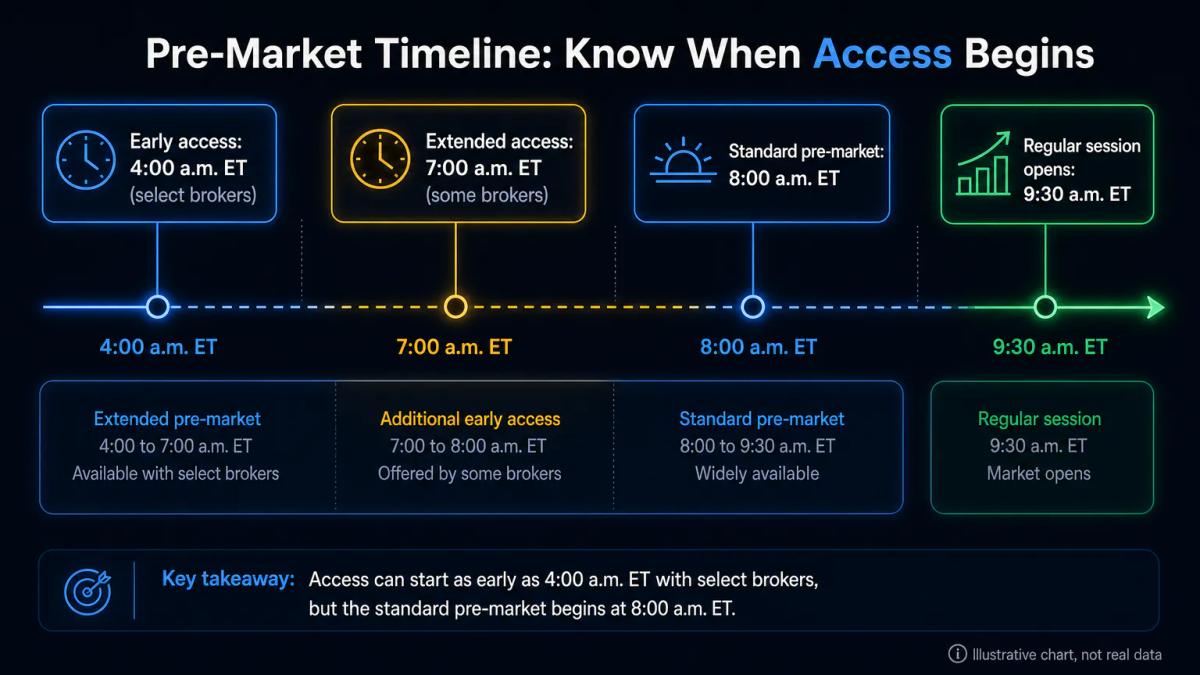
The standard pre-market window opens at 8:00 a.m. ET and closes at 9:30 a.m. ET, when the New York Stock Exchange and Nasdaq begin their regular session.
Some brokers extend access from 7:00 a.m. ET, and a handful start at 4:00 a.m. ET. Check whether your broker supports pre-market access at all before you assume you can trade it. Most retail traders only join the session around earnings announcements or major overnight news. Volume outside those triggers is usually too thin to justify the risk.
If you're considering trading during these volatile windows, understanding whether day trading is worth it can help you assess whether the costs and risks align with your goals.
After-hours trading: the evening session
After-hours trading runs from 4:00 p.m. to 8:00 p.m. ET, right after the regular close. Like the morning session, it uses ECNs and carries the same problems: thin liquidity, wide spreads, sharp gaps between prints.
Not every stock trades after hours. Small-cap names may see minutes without a single transaction. Most retail traders use the evening window to react to earnings released after the bell, or to breaking news from company press rooms. If you need background on how these releases move prices, see our earnings trading guide.
How pre-market and after-hours differ from regular trading
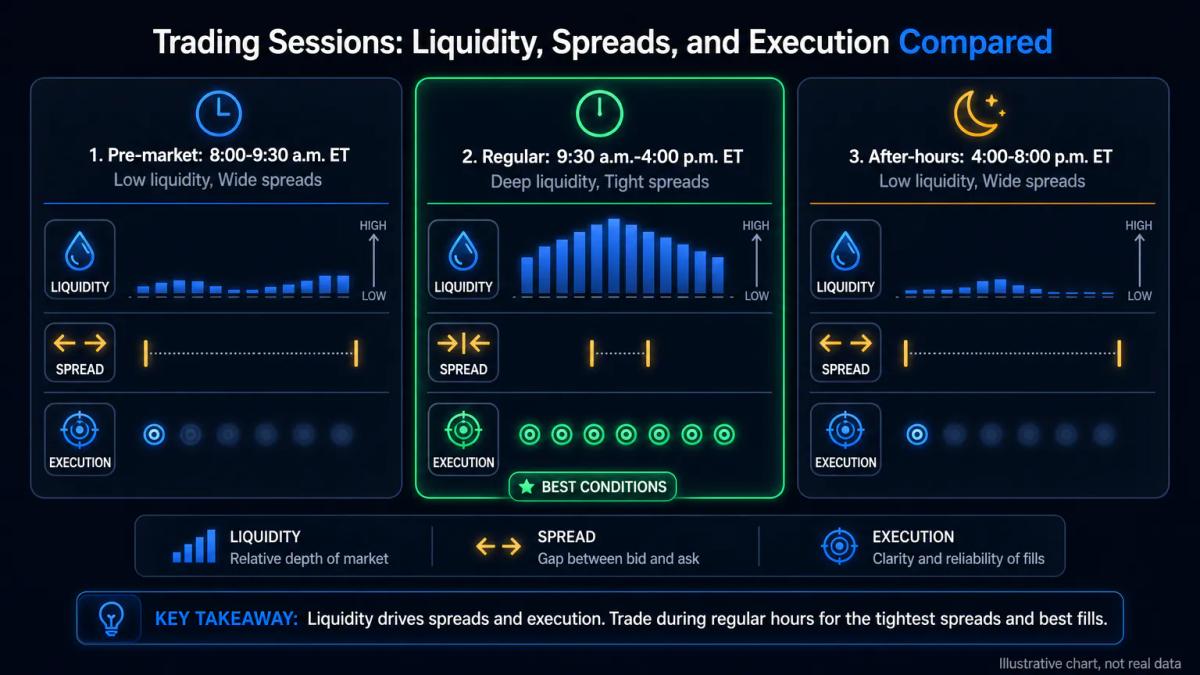
Regular hours (9:30 a.m. to 4:00 p.m. ET) offer deep liquidity, tight spreads, and predictable execution on the main exchange. Extended sessions rely on ECNs, which means fewer participants and larger jumps between trades.
| Feature | Pre-market (8:00 to 9:30 a.m. ET) | Regular (9:30 a.m. to 4:00 p.m. ET) | After-hours (4:00 to 8:00 p.m. ET) |
|---|---|---|---|
| Venue | ECNs only | NYSE, Nasdaq, ECNs | ECNs only |
| Order types | Limit orders only on most brokers | All order types | Limit orders only on most brokers |
| Short selling | Restricted at open | Allowed | Restricted |
| Typical volume | 5 to 10 percent of regular | Full book | 5 to 10 percent of regular |
| Spread width | Wide | Tight | Wide |
Key risk: your order may not fill at your target price, or may not fill at all, because there are fewer counterparties on the other side.
A worked example: you place a 500-share limit order at $150 during pre-market and only 200 shares fill at that price. The remaining 300 sit unfilled until the regular open. That is the core risk of thin liquidity. Understanding what is an order in trading and how different order types behave in low-liquidity environments will help you avoid partial fills and execution gaps.
Broker requirements and eligibility for extended-hours trading
Not every broker offers pre-market and after-hours access. Those that do often set account minimums, opt-in forms, or share-per-order caps. Some platforms restrict extended-hours to accounts holding £2,000 to £5,000 or the local equivalent.
Others require a short knowledge assessment before switching on the feature. Rules also vary by asset: US-listed ETFs usually trade in both sessions, single-stock options do not, and many mutual funds are excluded entirely. Check your broker's terms before assuming you have access. Before you open an account, review the questions to ask before opening a trading account to ensure your broker supports extended-hours trading and meets your other needs.
Frequently Asked Questions
When does pre-market trading open and what time does it close?
Pre-market trading opens at 8:00 a.m. ET and closes at 9:30 a.m. ET on US exchanges. Some brokers offer access from 7:00 a.m. ET, and a smaller group start at 4:00 a.m. ET. The 8:00 a.m. window is the industry standard for retail access.
Can you trade after hours, and what are the after-hours trading hours?
Yes, if your broker supports it. After-hours trading runs from 4:00 p.m. to 8:00 p.m. ET, right after the regular close. Not every stock trades in this window, and volume is a fraction of regular-hours activity.
Why is pre-market trading more volatile than regular trading hours?
Pre-market activity happens on ECNs with far fewer participants than the main exchange. That means wider bid-ask spreads, larger price gaps between trades, and prices that react sharply to earnings or news because there is less order flow to absorb them.
Do all brokers offer pre-market and after-hours trading access?
No. Many discount brokers and newer platforms do not support extended-hours sessions. Those that do usually require an opt-in, may set account minimums between £2,000 and £5,000 or the local equivalent, and cap share sizes per order. Check the broker's terms before assuming access.
About the authors


Put this into practice
Related articles

Prop Firm Challenge vs Live Broker Account: 10 Key Differences Traders Need to Know
Compare prop firm challenges and live broker accounts across capital risk, drawdown rules, costs, profit splits, and trader fit. Ten clear differences explained.

Prop Firm vs Self-Funded Trading: Which Path Makes More Sense for You?
Compare prop firm and self-funded trading across capital, risk, rules, and profit potential - and find out which path fits your situation.

Regulated vs Offshore Forex Brokers: An Honest Risk Assessment
Compare regulated and offshore forex brokers honestly. Understand real fund protections, risks, and how to choose safely.
0 comments