



Trading Strategies · Beginner · 14 min read
Is Day Trading Worth It? A Realistic Look at Costs, Risk, and Who Actually Succeeds
Is day trading worth it? The answer to that question depends exclusively on you, your goals, your trading style and, most importantly, your discipline. Many beginner jump into day trading without considering critical factors, such as sufficient capital, a tested edge, strict risk limits and the emotional discipline to accept losing streaks.
After spreads, slippage, financing and short-term tax rates, most retail day traders lose money in their first year. So for most, the answer is no.
Is day trading worth it? The short answer
Day trading means opening and closing positions inside the same session to profit from small price moves. It can be worth it, but only in a narrow set of conditions: a documented strategy with a positive edge, capital large enough to absorb losing streaks without ruin, and the temperament to follow rules under stress. Absent those, the arithmetic works against you. According to the FCA, most retail investor accounts lose money when trading CFDs, and CFDs are the vehicle most UK day traders use to access leverage on shares, indices and forex.
The honest question is whether you can produce a positive twelve-month result net of costs, taxes and drawdown. As of 2025, that bar is high for a self-directed retail trader, and the sections below break down why: the direct costs, the tax treatment, the psychology, the rules that constrain small accounts, and what the small minority of consistently profitable traders actually do differently.
[FCA, no year]: Most retail investor accounts lose money when trading CFDs, the leveraged instruments most commonly used by UK retail day traders.
Run this strategy on a solid platform — see the best forex brokers.
How day trading works and why the math is stacked against you
Day trading is the practice of buying and selling the same instrument within one trading session, aiming to capture short-term price movements and avoid overnight risk.
You might trade a stock five times in a morning, or scalp a forex pair (a currency exchange rate quoted as one currency against another) for a handful of pips (the smallest standard price increment, usually 0.0001 for major pairs). The idea is simple; the execution is not.
The math is stacked against you for three structural reasons.
- First, every trade pays a cost, either an explicit commission or an implicit spread (the gap between the price you can buy at and the price you can sell at). If your average winning trade is 10 pips and the spread is 1 pip, you have given away 10% of your gross profit before you touched the trade.
- Second, slippage (the difference between the price you expect and the price you actually get) widens during fast moves, exactly when you want to enter or exit.
- Third, leverage magnifies both directions, so a 1% adverse move on a 10:1 position wipes out 10% of your margin, and margin calls force you to close at the worst possible time.
As of 2025, FCA-authorised firms cap leverage for UK retail clients at 30:1 on major forex, 20:1 on major indices, 5:1 on individual equities, and CFDs on cryptoassets are prohibited for UK retail clients entirely.
These caps are protective, but they also mean a small account cannot express a high-conviction view with meaningful size without immediately running into margin constraints. According to ESMA, the leverage restrictions and negative balance protection introduced across the EU are specifically designed to reduce retail losses in CFD and forex products.
Broker fees, commissions, and slippage: the silent profit killer
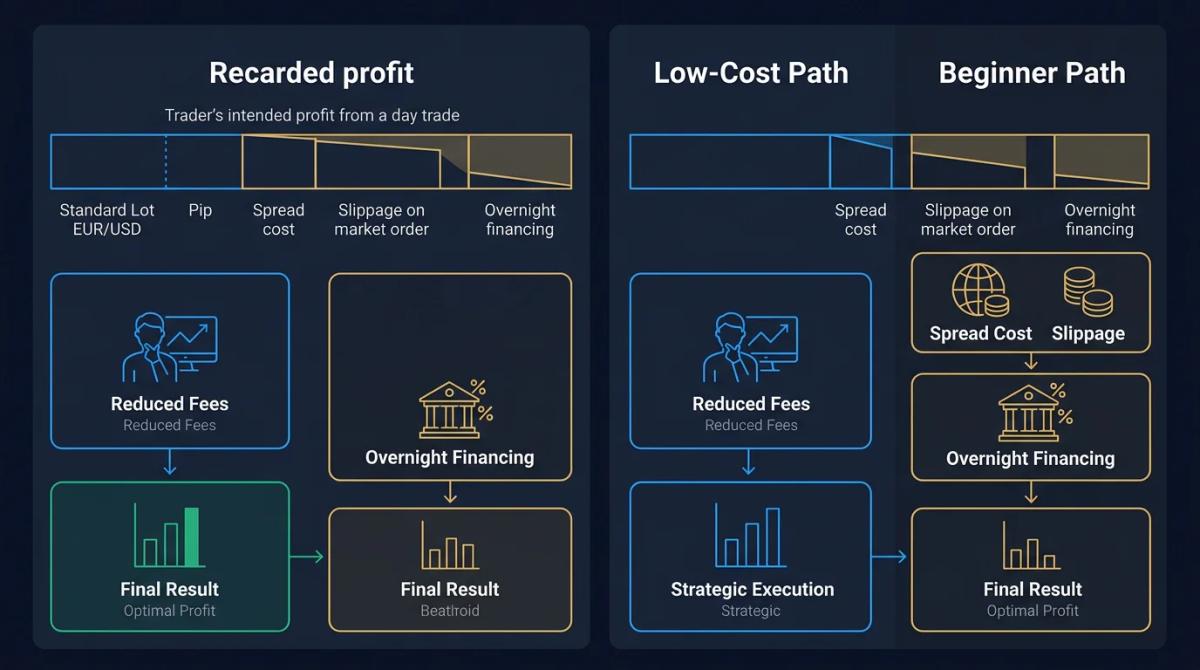
Even with a zero-commission broker, day trading is not free. You pay through the spread on every entry and exit, through slippage on market orders, and through overnight financing (called swap or rollover) if a position slips past the session close. On a leveraged CFD, that financing accrues daily and compounds against you. On US equities routed through a payment for order flow model, price improvement can be poor on fast-moving names, meaning your fill is a few cents worse than the mid-price.
As a working figure, a scalper trading a major forex pair 20 times a day at a 0.8 pip spread on 1 standard lot pays roughly 16 pips a day in spread costs alone, which on a $10,000 account represents 1.6% of equity daily before slippage. Add slippage of 0.2 to 0.5 pips per trade in normal conditions, more in news, and you can easily consume 1 to 3% of your account per month in pure friction, according to cost structures published by FCA-authorised brokers.
| Cost item | Typical retail range | When it bites hardest |
|---|---|---|
| Spread on major forex | 0.6 to 1.5 pips | High-frequency scalping |
| Spread on individual shares | 0.05% to 0.30% | Small-cap and illiquid names |
| Commission (share CFDs) | 0.08% to 0.10% per side | Larger notional trades |
| Slippage on market orders | 0.1 to 2+ pips | News releases, session opens |
| Overnight financing (CFDs) | Benchmark rate + 2.5 to 3.5% | Positions held into new day |
| Currency conversion | 0.3% to 1.0% | Non-base-currency instruments |
Before you count strategy edge, count these costs against your realistic monthly return target. If you aim for 3% a month gross and the friction is 2%, your strategy must be right often enough to net the remaining 1%, which is a much harder problem than the gross number suggested.
Tax treatment and short-term capital gains: what you owe
Day trading profits are taxed as short-term gains at ordinary income rates in most jurisdictions, which materially changes the after-tax result. In the UK, gains from CFDs and spot forex trading by an individual are generally treated under Capital Gains Tax rules, using the annual exempt amount (£3,000 for the 2024/25 tax year, according to HMRC) and then CGT rates above that. Spread betting profits, by contrast, are exempt from CGT for UK individuals, according to HMRC guidance, which is one reason UK retail traders often prefer spread bets over CFDs for short-term activity.
In the US, day trading gains held under one year are taxed as short-term capital gains at your ordinary income rate, which reaches 37% at the top federal bracket, according to the IRS. That is the same rate applied to your salary and considerably higher than the long-term capital gains rate applied to investments held over a year. A £10,000 or $10,000 short-term profit can hand back £2,000 to £4,000 or $2,200 to $3,700 in tax depending on your bracket, before state or devolved tax.
| Jurisdiction | Instrument | Typical retail tax treatment | Source |
|---|---|---|---|
| UK | CFDs, forex | Capital Gains Tax above annual exempt amount | HMRC |
| UK | Spread betting | Exempt from CGT for individuals | HMRC |
| US | Day-traded stocks | Short-term capital gains at ordinary income rate | IRS |
| US | Section 1256 contracts (futures, some options) | 60% long-term / 40% short-term blended rate | IRS |
Before you decide day trading is worth it on paper, run the tax on your projected annual net. A strategy that shows 30% gross can easily land at 18 to 20% net of costs and tax, and any drawdown eats first from that after-tax number.
Why most day traders fail: psychology and account drawdown
Most day traders fail for behavioural reasons. According to a study of Brazilian equity day traders by Chague, De-Losso and Giovannetti (2020) published in SSRN, only around 3% of retail day traders made more than the Brazilian minimum wage over a 12-month period, and 97% lost money.
According to a study of Taiwanese day traders by Barber, Lee, Liu and Odean (2014) published in the Review of Financial Studies, less than 1% of day traders were able to consistently outperform net of fees over the period studied. The pattern is repeated in every serious academic study of retail short-term trading.
The mechanism is drawdown (the percentage fall from a capital peak to the trough before a new peak). A 20% drawdown requires a 25% gain to recover; a 50% drawdown requires 100%. Retail traders rarely accept a losing streak calmly. They increase position size to recover faster, abandon the tested rules of a strategy after three losers, and revenge trade after a bad session. Each of those behaviours turns a manageable drawdown into a terminal one.
Leverage accelerates the psychological problem. On a 20:1 CFD position, a 5% adverse move wipes the margin. That is close enough to normal daily volatility on indices and forex that a poorly sized position can trigger a margin call inside a single session. Once a margin call forces liquidation at the worst moment, you have crystallised losses that no future trade can average away, and the account is often too small to trade the original strategy at all.
The honest read is that the failure rate is caused by the combination of cost drag, leverage and the human response to losses. That is why the successful minority spend more time on process and risk management (sizing, journaling, stopping rules) than on entry signals.
Who actually succeeds at day trading and what they do differently
The small minority of consistently profitable day traders share a specific profile, and it is not the one advertised on social media.
- They treat trading as a probabilistic process.
- They have a documented edge, a strategy tested on enough trades to have statistical meaning, with a positive expectancy (average win times win rate minus average loss times loss rate).
- They risk a fixed small percentage per trade, typically 0.5 to 1% of account equity, and they size positions from the stop distance, not from a lot number that felt right.
- They run a written journal, tagging trades by setup, session, instrument and outcome, and they review it weekly to catch drift.
- They have hard stopping rules: a daily loss limit that closes the platform, a weekly drawdown limit that halves position size, and a monthly review that either continues the strategy or pauses it.
- They accept that the market pays the disciplined, not the clever, and that most of their edge is protecting the good months from the bad weeks.
- They also, and this is the point most retail traders miss, have a life outside the screen; obsession degrades decisions.
| Trait | Successful minority | Losing majority |
|---|---|---|
| Edge source | Tested strategy with positive expectancy | Intuition, tips, indicators layered without testing |
| Risk per trade | 0.5 to 1% of account | 3% to 10% or unsized |
| Response to losing streak | Reduce size, review journal | Increase size, revenge trade |
| Daily loss limit | Written and enforced | None, or ignored |
| Time horizon | Multi-year process | This week's P&L |
| Leverage use | Sparing, sized to volatility | Maximum available |
They are often not full-time from year one. Many run a strategy alongside employment or another income stream for two to five years before scaling, precisely because the alternative, betting rent on a nascent edge, produces the psychology that destroys the edge.
Alternatives to day trading: lower-risk active strategies
If you want active engagement with markets without the costs and psychological load of intraday trading, several strategies sit between day trading and buy-and-hold.
- Swing trading holds positions for two days to a few weeks to capture larger moves, which means the spread and slippage costs represent a much smaller fraction of the expected win.
- Position trading holds for weeks to months, using weekly charts and macro theses.
- Systematic or algorithmic trading executes a rule-based strategy through code, removing the discretionary emotional layer and, if built correctly, running while you work.
Each alternative changes the cost and risk profile. Swing trades pay overnight financing on leveraged instruments, so many swing traders use cash equities or spread bets in the UK to avoid the drag. Position trading needs patience but rewards a broader thesis, and it fits alongside a job. Algorithmic strategies require coding skill and honest backtesting, including realistic slippage assumptions and out-of-sample validation.
| Strategy | Typical holding | Trades per month | Cost sensitivity | Psychological load |
|---|---|---|---|---|
| Scalping | Seconds to minutes | 200 to 2,000+ | Extreme | Very high |
| Day trading | Minutes to hours | 20 to 200 | High | High |
| Swing trading | 2 days to 3 weeks | 5 to 20 | Moderate | Moderate |
| Position trading | Weeks to months | 1 to 5 | Low | Low to moderate |
| Systematic/algo | Rule-dependent | Rule-dependent | Depends on frequency | Low if trusted |
| Long-term investing | Years | Rare | Very low | Low |
The honest test is which strategy fits your capital, your available screen time, your tax situation and your temperament. A swing trader running a tested trend-following rule on major indices, with 1% risk per trade and monthly reviews, will typically outperform a day trader running an untested scalp on the same instruments after fees and tax. That is the direction the arithmetic points once you subtract friction.
This content is general information and not advice: every situation needs checking with a licensed professional in the relevant jurisdiction.
Frequently Asked Questions
Can you make money day trading as a beginner?
It is possible but statistically unlikely. Academic studies of retail day traders in Brazil and Taiwan (Chague et al., 2020; Barber et al., 2014) found that 97% or more lost money over a full year and fewer than 1 to 3% consistently outperformed net of fees. Beginners face the same costs and tax rates as experienced traders but without the tested edge, journaling habit or risk rules that keep drawdowns survivable. If you want to try, do so on a small account you can afford to lose, size positions at 0.5 to 1% of equity per trade, and treat the first 12 months as tuition rather than income.
How much money do you need to start day trading?
It depends on jurisdiction and instrument. In the US, the FINRA Pattern Day Trader rule requires $25,000 minimum equity in a margin account to make four or more day trades in five business days. In the UK, there is no equivalent equity floor, but FCA leverage caps (30:1 major forex, 20:1 major indices, 5:1 individual equities) mean small accounts under £2,000 to £5,000 struggle to size positions meaningfully after risk limits. A practical working minimum for a UK retail trader running 1% risk per trade on major forex CFDs is £5,000 to £10,000; anything smaller and normal spreads consume most of your expected edge.
What is the Pattern Day Trader rule and how does it affect me?
The Pattern Day Trader rule is a FINRA rule for US margin accounts. If you execute four or more day trades within five business days and those trades represent more than 6% of your total trading activity, your broker classifies you as a Pattern Day Trader and requires you to maintain at least $25,000 in equity. Fall below that, and further day trades are restricted. It does not apply to cash accounts (though settlement periods restrict you differently), nor to non-US retail brokers, but many UK and EU brokers offering US equities apply similar risk-based controls.
How much do day traders typically lose in their first year?
The failure rate is high. According to Chague, De-Losso and Giovannetti (2020), 97% of Brazilian retail day traders who traded for at least 300 days lost money, and only 1.1% earned more than the local minimum wage. According to Barber, Lee, Liu and Odean (2014), fewer than 1% of Taiwanese day traders outperformed consistently net of costs. The typical mechanism is a series of small losses eroding capital, followed by an oversized loss during a losing streak when the trader increases position size to recover. Losses of 30 to 100% of the initial account within 12 months are common in first-year retail day trading.
Is day trading better than long-term investing for building wealth?
For the vast majority of retail participants, no. Long-term investing in diversified index funds compounds at historically 4 to 7% real annual returns net of inflation, with much lower transaction costs, favourable long-term capital gains tax treatment, and no daily screen time. Day trading offers higher theoretical upside on a small account but demands a tested edge, active risk management and an emotional temperament that most people lack. A rational allocation for most retail traders is to invest the majority of long-term savings passively and reserve a small speculative capital pot, money you can afford to lose entirely, for active trading.
About the authors


Put this into practice
Related articles

Option Strategies: A Trader's Guide to Calls, Puts, and Spreads
A plain-English guide to option strategies: how calls, puts, and spreads work, how to price risk and reward, and how to pick one for your outlook.

Politician Stock Tracker: Why the 30-45 Day Lag Limits Retail Edge
Politician stock trackers surface congressional trades from public filings, but the 30-45 day disclosure lag reshapes what retail traders can realistically do with the data.

Price Action Trading Strategy: Read Charts Without Indicators
A practical guide to price action trading for retail traders: patterns, levels, timeframes, position sizing, backtesting, and volume confirmation.
0 comments