



Trading Basics · Beginner · 6 min read
Are Short-Term Investments Assets or Liabilities? A Plain-English Answer
The balance sheet classification: why short-term investments are assets
On a company balance sheet, short-term investments live under current assets, alongside cash, receivables and inventory. They earn that place because the business owns them and expects to convert them into cash within one year or one operating cycle, whichever is longer. A Treasury bill held to maturity produces a cash inflow for the holder, which is the accounting definition of an asset in action.
This classification also signals liquidity to lenders, auditors and investors reading the accounts. A healthy cushion of current assets shows the company can cover short-term obligations without having to sell productive assets or borrow under pressure.
If you still need a broker, our guide to the best forex brokers compares the regulated options side by side.
What are considered short-term investments
Short-term investments are marketable securities and cash-like holdings you intend to convert to cash in under a year. The category is narrower than most beginners think.
| Instrument | What it is | Typical maturity |
|---|---|---|
| Treasury bills (T-bills) | Short-dated government debt sold at a discount to face value | 4 to 52 weeks |
| Certificates of deposit (CDs) | Time deposits with a bank at a fixed rate | 1 month to 1 year |
| Money market funds | Pooled funds investing in short-dated, high-quality debt | Daily liquidity |
| Commercial paper | Unsecured short-term corporate debt | Up to 270 days |
| High-yield savings | Bank deposit accounts with a variable rate | Instant access |
What ties these instruments together is intent and horizon rather than the label on the security. A share of stock bought with the plan of selling it in two weeks qualifies as a short-term investment, while the same share held for a decade sits in non-current assets. Marketable securities also implies the instrument trades on an active market at a quoted price.
Liquidity and convertibility: the defining feature
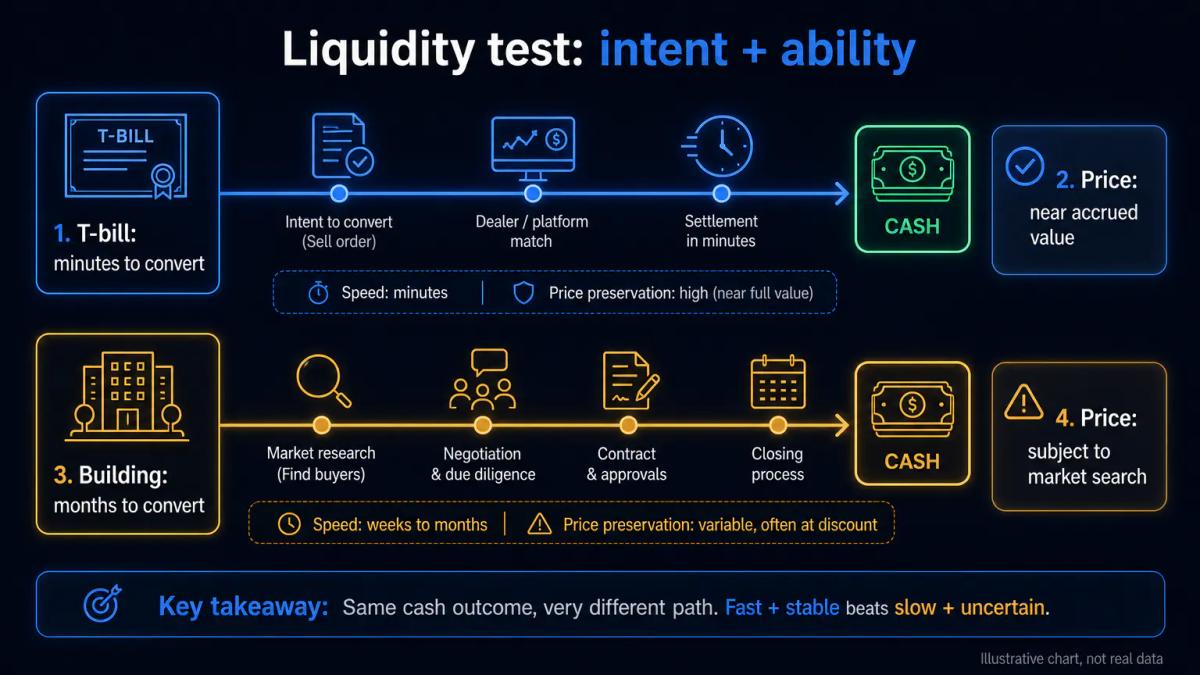
Liquidity, the speed at which you can turn an asset into cash without a meaningful price hit, is the reason these holdings live in current assets. A 3-month T-bill trades in a deep secondary market and can be sold within minutes at a price very close to its accrued value, whereas an office building would take months to sell and would move in price along the way.
Two conditions have to hold at the same time: the intent to convert within twelve months, and the practical ability to do so. When one of them breaks, the security drops out of the short-term bucket. A stock pledged as collateral for a two-year loan, for example, is no longer freely convertible and moves out of current assets even though its ticker still trades every second on the exchange.
Fair value accounting and mark-to-market treatment
Short-term investments are typically recorded at fair value, meaning the balance sheet shows the current market price at each reporting date rather than the price you paid. Fair value is the price you would receive to sell the asset in an orderly transaction between market participants.
This mark-to-market approach, revaluing to today's price at each reporting period, produces unrealised gains and losses that flow through the income statement or, for some categories, through other comprehensive income. Under both US GAAP (the accounting rulebook set by the Financial Accounting Standards Board) and IFRS (the international framework issued by the IASB), the treatment depends on whether the security is classified as trading, available-for-sale, or held-to-maturity. Trading securities route their gains and losses through profit or loss in every period, so reported earnings can swing meaningfully even in a quarter where no positions have been sold.
Short-term versus long-term: time horizon and tax treatment
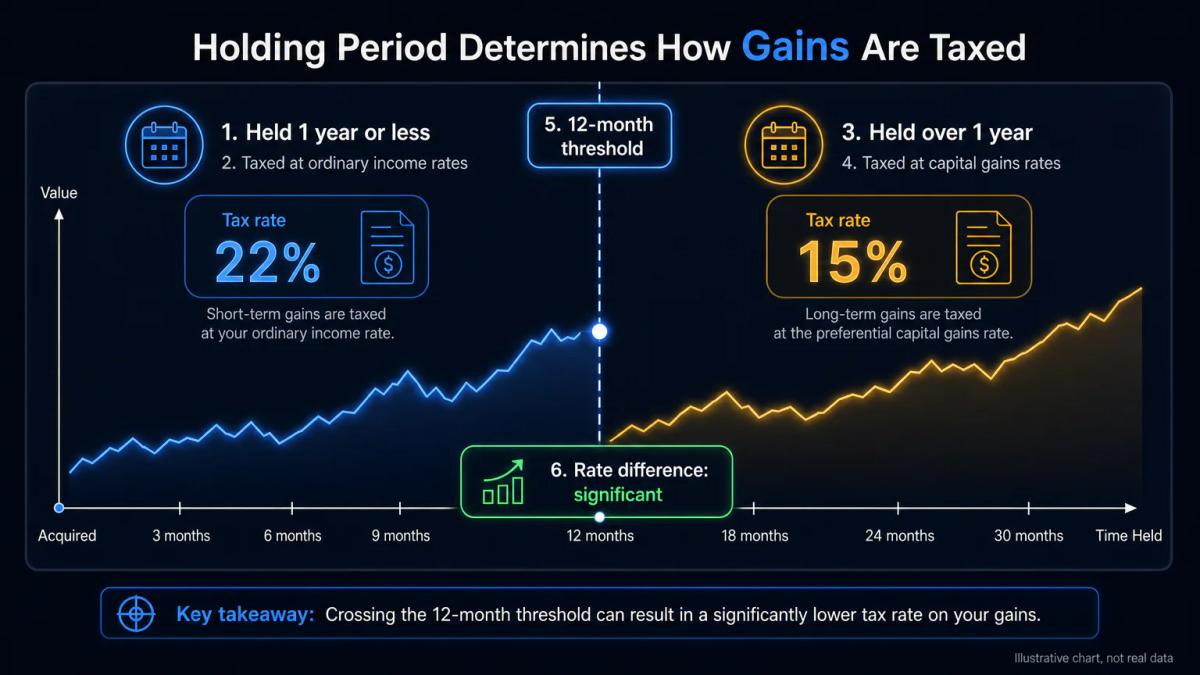
The twelve-month line does more than tidy up the balance sheet, because most tax systems also use it to decide how gains are taxed. In the United States, gains on positions held for one year or less are treated as short-term capital gains and taxed at ordinary income rates, which for higher earners can exceed the long-term capital gains rate by a wide margin.
| Feature | Short-term investment | Long-term investment |
|---|---|---|
| Balance sheet line | Current assets | Non-current assets |
| Typical horizon | Under 1 year | Over 1 year |
| US tax treatment on gains | Ordinary income rates | Preferential capital gains rates |
| Primary purpose | Liquidity, capital preservation | Growth, compounding |
Holding period is as much a tax lever as it is a strategy choice. Selling a profitable position one day before the one-year mark can turn what would have been a lightly taxed long-term gain into ordinary income at your marginal rate, which shows up as real money owed in most brackets.
Corporate treasury management and short-term investment strategy
Companies do not leave large cash balances sitting idle in a checking account. The treasury function, the team that manages a firm's cash and short-term financing, deploys surplus cash into a ladder of short-dated instruments to earn yield while keeping funds available for payroll, suppliers and unexpected needs.
A typical corporate policy sets limits by issuer, credit rating and maturity, so no single bank failure or bond default can hurt the operating float. That short-dated portfolio acts as a buffer between the day-to-day cash needed to run the business and the long-term capital that funds factories, acquisitions and research.
Inflation and real returns: the hidden cost of short-term safety
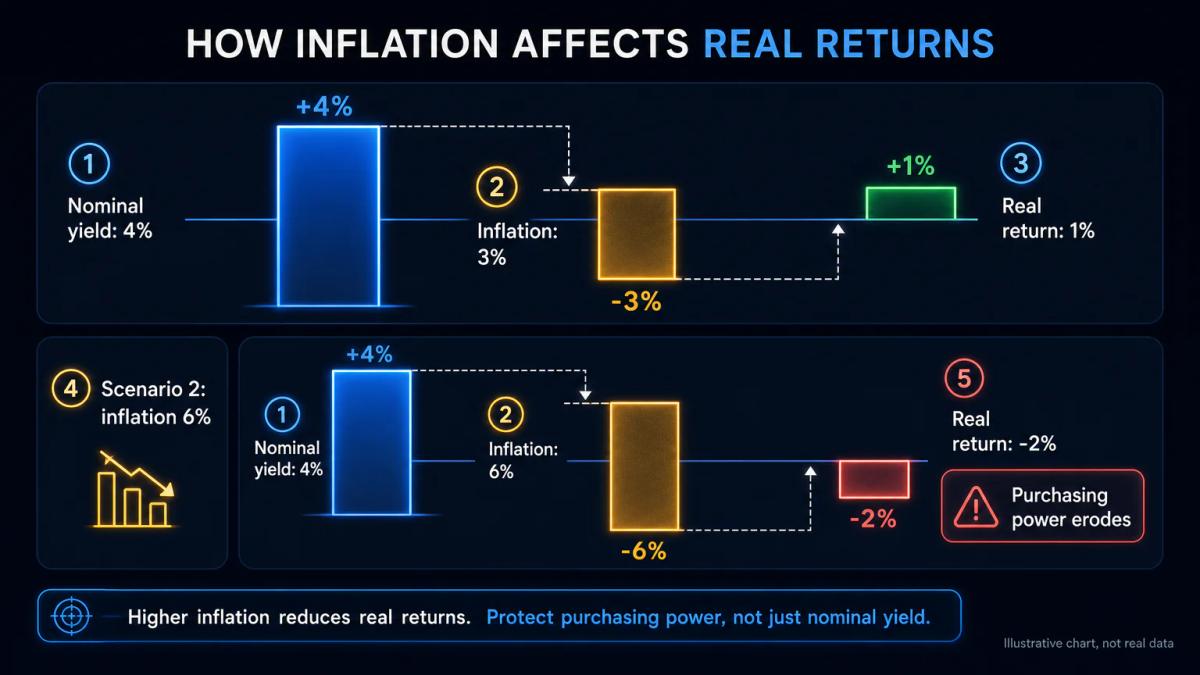
Capital safety and purchasing-power safety are two different things. The real return, meaning the yield after inflation, is what actually grows or shrinks your buying power over time. A money market fund paying a 4% yield in a 3% inflation environment delivers a 1% real return, while the same fund in a 6% inflation environment delivers minus 2%, even when the account statement still shows a nominal gain.
Accepting a thin real return in exchange for liquidity and predictability is the honest price of parking cash in short-dated instruments. That price looks reasonable when the money is going to be spent soon, and it becomes expensive when short-term vehicles are being used as a long-run store of value.
Risk profile and volatility considerations for retail traders
Short-term investments carry lower risk than equities or long-dated bonds, though they are far from risk-free. Three exposures deserve attention from retail holders:
- Interest rate risk: the price of a fixed-rate instrument falls when rates rise before you sell.
- Credit risk: the issuer of a CD or commercial paper defaults on its obligation.
- Opportunity cost: money locked at 4% while equities compound at more.
Matching the vehicle to the horizon is the practical rule. Money needed next month belongs in instant-access cash, while money that can be locked away for a year sits comfortably in a T-bill or CD. Retail portfolios usually stumble when these are mixed up, for example by keeping next month's rent in a single stock or parking a house deposit in a two-year bond that cannot be sold at par when the closing date arrives.
To see these conditions applied by a regulated broker, read our Global Prime review.
This content is general information and not advice: every situation needs checking with a licensed professional in the relevant jurisdiction.
Frequently Asked Questions
Are short-term investments classified as current assets or current liabilities?
They are current assets. A liability is something the business owes; a short-term investment is something the business owns and expects to turn into cash within one year, which is the definition of a current asset on a balance sheet.
What is the difference between short-term investments and cash equivalents?
Cash equivalents are the most liquid short-term holdings, typically maturing within 90 days from purchase, and are reported on the same line as cash. Short-term investments cover a wider range with maturities up to one year, such as one-year CDs or six-month T-bills, and appear on a separate line.
How does the one-year rule determine short-term investment classification?
If you expect to convert the security to cash within twelve months, or within one operating cycle when longer, it belongs in current assets as a short-term investment. If your intent and ability point beyond that window, the position moves to non-current assets.
Can short-term investments lose value before maturity?
Yes. Fixed-rate instruments such as T-bills and CDs can trade below their purchase price if interest rates rise before you sell. Under fair value accounting the balance sheet will show that unrealised loss even if you plan to hold to maturity.
What tax rate applies to short-term investment gains?
In the United States, gains on assets held one year or less are short-term capital gains and are taxed at ordinary income rates, which for many investors are higher than the preferential long-term capital gains rate applied after twelve months.
About the authors


Put this into practice
Related articles
Day Trading Discussion Boards: How to Use Forums Without Losing Money
A practical guide to day trading discussion boards: how they work, what to gain from them, and the risks, regulatory rules and psychological traps to watch for.

ECN vs Market Maker Broker: What the Difference Actually Costs You
ECN vs market maker broker: understand the real cost difference, conflict of interest risks, and which model suits your trading style

Forex Broker Scam Warning Signs: How to Spot a Fake Before You Deposit
Learn the key forex broker scam warning signs before you deposit. Check regulation, spot red flags, and protect your funds with this verification guide.
0 comments