



Trading Basics · Beginner · 10 min read
What is an offshore broker: regulation, leverage, and account setup
The core definition and how offshore brokers operate
If you have shopped around for a trading account, you have probably come across firms advertising headline leverage ratios and asset menus that no high-street broker offers. Many of them are offshore: trading firms registered and licensed in a country other than the one you live in, taking on international clients under that foreign jurisdiction's rules. Answering to a regulator abroad is what lets such a broker extend higher leverage, a broader asset menu and lower minimum deposits than a domestic firm, often alongside weaker investor protections.
The practical consequence of that structure is that your contract, your dispute resolution route and the compensation scheme, if any, sit in the broker's home country rather than in your own. A firm authorised in Mauritius, the British Virgin Islands or Seychelles operates under capital, audit and conduct standards defined there, and those standards do not line up with what a UK or EU retail client would expect from a domestic broker authorised by the Financial Conduct Authority (FCA) or a national competent authority under European rules.
For you as a retail trader, the choice of broker jurisdiction shapes three things at once: the maximum leverage you can access, the instruments on offer, and the recourse you have if something goes wrong. Leverage and asset access are what usually draw retail traders toward an offshore broker, while the question of recourse is where the main risk tends to sit.
Where you choose to trade shapes outcomes as much as the strategy itself; see the best forex brokers and their conditions.
Offshore versus domestic brokers: the key structural differences
A domestic broker operates under the regulatory authority of your home country and must comply with its capital, leverage and consumer protection rules. An offshore broker answers to a different regulator in a different jurisdiction, which typically means:
- higher leverage
- fewer product restrictions
- lower minimum deposits
- narrower protections if the firm fails
The differences cluster into a handful of structural categories. The table below summarises how a UK retail account at a domestic FCA-authorised broker compares with a typical offshore setup.
| Feature | Domestic broker (FCA, UK retail) | Typical offshore broker |
|---|---|---|
| Maximum leverage, major forex | 1:30 | 1:100 to 1:500 or higher |
| Maximum leverage, indices | 1:20 | 1:100 or higher |
| Maximum leverage, individual equities | 1:5 | 1:10 to 1:20 |
| CFDs on cryptocurrencies for retail | Prohibited by the FCA | Commonly offered |
| Negative balance protection | Mandatory for retail | Depends on the broker |
| Compensation scheme | FSCS cover up to £85,000 for eligible claims | Varies; often none |
| Minimum deposit | Often from $0 to $200 | Often $100 to $5,000 |
| Client fund segregation | Required | Depends on jurisdiction |
Two items on the right-hand column deserve a closer look. Without a compensation scheme, you would queue as a creditor in the local court if the broker became insolvent, and recovery would depend on how segregation was actually enforced. Without negative balance protection, a fast market move can leave you owing the broker money after a stop-out, which is something a UK retail account cannot suffer under current FCA rules.
Leverage, asset access and trading flexibility
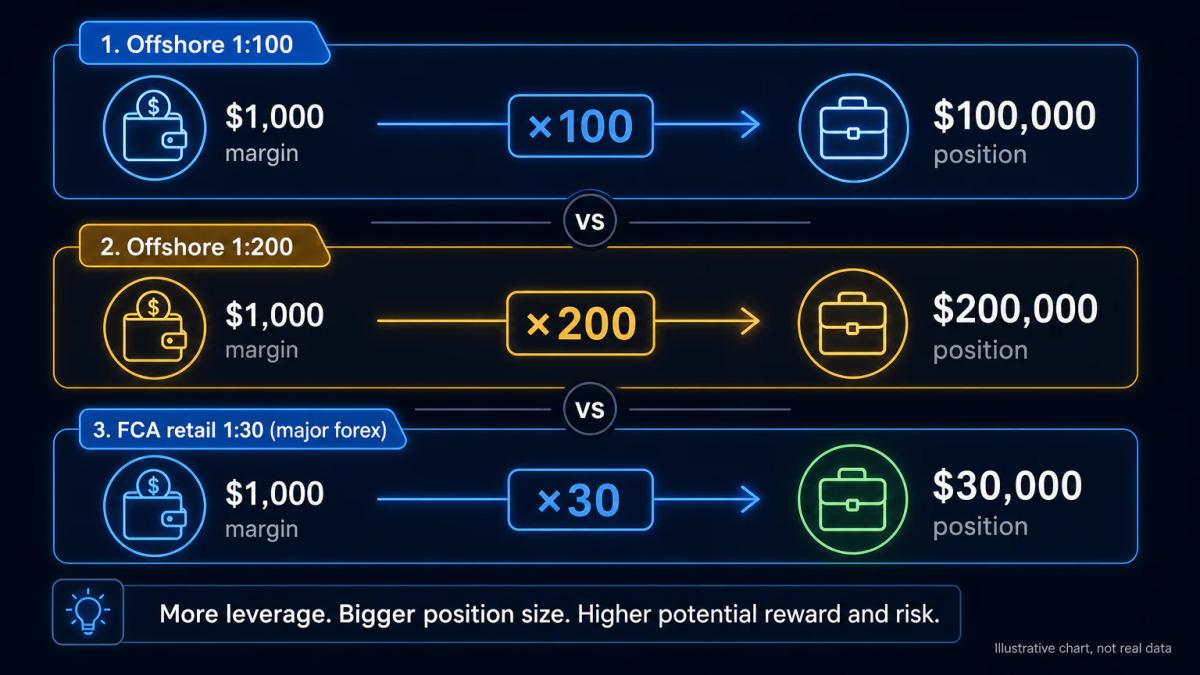
Leverage is the ratio between the position size you control and the margin you post. Imagine a 1:100 account where $1,000 of margin would control a $100,000 position. Offshore brokers commonly advertise 1:100, 1:200 or 1:500 on major forex pairs, whereas a UK retail client at a domestic broker is subject to FCA caps of:
- 1:30 on major forex
- 1:20 on indices
- 1:5 on single equities
| Asset class | Typical offshore leverage | FCA retail cap |
|---|---|---|
| Major forex pairs | 1:100 to 1:500 | 1:30 |
| Indices | 1:100 or higher | 1:20 |
| Commodities (non-gold) | 1:100 or higher | 1:10 |
| Single equities | 1:10 to 1:20 | 1:5 |
| Cryptocurrency CFDs (retail) | Commonly offered | Prohibited |
The asset menu also tends to be wider offshore. CFDs on cryptocurrencies are a representative example: the FCA prohibits them for UK retail clients, so a UK resident who wants that exposure cannot access it through a domestic broker. Exotic currency pairs, emerging-market indices and some commodity CFDs are more freely offered offshore.
Higher leverage amplifies gains and losses in equal proportion, so flexibility cuts both ways, and a 1:500 account hits a full-margin loss on a roughly 0.2% adverse move. Imagine opening a mini lot on EUR/USD, with a position value of around $10,000, at 1:500 leverage; the margin required would be roughly $20. Should a 20-pip move go against you, it would:
- amount to roughly $20 in losses
- erase the margin
- trigger a stop-out
The underlying forex pair is the same whether you trade it domestically or offshore, and what changes with the ratio is the survival distance between you and a wipeout.
Regulatory jurisdiction and what it means for your account
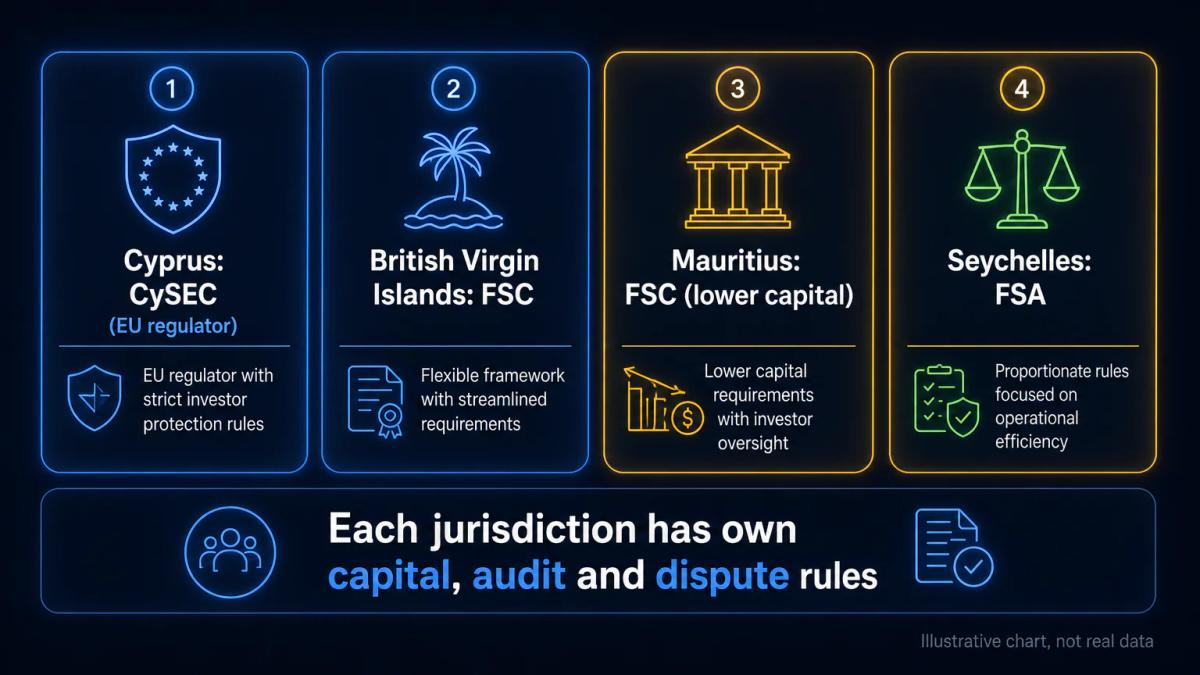
An offshore broker's regulatory home determines which rules govern your account, what protections apply if the broker fails, and whether your deposits are segregated or held in a client trust. Common offshore jurisdictions include:
- Cyprus (CySEC)
- the British Virgin Islands (FSC)
- Mauritius (FSC)
- Seychelles (FSA)
| Jurisdiction | Regulator | Character |
|---|---|---|
| Cyprus | CySEC | EU regulator; European rules and leverage caps apply to EU retail clients |
| Mauritius | FSC | Developed financial services regime; outside the European perimeter |
| British Virgin Islands | FSC | Classic offshore; lower capital requirements and lighter conduct rules |
| Seychelles | FSA | Classic offshore; lighter conduct rules and limited retail protections |
| Vanuatu | VFSC | Classic offshore; low capital requirements, limited investor recourse |
Each of these jurisdictions sets its own capital requirements, audit standards and dispute processes, which is why a licence from one of them cannot be read as equivalent to another.
A few distinctions guide how you read a licence:
- Cyprus (CySEC) is an EU regulator. CySEC-authorised investment firms operate under European rules and, for European retail clients, apply European leverage caps and protections. For UK retail clients post-Brexit, the picture is different: a CySEC licence does not confer UK retail access on its own.
- British Virgin Islands, Seychelles and Vanuatu are classic offshore jurisdictions with lower capital requirements and lighter conduct rules.
- Mauritius sits between the two, with a more developed financial services regime but still outside the European perimeter.
Many large groups run several entities in parallel: an FCA-authorised entity onboards UK retail clients under FCA rules, a CySEC entity onboards EU clients, and an offshore entity onboards clients in regions where those licences do not reach. A UK resident who ends up at the offshore arm of a familiar brand gets the brand's name while trading outside the FCA's rules. For a UK retail client, the FCA-authorised entity is the gold tier, and offshore entities of the same group should be flagged accordingly before you open an account.
Evaluating offshore broker credibility and compliance standing
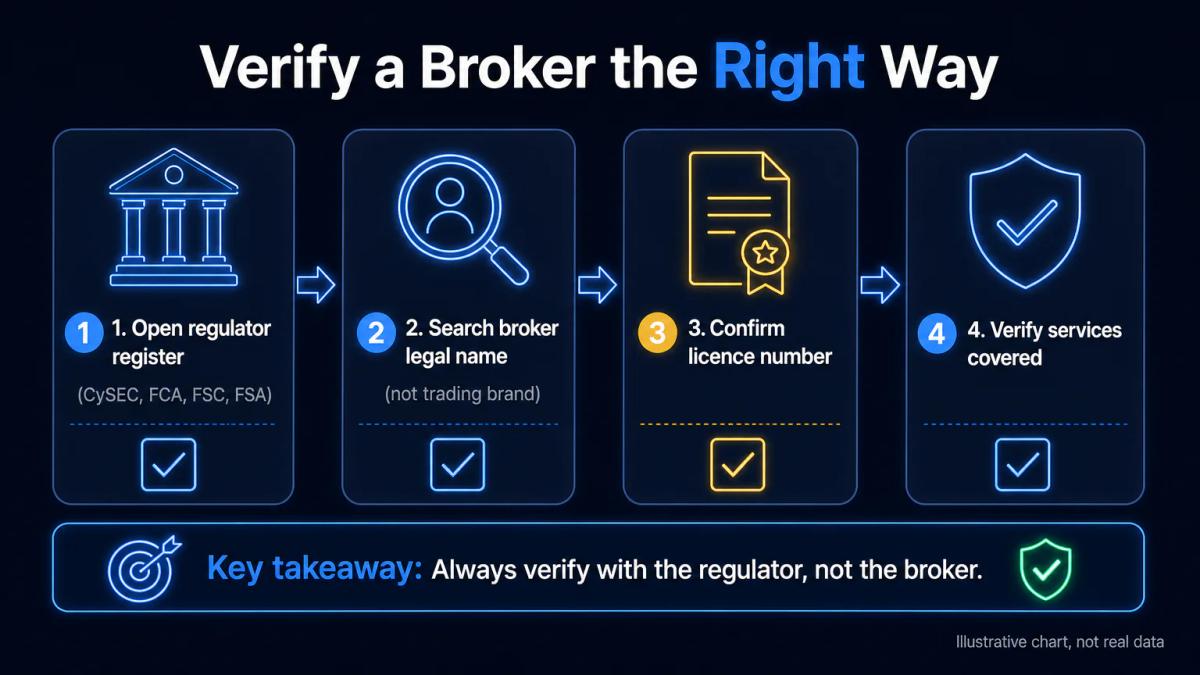
Assessing whether an offshore broker is legitimate starts with verifying the licence directly on the regulator's own records. If a licence number does not appear on the regulator's public register, you should treat it as unlicensed until proven otherwise.
A practical checklist for due diligence:
- Open the regulator's public register (for example, the FCA register in the UK, the CySEC register in Cyprus, the FSC register in Mauritius) and search the entity's exact legal name, not the trading brand.
- Confirm the licence covers the services you intend to use, for instance dealing on own account for CFDs, with authorisation that extends beyond payment services or corporate advisory.
- Check for public enforcement actions, warnings, suspensions or restrictions listed on the regulator's site.
- Verify that client funds are held in segregated accounts at named banks, with the segregation policy stated in the client agreement.
- Look for additional tier-one licences in the same group (FCA, ASIC, CySEC) that signal operational standards above the offshore minimum.
- Request audited financial statements; a firm that cannot provide any is a red flag.
Common red flags often appear in combination, and each one is enough on its own to walk away:
- regulators that do not actually exist, with invented acronyms designed to look official
- licence numbers that do not match the entity shown on the register
- pressure to deposit quickly, often reinforced by a bonus or deadline
- guaranteed-return promises of any kind
- withdrawal processes that require a new deposit before the previous funds are released
Tax reporting and compliance obligations for offshore accounts
This section is general information, not personal tax advice; every situation needs checking with a licensed professional in your jurisdiction.
Holding an offshore brokerage account does not exempt you from tax in your country of residence. A UK resident reports trading profits to HMRC under the applicable regime (capital gains tax or income tax depending on the instrument and the pattern of activity); a US person reports worldwide income to the IRS. Offshore brokers that onboard clients from reportable jurisdictions typically fall under international information-exchange frameworks: FATCA for US persons, and the Common Reporting Standard (CRS) for the many jurisdictions that have adopted it. Both route account information to the client's home tax authority.
A simplified picture of reporting touchpoints:
- United Kingdom: self-assessment, with CGT or income tax applied depending on classification; the specific rate band depends on your other income and is marginal.
- United States: Form 1040 plus Schedule D for capital gains, plus FBAR (FinCEN 114) for foreign financial accounts above the reporting threshold, plus FATCA reporting on Form 8938 where applicable.
- European Union: declaration under the local personal income tax regime; CRS exchanges account data back to your tax residence.
- Australia: ATO reporting of worldwide income by residents; capital gains taxed in the resident's hands.
- Canada: CRA reporting of worldwide income by residents; T1135 for specified foreign property above the threshold.
Under-reporting an offshore account is often more expensive than any tax saved, including:
- penalties
- interest
- in some jurisdictions, criminal exposure
Given those risks, the sensible default is to disclose everything your home authority asks for, and to keep records that back up what you file.
Costs, minimums and account setup considerations
Offshore brokers often advertise lower spreads and commissions than domestic competitors. The headline spread is only part of the cost; what you actually pay depends on commission per lot, overnight financing (swap), inactivity fees, deposit and withdrawal charges, and the FX conversion applied if your base currency differs from the broker's.
Typical features you compare before opening an account:
- Minimum deposit, which commonly ranges from $100 to $5,000 depending on the account tier.
- Base currency options and the FX conversion cost if you fund in a different currency.
- Spread model (fixed, variable, raw spread with commission).
- Overnight financing on the instruments you plan to hold.
- Withdrawal methods, timing and fees.
- Inactivity fee thresholds.
| Cost item | Typical offshore broker | Typical FCA retail broker |
|---|---|---|
| Minimum deposit | $100 to $5,000 depending on tier | $0 to $200 |
| EUR/USD spread (standard account) | 0.8 to 1.5 pips, often commission-free | 0.6 to 1.4 pips, often commission-free |
| Raw/ECN spread + commission | From 0.0 pip + ~$6 per round-turn lot | From 0.0 pip + ~$6 per round-turn lot |
| Overnight financing (swap) | Broker-set; swap-free options common | Broker-set; swap-free options restricted |
| Inactivity fee | Often $10 to $25 per month after 3 to 12 months | Often £10 to £18 per month after 6 to 12 months |
| Deposit methods | Card, bank transfer, e-wallet, crypto on some brokers | Card, bank transfer, open banking |
| Withdrawal fees | Often free on card/wallet, fixed fee on wire | Usually free; occasional wire fee |
| Base-currency conversion | Charged on funding in a non-base currency | Charged on funding in a non-base currency |
The account-opening flow at a typical offshore broker usually runs through the following steps, with verification often completing within one to three business days, though a mismatch between the ID and the proof of address, or a payment method held in a third party's name, is the most common cause of delay:
- Complete the online application with personal details and trading experience.
- Upload identity documents (passport or national ID) and proof of address (recent utility bill or bank statement) for Know Your Customer (KYC) checks.
- Pass the appropriateness test if the broker runs one.
- Fund the account by card, bank transfer or e-wallet.
- Activate the trading platform (MT4, MT5 or cTrader) and log in.
A few practical points save time on the way through:
- Use the exact name and address shown on your ID; a utility bill or bank statement older than three months is usually rejected.
- Fund from an account in your own name — third-party deposits are refused by most offshore brokers under their anti-money-laundering rules.
- Pick the base currency you earn in to avoid an ongoing FX conversion cost on every deposit, withdrawal and overnight financing charge.
- Note the account tier the deposit lands you in — spreads, commissions and swap treatment often differ between standard, raw and professional tiers at the same broker.
- Keep a copy of the signed client agreement; it is where the governing law, segregation policy and withdrawal terms are set out, and it is what any later dispute is read against.
Risks and legal considerations by home country
The legal picture depends heavily on where you live. UK retail clients cannot trade CFDs on cryptocurrencies through any broker because the FCA prohibits the product for retail. UK residents can open accounts with foreign brokers in general, but the FCA has repeatedly listed unauthorised firms that solicit UK clients without permission; trading with such a firm leaves you outside UK regulatory protection and without recourse to the Financial Ombudsman Service or FSCS. US citizens are largely excluded from offshore brokers because of CFTC and NFA registration requirements that most offshore firms do not meet.
Other considerations worth checking:
- Residency and visa status: some visa regimes require disclosure of foreign financial accounts, and large or opaque offshore holdings can complicate immigration or financial disclosures.
- Local reporting of foreign accounts (T1135 in Canada, FBAR and Form 8938 in the US, foreign-asset declarations in several EU countries).
- Capital-gains or income-tax treatment of trading profits in your country of residence.
- Enforceability of the client contract: a dispute with an offshore broker is heard under the broker's local law, which may be very different from the law of your home country.
The overall trade-off is reasonably explicit: higher leverage and a wider instrument menu come paired with weaker protections, harder recourse and more reporting work on your side.
To see these conditions applied by a regulated broker, read our Vantage Markets review.
This article is general information only and does not constitute financial, tax or legal advice. Rules on offshore accounts, leverage, consumer protections and reporting obligations vary by jurisdiction and change over time; every individual situation should be reviewed with a licensed professional in the relevant country before you act.
Frequently Asked Questions
Is it legal to trade with an offshore broker if you live in the UK or US?
For UK residents, it is generally legal to open an account with a foreign broker, but you lose FCA protections, FSCS cover and access to the Financial Ombudsman Service, and you cannot trade CFDs on cryptocurrencies because the FCA prohibits the product for retail clients. For US persons, most offshore brokers do not accept them because of CFTC and NFA registration rules, and trading with a non-registered firm as a US resident creates compliance and tax reporting problems.
What is the difference between an offshore broker and a regulated domestic broker?
A domestic broker is licensed by your home regulator and must apply its leverage caps, product restrictions, segregation rules and compensation schemes. An offshore broker is licensed in another country and applies that jurisdiction's rules, which usually means higher leverage, more products and lower minimums, with weaker investor protections, no local compensation cover and dispute resolution under foreign law.
How much leverage can you get with an offshore broker compared to a domestic one?
A UK retail client at a domestic FCA-authorised broker is capped at 1:30 on major forex, 1:20 on indices and 1:5 on single equities. Offshore brokers commonly advertise 1:100, 1:200 or 1:500 on major forex and higher ratios on indices. Higher leverage magnifies both gains and losses in equal proportion, so a 1:500 account can be wiped out by a small adverse move.
What happens to your money if an offshore broker goes bankrupt or is shut down?
You become a creditor in the broker's home jurisdiction. If client funds were held in segregated accounts and segregation was properly enforced, you can recover a share through the local insolvency process. If segregation was lax or there is no compensation scheme in that jurisdiction, recovery can be partial, slow or zero. A domestic FSCS-covered broker, by contrast, offers eligible UK retail claimants cover up to £85,000.
Do you have to pay tax on profits from an offshore brokerage account?
Yes. Your tax liability is determined by your country of residence, not by where the broker is licensed. A UK resident reports trading profits to HMRC under CGT or income tax rules. A US person reports worldwide income to the IRS and may need to file FBAR and FATCA forms. Many jurisdictions exchange account information automatically through the Common Reporting Standard, so under-reporting carries a real risk of penalties.
About the authors


Put this into practice
Related articles
What is liquidity in forex: how it affects your trades
A plain-English guide to forex liquidity: what it is, how it moves your spreads, when it dries up, and how to size and time trades around it.
What is liquidity in trading: spreads, slippage, and execution
A plain-English guide to liquidity in trading: how it moves your spreads, your slippage and your execution, with concrete numbers for forex, indices and equities.
How Much Do Forex Traders Actually Make? A Realistic Income Breakdown
A realistic, data-grounded breakdown of forex trader income across four trader types, from part-time retail to institutional, including what account size actually means for your earnings.
0 comments