


CFD Trading · Intermediate · 8 min read
Negative Balance Protection Explained: How It Shields You From Owing Your Broker
The safety mechanism that stops your losses at zero
Imagine a leveraged position collapsing so quickly that an ordinary account would end up thousands of pounds in the red. Negative balance protection is the regulatory safeguard that intervenes at precisely that moment, closing your open positions and resetting the balance to zero when your equity reaches that threshold, so you walk away without any further obligation to the firm beyond what you originally deposited. Because leverage amplifies both gains and losses in equal measure, a single violent move against a small deposit could otherwise generate a four- or five-figure debt, which is why the mechanism was built into retail trading in the first place.
Think of the protection as a ceiling on how much you can lose, with the caveat that losing the full amount you deposited remains entirely possible. On an account that carries it, however, you will never end a session owing money to the firm that holds your funds. The rest of this article walks through how the reset is triggered, which products and clients fall inside the regulatory perimeter, how to confirm your broker genuinely honours the commitment, and the circumstances where the safety net can still leave gaps.
Putting this into practice means opening an account: start with the best forex brokers our team reviewed.
Why leverage makes negative balance protection essential
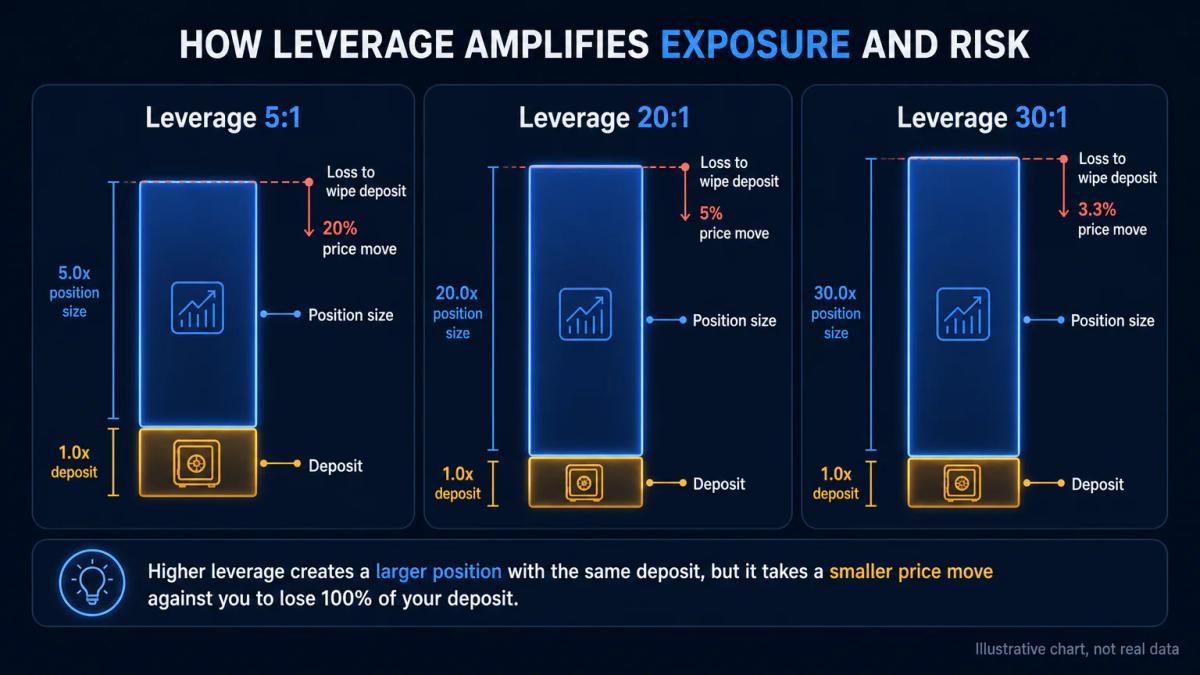
Leverage lets you control a position much larger than your deposit, which is useful when a trade goes your way and dangerous when it does not. Under the FCA retail leverage caps in force since 2018, you can take 30:1 on major currency pairs, 20:1 on major indices, 5:1 on individual equities, and leverage on crypto CFDs is prohibited for UK retail clients.
Consider what those caps mean for the mechanics of a loss:
- At 30:1 on EUR/USD, a 3.33% move against you consumes 100% of your margin.
- At 20:1 on an index CFD, a 5% move does the same.
- At 5:1 on an equity CFD, a 20% move empties the deposit.
Suppose you fund an account with $500 and open a single EUR/USD position at 30:1 leverage, which gives you notional exposure of $15,000. Should the pair move 4% against you, that represents a $600 loss on the position, already exceeding your deposit by $100. Without negative balance protection, the shortfall would be owed to your broker once the trade closed. With the protection in place, the system intervenes before the account turns negative, and your balance comes to rest at zero.
That gulf between what a leveraged position can lose and the modest sum sitting in the account is precisely why regulators turned the protection into a legal obligation for retail clients, rather than leaving it to each firm's discretion.
How the automatic balance reset works in practice
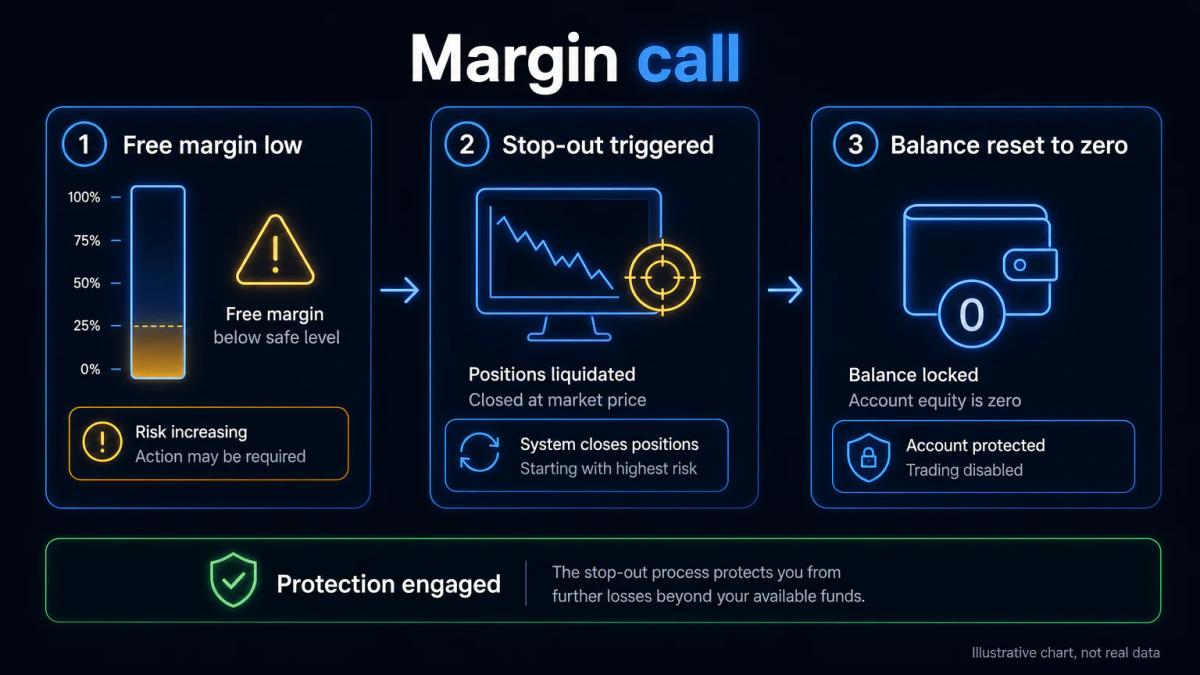
The reset is actually the final step in a longer sequence that begins well before your equity ever touches zero. First comes a margin call, a notification that your free margin is running low. Should the account continue to deteriorate from there, a stop-out follows, meaning positions are automatically liquidated once equity falls below a set percentage of required margin, typically around 50% at UK-regulated brokers. In fast markets where price moves outpace those earlier safeguards, equity can still slip through zero, and that is where negative balance protection steps in to catch what remains.
At the moment equity reaches zero, the broker's risk system forces a close of your open positions at the best available market price. The resulting debit is absorbed by the firm, and your displayed balance returns to zero. You keep whatever cash sat in a non-trading wallet, and if you held several positions, the broker may liquidate only the losing ones, leaving profitable positions open and your net balance positive.
The full sequence is designed to leave the client whole at zero, and it proceeds through four distinct stages:
- Margin call, warning you that your free margin is depleting.
- Stop-out, which automatically liquidates positions once equity falls below the required threshold.
- Forced close, in which any remaining open positions are shut at the best available market price.
- Balance reset, where any residual shortfall is absorbed by the broker and your displayed balance returns to zero.
In fast-moving conditions the first two stages can effectively be skipped. Should price gap straight through the stop-out level, the broker will end up closing positions at a worse price than its models assumed, and the protection absorbs the overflow, which means the firm rather than the client carries that cost.
Regulatory requirement in the UK and ESMA regions
Negative balance protection is a legal requirement for FCA-regulated firms selling CFDs, spread bets and rolling spot forex to UK retail clients, and for ESMA-regulated firms across the EU and EEA, which places it well outside the realm of optional marketing features. According to the FCA, firms marketing these products to retail clients must also display a standardised risk warning stating the percentage of that provider's retail investor accounts that lose money. Under COBS 22.5, that percentage is recalculated every three months over the 12-month period preceding the calculation, and firms are required to retain the underlying account records for five years.
The UK rules apply only to firms authorised to onboard UK retail clients through an FCA-regulated entity. A broker group may run several entities on different licences: the FCA arm offers the protection by law, while an offshore arm registered in a jurisdiction without equivalent rules may not. If your account was opened through a non-UK entity of a familiar brand, read the account agreement carefully to find out which rulebook governs it.
Which products and traders are covered
The protection covers leveraged retail products and leaves out everyone the regulator treats as able to look after themselves. The split is clean on paper and worth checking against your own account before you assume you are covered.
| Covered | Not covered |
|---|---|
| Retail CFDs on forex, indices, commodities, equities | Professional clients (opted up) |
| Spread betting accounts for UK retail clients | Eligible counterparties |
| Rolling spot forex contracts | Demo accounts in some firms |
| Equity CFDs within FCA leverage caps | Products traded through non-UK group entities |
If you have requested professional classification to access higher leverage, you have signed away the protection. The regulator treats the opt-up as evidence that you accept the risk of owing money to your broker. Crypto CFDs do not appear in either column for UK retail because the FCA prohibits them for that client type; the question of coverage does not arise.
What negative balance protection does not do
The protection is narrow by design, in the sense that stopping the balance from turning negative is the entire scope of what it accomplishes. It will not prevent a full loss of your deposit, pause a margin call, refund overnight financing charges or commissions deducted before the stop-out, or shield you from slippage when prices gap through your stop level during a flash crash or an abrupt policy announcement.
The Swiss franc shock in January 2015, when the Swiss National Bank removed the EUR/CHF floor and the pair moved several hundred pips within minutes, left retail traders at firms without the protection carrying substantial debts, whereas retail clients at firms that already applied a negative balance guarantee were kept at zero. In their case, the guarantee absorbed the shortfall rather than preventing the underlying loss, so a retail trader with the protection still saw their deposit wiped out, though they were spared the demand for the balance beyond it.
Treat the protection as a backstop behind your own risk management, position sizing and stop placement, so that it supports disciplined trading rather than tempting you to run positions larger than your account can genuinely carry.
How to verify your broker honours negative balance protection
The statement should be set out in writing within the client agreement itself, rather than only on the marketing pages. Three practical checks are worth running:
- Confirm the entity on your account is FCA-authorised. Search the Financial Services Register by the firm's name and reference number, and check which products the permission covers.
- Read the risk disclosure and the terms of business for an explicit clause confirming that the balance will not fall below zero for retail clients.
- Ask client support in writing to confirm negative balance protection applies to your specific account type, and keep the reply.
Among negative balance protection brokers serving UK retail clients, the mechanics are similar, but the communication is uneven: some firms highlight the protection on the account summary, others bury it in a schedule to the terms. Where the account was opened under a non-UK group entity, the written confirmation is the only reliable record. If support hedges the answer, treat that as a signal.
Edge cases and limitations you should know
Several situations fall outside the simple picture of the standard reset. Extreme market gaps can close positions at a price well past the stop-out level, so that even though the protection still absorbs the overflow, the realised loss on the deposit itself can be larger than the stop-out level implied. Multi-position accounts bring their own complication to the arithmetic, since the broker may close only the loss-making trades while leaving winners open, with the result that your remaining balance can finish positive once the dust settles.
Tax treatment of a reset is probably the quietest trap of the lot. HMRC treats spread betting winnings and losses as outside the scope of capital gains for UK individuals, meaning a reset on a spread betting account carries no tax consequence. For a retail CFD account, by contrast, losses are generally allowable capital losses for individuals, and the loss on which the reset was triggered is the loss of your deposit itself, with no separate write-off for the shortfall the broker absorbed. A tax adviser should sign off on the specific entries before you file. Where your account sits with an offshore entity of a familiar brand, assume the protection does not apply until the written terms confirm otherwise.
For a concrete example of costs and platform, the IG review goes through them line by line.
Frequently Asked Questions
Does negative balance protection apply to all CFD brokers?
No. It is mandatory for FCA-authorised firms selling CFDs to UK retail clients and for ESMA-regulated firms serving EU/EEA retail clients. Brokers operating under offshore licences, and non-UK group entities of familiar brands, are not bound by those rules. Always check which entity has opened your account and what the client agreement says in writing.
Can I lose more than my deposit if my broker does not have negative balance protection?
Yes. Without the protection, a leveraged position that gaps through your stop-out level can generate a loss larger than the cash in your account, and the broker is entitled to invoice you for the shortfall. Several retail traders faced five-figure debts after the January 2015 Swiss franc move at firms that had not applied a negative balance guarantee.
How quickly does negative balance protection trigger when my account hits zero?
The trigger is automatic. The broker's risk system monitors equity continuously and forces a close of open positions once equity reaches zero. Execution speed depends on liquidity at that moment; in a fast market the actual close price can be worse than the trigger level, and the broker absorbs the gap.
Do professional traders get negative balance protection?
Generally no. Clients who have opted up to professional status, and eligible counterparties, are assumed to understand and accept the risk of a negative balance. The regulator treats the opt-up as explicit acceptance of that risk. If you upgraded your classification to access higher leverage, you have given up the protection.
What happens to my open positions when negative balance protection is activated?
The broker closes the losing positions at the best available market price to bring the account back towards zero. If you held several trades and only some were in loss, winners can remain open and your net balance can end up positive. The firm, not the client, absorbs any shortfall below zero.
About the authors


Put this into practice
Brokers we have reviewed
Scored on the same five dimensions. Here are three of them — the full list is on the brokers page.



Related articles

Options vs Futures: Key Differences for Retail Traders
A clear look at the structural differences between options and futures, covering obligation, premium versus margin, risk shape and how each contract behaves on every trade.

PDT Rule: What Changed and How the New Intraday Margin Framework Affects You
The PDT rule no longer forces you to hold $25,000 to day trade US equities. A new intraday margin framework has replaced it, with a $2,000 minimum and real-time monitoring.

Position Trading Guide: Strategies, Indicators, and Timeframes
Learn in this position trading guide the strategies, indicators, and timeframes for capturing large market moves. Includes risk management tips
0 comments