



Financial Markets · Intermediate · 4 min read
Index Funds vs Active Trading: Costs, Returns and Discipline
The core difference: passive returns versus active timing
Index funds track a market benchmark with minimal trading, while active trading involves frequent buying and selling in an attempt to beat that benchmark. Passive investing accepts the market return as the goal, whereas active trading looks to exploit mispricing, momentum or sector shifts in pursuit of something higher. The choice between the two tends to hinge on three factors:
- Cost, including fees, spreads and tax drag.
- Time commitment, since active trading demands continuous attention.
- Whether you believe you can outperform the market consistently after fees.
According to the Chicago Booth Review, before costs and fees active managers beat their benchmarks on average by 5 basis points, and after costs and fees they underperform by the same margin, so the question becomes whether any trading edge survives expenses once they are deducted.
Why fees and costs tilt the odds against active traders
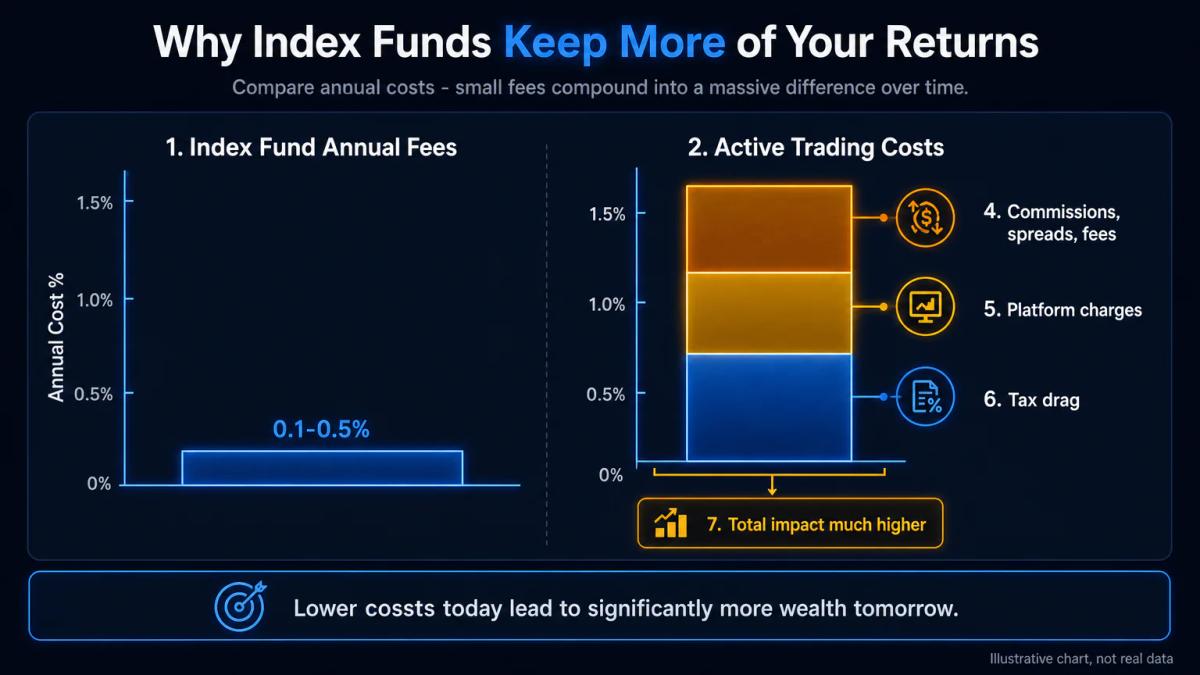
Cost is the single most predictable force in long-run returns, and it works against the active side of the ledger. Index funds charge a fraction of a percentage point annually and trade only when the benchmark rebalances, while active trading accumulates several categories of ongoing cost:
- Commissions on every entry and exit.
- Bid-ask spreads, which widen in less liquid names.
- Platform and data fees charged by the broker.
- Short-term tax drag on frequent profitable exits.
The scale effect is real too. According to the Chicago Booth Review, a one percentage-point increase in industry size produces a performance decline of 40 basis points per year for a typical fund, meaning the more capital chases alpha, the harder alpha becomes to find.
The cost gap also compounds over time. Over a 20-year horizon, a 1% annual fee difference, with returns held equal, reduces a terminal portfolio value by roughly a fifth, which is why much of the passive investing vs trading question gets settled at the expense-ratio line long before any stock-picking skill is ever tested.
Diversification and volatility: index funds as a hedge
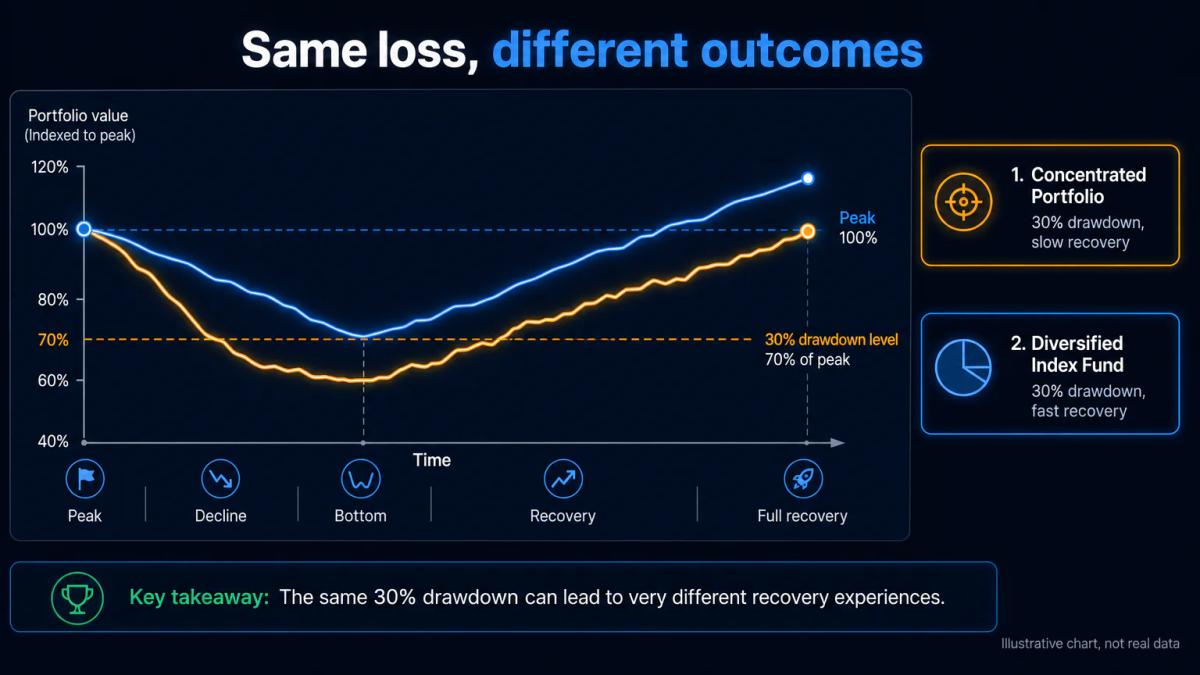
A broad index fund spreads your capital across hundreds or thousands of holdings, so a single stock collapse barely dents the portfolio. Active trading tends to concentrate risk in a handful of positions, which amplifies both upside and drawdown in equal measure. A drawdown (the fall from a capital peak to the trough before a new peak) of 30% in a concentrated book is far harder to recover from than the same figure in a diversified index position, because the probability of permanent capital loss rises with concentration. According to the Chicago Booth Review, Vanguard's Total Stock Market index mutual fund manages $318 billion, a figure built on exactly this diversification premise.
Behavioural discipline: the hidden cost of active trading
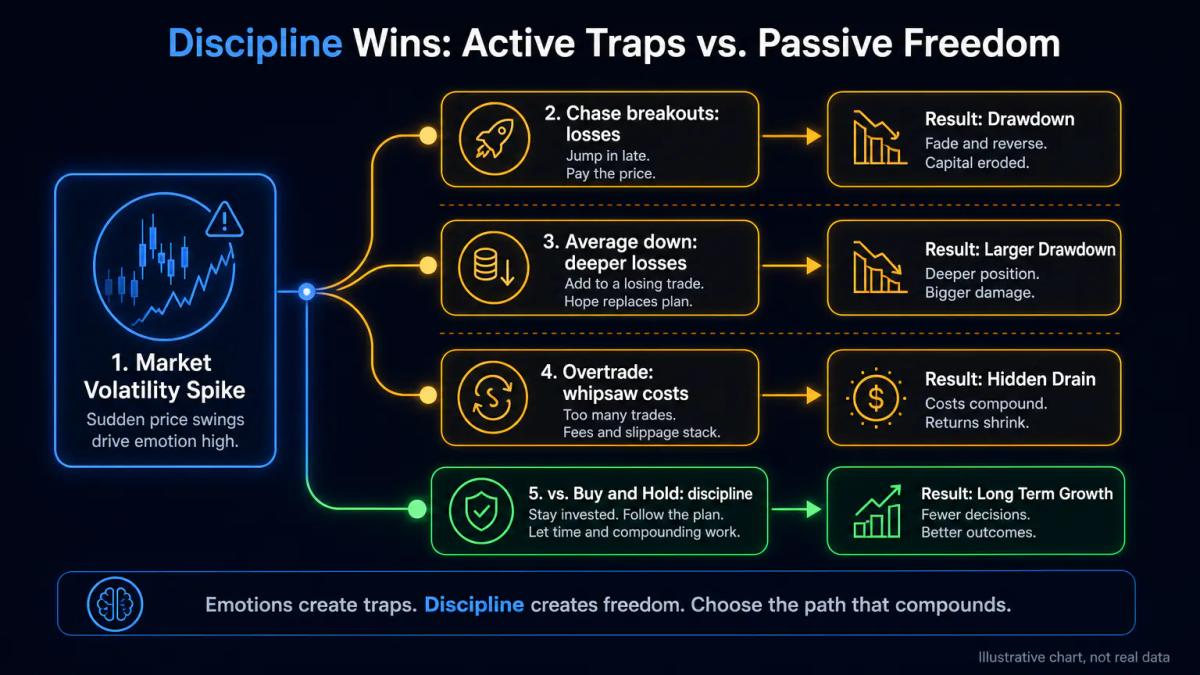
Fees show up on every statement, whereas behaviour tends to go unmeasured. Active traders face constant pressure to chase breakouts, average down into losers, or overtrade when volatility spikes, and each of those impulses carries a cost that never appears on a statement. Index investors sidestep most of these traps by committing to a buy-and-hold rule they only have to defend a few times a decade, usually during a crash.
The question of which performs better, index fund or trading, often reduces to something simpler: can you sit on your hands for ten years? According to the Chicago Booth Review, Vanguard has amassed $2 trillion in investor assets largely on the premise that the average investor cannot beat the market, and the behavioural evidence is a large part of why that premise holds.
Imagine two investors living through the same 25% market drop. One holds a broad index fund and does nothing, while the other holds three concentrated positions and rotates out near the bottom. As the index recovers, the first investor's paper loss unwinds; the second investor's realised loss does not.
Tax efficiency: a long-term advantage for passive investors
Index funds generate fewer taxable events because they hold positions for longer stretches and only trade on rebalancing. Active traders, by comparison, trigger capital-gains events on every profitable exit, and that compounds the drag on after-tax returns over the decades. Tax treatment also differs by account type and jurisdiction, and a handful of items can swing the net outcome by several percentage points a year:
- Short-term gains
- Dividend withholding
- Wrapper rules (ISAs, SIPPs, equivalents elsewhere)
This section is general information and tax outcomes depend on your residency and personal circumstances, so check any specific position with a licensed professional in your jurisdiction before acting on it.
The content of this article is general information for educational purposes only and does not constitute financial, investment or tax advice. Rules, rates and reliefs vary by jurisdiction and change over time, so review your own position with a licensed professional in the relevant jurisdiction before acting on anything you read here.
Frequently Asked Questions
Can an individual trader beat the market consistently?
Beating the market consistently is rare and hard to document. According to the Chicago Booth Review, average fund-manager skill rose from 24 basis points per month in 1979 to 42 basis points per month in 2011, yet after fees the typical active manager still underperforms the benchmark by about 5 basis points. If professional managers struggle, an individual trader with higher trading costs and less time faces longer odds.
What is the average expense ratio for an index fund versus an actively managed fund?
Broad index funds typically charge a small fraction of a percentage point annually, while actively managed funds charge several times that. The precise figures depend on the provider and jurisdiction, but the structural gap is wide enough that, according to the Chicago Booth Review, the average active fund's pre-cost edge of 5 basis points flips to a 5-basis-point deficit once fees are deducted.
Is active trading suitable for part-time traders with limited capital?
Limited capital makes fixed costs, commissions, spreads and data fees, bite harder as a share of returns, and part-time attention raises the risk of missed exits and poor execution. Many part-time investors use an index core for the bulk of their capital and treat active trading as a small satellite allocation they can afford to lose, rather than their primary wealth-building engine.
How do sector rotation strategies fit into an index fund portfolio?
Sector rotation (shifting allocation between industries based on the economic cycle) can sit alongside an index core through sector ETFs used as satellite positions. The core captures the market return cheaply; the satellite expresses a tactical view. The discipline is to size the satellite small enough that a wrong rotation call does not derail the overall portfolio, and to track whether the rotation adds return net of its extra trading costs.
About the authors


Put this into practice
Brokers we have reviewed
Scored on the same five dimensions. Here are three of them — the full list is on the brokers page.


Related articles
Index Trading: What Are Stock Indices and How to Trade Them
Learn what stock indices are, how they're calculated, and explore trading methods including ETFs, CFDs, futures, and options. A complete guide to index trading.

Interesting facts about the stock market: history, mechanics and modern trading
From the 1792 Buttonwood Agreement to modern electronic trading, discover the history, psychology and regulation behind the stock market.

Is Forex Trading Legal in Canada? Rules, Brokers and Tax Treatment
Forex trading is legal in Canada under CIRO oversight and provincial securities commissions. Here is how the rules shape leverage, brokers, taxes and account types.
0 comments