



Financial Markets · Advanced · 15 min read
Is Forex Trading Legal in Canada? Rules, Brokers and Tax Treatment
The legal status of forex trading in Canada, explained
Retail participants in Canada can trade forex within a defined legal framework, with activity routed through a dealer that holds registration with the Canadian Investment Regulatory Organization (CIRO, the successor body to IIROC since 2023) or that operates under a valid provincial exemption. Leverage caps, product scope and disclosure obligations fall to CIRO, while registration, enforcement and investor protection sit with the thirteen provincial and territorial securities commissions, each applying its own rules within its jurisdiction.
Your legal access to spot FX, rolling spot contracts and FX contracts for difference depends on two filters at once: whether the dealer is registered to deal with retail clients in your province, and whether the product itself is permitted there. Ontario, for instance, treats most rolling spot forex contracts as securities or derivatives requiring prospectus-level disclosure or a specific exemption; Quebec applies the Derivatives Act through the Autorité des marchés financiers (AMF) with its own qualification regime. Several large offshore brands you may see advertised internationally do not onboard Canadian residents at all because they lack the required registration.
Day trading forex falls under the same framework and carries no separate licence requirement, no pattern day trader rule equivalent to the one applied in the United States, and no regulator-imposed minimum balance for retail cash or margin forex accounts. Where frequency does change things is in how the Canada Revenue Agency characterises your results: once activity looks commercial in nature, gains can shift from the capital gains column to business income, with the corresponding tax treatment following that reclassification.
Fiscal and legal disclaimer: this article is general information on Canadian forex trading laws and tax treatment, not tax, legal or investment advice. Rules change, provincial interpretations differ, and the CRA assesses each file on its own facts; before acting on any specific point, confirm your situation with a licensed tax professional, lawyer or registered adviser in the relevant Canadian jurisdiction.
Who regulates forex trading in Canada and what they require
CIRO is the national self-regulatory organisation for investment dealers and mutual fund dealers, formed in 2023 from the amalgamation of IIROC and the MFDA. It writes and enforces the rulebook that any dealer offering retail forex to Canadians must follow: capital adequacy, client money handling, trade reporting, margin requirements, suitability, and complaint handling through the Ombudsman for Banking Services and Investments (OBSI).
Above CIRO sits the Canadian Securities Administrators (CSA), the umbrella coordinating body for the provincial regulators. The provincial commissions are the ones that actually grant registration and prosecute breaches:
- Ontario Securities Commission (OSC) in Ontario
- Autorité des marchés financiers (AMF) in Quebec
- British Columbia Securities Commission (BCSC)
- Alberta Securities Commission (ASC)
- Financial and Consumer Affairs Authority (FCAA) in Saskatchewan
- Manitoba Securities Commission (MSC)
- Financial and Consumer Services Commission (FCNB) in New Brunswick
- Nova Scotia Securities Commission (NSSC), plus the equivalents in PEI, Newfoundland and Labrador, Yukon, NWT and Nunavut
For a dealer to offer forex to you, it must typically be registered as an Investment Dealer, a member of CIRO, and separately registered in each province where it solicits clients. Client funds must be held segregated from the firm's operating capital, trades must be reported, and the dealer must maintain the risk capital CIRO requires against open client positions.
Two practical consequences follow for an advanced retail trader. The dealer offering you a Canadian account is almost always the Canadian entity of a global group, so the spread grid, financing rates and product list differ from what the group's Cyprus, UK or Australian arms show offshore clients, and it is worth comparing forex brokers on their Canadian offer specifically before assuming headline terms will carry over. The regulatory offer in Canada was also designed around cash equities and listed derivatives first, with FX layered on top, so the margin, reporting and tax infrastructure around your forex account tends to resemble a securities account more than a pure FX prime brokerage.
Leverage limits for Canadian retail forex traders
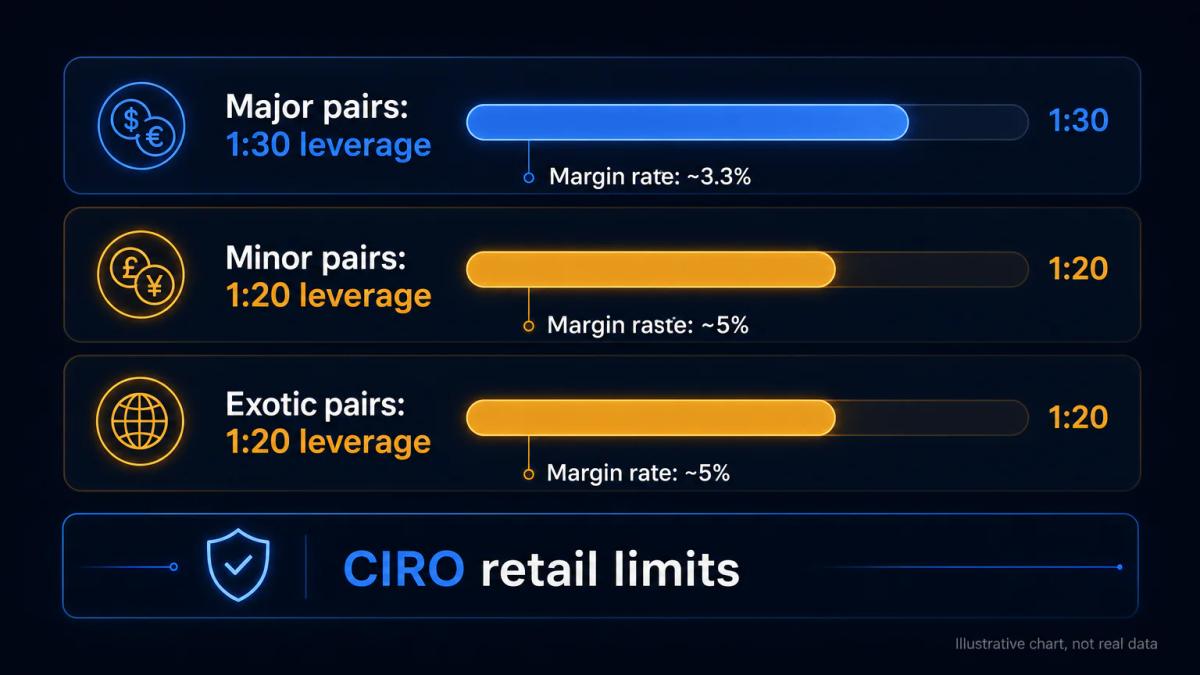
CIRO sets margin rates for spot FX through a published schedule, with the schedule distinguishing between a core group of major currency pairs and everything else. In practice the retail-facing numbers that Canadian dealers quote correspond to the standard IIROC/CIRO FX margin surcharges and work out to leverage in the following bands:
| Pair group | Typical margin rate | Approximate maximum leverage |
|---|---|---|
| Core majors (USD, EUR, GBP, JPY, CHF crosses within this set) | around 3% | about 1:33 |
| Other majors and liquid crosses (CAD, AUD, NZD vs core) | around 3% to 5% | about 1:20 to 1:33 |
| Secondary and exotic pairs | 5% and above | 1:20 or lower |
The exact number for a given pair is set in the dealer's margin schedule under CIRO rules, and the dealer may apply a surcharge above the regulatory minimum for its own risk reasons. Volatility events trigger temporary margin hikes, so the leverage you had on Friday is not guaranteed on Monday around a central bank decision or an election.
Unlike some jurisdictions, Canada does not operate a formal professional-client opt-up for retail forex: there is no documented route for a retail client to request CFTC-style wholesale leverage by passing a wealth and experience test. If you need higher gearing, the standard path is to qualify as a Permitted Client (broadly, institutional or high-net-worth under NI 31-103), which sits in a separate regulatory category from retail.
Finding a regulated forex broker that accepts Canadian clients
A regulated dealer offering forex to Canadian residents will be registered as an Investment Dealer with CIRO and listed on the National Registration Search of the CSA for each province where it operates. Verification runs in three steps:
- Search the firm's legal name on the CSA National Registration Search and confirm the registration category and the provinces listed.
- Confirm CIRO membership on the CIRO Dealers We Regulate directory and note the firm's business number.
- Check the Disciplined List and the enforcement notices on both CIRO and your provincial commission for any sanctions, undertakings or restrictions.
A dealer missing from either the CSA registry or the CIRO member list is not authorised to solicit Canadian retail clients, regardless of what its website says about offshore licensing. The CSA maintains an Investor Alerts list of firms that have been flagged for soliciting Canadian residents without registration; it is a short exercise to search a brand name against it before funding an account.
The practical consequence of using an unregistered dealer, beyond the fraud risk, is that OBSI will not take your complaint, provincial restitution funds will not pay out, and civil enforcement against an offshore entity is slow and expensive. Credit card chargebacks and bank reversals are often the only effective recourse, and both have narrow time windows.
For an advanced trader, the operational points that separate CIRO dealers typically fall across a handful of categories, with TradingView integration remaining uneven across the Canadian entities alongside the usual MetaTrader 4 and 5, cTrader and in-house web and desktop builds:
- Execution reporting quality, including fill price, slippage statistics and rejection rates.
- The full margin schedule beyond the headline leverage figure.
- The tax reporting package, including T5008 handling for FX and RRSP or TFSA eligibility of the account.
- Platform and connectivity, including whether the dealer supports an API or restricts you to its proprietary platform.
Tax treatment of forex trading profits in Canada
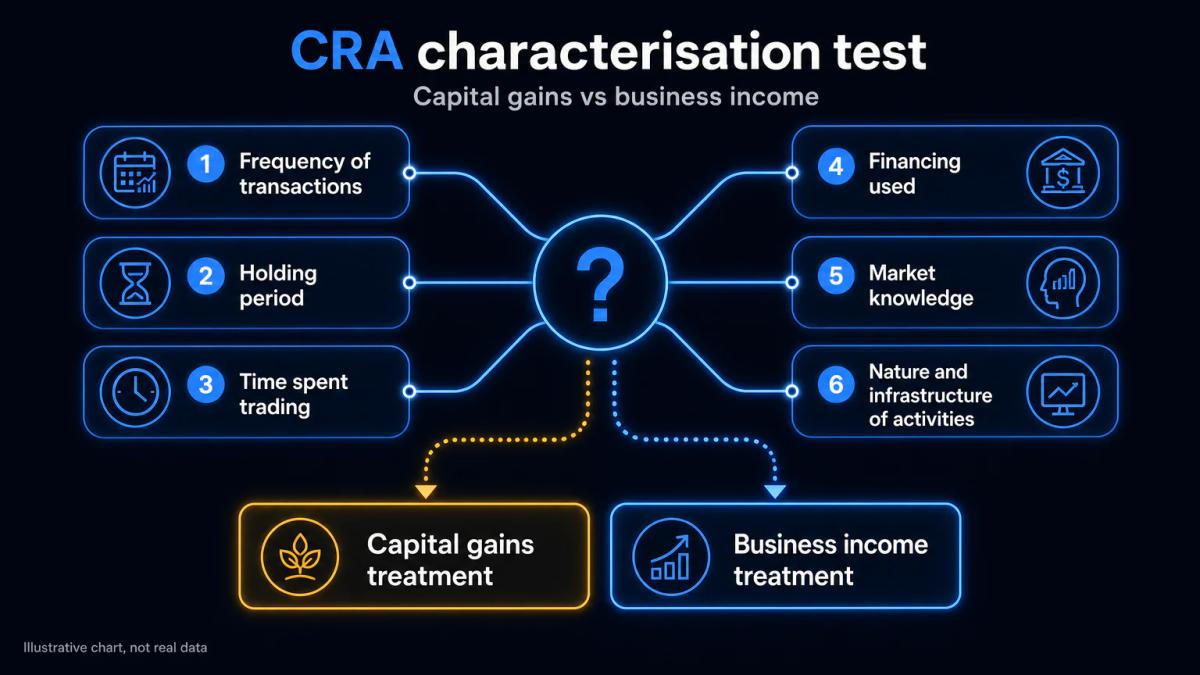
The Canada Revenue Agency assesses forex gains under one of two regimes, and the choice is not left to the taxpayer: it is determined by the facts of the activity. Interpretation Bulletin IT-95R and CRA folios on characterisation of gains set out the test, which looks at frequency of transactions, holding period, time spent, financing used, knowledge of markets, and whether trading is a stated source of livelihood.
- Capital gains treatment applies when forex is held as a capital investment. Half of the net gain is included in taxable income at your marginal rate; losses are capital losses, deductible only against capital gains in the same year, the three prior years, or carried forward indefinitely.
- Business income treatment applies when activity is commercial in nature. The full gain is taxable at your marginal rate; losses are non-capital losses, deductible against any source of income in the year, carried back three years or forward twenty.
Section 39(2) of the Income Tax Act contains a specific rule for foreign exchange gains and losses on capital account from the fluctuation of currencies: the first CAD 200 of net FX capital gain or loss in the year is disregarded. Beyond that threshold the normal rules apply. Section 39(2) does not apply to amounts on income account or to speculative trading that qualifies as a business.
Marginal rates are federal plus provincial combined. The top combined marginal rates for 2024 ranged from roughly 44.5% in Alberta to about 54.8% in Nova Scotia on ordinary income, with the capital gains inclusion rate making the effective top rate on capital gains roughly half of those numbers for amounts within the standard inclusion band. The federal government proposed changes to the capital gains inclusion rate for amounts above CAD 250,000 per year, with implementation deferred; the status of that measure needs confirmation with a tax professional before relying on it for planning.
Suppose you report a CAD 40,000 net forex gain for the year and the CRA accepts capital treatment. The CAD 200 section 39(2) disregard removes a trivial slice, half of the remainder is included in income, and that included amount is taxed at your marginal rate for the year. If the same CAD 40,000 is characterised as business income, the whole amount is taxable at your marginal rate, and losses in future years are deductible against employment or other income, with capital gains treatment restricting that deductibility. The absolute tax bill between the two paths can differ by five figures on a gain of this size, so the characterisation is where the planning sits.
Account types and registration requirements for Canadian traders
Canadian dealers offer forex in a narrower set of account structures than equities, because of the regulatory treatment of FX margin trading and the registered-plan rules on qualified investments. The practical menu looks like this:
| Account type | Forex availability | Tax treatment inside | Key limit |
|---|---|---|---|
| Non-registered individual (cash or margin) | Yes, at CIRO dealers | Capital or business per CRA test | None, full taxation |
| Non-registered joint | Yes at most dealers | Attributed between holders | None |
| TFSA | Rarely for FX margin; some dealers allow deliverable FX only | Tax-free growth if compliant | CAD 7,000 contribution for 2024 (indexed), lifetime cumulative since 2009 |
| RRSP | Rarely for FX margin; deliverable FX in some cases | Tax-deferred | 18% of prior-year earned income up to the annual dollar limit |
| FHSA (First Home Savings Account) | Limited to qualified investments | Tax-free if used for qualifying home purchase | CAD 8,000 annual, CAD 40,000 lifetime |
| Corporate account | Yes at CIRO dealers that onboard corporates | Corporate tax plus integration | Suitability and KYC heavier |
The reason registered plans are a tight fit for leveraged forex is the qualified investments rule in the Income Tax Act. Spot FX held outright may qualify, but FX margin contracts, rolling spot and most CFD-style instruments are generally not qualified investments for RRSPs, TFSAs or FHSAs, and holding a non-qualified investment in a registered plan triggers a 50% penalty tax on the fair market value of the asset. Contribution limits in the table above (CAD 7,000 TFSA for 2024, CAD 8,000/40,000 FHSA, and the RRSP 18% rule up to the annual dollar limit) are the figures published by the Canada Revenue Agency and are indexed over time, so confirm the current year's number on the CRA site before relying on them. Dealers therefore restrict the FX offer inside registered plans to deliverable FX or exclude it altogether. If a dealer markets leveraged FX inside a TFSA without a clear qualification analysis, that is a flag to confirm the structure with a tax adviser before funding.
Trading frequency inside a TFSA creates a further area of exposure. The CRA has reassessed TFSA accounts as carrying on a business, with the risks of overtrading in a sheltered account, which strips the tax-free status and taxes the gains as business income to the holder. Published cases involve stock trading, and the reasoning applies by analogy to active FX activity in a registered plan.
Penalties and enforcement for unregulated forex activity
The enforcement regime runs on two tracks: action against the unregistered dealer, and administrative consequences for the Canadian resident client. Provincial securities commissions have the stronger toolkit against dealers, with powers that include:
- issuing cease trade orders
- imposing administrative penalties into the millions of dollars
- obtaining disgorgement of amounts received from investors
- referring cases for quasi-criminal prosecution under the provincial Securities Act
The OSC, AMF and BCSC publish enforcement decisions regularly and name individuals as well as entities.
On the Canadian client side, the consequences fall into practical and civil categories rather than criminal ones, because trading with an unregistered offshore broker is not in itself an offence committed by the retail participant. What does bite are the lost protections and reporting burdens that follow:
- No access to OBSI, which handles investment complaints only against participating firms.
- No coverage from the Canadian Investor Protection Fund (CIPF), which protects client assets at insolvent CIRO member firms up to CAD 1 million per account category.
- No recourse to provincial restitution funds, where they exist.
- Difficulty enforcing a foreign judgment against an offshore entity even if you obtain one.
- Potential CRA scrutiny of gains and losses, since offshore accounts above CAD 100,000 in cost base trigger Form T1135 Foreign Income Verification Statement reporting, with penalties for non-filing.
For a trader who has already funded an unregistered broker and runs into withdrawal problems, the useful steps are to:
- Collect and preserve all communications with the broker, including chats, emails and account statements.
- File a complaint with the provincial commission that covers your residence.
- File an Investor Alert tip with the CSA so the firm is flagged for other Canadian residents.
- Move quickly on bank or card reversals, since both have narrow time windows.
- Consider civil action only after weighing cost against likely recovery, as pursuing an offshore defendant is rarely economic on retail account sizes.
How Canadian forex rules compare to the US and UK
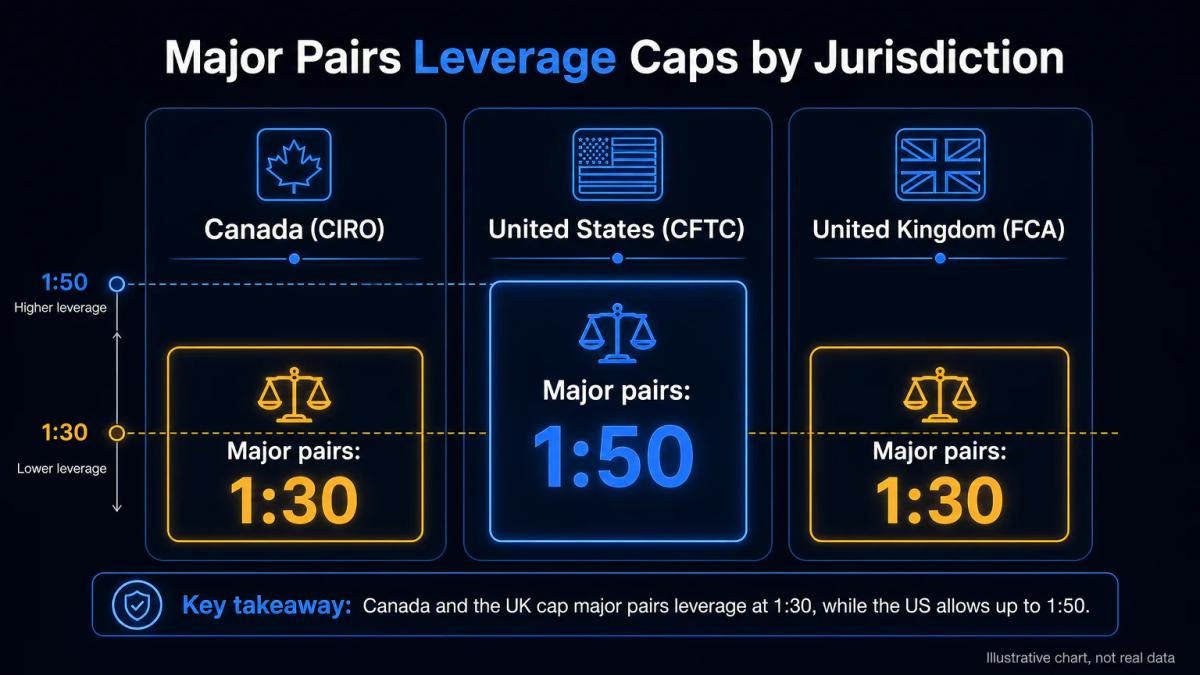
Canada occupies a middle position between the United States and the United Kingdom across most regulatory dimensions, aligning with UK practice on leverage and product scope while sitting closer to the US approach when it comes to the taxation of active trading.
| Dimension | Canada (CIRO) | United States (CFTC/NFA) | United Kingdom (FCA) |
|---|---|---|---|
| Retail leverage, major pairs | about 1:33 via margin schedule | 1:50 | 1:30 |
| Retail leverage, minor and exotic pairs | 1:20 or lower | 1:20 | 1:20 |
| CFDs for retail | Permitted via CIRO dealers | Prohibited | Permitted with ESMA-style restrictions retained post-Brexit |
| Binary options for retail | Prohibited (CSA ban) | Restricted to designated exchanges | Prohibited |
| Crypto CFDs for retail | Restricted, varies by dealer and province | Not offered as retail FX product | Prohibited by FCA for UK retail |
| Negative balance protection | Not a formal rule; dealer-level practice | Not required | Required by FCA for retail |
| Hedging and FIFO | Hedging permitted; no FIFO rule | FIFO rule and no hedging on same pair | Hedging permitted; no FIFO rule |
| Tax of active trading | Capital gains or business income per CRA facts test | Section 988 ordinary income by default; Section 1256 60/40 by election for certain contracts | Capital gains tax with annual allowance; income tax if trading is a trade |
| Account protection | CIPF up to CAD 1,000,000 per account category | SIPC does not cover forex; segregation rules only | FSCS up to GBP 85,000 per person per firm |
| ISA/TFSA/IRA equivalent for FX | TFSA, RRSP, FHSA, with qualified investment limits | IRA, with custodian restrictions on FX | ISA and SIPP, with FX typically excluded for margin products |
Three points stand out for an advanced trader choosing between jurisdictions:
- CFD access distinguishes Canada and the UK from the US, where retail CFDs are not offered at all; this changes the realistic product mix available to a Canadian trader relative to a US resident, especially for shorter-horizon approaches like swing trading across multiple instruments.
- The US FIFO rule and no-hedging rule do not apply in Canada, so strategies that require simultaneous long and short positions in the same pair are workable at a CIRO dealer.
- Negative balance protection is a formal FCA rule for UK retail, while in Canada it operates as a dealer-level practice without a regulatory guarantee, so a stop-out event in a gap market can in principle leave a Canadian retail account owing money, subject to the dealer's own policy.
Day trading legality tracks the same framework in all three countries: it is legal for retail participants at a registered dealer, with the US adding the Pattern Day Trader rule for margin equities (not FX) and Canada adding no equivalent restriction. In Canada, day trading raises the probability that the CRA treats gains as business income, with the capital gains route becoming harder to defend and the tax consequences set out above.
Frequently Asked Questions
Can I trade forex in Canada if I live in Ontario or British Columbia?
Yes, in both provinces, through a dealer registered with CIRO and separately registered with the Ontario Securities Commission or the British Columbia Securities Commission. The product list and margin schedule may differ because each commission can impose conditions on registration or require specific disclosure for FX contracts, so the same dealer sometimes offers slightly different instruments or leverage to Ontario and BC residents.
What happens if I trade with an unregulated forex broker while living in Canada?
Trading itself is not a criminal act for you as the retail client, but you lose access to OBSI complaint handling, CIPF asset protection up to CAD 1,000,000, and provincial restitution funds. If the broker refuses withdrawals or becomes insolvent, your realistic recourse is bank or card reversal within the issuer's time window and a complaint to your provincial commission; civil action against an offshore entity is slow and rarely economic at retail account sizes.
Do I need to report forex losses to the CRA, and can I claim them as deductions?
Yes, forex losses are reportable, and the deduction rule depends on characterisation. On capital account they are capital losses, usable only against capital gains in the current year, the three prior years or carried forward indefinitely. On business account they are non-capital losses, deductible against any income in the year, with a three-year carry-back and twenty-year carry-forward. Section 39(2) adds a CAD 200 annual disregard on capital-account FX fluctuation.
Are there forex brokers that offer higher leverage to Canadian traders, and is it legal?
CIRO dealers are bound by the regulatory margin schedule, which caps retail leverage on majors at roughly 1:33. Offshore brands that advertise 1:200 or 1:500 to Canadian residents are either not registered to solicit Canadian clients, in which case the solicitation itself is in breach, or they are operating under a Permitted Client exemption that does not apply to a standard retail account. Higher leverage marketed to a Canadian retail resident is a registration flag.
How do I verify that a forex broker is regulated by CIRO before opening an account?
Search the firm's legal name on the CSA National Registration Search for your province, confirm the registration category is Investment Dealer, then cross-check the CIRO Dealers We Regulate directory for current membership. Review the Disciplined List and enforcement notices on CIRO and your provincial commission for any sanctions. Finally, check the CSA Investor Alerts list to make sure the firm has not been flagged for unregistered solicitation.
About the authors


Put this into practice
Brokers we have reviewed
Scored on the same five dimensions. Here are three of them — the full list is on the brokers page.



Related articles

Is Forex Trading Legal in the UK? FCA Rules and Your Rights
Forex trading is legal in the UK through FCA-authorised brokers. Understand leverage caps, product restrictions, FSCS protection and the risks of offshore firms.

Most Volatile Stocks: How to Find and Trade Them
A practical guide for retail traders on where to find the most volatile stocks, why they swing, and how to trade them without blowing up your account.

Options Trading Explained: Calls, Puts, and Broker Approval
How options trading works for UK retail traders: calls, puts, strike prices, premiums, broker approval, risk limits, and tax reporting, in plain English.
0 comments