



Financial Markets · Advanced · 12 min read
Is Forex Trading Legal in Australia? ASIC Rules, Leverage Caps and Broker Licensing
The legal status of forex trading in Australia
The lawfulness of retail forex activity in Australia hinges on who sits on the other side of your trade. A broker holding an Australian Financial Services Licence (AFSL) issued by ASIC, the Australian Securities and Investments Commission, can lawfully offer forex CFDs to retail clients at leverage capped at 1:30 on major pairs under ASIC's product intervention order. If you trade with an unlicensed offshore venue, you commit no offence as the client, although you also give up every protection the Australian investor framework offers.
What the regime protects is the perimeter of the Australian framework itself. Day trading is legal in Australia regardless of frequency: ASIC applies no pattern day trader rule equivalent to the US FINRA threshold, and no minimum equity requirement governs how many intraday positions you open and close. The forex trading laws Australia applies focus on the licensing and conduct of your counterparty rather than on your trading cadence. High-frequency activity changes your tax classification, your record-keeping obligations, and the margin consumption rate that triggers ASIC's mandatory margin close-out at 50% of initial margin.
The content below is general information only, not tax or legal advice; each situation is specific, and you should confirm your position with a licensed professional — an Australian-registered tax agent, financial adviser or legal practitioner — in the relevant jurisdiction before acting.
This article treats the regulated chain end to end: AFSL scope, leverage and margin mechanics, ATO treatment, client money rules, AFCA dispute resolution, the CFD wrapper that defines retail access, broker comparison criteria, onboarding, platform choice, and the specific risks ASIC's regime is engineered to contain.
ASIC regulation and broker licensing requirements
Any provider dealing in or advising on forex CFDs to Australian retail clients must hold an AFSL with authorisations covering derivatives and foreign exchange contracts, and must be a member of AFCA. The AFSL conditions impose organisational competence, adequate financial resources, PI insurance, dispute resolution membership, and compliance with the Corporations Act 2001 and the ASIC Market Integrity Rules. ASIC publishes licensees on its Professional Registers, and verifying the AFSL number directly on that register is the only reliable way to confirm a broker's status, since a logo on a website proves nothing.
Brokers operating under offshore licences (Vanuatu VFSC, Seychelles FSA, SVG FSA) can accept Australian clients commercially while offering no AFCA access and no ASIC enforcement against misconduct. Several brands run dual entities: an AFSL vehicle for Australian onboarding alongside an offshore vehicle used elsewhere, with the signup funnel sometimes routing clients between the two. Your legal protection is determined by the entity actually named in your client agreement, so that document, and not the group's marketing site, is what you should check.
The AFSL regime also imposes design and distribution obligations (DDO) under the Treasury Laws Amendment (Design and Distribution Obligations) Act. Each product has a Target Market Determination (TMD) describing the retail cohort for whom the forex CFD is appropriate; brokers must take reasonable steps to distribute within that cohort. In practice this surfaces as the suitability questionnaire during account opening, where answers inconsistent with the TMD can block retail access or route you to a wholesale (sophisticated investor) assessment under section 761GA, which removes retail protections including the ASIC leverage cap.
Leverage limits and margin requirements for Australian traders
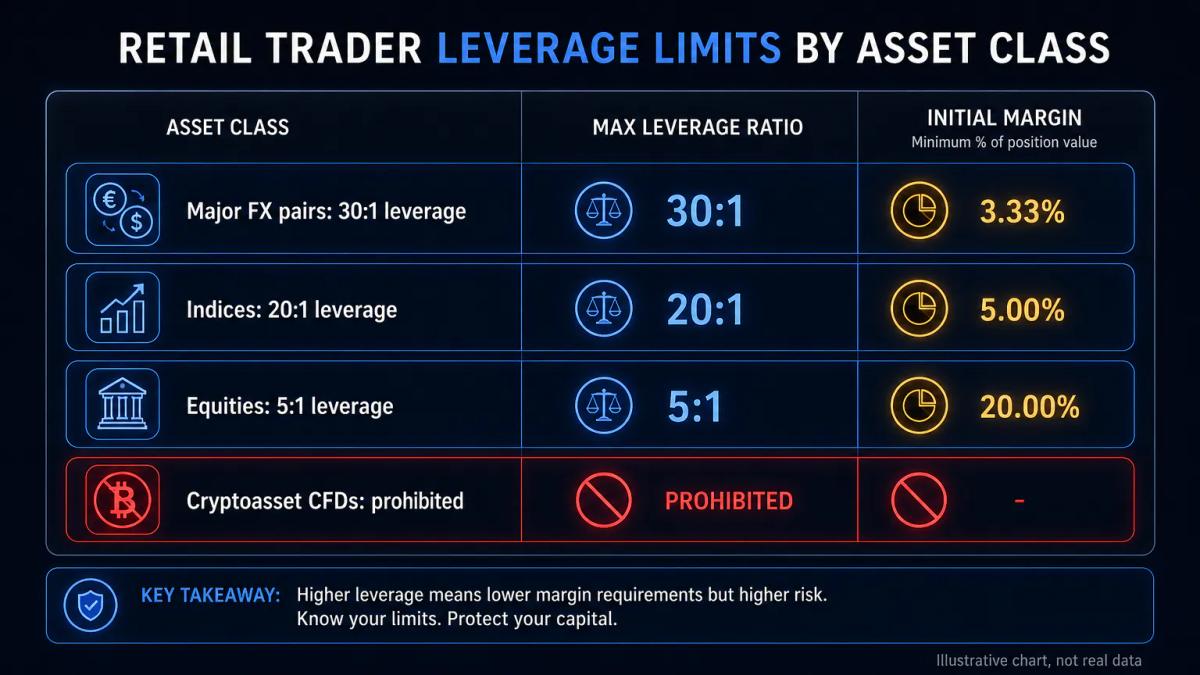
ASIC Corporations (Product Intervention Order, Contracts for Difference) Instrument 2020/986, in force since 29 March 2021, sets the retail leverage ceilings currently applied in Australia:
| Underlying | Maximum leverage | Initial margin |
|---|---|---|
| Major FX pairs | 30:1 | 3.33% |
| Minor FX pairs, gold, major indices | 20:1 | 5% |
| Commodities (ex-gold), minor indices | 10:1 | 10% |
| Shares and other reference assets | 5:1 | 20% |
| Cryptoasset CFDs | 2:1 | 50% |
Crypto CFDs remain available to Australian retail clients under this instrument, subject to a 2:1 cap; the outright ban applies in the United Kingdom under the FCA regime. The margin close-out rule requires brokers to close one or more open CFDs when the account's net equity falls to 50% of the total initial margin posted on open positions. Negative balance protection is mandatory on a per-account basis, so your loss on the CFD trading account cannot exceed the funds in it.
Wholesale clients certified under section 708 or 761GA fall outside the instrument. Reclassification removes the leverage cap and the margin close-out, and at several brokers unlocks 1:200 or 1:500 on majors. The certification requires either a qualified accountant's certificate (net assets of $2.5 million or gross income of $250,000 for two consecutive years) or a product-specific sophistication test. The trade-off is worth stating clearly: higher leverage comes with the loss of retail-only safeguards, including PDS and TMD obligations in your favour.
Tax treatment of forex trading gains and losses
The ATO distinguishes between a trader (business) and an investor (holder of CGT assets) based on the indicators in TR 97/11 and the forex-specific guidance in TD 2011/15 and TR 2005/15. The factors examined are:
- intention to profit
- repetition and regularity
- volume and capital committed
- business-like organisation (plan, records, dedicated setup)
- time devoted
The classification determines the regime:
- Business trader: gains are ordinary income under section 6-5 ITAA 1997, taxed at your marginal rate; losses are deductible against other income subject to the non-commercial loss rules in Division 35; expenses (data feeds, VPS, platform fees, home office apportionment, interest on borrowings used for trading capital) are deductible under section 8-1.
- Investor: gains and losses fall under the CGT regime (Part 3-1), with the 50% CGT discount available after 12 months of holding, which rarely applies to leveraged CFDs given typical holding periods.
- Specific forex rules: Division 775 ITAA 1997 governs realisation of forex gains and losses on actual currency and forex-denominated obligations; CFDs themselves are taxed under TR 2005/15 as ordinary income or loss depending on the profit-making intention.
Marginal rates for Australian tax residents, as published by the ATO for the 2024-25 income year, apply across the following brackets:
- 0% on income up to $18,200
- 16% from $18,201 to $45,000
- 30% from $45,001 to $135,000
- 37% from $135,001 to $190,000
- 45% above $190,000
On top of the brackets above, the 2% Medicare levy applies where relevant. Non-residents are taxed from the first dollar at the non-resident scale. Records must be kept for five years from the date of lodgement, and broker annual statements plus a reconciled trade ledger form the practical baseline.
Client fund protection and dispute resolution
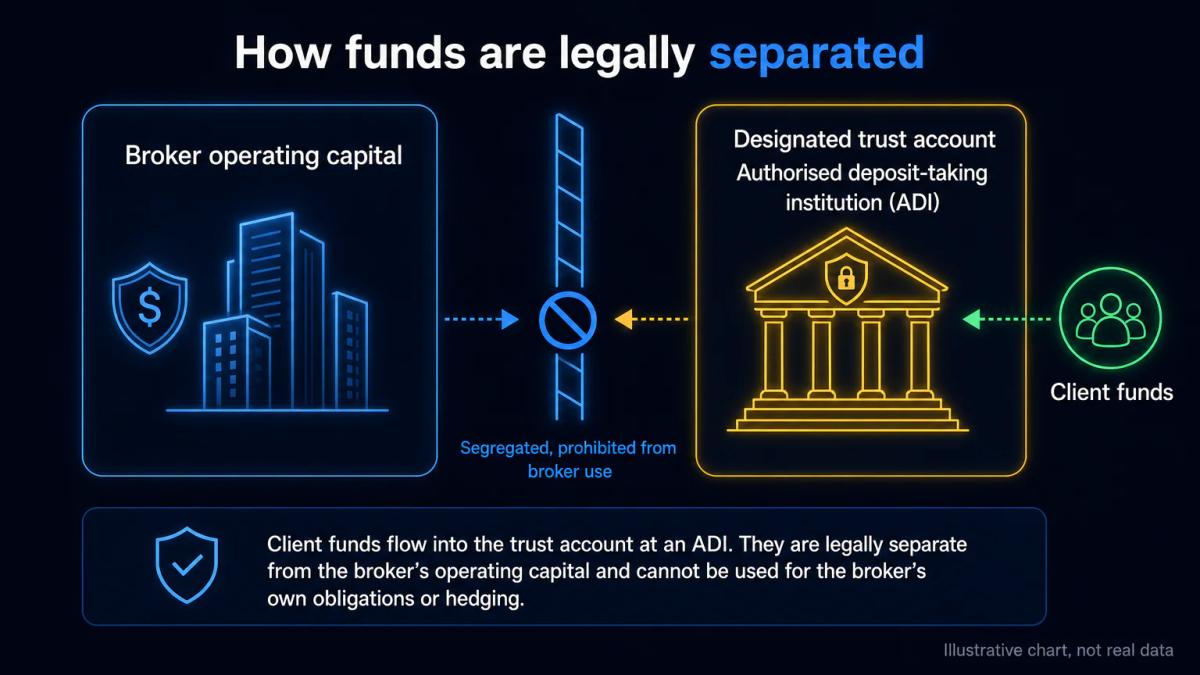
AFSL holders dealing in derivatives must comply with the client money regime in Part 7.8 of the Corporations Act, as amended by the Treasury Laws Amendment (2017 Measures No. 6) Act. Retail client money for derivatives must be held in a designated client trust account at an ADI (authorised deposit-taking institution) and is prohibited from being used to meet the broker's own obligations, including hedging with counterparties. This closes the pre-2018 practice of using client money as working capital.
The trust account structure protects the pool against commingling with the broker's assets, but it does not operate as a government compensation scheme. If an AFSL holder becomes insolvent, segregated client funds should be returnable, net of administration costs and any shortfall from unauthorised use. Reconstruction of the pool and recovery is a matter for the external administrator under the Corporations Act's insolvency provisions.
Dispute resolution runs through AFCA, which replaced FOS and CIO in November 2018. AFCA's determinations are binding on the AFSL holder up to the monetary limits set in its Rules; for most CFD-related complaints the current compensation cap sits in the hundreds of thousands of dollars per claim, with specific thresholds published in AFCA's Operational Guidelines. Filing is free for the complainant and requires exhausting the firm's internal dispute resolution (IDR) first, which has a 30-day statutory response window under RG 271.
Forex trading versus CFD trading under Australian law
Retail access to the FX market in Australia is almost entirely via CFDs or margin FX contracts, both treated as derivatives under Chapter 7 of the Corporations Act. A margin FX contract is a rolling forward where the economic exposure is cash-settled and ownership of the underlying currency never passes. A CFD on a currency pair is functionally equivalent for retail purposes: both fall under ASIC Instrument 2020/986 and share the same leverage caps, margin close-out and negative balance protection.
Spot FX in the interbank sense, where you take delivery of the quoted currency against your base currency through an FX dealer, is restricted to corporates and wholesale clients and does not form part of the retail product set. Physical currency conversion through a licensed money services business or an ADI is a different service altogether, regulated under the AML/CTF Act 2006 and supervised by AUSTRAC under a separate regime from ASIC's derivatives rules.
Choosing an ASIC-regulated broker: criteria and current field
Selection on the Australian field reduces to five verifiable attributes:
- AFSL authorisations
- execution model
- pricing structure
- platform coverage
- funding rails
Comparing representative ASIC-licensed providers on those axes:
| Broker | AFSL number | Execution | EUR/USD spread (typical) | Minimum deposit | Platforms |
|---|---|---|---|---|---|
| IC Markets | 335692 | ECN Raw | 0.1 pip + $3.50/lot commission | $200 | MT4, MT5, cTrader, TradingView |
| Pepperstone | 414530 | ECN Razor | 0.1 pip + $3.50/lot commission | $0 | MT4, MT5, cTrader, TradingView |
| CMC Markets | 238054 | Market maker | 0.7 pip all-in | $0 | Next Generation, MT4 |
| City Index (StoneX) | 345646 | Market maker | 0.5 pip all-in | $0 | Web Trader, MT4, TradingView |
| FP Markets | 286354 | ECN | 0.1 pip + $3.00/lot commission | $100 | MT4, MT5, cTrader, TradingView, IRESS |
Spread figures are indicative of typical London session conditions on EUR/USD and widen outside liquid hours. Commission structures on raw-spread accounts should be converted to the equivalent all-in cost (pip value plus commission per lot) before comparing.
Opening and verifying an account with an ASIC-licensed broker
The sequence is standardised by AML/CTF obligations and DDO:
- Verify the AFSL on the ASIC Professional Registers using the licensee's legal name, not the trading brand.
- Read the PDS and TMD for the specific product (margin FX / CFD) you intend to trade, and confirm you fall within the target market.
- Complete the online application: personal details, tax file number (optional but relevant for interest withholding), employment, financial position, trading experience.
- Pass the suitability questionnaire assessing knowledge of leverage, margin and CFD risk; failure routes you to educational material and a retry.
- Verify identity under the AML/CTF Act 2006: electronic KYC using passport or driver licence plus a Medicare card typically clears in minutes; manual verification requires certified copies.
- Fund the account via POLi, PayID/OSKO, bank transfer or card. Deposits must come from an account in your own name; third-party funding is refused under source-of-funds rules.
- Set leverage within the retail cap, configure platform access and test with the minimum lot size before scaling.
Risks and how the ASIC regime addresses each
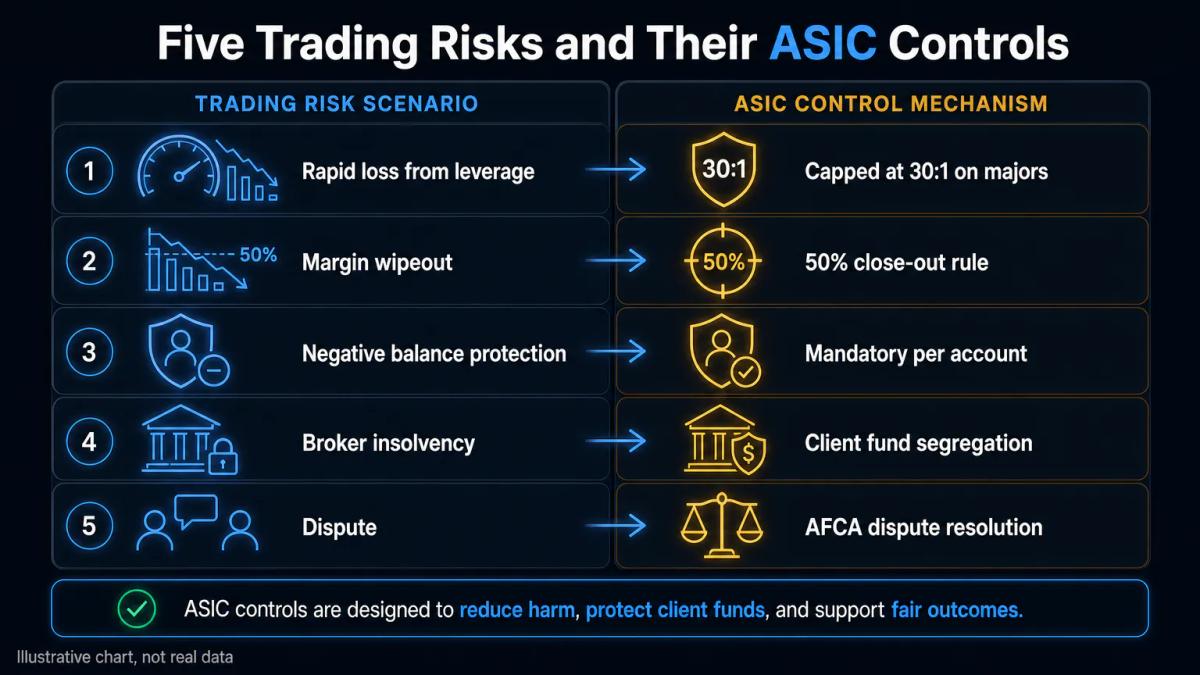
Retail CFD risk decomposes into five categories, each mapped to a specific control:
- Rapid loss from leverage: capped at 30:1 on majors by Instrument 2020/986.
- Margin wipeout: addressed by the 50% margin close-out rule applied per account.
- Account going negative on a gap (SNB-style event): neutralised by mandatory negative balance protection per retail account.
- Broker insolvency and misuse of client funds: client money held in trust at an ADI under Part 7.8, prohibited from use as working capital.
- Mis-selling to unsuitable clients: DDO and TMD impose distribution controls, with AFCA as the remedy channel if controls fail.
Several residual risks sit outside the regime and need to be managed by the trader:
- slippage on illiquid instruments
- execution quality on market-maker models
- counterparty hedging quality
- the behavioural risk of overtrading
Broker choice, position sizing and a documented process are the main tools available for keeping these within acceptable bounds.
Platform choice under Australian regulation
ASIC does not prescribe a trading platform; the regulatory obligations attach to the broker rather than to the software they offer. Platform choice is therefore a workflow decision rather than a legal one:
| Platform | Order types | Automation | Depth of market | Strengths |
|---|---|---|---|---|
| MT4 | Market, limit, stop, trailing stop | EAs in MQL4, large third-party library | No native DOM on FX | Deepest EA and indicator ecosystem |
| MT5 | MT4 set plus buy/sell stop limit | EAs in MQL5, strategy tester with multi-asset | Native DOM, exchange execution model | Faster backtesting, hedging and netting modes |
| cTrader | Advanced conditional orders, level II | cBots in C#, no scripting lock-in | Native level II DOM | Institutional-style order management, transparent ECN pricing |
Suppose you run a mean-reversion EA on EUR/USD with an average holding time of two hours and 20 trades per week. On MT4 the EA is portable to any MT4 broker; the same logic ported to C# for cTrader gains access to level II data while losing the MQL4 library. In other words, the trade-off sits between ecosystem lock-in and execution transparency, and has no bearing on regulatory status.
Imagine opening a 1-lot EUR/USD position (100,000 units) at 1.0850 with an ASIC retail account. Initial margin at 30:1 is approximately $3,616 in account currency; the 50% close-out trigger is roughly $1,808 of equity on that position in isolation. A 100-pip adverse move produces a $1,000 drawdown on that single lot. Figures are order-of-magnitude and ignore swaps, commissions and the effect of other open positions.
Frequently Asked Questions
Do I need a licence to trade forex in Australia as a retail trader?
No. You do not need any licence to trade your own capital. The AFSL requirement applies to the broker, not to you. You must trade through an AFSL holder to remain inside the ASIC perimeter and retain AFCA access.
What is the maximum leverage I can use for forex trading in Australia?
Retail leverage is capped at 30:1 on major currency pairs, 20:1 on minors and gold, 10:1 on non-gold commodities and minor indices, 5:1 on shares and 2:1 on cryptoasset CFDs, under ASIC Instrument 2020/986. Wholesale clients certified under section 708 or 761GA are outside these caps.
How are forex trading profits taxed in Australia?
CFD and margin FX profits are taxed under TR 2005/15 as ordinary income at your marginal rate, from 16% above $18,200 to 45% above $190,000 for residents in the 2024-25 year, plus Medicare levy. Business-trader classification allows deduction of trading expenses; losses are subject to Division 35 non-commercial loss rules. Confirm your position with a registered tax agent.
What happens to my money if my forex broker goes bankrupt?
Retail client money held under Part 7.8 of the Corporations Act sits in trust at an ADI, segregated from the broker's own funds and prohibited from use as working capital. On insolvency it should be returnable through the external administrator, net of administration costs and any shortfall. There is no government compensation scheme equivalent to the UK FSCS.
Can I trade cryptocurrencies on forex platforms in Australia?
Yes. Cryptoasset CFDs are legal for Australian retail clients under ASIC Instrument 2020/986 but capped at 2:1 leverage, meaning 50% initial margin. This differs from the United Kingdom, where crypto CFDs are banned for retail clients under the FCA regime.
About the authors


Put this into practice
Brokers we have reviewed
Scored on the same five dimensions. Here are three of them — the full list is on the brokers page.



Related articles

Is Forex Trading Legal in Canada? Rules, Brokers and Tax Treatment
Forex trading is legal in Canada under CIRO oversight and provincial securities commissions. Here is how the rules shape leverage, brokers, taxes and account types.

Is Forex Trading Legal in the UK? FCA Rules and Your Rights
Forex trading is legal in the UK through FCA-authorised brokers. Understand leverage caps, product restrictions, FSCS protection and the risks of offshore firms.

Most Volatile Stocks: How to Find and Trade Them
A practical guide for retail traders on where to find the most volatile stocks, why they swing, and how to trade them without blowing up your account.
0 comments