



How to Trade · Beginner · 6 min read
AI Agents for Stock Trading: How They Work and What to Expect
What AI agents do in stock trading
AI agents for stock trading are autonomous software systems that lean on large language models and decision-making frameworks to analyse market data, generate trade signals and route orders with minimal human intervention. A large language model, or LLM, is an AI system trained on text that can read prompts and produce reasoned responses. Where a traditional bot follows fixed if-then rules, an agent reasons through several data sources in real time and adapts its behaviour as conditions change, which opens the door to more nuanced decisions and to new failure modes worth understanding before you deploy one.
For a retail trader, this setup means the agent can read a news headline, glance at the chart, review any open positions and decide what to do without a single click on your part. It keeps running overnight and across sessions, which is part of the appeal, and it also makes mistakes at machine speed, which is why the rest of this article focuses on what to expect before you connect one to real money.
Where you trade weighs as heavily as the strategy itself; take a look at the best forex brokers and the conditions they offer.
How multi-agent frameworks make trading decisions
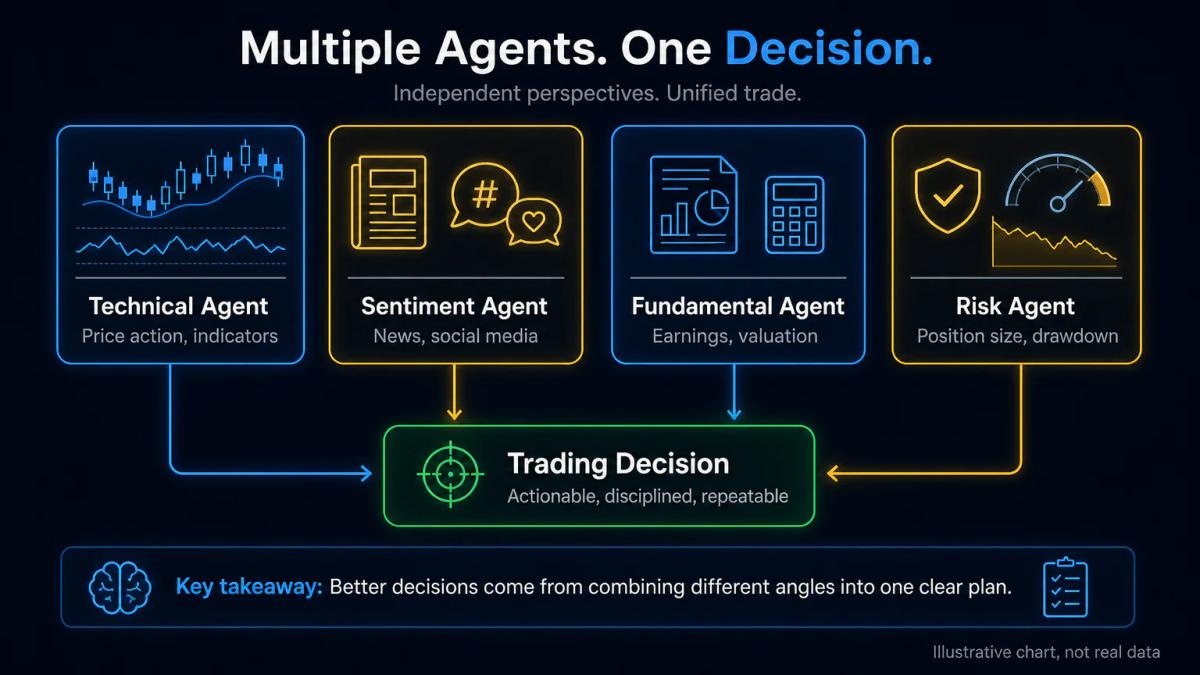
Multi-agent frameworks split the work of trading across several specialised AI agents that talk to each other. A typical setup relies on four roles working in parallel, each with its own remit:
- Technical agent: reads price action and indicators.
- Sentiment agent: reads news headlines and social media posts to gauge whether the mood around a stock is positive or negative.
- Fundamental agent: looks at earnings, revenue growth and valuation ratios.
- Risk agent: tracks position size and drawdown, which is the fall from a capital peak to the trough before a new peak.
Each agent produces its own view of buy, sell or hold, often with a confidence score attached. A coordinator agent then weighs these views and issues a final instruction. Imagine that the technical and sentiment agents both flag a buy while the risk agent reports that you already hold too much exposure to the same sector: the coordinator can override the trade and keep you out of a concentrated bet.
This structure carries two practical advantages worth naming. It reduces the blind spots of a single-strategy system, because no one agent ever gets to act alone, and it lets you combine analytical angles across price, news, fundamentals and risk without writing the nested conditional logic yourself. Open-source frameworks such as AutoGen, LangChain and CrewAI package this pattern so you can configure roles in a few files.
Backtesting versus live trading: the reality gap
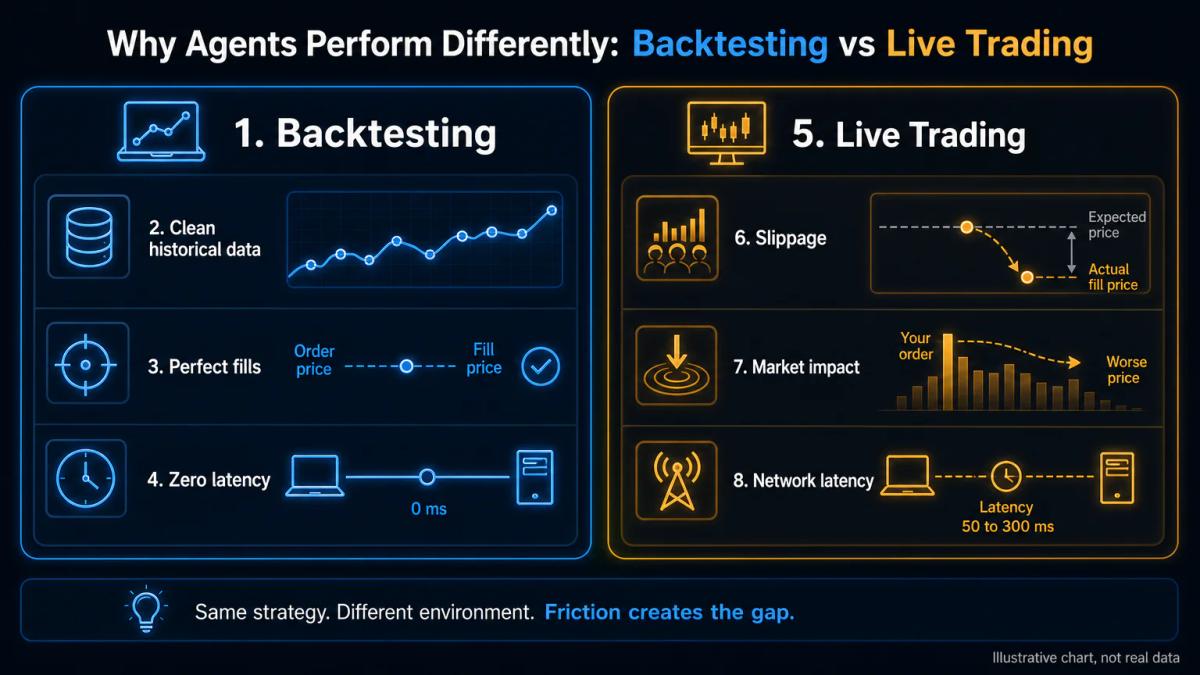
AI agents often look impressive in backtests and then disappoint once they hit live trading. A backtest replays historical price data through your agent to see how it would have performed on paper. The trouble is that historical data is clean, fills are assumed at the printed price, and the exercise ignores network latency entirely, whereas live markets tend to be considerably messier on all three counts.
In live conditions your agent runs into slippage, which is the difference between the price you expected and the price you actually got, market impact when your order moves the book, and execution delays from your broker's API. It will also meet market regimes it never saw during development, whether that is a sudden volatility spike, a halted stock or a thin pre-market session, and it may react poorly. Treat backtest results as an upper bound rather than a forecast, and size positions so that a significant drop in live performance still leaves you solvent.
Most retail setups connect an agent to a broker through a REST or WebSocket API. A REST API lets your code send individual requests, such as placing an order or checking a balance, over standard web calls, while a WebSocket keeps a live connection open so price updates stream in without you asking each time. Retail-friendly options include Alpaca, Interactive Brokers and market-data providers such as Polygon.
The workflow itself is straightforward in shape and comes down to three moves:
- Deploy an agent framework such as AutoGen, LangChain or CrewAI on a cloud server or your own machine.
- Authenticate with your broker using API keys, which are long secret strings that identify your account.
- Feed the agent real-time prices and your current positions, then let it submit orders programmatically.
Three details decide whether the setup survives contact with the market:
- Latency: every hundred milliseconds of delay between signal and order costs you on active names.
- Rate limits: brokers cap how many requests per minute you can send, and an agent that loops too fast gets throttled.
- Security: leaked API keys can drain an account, so keys belong in environment variables or a secrets manager, never in code you push to a public repository.
A misconfigured credential or a retry loop without a cooldown can also fire duplicate orders, which is one of the quickest ways to blow through a daily loss limit.
Running an agent 24/5 is not free. A basic cloud server on AWS, Google Cloud or a similar provider typically costs between $10 and $50 per month for a small instance. On top of that you pay your broker's transaction fees on every fill, and if you rely on premium market data or a paid LLM API, those charges add up quickly on an agent that queries the model many times per hour.
Infrastructure quality weighs as heavily as price. A 500-millisecond delay to the exchange, a brief server outage or a dropped WebSocket can all cause slippage or missed entries. Before you commit capital, work out whether your strategy's edge, its expected profit per trade after costs, is large enough to survive these operational drags across a realistic month of trading.
An AI agent that trades frequently or at size can attract regulatory attention, and a handful of behaviours are prohibited whether a human or an agent produces them:
- Spoofing: placing orders you intend to cancel in order to move the price.
- Layering: stacking orders on one side of the book to mislead other participants.
Your broker also monitors unusual patterns and can freeze an account pending review, so a strategy that trips these signals will not stay quietly ignored for long.
Keep the agent's logic transparent enough that you can explain any trade if a broker or regulator asks, and size positions conservatively rather than chasing capacity you cannot defend. Log every decision the agent makes, including the inputs it saw, so you have an audit trail if things go wrong, and avoid deploying agents whose purpose is to inflate volume or influence other participants.
AI agents versus traditional algorithmic trading systems
Traditional algorithms run hard-coded rules and statistical models with predictable behaviour, while AI agents reason with language models and adapt their approach as new information comes in. The table below sets the two side by side across the attributes that tend to decide which one is the right fit.
| Attribute | Traditional algo | AI agent |
|---|---|---|
| Execution speed | Microseconds to milliseconds | Hundreds of milliseconds to seconds |
| Unstructured data (news, filings) | Hard to handle | Native strength |
| Debuggability | Deterministic, easy to trace | Probabilistic, harder to reproduce |
| Infrastructure cost | Low once built | Server plus LLM API calls |
| Predictability | High | Variable |
For most retail traders, a well-tuned traditional algorithm still comes out ahead of an agent on speed, cost and reliability, and agents earn their place mainly when the signal genuinely lives in text that a rules engine cannot easily parse.
To see these conditions applied by a regulated broker, read our Tickmill review.
Frequently Asked Questions
Can AI agents for stock trading actually make money?
A minority of well-run agents genuinely make money, while the majority do not. An agent needs a real edge, meaning a signal that pays more than the round-trip cost of trading, together with the discipline to size positions small enough to survive drawdowns. Impressive backtests routinely fail in live conditions because slippage, latency and unfamiliar market regimes erode returns. Treat any agent as unproven until it has traded real money in a live account for several months across different market conditions.
What data do AI trading agents need to work effectively?
At minimum, an agent needs real-time price data for the stocks you trade, plus your account state such as cash, positions and open orders. Multi-agent setups usually layer on news feeds, filings, earnings data and social sentiment. Data quality carries more weight than sheer quantity, because stale quotes, missing ticks or delayed news will produce bad decisions regardless of how sophisticated the model happens to be. Latency to the exchange and to your data source should stay low and consistent.
How much does it cost to run an AI trading agent?
Budget $10 to $50 per month for a small cloud server, plus your broker's transaction fees on every fill. If your agent calls a paid LLM API for reasoning, those costs scale with how often it thinks, and can easily exceed the hosting bill on an active setup. Premium market data adds another monthly fee. These fixed costs eat into any edge, so account for them before you evaluate performance.
Are AI trading agents legal for retail traders?
Yes, in the sense that automated trading through a broker's API is generally permitted for retail accounts. Market manipulation remains illegal for humans and agents alike, which covers spoofing, layering, wash trades and coordinated activity designed to mislead other participants. Your broker's terms of service also apply on top of that. Keep the agent's logic transparent, log its decisions and stay within reasonable position sizes.
What happens if my AI agent makes a bad trade?
You are responsible for the position and any loss it produces, because brokers do not reverse orders on the grounds that your software misbehaved. Build in hard safeguards before you go live, including a maximum position size per trade, a daily loss limit that halts the agent automatically, and a kill switch you can trigger from your phone. Keep detailed logs so you can diagnose what went wrong afterwards and prevent the same failure from repeating.
About the authors


Put this into practice
Related articles

Best EMA for Finding Trends in Day Trading: 9, 21 and 50 Explained
How the 9, 21 and 50 EMAs work together to identify intraday trends, plus the 5, 8, 13 setup, stop placement, volume filters and common pitfalls.

Can You Day Trade Futures? Rules, Margin, and Requirements
A practical guide to day trading futures for retail traders: margin, PDT exemption, 24-hour access, Section 1256 tax treatment, and how to start with micro contracts.

Cryptocurrency Trading Guide for Beginners: How to Start
A plain-English cryptocurrency trading guide for beginners covering strategies, risk management, platform choice, UK regulation, tax reporting and asset security.
0 comments