



How to Trade · Beginner · 7 min read
Can You Day Trade Futures? Rules, Margin, and Requirements
Yes, retail traders can day trade futures
Futures day trading sits under a very different rulebook from equities. Retail traders can legally trade futures intraday in most jurisdictions if they use a futures-approved broker and meet exchange margin requirements, and there is no regulatory minimum account size, no weekly trade cap, and no forced cash account. According to the CFTC, NFA registration is required for professionals who handle customer funds or give trading advice, although a retail participant trading only their own money does not fall under that obligation.
A quick definition before going further: a futures contract is a standardised agreement to buy or sell an asset at a set price on a future date, traded on regulated exchanges such as the CME. Day trading futures means opening and closing those contracts within the same session, so overnight exposure never carries over. The sections that follow cover the rules, the leverage, the tax angle, and the practical setup for getting started.
If you still need a broker, our guide to the best forex brokers compares the regulated options side by side.
Margin requirements and leverage in futures day trading
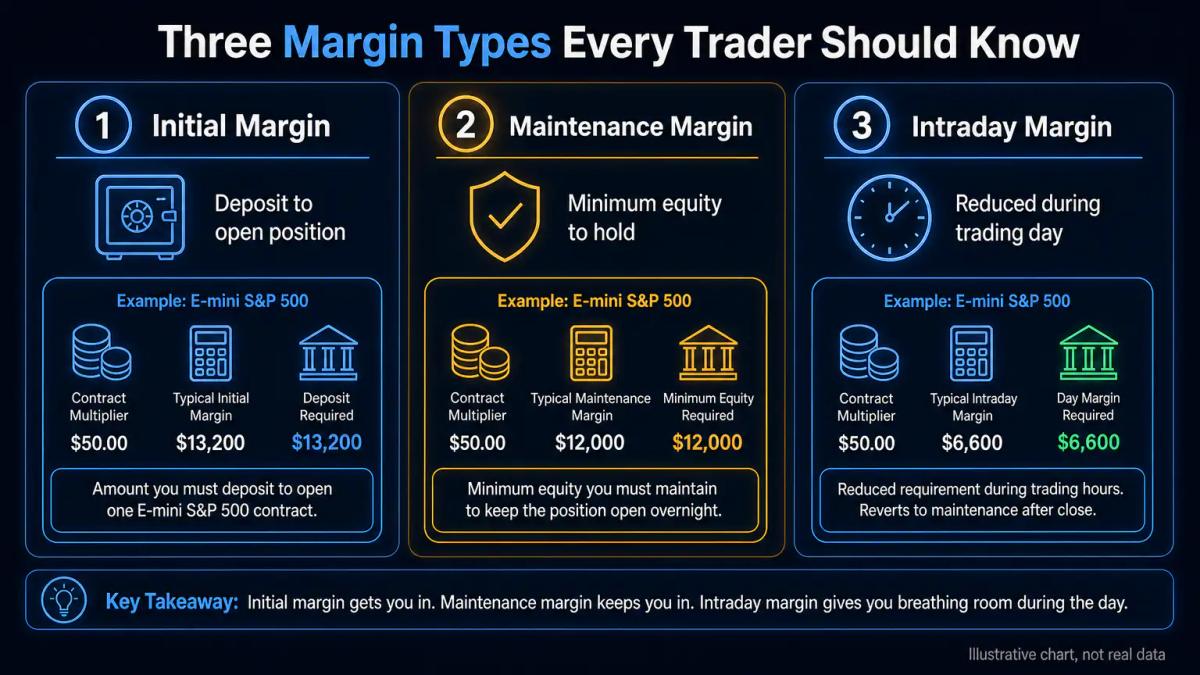
Futures allow a trader to control a large notional position with a relatively small deposit. Margin in this context works as a good-faith performance bond that the exchange requires you to keep on account, rather than money borrowed from a broker. Two numbers set the frame. Initial margin is what you must post to open a contract, while maintenance margin is the minimum equity you must keep while the position is open; if equity drops below it, the broker issues a margin call or liquidates the position.
For day trading specifically, many brokers apply a reduced intraday margin, sometimes only a fraction of the overnight figure, provided the position is closed before the session ends.
Consider an E-mini S&P 500 contract (ticker ES), which has a notional value of roughly $50 times the index level. If the index sat near 5,000 points, a single contract would control around $250,000 of exposure. Should the broker set intraday margin as low as $500 per contract, effective leverage would reach several hundred to one.
That ratio works in both directions. A one-point move in ES is worth $50 per contract, so a 10-point adverse swing translates into a $500 loss on a position that may only have $500 of intraday margin behind it.
Why futures day trading avoids the PDT rule and pattern day trader restrictions
The Pattern Day Trader (PDT) rule is a FINRA requirement that flags any US margin account executing four or more day trades in stocks or stock options within five business days, at which point the account must keep at least $25,000 in equity or face restrictions. Futures fall under a different regulator, the CFTC, and a different self-regulatory body, the NFA, so the PDT rule simply does not apply to them.
In practice this exemption has three consequences for a retail futures day trader:
- You can open and close as many round-trip futures trades per day as your margin supports.
- Your account is not frozen if it dips under $25,000.
- You are not pushed into a cash-only account for being too active.
For someone with $3,000 or $5,000 who wants to place several intraday trades a week, futures remove a structural obstacle that equity day trading imposes at that account size.
24-hour market access and trading hours for different futures contracts
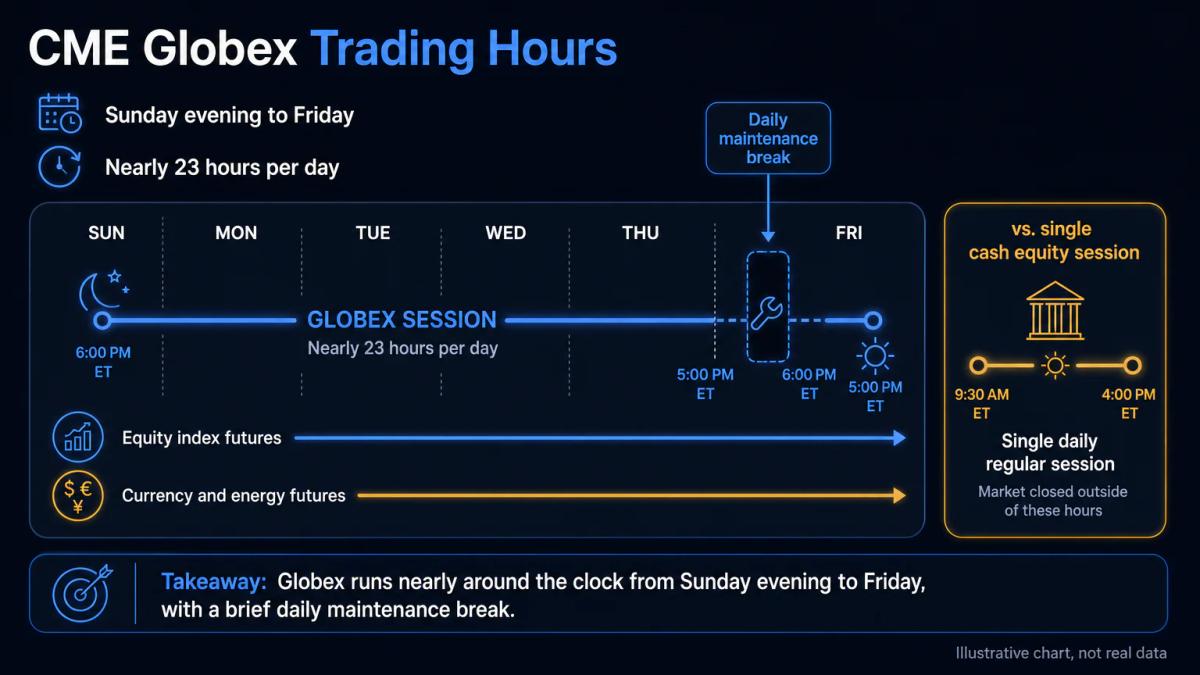
Most benchmark futures trade close to 23 hours a day, from Sunday evening through Friday afternoon US time, on the CME Globex electronic platform. Equity index futures (ES, NQ), currency futures, and energy contracts such as WTI crude all follow this near-continuous schedule with a short daily maintenance break, whereas agricultural contracts have narrower windows tied to their pit sessions.
That kind of access offers a genuine advantage over cash equities, which trade a single regular session. A futures trader can react to Asian and European data releases when they land, hedge an overnight event, or trade the London open from any time zone. Liquidity, however, is far from uniform: spreads widen and volume thins in the overnight hours, so slippage costs climb accordingly. Most active retail futures day trading tends to concentrate in the US morning and the London-New York overlap.
Tax treatment and Section 1256 contracts: a major advantage over stocks
Tax rules on trading are jurisdiction-specific and change: what follows is general information, and you should confirm your own position with a qualified tax professional in your country of residence before you act.
For US taxpayers, most exchange-traded futures qualify as Section 1256 contracts. That regime carries two features of particular relevance to day traders:
- The 60/40 rule. Gains and losses are taxed 60% at the long-term capital gains rate and 40% at the short-term rate, regardless of how briefly the contract was held. For someone in a high marginal bracket, the blended rate ends up materially lower than treating every intraday profit as ordinary income.
- Mark-to-market accounting. Open positions at year-end are treated as sold at fair value, and losses can be carried back three years against prior 1256 gains.
Outside the US the picture varies considerably. UK residents pay Capital Gains Tax on futures profits above the annual allowance, at the applicable CGT band, while other jurisdictions treat frequent trading as business income taxable at marginal rates. Section 1256 treatment should never be assumed to travel with you across borders.
Risk management and psychological discipline in leveraged day trading
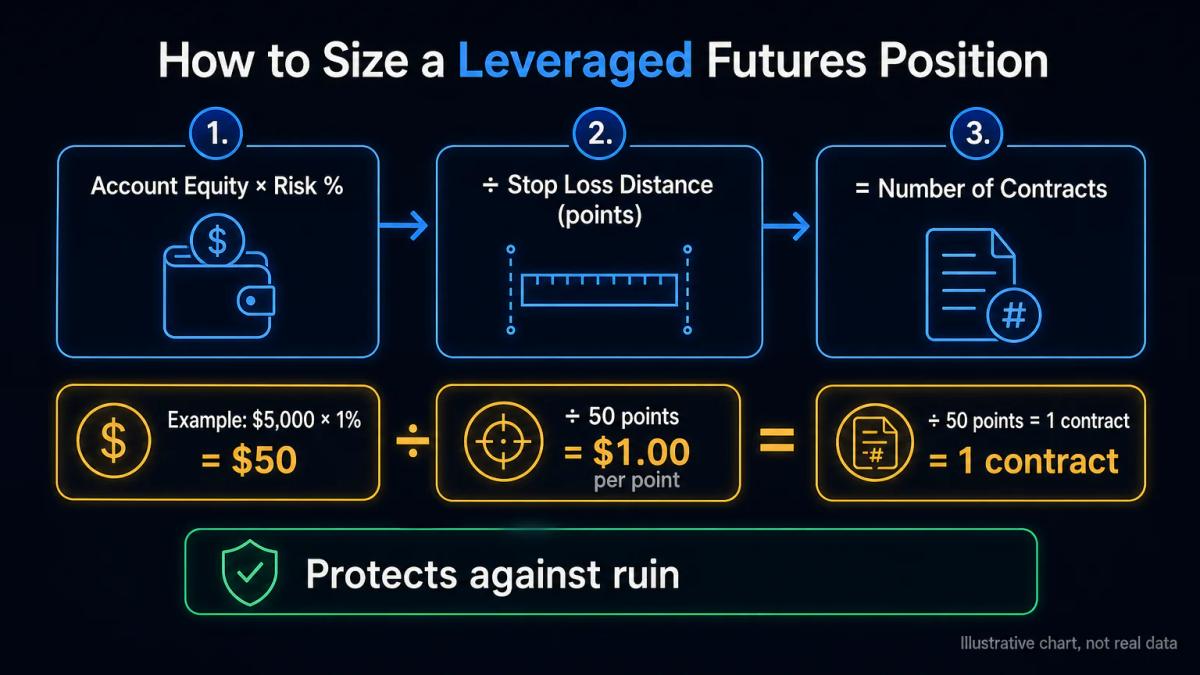
Leverage is a mechanical multiplier of outcomes, and the psychological load rises with it. A stop loss is a resting order that closes your position automatically at a preset adverse price; without one, a leveraged futures trade can consume a meaningful share of your account in minutes. Position sizing means deciding, before entry, the maximum dollar amount you will risk if the stop is hit: a common rule is 1% of account equity per trade.
The recurring mistakes tend to be behavioural in nature, showing up as a familiar cluster:
- Widening a stop after entry to avoid being taken out.
- Doubling into a losing position in order to lower the average.
- Revenge trading after a loss.
- Overtrading because the market is open around the clock.
A written trading plan with fixed rules for entry, exit, stop distance and daily loss limit provides the practical defence. With the plan set in advance, the session becomes an exercise in execution instead of an internal negotiation carried out in real time.
Getting started: account setup, micro contracts, and broker selection
Open an account with a futures-approved broker, a regulated firm authorised to clear futures trades, and complete the futures suitability questionnaire. Fund the account with an amount you can afford to lose entirely; $2,000 to $5,000 is a realistic floor for someone starting with micro contracts, because you need room to absorb a run of losses without breaching maintenance margin.
Micro contracts are sized at one-tenth of their standard equivalents, which makes them practical entry points for a beginner. Intraday margins run around $50 to $100 per contract at many brokers, giving a new trader room to practise real position sizing without concentrating the account in a single trade.
- Micro E-mini S&P 500 (MES): $5 point value, against $50 for ES.
- Micro E-mini Nasdaq (MNQ): $2 per point, against $20 for NQ.
- Micro WTI Crude (MCL): $100 per dollar move, against $1,000 for CL.
| Feature | What to check | Why it matters |
|---|---|---|
| Regulation | CFTC registration, NFA membership | Segregated client funds, complaint route |
| Commissions | Per-side, per-contract | Compounds fast at 10+ trades a day |
| Platform | Depth of book, one-click entry, native stops | Execution speed defines slippage |
| Data fees | CME real-time subscription | Delayed data is unusable intraday |
| Margins | Intraday vs overnight rates | Determines how many contracts you can size |
When you compare brokers, weight execution and total cost more than headline promotions: a low commission that comes with wide spreads or unreliable fills is more expensive than it looks on the fee page.
For a concrete example of costs and platform, the Vantage Markets review goes through them line by line.
This article is general information only and is not tax, legal or investment advice. Rules on futures trading, margin and taxation vary by jurisdiction and change over time; consult a licensed professional in your country of residence before acting on anything covered here.
Frequently Asked Questions
What is the minimum account size required to day trade futures?
There is no regulatory minimum for futures day trading, unlike the $25,000 PDT threshold for US stock day traders. Brokers set their own funding floors, often between $500 and $2,000. As a practical matter, $2,000 to $5,000 gives enough cushion to trade one or two micro contracts and absorb a losing streak without breaching maintenance margin.
Do I need to register with the NFA to day trade futures as a retail trader?
No. According to the CFTC, registration with the National Futures Association is required for professionals who handle customer funds or give trading advice. A retail trader who only trades a personal account with their own money does not trigger that obligation. Registration becomes relevant if you manage other people's capital or offer paid advisory services.
How much leverage can I use when day trading futures?
Effective leverage depends on the intraday margin a broker offers against the notional value of the contract. On the E-mini S&P 500, with a notional near $250,000 and intraday margin as low as $500 per contract, effective leverage can exceed 400:1. That level is high enough that a small adverse move can consume most of the posted margin, which is why disciplined position sizing carries more weight than the headline ratio.
What are the best micro futures contracts for beginners?
The Micro E-mini S&P 500 (MES) and Micro E-mini Nasdaq (MNQ) are widely used starting points because they track major indices, offer deep liquidity, and cost around $5 and $2 per point respectively. Micro WTI Crude (MCL) suits traders wanting commodity exposure. All three carry intraday margins of roughly $50 to $100 per contract at many futures-approved brokers.
Can I day trade futures with a small account under $5,000?
Yes, provided the trader uses micro contracts and sizes positions conservatively. A $3,000 account can support one or two MES or MNQ contracts per trade under a 1% risk rule (around $30 per trade). The real constraint tends to come from the mathematics of drawdown rather than the exchange minimum: with high leverage, undersized accounts run out of margin quickly when position sizing is loose.
About the authors


Put this into practice
Related articles

Cryptocurrency Trading Guide for Beginners: How to Start
A plain-English cryptocurrency trading guide for beginners covering strategies, risk management, platform choice, UK regulation, tax reporting and asset security.

Earnings Call Transcripts: How to Use Them for Trading Decisions
A practical guide to earnings call transcripts: where to find them, how to read prepared remarks and Q&A, and how to turn language shifts into trading signals.

Forex Swing Trading Signals: How to Read, Evaluate and Use Them
A practical editorial guide to forex swing trading signals: anatomy, indicators, risk sizing, provider evaluation, and the mistakes that quietly destroy accounts.
0 comments