



How to Trade · Beginner · 13 min read
Cryptocurrency Trading Guide for Beginners: How to Start
This cryptocurrency trading guide for beginners explains how to trade digital assets like Bitcoin and Ethereum through spot exchanges or CFD brokers. You learn how orders work, how leverage amplifies losses, which platforms suit your style, and how tax, regulation and security shape every decision you make before risking a single pound.
What is cryptocurrency trading and how does it work
Cryptocurrency trading is the act of buying and selling digital assets to profit from price changes. You can trade the coin itself on a spot exchange, where settlement transfers the asset to your wallet, or trade a contract for difference (CFD, a derivative that tracks the price without giving you ownership) through a regulated broker. Both routes let you go long or short, but the mechanics, custody and tax treatment differ sharply.
A crypto market runs 24 hours a day, seven days a week. Unlike equities, there is no closing bell, no circuit breaker on most venues, and price gaps of 5 to 10% overnight are common. That constant motion sounds like opportunity, but it also means your positions accrue risk while you sleep. Order types (market, limit, stop) behave the same as in forex, yet spreads widen sharply during weekend low-liquidity windows.
Settlement mechanics vary. On a spot exchange, once your order fills, the coin appears in your exchange wallet within seconds, and you can withdraw it to a private wallet. On a CFD platform, no coin changes hands: your profit or loss is settled in the account currency, and you pay a financing charge (an overnight interest fee on leveraged positions) for every night the trade is held. Choose your route before you fund an account, because switching later means paying withdrawal fees and re-verifying identity.
FCA, 2020: The Financial Conduct Authority banned the sale of crypto derivatives and exchange traded notes to UK retail consumers from 6 January 2021, citing extreme volatility and inadequate understanding of the underlying assets.
You’ll need a broker first: see the best forex brokers.
Types of cryptocurrency trading strategies for beginners
Beginner traders usually pick one of three timeframes: day trading, swing trading or position trading. The right choice depends on how many hours you can watch charts, how much drawdown (the fall from a capital peak to the trough before a new peak) you tolerate, and whether you want the coin in custody or just exposure to price. Trying to run all three at once fragments your attention and blows small accounts. Understanding 5 trading strategies that work across multiple asset classes will help you identify which approach fits your schedule and risk tolerance.
Day trading means opening and closing positions within a single session, often within minutes. It demands live monitoring, tight spreads and a platform that executes without slippage during volatile spikes. Fees compound quickly: if a spot exchange charges 0.20% per side, ten round-trip trades a day cost 4% of turnover, which few beginners recover from directly. Day trading suits people who can commit uninterrupted screen hours and accept frequent small losses.
Swing trading holds positions from two days to a few weeks, targeting moves of 5 to 20%. You review charts once or twice a day, use daily and 4-hour timeframes, and rely on technical patterns plus fundamental catalysts (protocol upgrades, macro events). Swing trading tolerates part-time schedules and reduces fee drag. The trade-off is overnight and weekend exposure: a regulatory announcement in Asia can gap the market against you before European hours open.
Position trading is closer to investing. You hold for months, ignoring daily noise and focusing on multi-quarter trends. This approach reduces trading costs and taxable events, but exposes you to platform risk, protocol failures and long stretches of unrealised drawdown. Comparing the three:
| Feature | Day trading | Swing trading | Position trading |
|---|---|---|---|
| Typical hold | Minutes to hours | Days to weeks | Months to years |
| Screen time per day | 4 to 8 hours | 30 to 60 minutes | Weekly review |
| Fee sensitivity | Very high | Moderate | Low |
| Overnight risk | Low (flat by close) | High | Very high |
| Suits | Full-time trader | Part-time trader | Long-term holder |
How to buy and sell cryptocurrencies: practical steps
Buying and selling crypto follows the same core sequence on every regulated venue: choose a platform, verify your identity, deposit funds, place an order, and manage the position until exit. The differences appear in the details: how quickly a deposit clears, which fiat currencies fund the account, whether withdrawals to external wallets are permitted, and how the platform handles a network congestion event.
Account opening on a compliant exchange requires Know Your Customer (KYC) checks: passport or driving licence, proof of address, and often a selfie video. Verification takes minutes to a few days depending on the venue. Once approved, you fund the account by bank transfer, debit card or, on some platforms, faster payments. Card deposits clear instantly but usually cost 1.5 to 3%; bank transfers are cheaper but slower. Read the deposit currency list: funding a GBP-only account with EUR triggers conversion charges.
Placing an order looks similar across platforms. A market order fills immediately at the best available price; a limit order sits on the book until price reaches your level. Beginners should default to limit orders during the first months, because market orders on thin altcoin books can slip several percent. After execution, review the fee, the average fill price, and the resulting position size. Confirm withdrawal addresses character by character: a mistyped address is unrecoverable.
Settlement diverges by venue type. On a spot exchange you receive the coin and can move it to a hardware wallet within the hour, subject to network fees. On a CFD platform, the position sits in your account as an open P&L; there is no coin to withdraw, only cash. If your priority is long-term holding, use a spot exchange; if your priority is short-term price exposure with tight risk controls, a regulated CFD broker in a jurisdiction that permits crypto CFDs is the cleaner route.
Risk management and leverage in cryptocurrency trading
Risk management is the discipline that separates traders who last from traders who blow up. In crypto, where 20% intraday moves happen several times a year on major coins, leverage trading mistakes are the most common way accounts fail. Three tools do most of the work: stop losses, position sizing, and hard limits on leverage. Skipping any one of them turns a normal loss into a fatal one.
A stop loss is a resting order that closes the position when price reaches a preset adverse level. It caps loss per trade to a fixed cash amount, which you decide before entry. A common rule is to risk no more than 1 to 2% of account equity per position. On a £5,000 account, that means £50 to £100 at risk per trade. Position size follows from the stop distance: if your stop is 5% away, you buy £1,000 of exposure to risk £50.
Leverage amplifies both directions. A leverage of 5:1 means £1,000 of equity controls £5,000 of exposure. A 10% adverse move on the underlying wipes out 50% of your equity; a 20% move wipes it out entirely. Regulators recognise this, which is why leverage caps differ by product and jurisdiction:
| Jurisdiction | Product | Retail leverage cap |
|---|---|---|
| UK (FCA) | Crypto CFDs | Prohibited for retail |
| UK (FCA) | Major forex CFDs | 30:1 |
| UK (FCA) | Equity CFDs | 5:1 |
| EU (ESMA) | Crypto CFDs | 2:1 |
| Australia (ASIC) | Crypto CFDs | 2:1 |
FCA policy statement PS20/10, 2020: The FCA concluded that retail consumers cannot reliably value crypto derivatives, and prohibited their sale to UK retail clients from January 2021.
Emotional discipline is the fourth pillar. Revenge trading (doubling size after a loss to recover it), FOMO entries (chasing a coin already up 40% in a day), and moving stops further away to avoid a loss are the three habits that convert a manageable drawdown into a wipeout. Understanding margin call mechanics helps you grasp why brokers force-close positions when equity falls below a threshold. Write your rules on paper, review them weekly, and log every trade with the reason for entry and exit.
Popular cryptocurrencies for beginner traders
Bitcoin and Ethereum are the two coins beginners should learn first, because they carry the deepest liquidity, the tightest spreads, and the largest volume of independent price data. Deep liquidity means your orders fill near the quoted price even during volatile hours; on smaller-cap altcoins, a £2,000 market order can move the price several percent against you before it fills.
Bitcoin functions as the reserve asset of the crypto market. Its price sets the tone for most other coins, and macro flows (institutional allocations, ETF inflows, monetary policy shifts) drive its longer-term direction. Ethereum is both an asset and the base layer for a large share of decentralised applications, so its price reflects network usage and protocol upgrades in addition to speculative flows.
Altcoins outside the top ten by market capitalisation carry meaningfully higher risk. Lower liquidity means wider spreads, more slippage and greater vulnerability to price manipulation by concentrated holders. Exchange delistings can trap you in an illiquid position with no exit. Beginners should treat any altcoin allocation as a small satellite position, not the core. Confirm the coin trades on more than one regulated venue, that its market capitalisation exceeds a threshold you set in advance, and that daily volume comfortably absorbs your intended position size.
Choosing a cryptocurrency trading platform or exchange
Platform choice is a regulatory decision first and a features decision second. In the UK, only firms registered with the FCA under the Money Laundering Regulations can lawfully offer crypto-asset services to UK residents. The FCA publishes the register of authorised firms; check it directly before you deposit. Unregistered offshore venues may accept UK customers, but you have no compensation scheme, no ombudsman, and limited legal recourse if the platform fails.
Once you narrow the list to compliant venues, compare on the criteria that matter for your trading style:
| Criterion | What to check |
|---|---|
| Regulation | FCA register (UK), ASIC (Australia), MiCA authorisation (EU) |
| Fees | Maker and taker fees, deposit charges, withdrawal fees |
| Spread | Quoted bid-ask on your primary pair at your trading hours |
| Fiat rails | GBP support, faster payments, bank transfer times |
| Assets | Coins supported, staking, derivatives availability |
| Custody | Cold storage percentage, proof of reserves, insurance |
| Withdrawals | Whitelist controls, daily limits, network fee policy |
A compliant spot exchange with GBP faster payments suits long-term holders and swing traders who want to withdraw the coin. A regulated CFD broker suits short-term traders comfortable with derivatives, though remember UK retail clients are excluded from crypto CFDs entirely. Trading availability for a UK resident depends on which entity onboards you: an FCA-authorised UK entity is the strongest tier, while offshore group entities are a flag to scrutinise closely.
Common beginner mistakes and how to avoid them
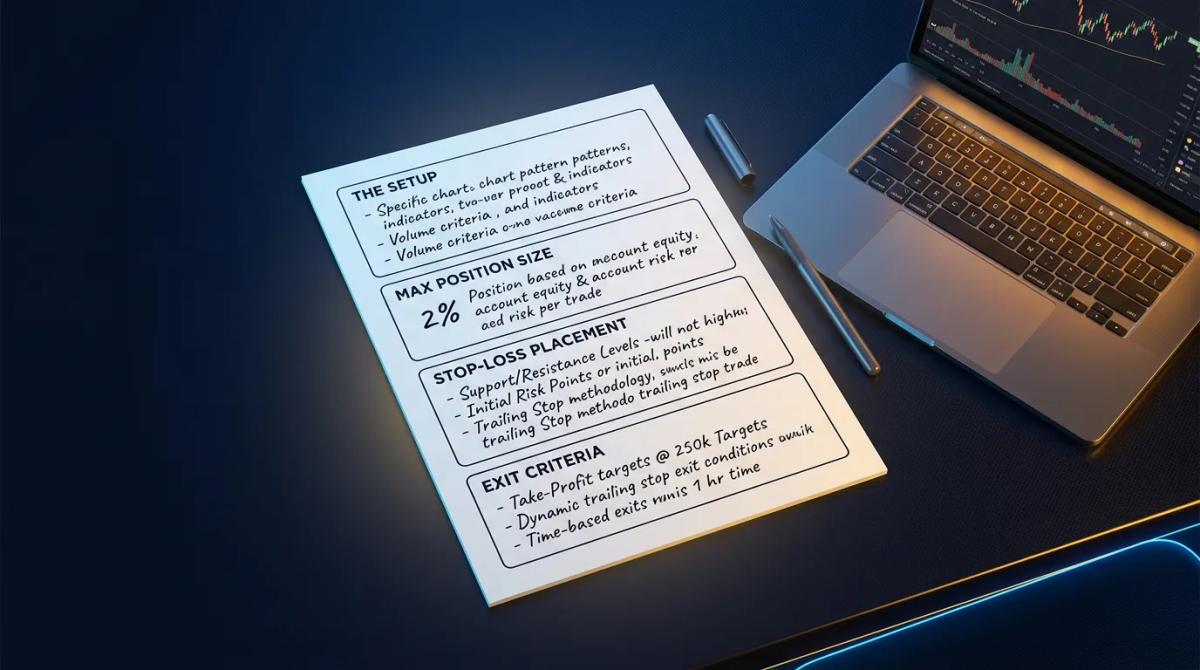
Most blown accounts share the same five mistakes: trading without a written plan, using leverage larger than the account can tolerate, chasing losses, ignoring security, and treating every green candle as a signal to enter. Each is preventable with a rule you write down before funding the account and review after every session.
Trading without a plan means opening positions on impulse, sizing them by feel, and exiting when the pain becomes uncomfortable. A written plan states the setup you trade, the timeframe, the entry trigger, the stop distance, the position size formula and the exit rule. If a candidate trade does not match the plan, you skip it. This single habit removes half the losses beginners take.
Leverage misuse is the second killer. A trader with a £2,000 account who takes 10:1 exposure on Bitcoin is one 10% move from ruin, and Bitcoin moves 10% intraday several times a year. Cap total leverage at a level you can defend with math, not enthusiasm. Chasing losses (increasing size after a losing streak) turns a normal drawdown into a terminal one; the correct response to a losing streak is to reduce size or stop trading for a week.
Security failures cost more than bad analysis. Storing significant balances on a hot exchange wallet, reusing passwords, skipping two-factor authentication, or approving unknown smart contracts have drained more accounts than any market crash. Use a hardware wallet for balances you are not actively trading, enable hardware-key two-factor authentication on every exchange, and never share a seed phrase with anyone who asks, including support staff. Genuine platforms never request it.
Frequently Asked Questions
Can I start cryptocurrency trading with a small amount of money?
Yes. Most regulated spot exchanges accept deposits from £10 to £50 and allow fractional coin purchases, so you can buy 0.001 BTC or less. Small accounts should focus on learning process and record-keeping rather than profit targets, because fixed fees consume a larger share of tiny positions. Trade sizes below £100 typically pay more in spread and fees than they gain in P&L, so treat the first months as tuition.
What is the difference between spot trading and margin trading in cryptocurrency?
Spot trading means buying the coin outright with your own funds and taking delivery to a wallet. Margin trading means borrowing from the platform to open a larger position than your cash allows, and paying interest on the borrowed portion. Margin amplifies both gains and losses, and forced liquidations happen when the account falls below the maintenance margin. Spot is the safer starting point; margin should wait until you have a consistent track record with unleveraged trades.
How much can I lose if I trade cryptocurrency with leverage?
With leverage, you can lose more than the price move suggests, and on some products more than your initial deposit. At 5:1 leverage, a 20% adverse move wipes out your entire margin. Regulated brokers in the EU and Australia apply negative balance protection on retail accounts, capping losses at the deposit. Unregulated offshore venues often do not, so a fast liquidation can leave you owing the platform.
Is cryptocurrency trading regulated in the UK?
Partially. Spot crypto services offered to UK residents must come from firms registered with the FCA under the Money Laundering Regulations. Crypto derivatives, including CFDs, futures and exchange traded notes, are prohibited for UK retail clients under FCA policy statement PS20/10 from January 2021. Check the FCA register directly before depositing, and be aware that FCA registration for money laundering purposes is narrower than full conduct authorisation.
What security measures should I take to protect my cryptocurrency?
Move balances you are not actively trading to a hardware wallet, and store the recovery seed phrase on paper or steel in a physically secure location. Enable app-based or hardware-key two-factor authentication on every exchange; avoid SMS 2FA where possible because SIM swap attacks bypass it. Whitelist withdrawal addresses so a compromised login cannot drain the account instantly, and treat any unsolicited support message asking for a seed phrase as a scam.
About the authors


Put this into practice
Brokers we have reviewed
Scored on the same five dimensions. Here are three of them — the full list is on the brokers page.



Related articles

Custom Indicator (MQL4, MQL5): Structure, Setup, and Code
A working guide to coding, installing, debugging and optimizing custom indicators in MQL4 and MQL5, including a moving average crossover walkthrough.

Earnings Call Transcripts: How to Use Them for Trading Decisions
A practical guide to earnings call transcripts: where to find them, how to read prepared remarks and Q&A, and how to turn language shifts into trading signals.

Forex Swing Trading Signals: How to Read, Evaluate and Use Them
A practical editorial guide to forex swing trading signals: anatomy, indicators, risk sizing, provider evaluation, and the mistakes that quietly destroy accounts.
0 comments