



How to Trade · Intermediate · 5 min read
Futures Trading Signals: How to Read and Act on Them
A futures trading signal is a discrete instruction, typically 'buy', 'sell', or 'exit', generated by an algorithm or analyst and delivered against a specific futures contract such as the E-mini S&P 500 (ES) or Crude Oil (CL).
The signal names the instrument, the direction, the entry price, a stop loss (a preset price where you exit to cap the loss), and often a take profit target. The provider publishes the logic, whether a moving average crossover, a volume breakout, or a proprietary study, and the platform relays the alert the moment its conditions are met.
Your job is to execute or reject the trade, not to invent the setup. How trading signals work compress the analytical workload into a decision: act, size correctly, or pass.
Signal delivery: where and how you receive alerts
Most futures trading signals arrive through integrated charting platforms or direct email and SMS notifications. Real-time delivery is critical because a delayed signal can miss the entry window entirely, especially in fast-moving CME futures markets where ticks translate to meaningful dollars per contract.
TradingView pushes alerts to a mobile app, browser, and webhook simultaneously; Sierra Chart triggers audio and pop-up alerts directly on the DOM (depth-of-market ladder). Some providers also send signals to a private Discord or Telegram channel, which adds seconds of latency you should measure before subscribing.
If your workflow depends on manual clicks, count the delay between the alert and your order confirmation, because a 30-second lag on a 1-minute chart is structural, not incidental.
Open an account with one of the best forex & CFD brokers to follow along.
Proprietary indicators and algorithmic logic behind signals
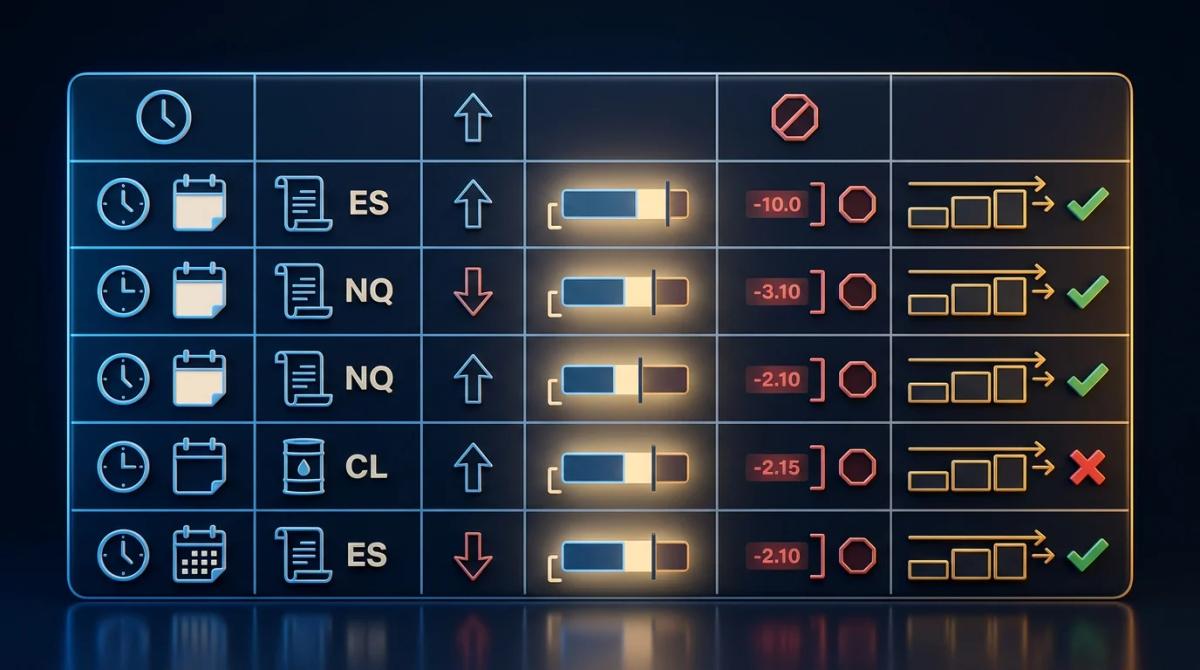
Signal providers use rule-based algorithmic studies, not subjective opinion, to identify entry and exit points. Common approaches include momentum indicators (which measure the speed of price change), trend-following algorithms, and volatility breakout logic applied to price data from CME futures contracts.
A momentum signal might fire when the 14-period RSI (Relative Strength Index, a 0-100 momentum oscillator) crosses 70 on a 5-minute chart of Nasdaq futures (NQ). A trend-following signal might combine a 50-period exponential moving average slope with an ADX (Average Directional Index) filter above 25.
Before you subscribe, ask the provider to publish the exact rule set. Understanding how the RSI indicator works and other momentum tools helps you validate whether the logic is sound or a black box marketed as 'artificial intelligence' with no disclosed inputs, which you cannot backtest, cannot debug losing streaks, and cannot know whether the edge is real or curve-fitted to past data.
Free trials and freemium access: testing signals without commitment
Most established signal providers offer free trial periods or freemium tiers that let you receive signals and review historical performance without entering a credit card. This lets you evaluate accuracy and fit before paying for a subscription. Use the trial to log every signal in a spreadsheet: timestamp, instrument, direction, entry, stop, target, and eventual outcome. A two-week trial that produces 20 to 30 signals is enough to detect obvious problems, such as signals that only work in trending sessions or setups that concentrate in illiquid overnight hours. If a provider refuses any trial and demands a monthly fee upfront, treat that as a red flag on transparency.
Backtesting and performance tracking: validating signal quality
Before you trade live signals, check whether the provider publishes historical performance data and allows you to backtest the logic on past price action. This shows win rate, average profit per trade, and drawdown (the fall from a capital peak to the trough before a new peak) under real market conditions. Reputable providers publish a full trade ledger, not a curated highlights reel.
Focus on three metrics: win rate above 50% is common but not sufficient; the ratio of average win to average loss should exceed 1.2 to survive commissions; and maximum drawdown tells you the worst realistic equity dip. Survivorship bias is the trap here: a provider showing only their best strategy or best year hides the ones they quietly retired.
Learning how trading strategies work across asset classes helps you spot whether a signal provider is cherry-picking results or showing genuine edge. Ask for the full history, not the marketing snapshot.
Position sizing and risk management tied to signal strength
Strong signals warrant larger positions; weak or conflicting signals warrant smaller ones or no trade at all. Pairing signal alerts with a fixed position sizing rule and stop loss discipline protects your account from overexposure to any single trade.
Understanding common leverage trading mistakes is essential when sizing positions tied to signal strength. A workable framework caps risk per trade at 1% of account equity: on a £25,000 account, that is £250 maximum loss per position. Divide £250 by the distance from entry to stop in pound terms per contract to get the number of contracts.
When two signals conflict, for example a long from the trend model and a short from the mean-reversion model, halve the size or skip the trade. Signal strength without a size rule is just noise attached to a bigger bet.
Frequently Asked Questions
Are futures trading signals reliable and profitable?
Reliability depends on the provider's transparency. A signal service with a published rule set, a full historical trade ledger, and a win-to-loss ratio above 1.2 can be profitable after commissions. Services that hide the logic, show only curated screenshots, or omit losing periods should be treated as unverified.
How do I know if a futures trading signal provider is legitimate?
Check three things: whether the algorithm's rules are disclosed, whether a complete trade-by-trade history is available for independent review, and whether the provider offers a free trial without a credit card. Legitimate providers publish drawdowns and losing streaks alongside wins.
Can I automate futures trading signals through a broker API?
Yes. Platforms like TradingView send signals to webhooks, which can be routed to broker APIs or third-party bridges that execute the order on your futures account. Test automation on a demo account first to confirm slippage, latency, and order type behave as expected before risking live capital.
What is the typical cost of a futures trading signals subscription?
Retail futures signal subscriptions typically run from about $50 to $300 per month depending on the market coverage, delivery speed, and included education. Institutional-grade feeds cost significantly more. Weigh the fee against realistic expected profit per contract after commissions and exchange fees.
How do I backtest a futures trading signal before using it live?
If the provider discloses the rules, replicate them in a platform like TradingView's Pine Script or Sierra Chart's spreadsheet study and run the logic across at least two to three years of price data on the target contract. Record win rate, average win, average loss, and maximum drawdown.
About the authors


Put this into practice
Brokers we have reviewed
Scored on the same five dimensions. Here are three of them — the full list is on the brokers page.



Related articles

How Many Trades Per Day Should You Make? A Beginner's Guide
A practical guide to deciding how many trades per day fits your strategy, your account size, and the rules that apply to your jurisdiction.

How Much Should You Invest in Stocks: A Framework for Your Situation
Deciding how much to invest in stocks is a personal calculation. Anchor it to your income, obligations, timeline and risk tolerance rather than settling on a fixed figure.

How to Become a Trader: A Practical Roadmap for Retail Traders
A step-by-step guide to becoming a retail trader in the UK: capital, platforms, FCA leverage caps, tax duties, and the discipline that separates traders from gamblers.
0 comments