


How to Trade · Intermediate · 8 min read
How to Trade Gold (XAU/USD): Sessions, Spreads and Strategy
The mechanics of gold trading: what you're actually buying
Trading gold as XAU/USD means speculating on the price of one troy ounce of gold against the US dollar through a CFD (contract for difference, a derivative that pays the difference between entry and exit price) or a spot contract. You never take delivery of bullion; your profit or loss comes from price movement alone, amplified by leverage your broker provides.
Three costs hit your account immediately. The spread (the gap between buy and sell price) is the first, followed by any commission, and overnight financing on positions held past the daily rollover. Your risk exposure scales with contract size, not with the cash sitting in your account, because leverage lets a small balance control a much larger notional value. Tax treatment follows derivatives rules in your jurisdiction, not the rules for physical bullion. In the UK, spread-bet gains on gold are currently exempt from capital gains tax for retail clients, while CFD gains on gold are not. Confirm the current position with HMRC or a qualified adviser before you file.
Putting this into practice means opening an account: start with the best forex brokers our team reviewed.
Which trading sessions matter most for XAU/USD liquidity and volatility
Gold trades around the clock from Sunday evening to Friday evening, but liquidity pools unevenly across the day. The London session (roughly 08:00 to 17:00 UTC) and the New York session (roughly 13:00 to 22:00 UTC) carry the deepest order books and the tightest quoted spreads. The Asian session (roughly 22:00 to 08:00 UTC) is thinner, and spreads widen in response.
The London and New York overlap, from 13:00 to 17:00 UTC, is the window when you get the fastest execution, the narrowest spreads, and the most predictable price action. US economic releases cluster at 12:30 and 14:00 UTC and fall inside this window, which concentrates both opportunity and risk.
Session choice hits your cost directly:
- During the overlap, you often see XAU/USD spreads near the lower end of your broker's range.
- During the Asian session, the same broker can quote two or three times that spread, and slippage (the gap between the price you clicked and the price you were filled at) grows.
- Around the daily rollover, usually 21:00 or 22:00 UTC depending on the broker, spreads widen briefly as liquidity thins between venues.
If you trade intraday, planning entries inside the London and New York hours lowers your transaction cost before any strategy is applied.
How spreads and commissions vary by broker and session
XAU/USD spreads for UK retail clients range from around 0.3 pips at raw-spread institutional accounts to 3 pips or more at standard retail accounts, and they widen in thin sessions. Some brokers charge a flat commission per lot on raw-spread accounts, typically a few dollars per side per standard lot, while others embed the cost in a wider spread.
A pip on XAU/USD is $0.01 of price movement per ounce traded. A standard lot is 100 ounces, so one pip is worth $1 per standard lot, and a 1-pip spread costs you $100 per round-trip on a standard lot, not $10. On a 0.01 micro lot the same spread costs $0.01. Confirm the lot definition in your broker's contract specification, because a minority of venues size the gold contract differently.
| Account style | Typical XAU/USD spread (London hours) | Commission per standard lot round-trip | Total cost per standard lot round-trip |
|---|---|---|---|
| Raw-spread / ECN | 0.3 to 0.8 pips | $6 to $14 | roughly $36 to $94 |
| Standard retail | 1.5 to 3.5 pips | $0 | roughly $150 to $350 |
| Offshore wide-spread | 3 pips or more | $0 | $300 or more |
Overnight financing (the swap charge for holding a position past rollover) is a separate line and compounds over multi-day trades. Compare the total cost across brokers and sessions before you commit capital.
Entry strategies for gold: technical levels and economic triggers
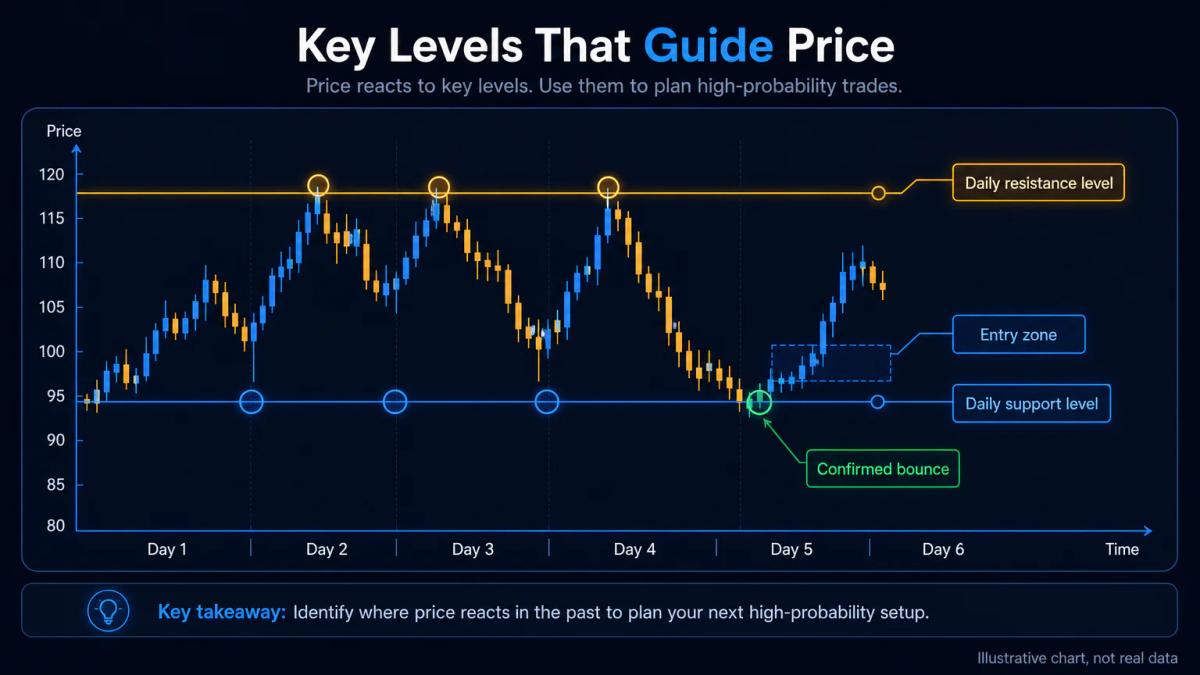
Entries on XAU/USD cluster around two inputs: price structure on higher timeframes, and scheduled economic data from the United States. On the structural side, support and resistance levels drawn on 4-hour and daily charts frame where buyers and sellers have reacted before. An intermediate trader's basic rule set is to buy near a confirmed daily support in a daily uptrend, sell near a confirmed daily resistance in a daily downtrend, and place a stop loss (an automatic exit that caps the loss) 20 to 30 pips beyond the level.
On the macro side, three releases move gold more than any others: US non-farm payrolls on the first Friday of the month, the Consumer Price Index release, and Federal Reserve policy decisions with their accompanying statements. Each lands with pre-announced times, so you can decide in advance whether to trade through them or stand aside.
Suppose XAU/USD is trading at $2,400 inside a daily uptrend and you plan to buy a dip into $2,380 support with a stop at $2,375 and a target at $2,420. The stop is 500 pips (50 points) below entry; on a 0.10 lot that risks about $500. If your account is $20,000, that is 2.5% at risk on a single trade, above the usual 1 to 2% band and a signal to cut size.
Why USD strength and economic data drive gold prices
Gold is quoted in US dollars worldwide, which ties its price to the dollar's purchasing power. A stronger dollar makes gold more expensive for buyers paying in euros, yen or sterling, dampening demand and typically pressuring the dollar price lower. A weaker dollar does the reverse. This inverse relationship is not mechanical minute by minute, but over days and weeks it is one of the most reliable patterns in the pair.
Interest-rate expectations drive the dollar leg of that equation. When US data points to higher rates for longer, strong payrolls, sticky inflation, hawkish Fed language, the dollar tends to strengthen and gold tends to soften. Falling real yields (the yield on inflation-protected US Treasuries) remove a key opportunity cost of holding a non-yielding asset like gold, and the metal tends to rally.
Safe-haven flows are the second layer. During geopolitical stress, banking stress or sharp equity drawdowns, gold often rises even when the dollar also rises, because both are treated as refuges. Reading the macro calendar alongside the chart gives you a directional bias before you look for an entry.
Risk management: position sizing and stop-loss discipline
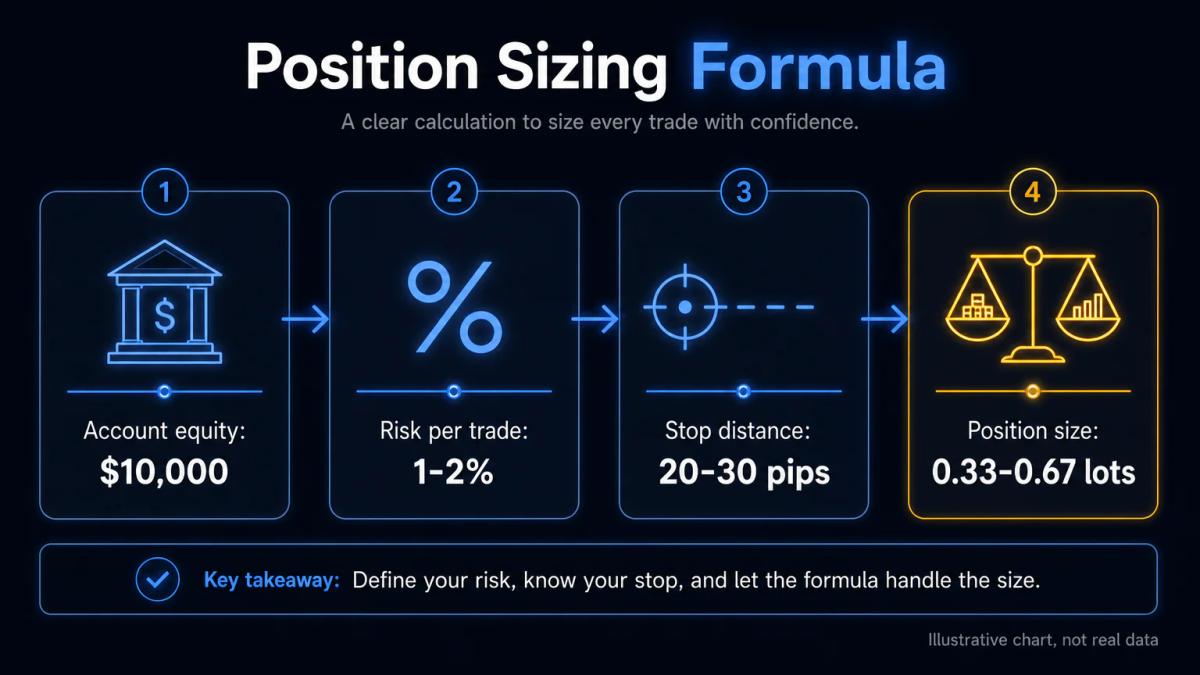
Position sizing is where retail accounts are won or lost. The working rule for an intermediate trader is to risk no more than 1 to 2% of account equity on any single XAU/USD trade, measured from entry to stop. The stop distance drives the size: a wider stop demands a smaller position, a tighter stop allows a larger one, so that the dollar loss at the stop is constant.
Three habits protect that framework:
- Place a hard stop loss on every entry before the position is live, not after.
- Never widen a stop against the position; if the trade needs more room, the thesis has changed and the correct action is to close.
- Exit at the planned target or stop without renegotiating the plan mid-trade.
Gold is a volatile instrument, and intraday ranges of several hundred pips are routine around US data. Oversized positions are the most common way retail accounts are closed on one or two bad trades. Fear and greed amplify in high-volatility windows, so writing the entry, stop, target and size down before the session starts removes most of the discretionary error.
Choosing a broker for gold trading: what to compare
| Criterion | What to check | Why it affects you |
|---|---|---|
| Regulatory status | FCA authorisation for the UK onboarding entity | FCA-authorised firms are the gold tier; offshore entities carry weaker client-money and complaints protection |
| Leverage cap on gold | 1:20 for UK retail under FCA rules | Caps your maximum notional per unit of margin; higher offshore caps raise ruin risk |
| Average XAU/USD spread in London hours | Published or verifiable live | Direct per-trade cost |
| Commission structure | Per-lot round-trip on raw accounts, zero on standard | Combine with spread for true cost |
| Overnight financing | Swap long and swap short on XAU/USD | Compounds on multi-day positions |
| Execution and slippage | Fill quality around data releases | Determines whether your stop and entry prices are respected |
| Platform stability | MT4, MT5, cTrader, TradingView, or proprietary | Downtime around data equals missed exits |
UK retail clients onboarded by an FCA-authorised entity get the Financial Services Compensation Scheme (the UK statutory client-money safety net) up to the current £85,000 limit per eligible claim. Clients onboarded by an offshore group entity, even under the same brand, usually do not. Confirm which legal entity appears on your account agreement before funding, and treat the regulator as the first filter and spread as the second.
To see these conditions applied by a regulated broker, read our Admirals review.
Frequently Asked Questions
What is the best time of day to trade XAU/USD?
The London and New York overlap, roughly 13:00 to 17:00 UTC, offers the tightest spreads and the deepest liquidity for XAU/USD. US economic releases also land in this window, concentrating both opportunity and risk. If you want calmer conditions, the London morning before 12:00 UTC tends to be structured and less headline-driven. The Asian session is thinner, with wider spreads and more slippage, so most intraday retail traders avoid it.
How much money do I need to start trading gold?
There is no fixed minimum, but risk mathematics sets a sensible floor. If you cap risk at 1 to 2% per trade and the smallest contract your broker offers is 0.01 lots on XAU/USD, a stop of 300 pips costs about $3. A balance of $500 to $1,000 gives you room to size trades correctly without a single loss crippling the account. Starting with less forces you to oversize, which is the most common cause of early blow-ups.
What is the difference between trading gold CFDs and buying physical gold?
A gold CFD is a leveraged derivative: you post margin, you pay a spread and overnight financing, and you profit or lose on price movement without ever holding metal. Physical gold means buying bars or coins, paying a dealer premium over spot, and arranging storage and insurance. CFDs are liquid and cheap to enter but costly to hold for months because of swap charges. Physical gold has no financing cost but is illiquid, bulky and expensive to insure. UK tax treatment also differs between the two.
Can I trade gold on weekends?
No. The XAU/USD market closes on Friday evening and reopens on Sunday evening (times vary slightly by broker, usually around 22:00 UTC Friday to 22:00 UTC Sunday). A small number of brokers offer a synthetic weekend gold product, but liquidity is poor and spreads are very wide. Gold-related news that breaks over the weekend typically shows up as a gap at the Sunday open, which is why open positions carried across the weekend carry gap risk.
What leverage should I use for gold trading as a beginner?
FCA rules cap leverage on gold CFDs at 1:20 for UK retail clients, and that cap is a ceiling, not a target. Beginners get better outcomes using far less, often 1:5 or lower in effective terms, by sizing positions off the stop distance rather than the margin available. The right question is not what leverage the broker allows but what dollar loss your stop implies, and whether that loss is 1 to 2% of your account.
About the authors


Put this into practice
Brokers we have reviewed
Scored on the same five dimensions. Here are three of them — the full list is on the brokers page.



Related articles

How to Trade Oil Futures: A Step-by-Step Guide for Retail Traders
A practical walkthrough of how to trade oil futures: WTI and Brent contracts, margin, position sizing, charting setup and seasonal drivers.

How to build a trading bot: setup, security and cost reality
From API keys to backtesting, cost analysis to FCA rules, here is what setting up a trading bot actually involves for UK retail traders.

How to choose a mobile trading app: fees, licensing and features that count
What separates a solid mobile trading app from a flashy one: fees, FCA licensing, leverage caps, security and the asset range you actually need.
0 comments