



Prop Trading · Beginner · 7 min read
Forex Prop Firms for US Traders: CFTC Rules, Capital Tiers and Payouts
What Prop Firms Offer US Forex Traders
A forex prop firm is a company that hands you capital to trade, in either a live or a simulated account, once you clear an evaluation challenge and agree to a strict rulebook on losses and behaviour. For anyone based in the United States, that arrangement runs through two regulators. The CFTC (Commodity Futures Trading Commission) is the federal agency responsible for derivatives, and the NFA (National Futures Association) is its self-regulatory arm. Together they cap retail forex leverage, require registration for firms soliciting US customers, and impose conduct standards that many offshore prop shops choose to ignore.
Three practical consequences follow for traders operating from US soil:
- The pool of firms that legally accept US residents is narrower than what a trader in Europe or Asia would see.
- Account sizes are almost always denominated in US dollars, which simplifies bookkeeping but limits currency choice.
- The paperwork you sign at onboarding tends to be heavier, with tax forms and identity verification built into the process.
In exchange for that friction, you get a clearer legal footing and, in most cases, a published rulebook covering drawdown, payouts and dispute handling.
How CFTC Regulation Shapes the US Prop Firm Landscape
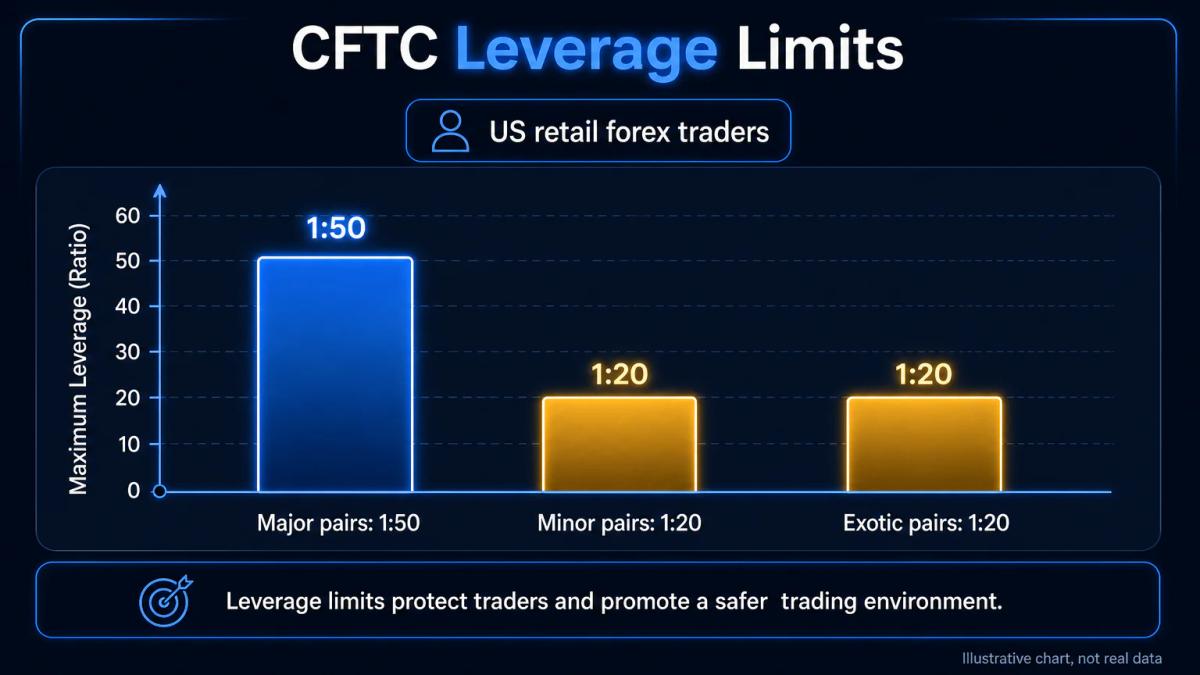
The CFTC sets the leverage ceilings that every US-facing forex offer has to respect, whether the product is retail or proprietary. Under CFTC rules, retail forex traders in the US are capped at roughly 1:50 on major currency pairs and 1:20 on minor and exotic pairs; the exact matrix is published by the agency, and firms cannot advertise higher leverage to US residents even if their offshore pages show 1:100 or 1:500. Leverage itself is simply the ratio between the notional size of your position and the margin you post, so a 1:50 setting means that $1,000 of margin controls $50,000 of currency exposure.
Registration is the second pillar of the framework. Any firm that solicits US customers for forex trading has to be registered with the CFTC in an appropriate category, typically as a Retail Foreign Exchange Dealer or associated introducing broker, and must hold NFA membership. A purely proprietary shop that trades only its own capital, without soliciting customers, sits outside that regime.
The picture changes once the same shop starts selling evaluations to retail traders and paying them a share of simulated or live profits, at which point regulators tend to look at the arrangement much more closely. For that reason, some US-facing prop firms structure their product as a skills contest with a prize payout, which places the offer inside a different legal box.
NFA Prop Trading Rules and Trader Access
NFA prop trading, in plain terms, is proprietary trading conducted through an NFA-member firm that follows the association's rulebook on disclosure, capital and conduct. From your seat as a trader, several concrete signals point to a compliant setup:
- An NFA ID displayed on the firm's site that you can look up on the public registry.
- A written agreement covering evaluation rules, drawdown methodology and payout timing.
- KYC (know-your-customer) verification, in which the firm collects identity documents before funding you.
- Advertised leverage that stays within the CFTC caps on retail forex.
Access is not automatic, and the onboarding pack is fairly standard across compliant firms. Expect to submit the following:
- A government-issued photo ID.
- Proof of address, usually a recent utility bill or bank statement.
- A W-9 tax form so the firm can report your income to the IRS.
- On occasion, a short trading questionnaire aimed at gauging experience.
Firms that skip these steps for US residents are typically either operating offshore or trading inside a legal grey zone, and dispute recourse tends to be thin in both cases if something goes wrong.
Account Sizes, Capital Allocation and Profit Splits
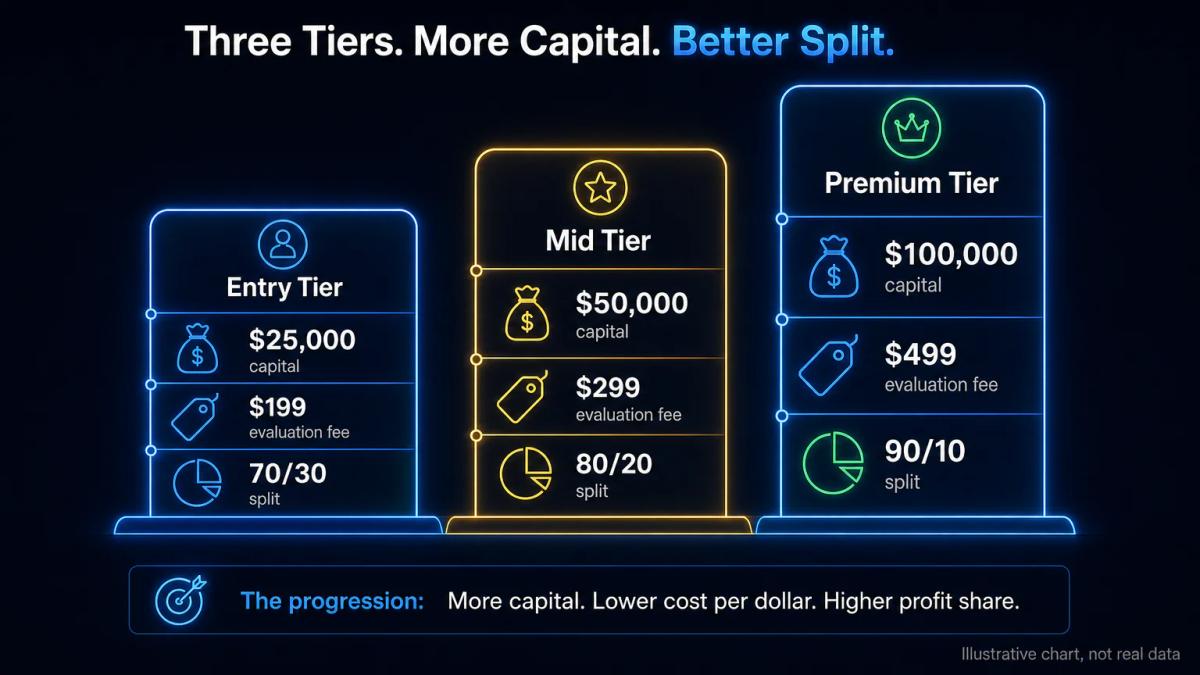
US-facing prop firms typically offer tiered accounts running from $10,000 to $500,000 of nominal capital, with the most common starting tiers at $25,000, $50,000 and $100,000. The higher the tier, the higher the evaluation fee and the tighter the drawdown limits in dollar terms. Profit splits usually start at 70/30 or 80/20 in your favour on the funded stage and can rise to 90/10 after consistent performance.
| Account tier | Typical fee range | Common daily drawdown | Common max drawdown | Typical starting split |
|---|---|---|---|---|
| $25,000 | $150 to $250 | 5% | 8% to 10% | 70/30 to 80/20 |
| $50,000 | $250 to $400 | 5% | 8% to 10% | 75/25 to 80/20 |
| $100,000 | $500 to $650 | 5% | 8% to 10% | 80/20 |
| $200,000 | $900 to $1,100 | 4% to 5% | 8% to 10% | 80/20 to 90/10 |
The figures above are ranges commonly published by US-facing firms; the exact number varies by provider and can change, so read the current rulebook before you pay. Funding speed after a pass usually lands between 3 and 10 business days at compliant US firms, whereas offshore alternatives often release capital in 24 to 48 hours, because the compliance verification required onshore takes real time.
Evaluation Programs and Challenge Formats
Most firms use a one-phase or two-phase evaluation. The two-phase model runs like this:
- Phase one asks you to hit a profit target of around 8% to 10% on a demo account inside a set window, while respecting a daily drawdown and a maximum drawdown.
- Phase two lowers the profit target, often to 4% or 5%, and repeats the same drawdown test on the same rulebook.
- After clearing both phases, you sign the funded-trader agreement and start trading real or scaled capital.
The one-phase model compresses the same idea into a single profit target under the same drawdown rules. A handful of firms also sell instant funding without any challenge for a higher upfront fee, though the drawdown thresholds, minimum trading-day requirements and payout rules continue to bind the account. Paying more shifts where the risk controls sit in the process, without ever removing them.
Platform Options and Trading Instruments
MT4, MT5 and cTrader dominate the platform menu at US-facing prop firms, and a growing number of shops now add TradingView, a browser-based charting platform, as an execution front end. Proprietary platforms built by the firm itself are also common in the US market, especially at shops that want tighter control over risk enforcement. On the instrument side, a US-facing offer will typically cover:
- The 28 major and minor forex pairs.
- Metals such as gold and silver.
- Indices, offered either as CFDs or as futures depending on the firm's legal structure.
Crypto is a common exclusion for US-facing offers, because the CFTC and the SEC each treat several tokens as their own jurisdiction and firms prefer to sidestep the resulting grey area. Before you start, confirm the firm's stance on EA (expert advisor, an automated trading script) use and copy-trading; permissions vary widely, with some firms allowing them freely, others restricting them to the funded stage, and a few banning them across the board.
Drawdown Rules and Risk Management Mechanics
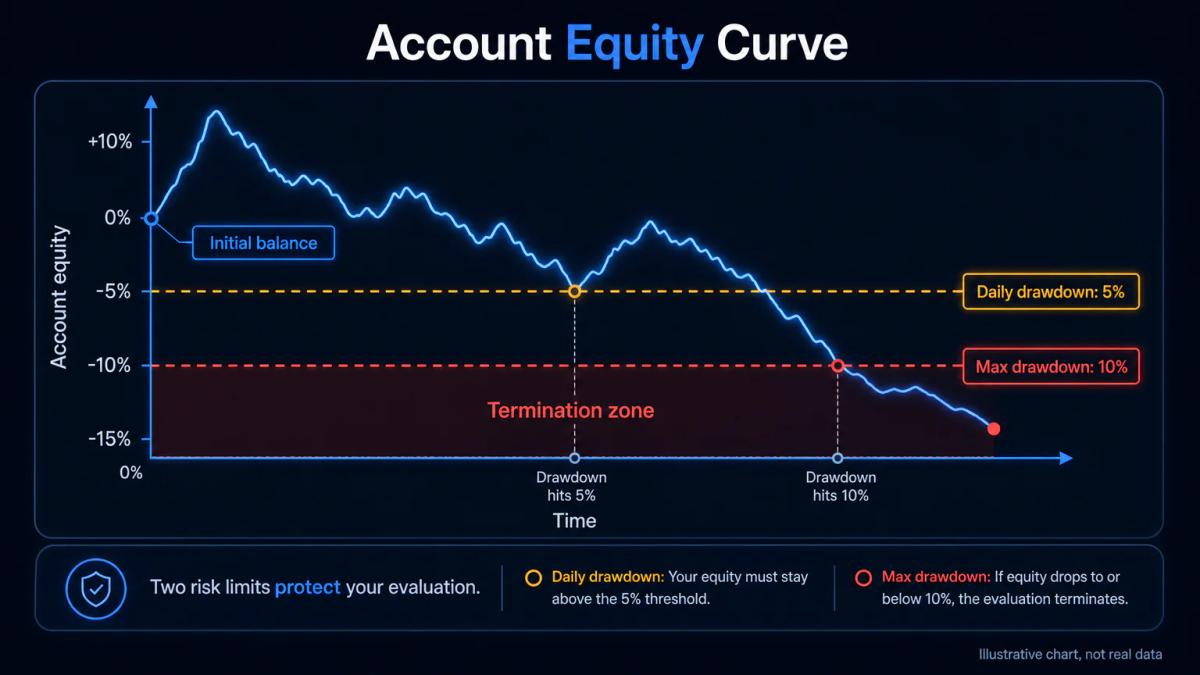
Drawdown describes the fall from a peak in your account balance or equity down to the trough before a new peak is set, and in prop trading it accounts for the majority of account terminations. US firms typically enforce two thresholds at the same time:
- The daily drawdown, which caps how much you can lose from the start-of-day equity, usually set at 4% or 5%.
- The maximum drawdown, which caps cumulative losses over the life of the account, usually set between 8% and 10%.
Firms differ in how they measure the maximum drawdown. Some anchor it as a fixed line from the initial balance, while others trail it beneath your highest equity mark, which progressively tightens the rule as the account grows. Should either limit be breached, the account closes immediately, any unrealised profit above the payout threshold is typically forfeited, and the trader restarts by paying for a fresh evaluation.
Given those thresholds, risk management sits at the centre of a working prop-trading routine rather than at its margins. Traders who last tend to size positions so that a full stop-loss on any single trade costs only a fraction of the daily limit, commonly in the 1% to 2% range of account equity, and they usually stop trading for the day well before the daily cap comes into view.
Consider a $50,000 account with a 5% daily drawdown: the daily loss ceiling sits at $2,500, so a trader risking 1% per trade caps each idea at $500 and would need five losing trades in a row to hit the wall.
Tax Implications and Payout Timelines for US Traders
This section is general information about US taxation of prop-trading income and is not tax advice: consult a licensed US tax professional about your own situation. In broad terms, income from a US prop firm is usually reported to you on a Form 1099, as miscellaneous or non-employee compensation, and treated as ordinary income on your federal return; the firm does not withhold federal tax, so you are typically responsible for quarterly estimated payments to the IRS. Some traders qualify for trader tax status, which can change how expenses and losses are treated, but the qualification bar is specific and fact-dependent.
Payouts themselves usually clear in 5 to 15 business days at compliant US firms once a request is submitted, while many offshore alternatives pay out within 2 to 7 days on the same request. Keep a full trade log, every fee receipt and the firm's payout statements: prop income is reportable regardless of how the firm labels its programme, and that paperwork is what protects you if the IRS asks questions later.
Frequently Asked Questions
What are the best forex prop firms for United States traders?
The best firm depends on several factors specific to your setup, including the platform you trade on, whether the firm genuinely accepts US residents both on paper and in practice, how it measures drawdown (fixed or trailing), the profit split at your account tier, and whether EAs and news trading are allowed. Give preference to firms that publish an NFA ID or a clear legal structure, back it with a written rulebook, and offer payout timelines that can be checked against public records or independent trader reports.
Can US traders access offshore prop firms, and what are the risks?
Many offshore firms will accept US residents at signup, and the risks are worth weighing before you commit. Any leverage advertised above CFTC caps becomes unenforceable for you if a dispute ever reaches a US court. Deposits and payouts often route through third-party processors, which can complicate refunds and chargebacks. Consumer-protection recourse is thin, because the firm is not an NFA member and lies outside US jurisdiction, and you still carry the full US tax reporting burden on any income regardless of where the firm is domiciled.
How long does it take to get funded by a US forex prop firm?
Once the evaluation is passed, US-facing firms typically fund accounts within 3 to 10 business days, because they run KYC checks and W-9 collection before releasing capital. Offshore firms often fund in 24 to 48 hours by skipping most of that verification, which speeds up onboarding while introducing the trade-offs described above.
What is the typical profit split offered by US prop firms?
Starting splits usually sit between 70/30 and 80/20 in your favour, with 90/10 reachable after a documented track record or a scaling milestone. Splits apply to net profits after any platform, data or commission fees the firm charges; read the fee schedule alongside the split, because a 90/10 split with high commissions can pay less than an 80/20 split with tight spreads.
Do US prop firms allow automated trading and expert advisors?
Automation policies vary widely across US prop firms. A number of shops allow EAs throughout, others restrict them to the funded phase, and a smaller group prohibits them entirely. Copy-trading between your own accounts is often blocked, and news-based strategies may be paused during high-impact releases. The rulebook is the source of truth here, so if EAs sit at the centre of your approach, confirm the exact permitted setup in writing before paying for an evaluation.
About the authors


Put this into practice
Related articles

Free Prop Firm Challenge: How Zero-Fee Trader Evaluations Actually Work
A plain-English guide to the free prop firm challenge: what it is, how account sizes and profit splits work, and the rules that will end your evaluation.

High Frequency Trading (HFT): How Speed Became a Market Edge
A grounded look at high frequency trading (HFT): the infrastructure, the strategies, the regulatory guardrails, and what it changes for you at the retail level.

How to Become a Proprietary Trader: Path, Requirements, and Reality
A practical guide to becoming a proprietary trader: institutional versus online routes, evaluation mechanics, risk limits, taxes and a first 90-day plan.
0 comments