



Prop Trading · Beginner · 4 min read
Free Prop Firm Challenge: How Zero-Fee Trader Evaluations Actually Work
The mechanics of a zero-cost trading evaluation
A free prop firm challenge is an evaluation where you trade a simulated account without paying upfront, hit performance targets, and then draw a percentage of profits on a funded account. The firm doesn't charge you because the odds favour their house: most applicants breach the rules before they get there.
Prop firm is short for proprietary trading firm: a company that risks its own capital, or capital raised from investors, through selected traders. In the free-challenge model, you bring the skill and time; the firm brings the capital and the platform. A simulated account is a live-price account with virtual money that scores your behaviour under the same rules you'll face once funded.
Because there is no entry fee, prop firms are selective. They filter through drawdown ceilings and consistency rules explained further down, and most participants never reach a payout. Regulation is uneven: in the UK, the FCA does not currently authorise prop firm evaluations as a specific regulated activity, so contractual terms carry more weight than any licence badge. Read the trader agreement before you register.
See which firms offer the fairest rules in our best prop firms list.
Account sizes and profit-sharing structures
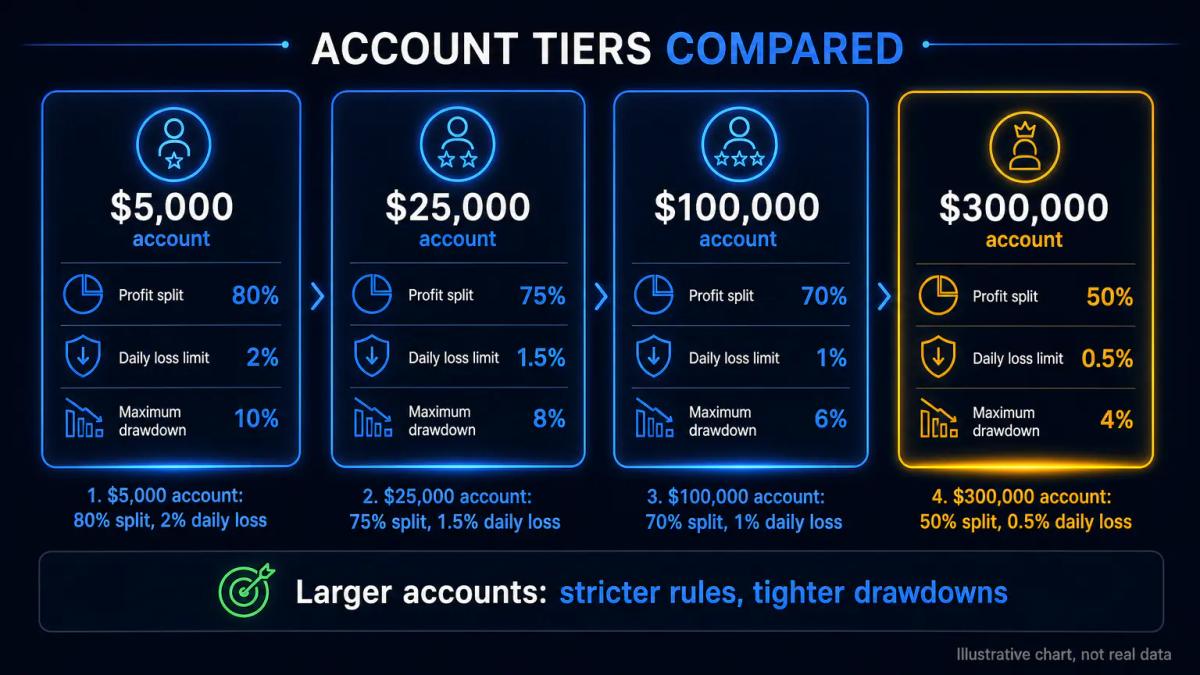
Free challenges usually offer simulated account sizes from $5,000 to $300,000, with profit splits between 50% and 95% once you are funded. Larger accounts come with stricter consistency rules, tighter drawdown ceilings, and slower scaling. The profit split is your percentage of the net gains you generate.
| Account size | Typical split (funded) | Typical daily loss cap | Typical max drawdown |
|---|---|---|---|
| $10,000 | 70% to 80% | 4% to 5% | 8% to 10% |
| $50,000 | 75% to 85% | 4% to 5% | 6% to 10% |
| $100,000 | 80% to 90% | 3% to 5% | 5% to 10% |
| $200,000+ | 85% to 95% | 3% to 4% | 5% to 8% |
Splits above 90% almost always require you to first prove yourself on a smaller size, or clear a paid challenge in parallel.
Single-step versus two-step evaluation paths
Single-step challenges give you one profit target and one set of risk rules. Hit the target without breaching the drawdown, and the firm moves you to a funded account.
Two-step challenges split the process into Phase 1 (higher target, e.g. 8% to 10%) and Phase 2 (lower target, e.g. 4% to 5%), both under the same drawdown ceiling. The two-step path is the more common route for free challenges because it costs the firm less to run: statistically, a second target filters out lucky runs from Phase 1.
A minority of firms offer instant funding on a verified trading history, but they scrutinise your track record and often ask for a broker statement covering several months. Understanding how long the funding process typically takes can help you plan your challenge timeline.
Drawdown is the fall from your account's peak equity to its lowest point before a new peak. Free challenges enforce two ceilings: a maximum drawdown (often 5% to 10% of the starting balance or the peak balance) and a daily loss limit (often 3% to 5%, measured from the previous day's close). Touch either ceiling on an intraday basis, not just on close, and the account is terminated. Some firms use a trailing drawdown that follows your equity up but not down, which is stricter than a static ceiling. Read the exact wording: 'balance-based' and 'equity-based' rules trigger at different moments.
Payout frequency depends on the firm. Monthly cycles are the most common on funded accounts, with some firms offering bi-weekly payouts after your first successful cycle and others sticking to quarterly. Withdrawal requests typically process within 5 to 15 business days after the payout window closes, subject to identity verification. Payment rails vary: bank transfer, stablecoin, or third-party processors. Check which method is available for your country before you start the challenge.
Frequently Asked Questions
Do I really pay nothing to enter a free prop firm challenge?
Yes, the evaluation itself carries no fee, but the firm recovers its cost through the high failure rate of applicants and, on some plans, through a refundable activation fee taken from your first payout. Read the fee schedule and the payout terms before you register.
What happens if I hit the maximum drawdown or daily loss limit?
The account is terminated immediately, usually on an intraday basis rather than at market close. You lose access to the challenge and any simulated profit accrued. Most firms let you restart with a new free challenge, subject to a cooling-off period.
Can I trade forex, stocks, futures and crypto in the same challenge account?
It depends on the firm and the platform. MetaTrader 4 and 5 accounts commonly cover forex, indices and metals; cTrader adds equities CFDs at some firms; futures-focused firms use dedicated platforms and cover CME products only. Crypto CFDs are restricted for UK retail clients under FCA rules.
How long does it take to get funded after passing the evaluation?
Between 1 and 10 business days is typical, once identity verification and the funded-account agreement are signed. Instant-funding programs move faster but require a prior verified track record.
What support or educational resources do prop firms provide during the challenge?
Quality varies widely. Better firms offer written risk-management guides, journalling templates, weekly webinars and email or chat support with typical response times under 24 hours. Weaker firms provide little beyond a rulebook. Check reviews of support response times before committing.
About the authors


Put this into practice
Related articles

High Frequency Trading (HFT): How Speed Became a Market Edge
A grounded look at high frequency trading (HFT): the infrastructure, the strategies, the regulatory guardrails, and what it changes for you at the retail level.

How to Become a Proprietary Trader: Path, Requirements, and Reality
A practical guide to becoming a proprietary trader: institutional versus online routes, evaluation mechanics, risk limits, taxes and a first 90-day plan.

Kraken Crypto Prop Trading Explained: How It Works and How to Get Started
A plain-English explanation of Kraken's funded trader model, plus the five steps to getting started: verify your account, pick a tier that fits your risk, rehearse the rules, pass the evaluation, then trade funded.
0 comments