



How Long Does It Take to Get Funded by a Prop Firm?
Getting funded by a prop firm takes anywhere from two weeks to several months, and the gap between those extremes is almost entirely within your control. This guide breaks down exactly what happens at each stage, how long each stage actually takes across five major firms, and what determines whether you reach the funded stage quickly or slowly.
What the Funding Timeline Actually Covers
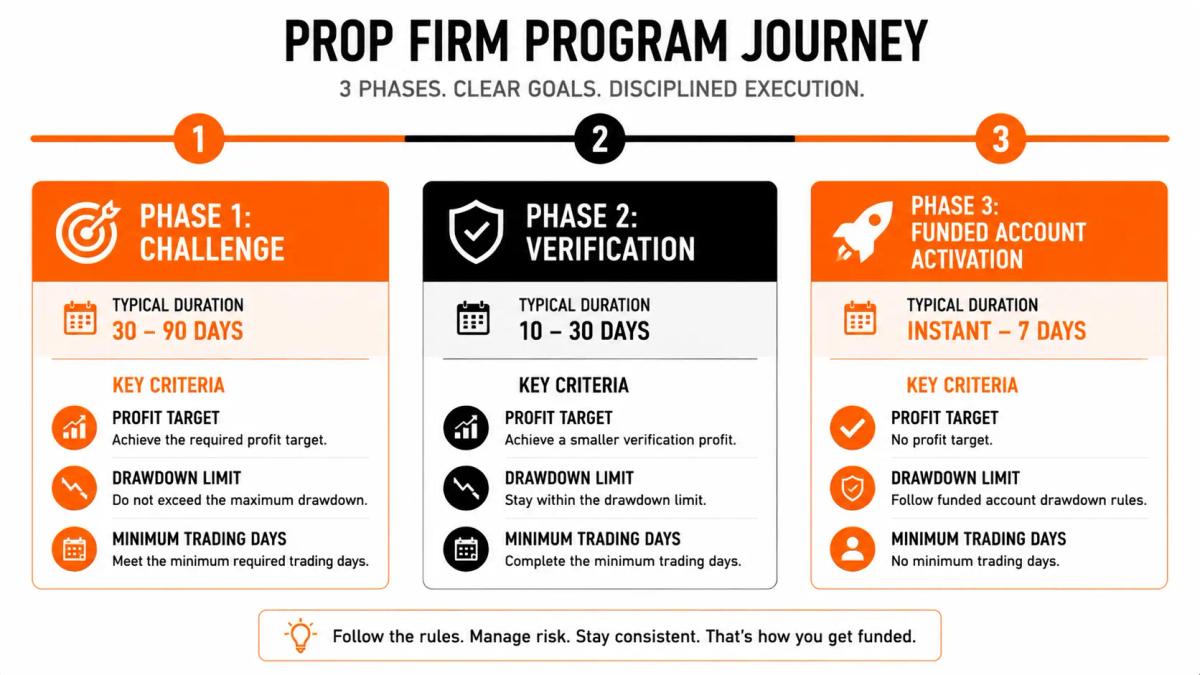
Before you can understand how long it takes, you need to understand what the clock is measuring. The funding process has three distinct phases, each with its own time requirements.
Phase 1: The Challenge
The Challenge is the first evaluation stage. You receive a demo account with a set balance (typically $10,000 to $200,000 depending on what you have purchased) and must meet a profit target, usually 8–10%, while staying within defined risk limits (typically a maximum daily loss of 5% and a maximum overall drawdown of 10%).
Most firms set a minimum number of trading days you must be active during the challenge. This is not optional. Hitting the profit target on day one does not let you move on. The minimum trading day requirement exists to assess consistency, not just profit-seeking ability.
The challenge phase ends when you hit the profit target within risk rules, having satisfied the minimum trading day requirement.
Phase 2: Verification
After passing the Challenge, most firms add a second phase (sometimes called Phase 2 or Verification). The parameters are typically more lenient, with a lower profit target (around 5%) and the same or similar risk limits. Minimum trading day requirements apply here too.
The Verification phase exists to confirm the first result was not a fluke. Some firms have removed it entirely (see Instant Funding below), but most major evaluation-model firms retain it.
See which firms offer the fairest rules in our best prop firms list.
Phase 3: Funded Account Activation
Once you have passed both phases, the firm reviews your results and activates your funded account. This step involves the firm's internal processing: reviewing your trading record, identity verification if not already completed, and account setup. It is largely out of your hands at this point.
How quickly this happens varies significantly by firm. Some process within 24–48 hours. Others take a week or more.
Minimum Trading Days vs. Calendar Days: The Distinction That Trips People Up
This is the most commonly misunderstood aspect of the prop firm timeline.
- Minimum trading days = the number of distinct calendar days on which you must execute at least one trade.
- Calendar days = the actual number of days the phase runs.
These are not the same number, and the gap between them determines how quickly you can theoretically complete each phase.
If a firm requires four minimum trading days and you trade every single available market day, you could technically clear the challenge in four trading days. But if those four days span two calendar weeks because you only trade a few days per week, the same requirement takes considerably longer.
A practical example: a challenge with a four-minimum-trading-day requirement and an 8% profit target takes:
- Minimum possible calendar time: four trading days (trading every available market day)
- Typical trader timeline: two to four weeks (trading two to three days per week)
- Conservative trader timeline: four to eight weeks (lower frequency, cautious approach)
The minimum trading day requirement sets the floor. Your trading frequency, risk approach, and the time needed to reach the profit target set the ceiling. Most traders land somewhere in the middle.
How Long Major Prop Firms Take (Comparison)
FTMO
FTMO runs a two-phase evaluation (FTMO Challenge + Verification).
- Phase 1 (Challenge): Profit target 10%, max daily loss 5%, max drawdown 10%. Minimum 4 trading days. No maximum time limit.
- Phase 2 (Verification): Profit target 5%, same risk rules. Minimum 4 trading days. No maximum time limit.
- Account activation: Typically within a few business days of passing Phase 2, pending identity verification.
Realistic minimum timeline: approximately two weeks (trading actively, hitting targets efficiently). Typical timeline: four to eight weeks across both phases.
FTMO's no-time-limit structure is a meaningful advantage for traders who want to approach the challenge methodically without racing against a deadline.
The5ers
The5ers has evolved its offering over the years. Their current Hyper program offers instant funding at lower starting capital with a growth path, while their High Stakes program runs a more traditional challenge.
- Hyper Program: Instant funded access from day one, with growth milestones to unlock higher capital. No challenge phase as such.
- High Stakes Program (2-phase): Phase 1 profit target 6–8% depending on account type, minimum 3 trading days. Phase 2 follows a similar structure.
Realistic minimum timeline (High Stakes): under two weeks with active trading. Typical timeline: three to six weeks. Hyper Program: day-one access, with progression measured in months depending on how quickly you hit growth targets.
TopStep
TopStep focuses on futures (CME markets) rather than forex specifically, but it is widely used and worth including for context.
- Trading Combine: Single-phase evaluation with a defined profit target and risk limits. Minimum 5 trading days.
- Funded Account: Available once the Combine is passed, with a separate Express Funded Trader path available at higher entry cost for faster access.
Realistic minimum timeline: one to two weeks with active daily trading. Typical timeline: three to six weeks.
FundedNext
FundedNext offers two main paths: the Evaluation model (two-phase) and the Express model (single phase).
- Evaluation Model: Phase 1 target 10%, Phase 2 target 5%. Minimum 5 trading days in Phase 1, minimum 5 days in Phase 2. No maximum time limit.
- Express Model: Single phase, 25% profit target, minimum 5 trading days. Higher cost, but cuts the process in half.
Realistic minimum timeline (Evaluation): approximately two weeks. Typical timeline: four to eight weeks. Express Model minimum: under two weeks with active trading.
FundedNext also offers a "Stellar" model where traders can begin receiving profit shares during the evaluation itself, which changes the financial dynamics without changing the timeline structure.
E8 Funding
E8 runs a two-phase evaluation model (E8 Classic).
- Phase 1: Profit target 8%, max daily loss 4%, max overall drawdown 8%. No minimum trading days (you must place at least one trade every 60 days to keep the account active). No maximum time limit.
- Phase 2: Profit target 4%, same risk rules. No minimum trading days.
- Account activation: Typically one to three business days.
Realistic minimum timeline: as few as one to two weeks with active trading (no minimum trading day requirement). Typical timeline: four to six weeks.
With no minimum trading day requirement, the timeline for E8 is determined primarily by how quickly you reach the profit targets within the risk rules, rather than by any mandatory day count.
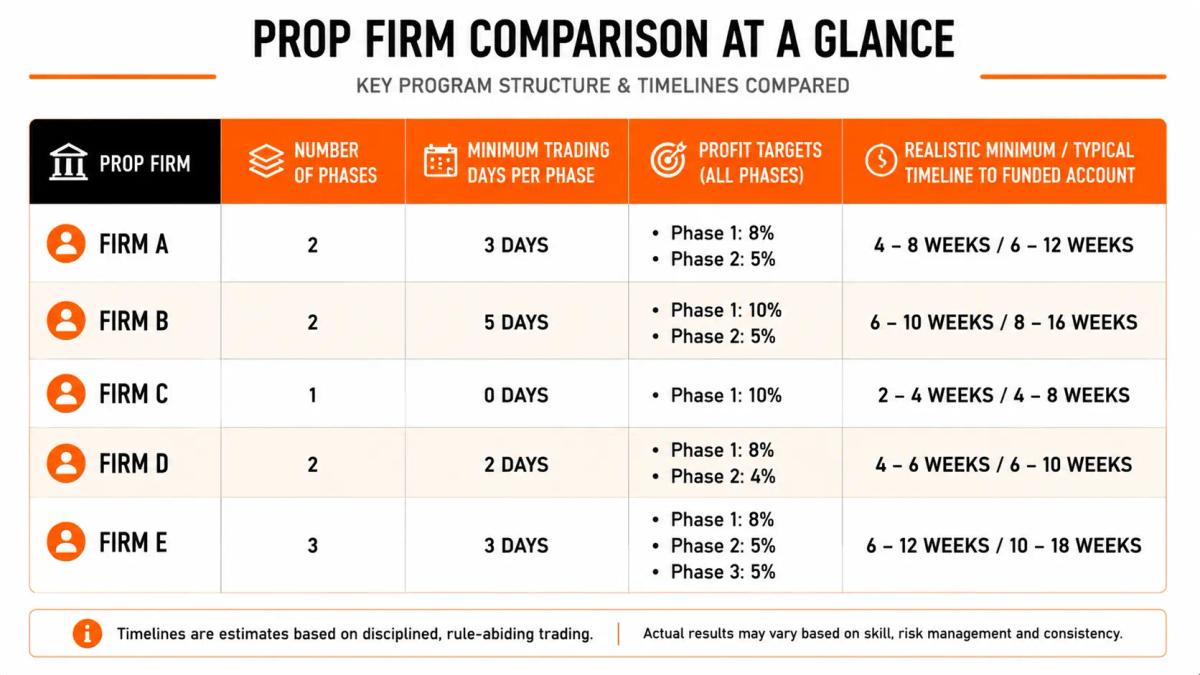
What Actually Determines Your Timeline
Trading frequency and style
The single biggest variable in your timeline is how often you trade.
A trader active four to five days per week will clear minimum trading day requirements in the shortest possible calendar time. A trader active two days per week will take more than twice as long to clear the same requirement, regardless of performance.
Higher trading frequency reduces calendar time but also increases your exposure to drawdown risk. Forcing trades simply to tick off minimum trading days is one of the most common ways traders blow challenges.
How aggressively you target the profit goal
Traders who push hard for the profit target carry more risk per trade and are more likely to breach drawdown limits. The majority of failed challenges end in a drawdown breach, not a slow grind toward the target.
How quickly you reach the profit target depends on your position sizing, your trading frequency, and the market conditions you encounter. There is an inherent tension between moving quickly and staying within risk limits, and every trader finds their own balance across that spectrum.
How quickly the firm processes verification
After passing both phases, you are waiting on the firm's internal process. This varies more than you might expect:
- Fast firms (FTMO, FundedNext): account activation typically within one to three business days
- Moderate firms: three to seven business days
- Slower firms: up to two weeks in some cases
During peak periods (new year, post-promotion surges), processing times can extend. If a firm has not activated your account within the stated timeframe, contacting support promptly is worthwhile, as accounts occasionally get stuck in queue for administrative reasons.
Instant Funding Options: Speed vs. Trade-Offs
A growing number of firms now offer instant funded accounts: you pay, you receive a funded account immediately, with no evaluation phase. The trade-offs are real:
- Higher entry cost: Instant funding programs typically cost two to four times more than equivalent evaluation programs
- Lower initial capital: You often start with a smaller funded account and need to demonstrate consistency to scale
- Stricter ongoing rules: Some instant funded programs have tighter ongoing risk parameters than evaluation-based funded accounts
- Scaling path length: If the goal is a large funded account (such as $100,000+), the scaling path from a smaller instant funded account may take longer than simply passing a traditional evaluation for that capital level
Firms offering instant or near-instant funding include The5ers (Hyper), several newer firms, and various accelerated paths offered by established operators. If time is genuinely the constraint, instant funding removes the evaluation waiting period entirely. If capital efficiency matters more, a traditional evaluation often provides better capital access for the entry cost.
What to Expect After You Pass
Passing the evaluation is the starting gate, not the finish line. Here is what the first few weeks of a funded account typically involve:
- Identity verification (if not completed earlier), typically requiring government ID and proof of address
- Account setup and login credentials, usually delivered within the activation timeframe stated above
- First profit split, with most firms paying profit shares at the end of the first month or at the first withdrawal request, subject to minimum thresholds and any consistency rule requirements
- Scaling plan, as most firms have a structured path to increase your capital allocation after demonstrating consistent performance over one or more months
One point worth being clear about: passing quickly does not mean you are immediately collecting large payouts. Profit splits on a $100,000 account at 80% amount to $800 for every 1% you make. The funded stage is where the real work begins, and consistency over months matters far more than speed through the evaluation.
Frequently Asked Questions
What is the minimum time it is possible to get funded by a prop firm?
With a firm like FTMO or FundedNext that requires four to five minimum trading days per phase, the absolute minimum for a two-phase evaluation is around eight to ten trading days, plus activation time. In calendar terms, that is roughly two weeks if you are trading every available market day. In practice, very few traders achieve this, and the typical timeline is four to eight weeks.
Do weekends count as trading days?
No. Minimum trading day requirements refer to days on which the markets are open and you execute at least one trade. Forex markets are closed on Saturdays and Sundays, so those days do not count toward your minimum. Holidays and market closures do not count either.
Can I trade more frequently to speed up the timeline?
Trading frequency directly affects how quickly you accumulate minimum trading days. A trader active four to five days per week will clear that requirement in fewer calendar weeks than one active two days per week. The relationship is straightforward: more active trading days compress the calendar timeline. How you trade on those days is a separate question governed by each firm's specific risk rules, which you should review carefully before starting a challenge.
What happens if I take too long to pass the challenge?
Most major firms, including FTMO, FundedNext, and E8, have removed maximum time limits on their challenges. You can take as long as you need, provided you do not breach the risk rules. Some firms and some account types still have time limits, so check the specific terms of the challenge you have purchased.
If I fail, do I have to start the timeline again from scratch?
Yes. Failing a challenge by breaching a risk rule means purchasing a new challenge and restarting from Phase 1. Some firms offer discounted retakes or reset options that refund the challenge fee if you pass on the second attempt. Factor retake rates into your decision when choosing a firm, as some traders take two to three attempts before passing.
Does trading style (scalping vs swing trading) affect how long it takes?
Yes, significantly. Scalpers who are active every day clear minimum trading day requirements fastest but also face the highest risk of daily loss breaches. Swing traders who hold positions over multiple days may trade fewer times but take longer to reach the minimum trading day requirement. Consistency and risk control matter more than style.
Is it worth paying for an instant funded account to save time?
It depends on your circumstances. Instant funding costs more upfront and typically starts at lower capital. If the evaluation process genuinely costs you money in lost time or opportunity cost and you have a well-demonstrated track record, instant funding can make sense. For most traders who are newer to the prop firm environment, the evaluation process itself serves as a useful discipline and risk management exercise.
Can the prop firm take longer than expected to activate my account?
Yes. Activation timeframes are estimates and can be affected by application volume, KYC verification delays, or administrative backlogs. If your account has not been activated within the firm's stated timeframe, contact their support team. Keep records of when you passed each phase and when you submitted any required documents.
About the authors


Put this into practice
Prop firms we have reviewed
Scored on the same five dimensions, with the rules that decide payouts. Here are three — the full list is on the prop firms page.



Related articles
I Passed 3 Prop Firm Challenges Before I Failed One: Here's What I Learned
Passing three prop firm challenges didn't prepare me for failing the fourth. Here's what changed, what broke down, and what I'd do differently now.

1 Step Challenge Prop Firm: How Single-Phase Evaluations Work
A plain-English guide to single-phase prop firm evaluations: profit targets, drawdown rules, account sizes, costs and how payouts work once you pass.

100% Profit Split Prop Firms: How It Works and What You Actually Keep
A plain look at firms that give traders full profit: the fees, buffers and consistency rules behind the profit split 100 model explained for retail traders.
0 comments