



I Passed 3 Prop Firm Challenges Before I Failed One: Here's What I Learned
The failure taught me more than the three passes combined. That's a specific observation about what changes psychologically when success starts to feel like a baseline. This article traces exactly what happened across four challenges, what shifted in my behaviour, and what any trader going through their own prop firm journey needs to watch for.
What Three Passes Actually Look Like From the Inside
Three consecutive challenge passes sounds like evidence of skill. And it is, but it's also evidence of something less durable: optimal conditions and high alertness. Passing a challenge once is deliberate. Passing three times can start to feel inevitable. That feeling is the beginning of the problem.
The first pass was cautious almost to a fault. Every trade had a defined stop, a defined target, and a position size calculated to keep daily risk within comfortable limits.
The Rules I Followed When the Stakes Felt High
During the first and second challenges, a specific set of behaviours was non-negotiable:
- No trading in the first 15 minutes after market open (too volatile, too prone to false moves)
- Maximum two open positions at any time
- If the day was down by a defined amount, trading stopped, full stop
- If the weekly account was at a drawdown level that made me uncomfortable, position sizes dropped by half
- No trades placed in the hour before major economic releases
None of these rules were imposed by the prop firm. They were my own, built to create a buffer between my daily behaviour and the firm's limits. The goal was to stay so far inside it that a bad day never became an existential threat to the challenge.
How Consistency Became a System
By the second challenge, these behaviours had stopped feeling like discipline and started feeling like routine. Routine creates consistency, but it also reduces vigilance. You start executing the rules but because that's just what you do.
During the first two passes, it was a system. By the third pass, it was drifting toward autopilot, which meant my internal alarm system was quieter than it should have been.
See which firms offer the fairest rules in our best prop firms list.
The Fourth Challenge: What Changed
The fourth challenge was the first one I approached feeling like I already knew how it was going to end. That's not confidence. It's something more dangerous.
The Overconfidence Problem Nobody Talks About
Overconfidence in trading shows up as a slight loosening of self-monitoring. You skip the 15-minute rule just this once because the setup looks genuinely strong at the open. You let a third position stay open because the first two are deep in profit and the risk feels balanced. You don't cut a bad day short because you're confident in your ability to recover it.
None of these individual decisions look catastrophic in isolation. Each one carries a reasonable internal justification. The problem is cumulative: each loosened rule slightly increases the probability of a large single-session loss. In a prop firm challenge with daily drawdown limits, a single large loss can end everything, regardless of how strong the prior sessions looked.
Where the Drawdown Discipline Broke Down
The specific breakdown came down to one session. Six strong days in a row had produced an almost suspiciously clean equity curve. That session, I was up in the first two hours and started trading more aggressively than my rules allowed: larger position sizes, a third concurrent position, staying through a data release I would normally have sat out.
The release moved sharply against all three positions simultaneously. Within 20 minutes, a profitable day had become a loss that breached my personal daily limit threshold: not the firm's limit, mine. But because I'd already been operating outside my rules, I didn't have the psychological trigger I normally would to stop trading for the day. So I kept going.
That's how a manageable bad session became a significant drawdown event.
The Specific Moment the Challenge Was Lost
The challenge wasn't technically ended by that session; the firm's limits held. But the equity position after that session meant reaching the profit target required taking more risk than my strategy generates profitably. I shifted from a consistent, patient approach to a recovery mindset.
Recovery mindset in a prop firm context is essentially the same as loss-chasing in retail trading. The goal shifts from "execute my process" to "close the gap." Those two goals produce completely different behaviours. The fourth challenge was lost not in the bad session, but in the three sessions after it.
Lessons From the Failure (Not the Passes)
Lesson 1: Complacency Is a Risk Management Problem
The standard framing of complacency is psychological: you get comfortable, you stop paying attention. That's true but incomplete. Complacency is also a structural risk management failure because it makes your rules discretionary at exactly the moments they should be mandatory.
Trading with full alertness in a first challenge, the rules feel protective. You'd never skip a daily loss limit because the risk of losing the challenge feels immediate. After three passes, the rules start to feel optional because your recent track record suggests they're excessive. That's the complacency trap: past performance making current rules feel unnecessary.
Lesson 2: Your Rules Must Survive a Winning Streak
Rules feel easy to follow when things are going poorly; there's no temptation to push beyond them. The real test of a rule is whether you follow it when things are going well. A rule that you only apply when you're losing isn't a rule. It's a loss-management reaction.
The specific rules I violated in the fourth challenge were ones I'd followed consistently during the first three. I violated them not because I was performing badly, but because I was performing well and the rules had started to feel like unnecessary friction.
Lesson 3: Psychological Pressure Shifts After You've Succeeded
Before the first pass, the psychological pressure was the fear of failure. After three passes, the pressure inverted: it became the fear of losing a streak I'd built. These are different pressures, and they produce different failure modes.
Fear of initial failure makes you cautious. Fear of breaking a streak makes you want to force results when things start going wrong, to prove the streak wasn't luck. That's where the recovery mindset kicks in. It's not rational, but it's consistent.
Lesson 4: Drawdown Rules Are Not Suggestions
The firm's drawdown rules exist for a reason: they define the maximum loss they're willing to absorb from any single trader. Your own personal drawdown rules exist for the same reason at a smaller scale; they define the maximum loss your strategy and psychology can sustain in a single session before your judgment is compromised.
Treating drawdown rules as guidelines rather than hard stops is the mechanical cause of most challenge failures. The rule is only useful if it's absolute.
What a Fifth Attempt Would Look Like Differently
Pre-Challenge Preparation Changes
Before attempting a fifth challenge, I'd implement a more formal pre-challenge review process:
- Write out every rule explicitly: not as remembered principles, but as specific written conditions with no ambiguity
- Run through the prior challenge's trade log and identify every instance where a rule was bent, even slightly
- Define in writing what the psychological warning signs of overconfidence look like for me specifically: the internal monologue that precedes rule violations
- Set a personal equity milestone at which I'd do a formal mid-challenge review: not to celebrate, but to assess whether my behaviour is drifting
In-Challenge Behavioural Guardrails
The structural changes I'd make during the challenge itself:
- Reinstate all self-imposed rules as hard limits, not soft guidelines
- Add one new rule: after any day with above-average profit, reduce position sizing by 20% for the next session (winning days can create the same overconfidence that losing days create recovery pressure)
- Log a brief note at the end of each trading session rating my own rule compliance, not just the P&L
- Treat a sixth consecutive profitable day as a warning signal rather than a reward
The sixth consecutive good day is where my discipline started degrading. Building a specific check around that milestone would catch the drift earlier.
When to Walk Away From a Session
This is the rule I failed to apply, and the one I'd make explicit for a fifth attempt: the moment I notice I'm trading outside my rules and justifying it, the session ends.
The alternative, staying in a session where my rules are already compromised, has a documented outcome. Walking away with a small loss or a reduced gain is strictly better than staying in with compromised discipline.
Choosing the Right Prop Firm for Your Style
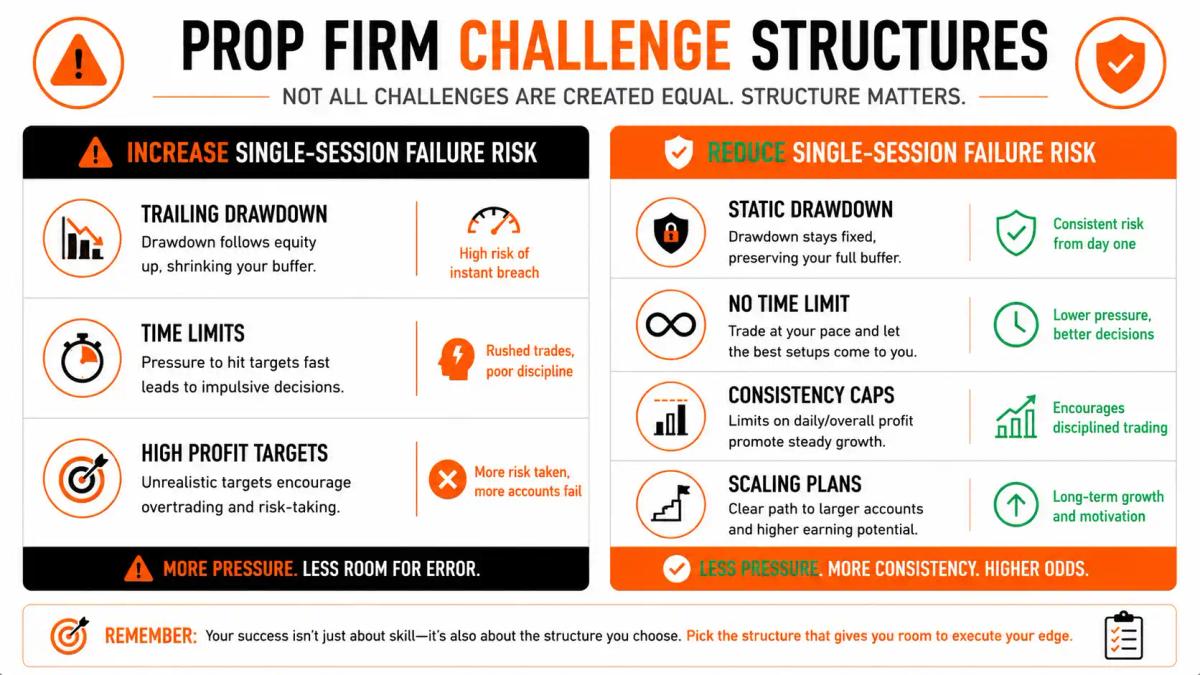
Not all challenge structures expose you equally to the failure pattern described above. Some firm structures actively reduce the risk that a single bad session ends your challenge. Others make that risk more acute.
How Challenge Structure Affects Your Risk
Key structural variables to evaluate:
- Daily drawdown type: A trailing daily drawdown (calculated from the daily equity high) is significantly more restrictive than a static daily drawdown (calculated from starting equity). A trailing drawdown can be triggered by a reversal after a strong start to the day: the exact scenario in the fourth challenge.
- Profit target level: Higher profit targets require more trading time and more risk-taking to reach within any time limit. They create more opportunities for the overconfidence pattern to develop.
- Time limits vs. no time limits: Challenges with no time limit allow traders to be patient through losing periods without pressure to recover quickly. Time-limited challenges create recovery pressure that changes behaviour.
- Two-phase vs. one-phase challenges: Two-phase challenges impose a longer period of consistent behaviour before funding. That filters out traders who got lucky in phase one.
Firms With Rules That Reward Consistency
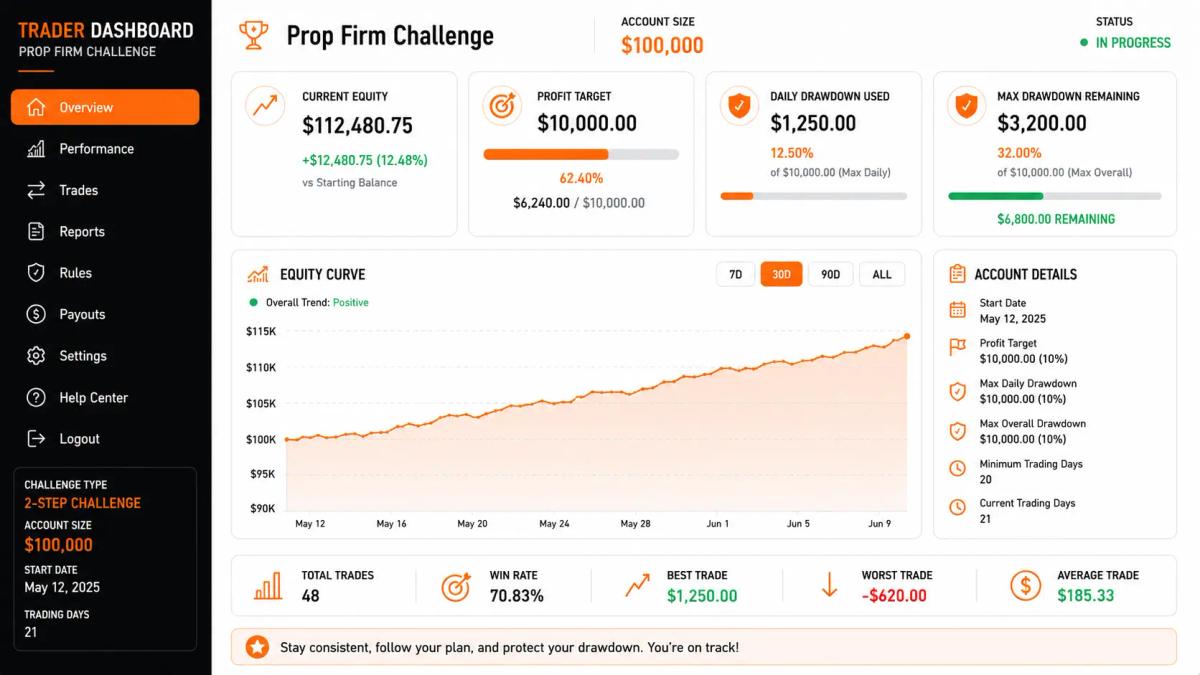
Firms that explicitly reward consistent behaviour, through consistency rules that cap the percentage of total profit from a single day, suit the approach described in this article well. If no single day can account for more than 40-50% of your total profit, you're structurally prevented from taking the kind of outsized risk that caused the fourth failure.
Look for firms that:
- Use static daily drawdown rather than trailing (more predictable limit behaviour)
- Don't impose strict time limits on challenge completion
- Offer a scaling plan that rewards consistent performance rather than a single large account from day one
- Have transparent, publicly documented rules with no ambiguous clauses
A firm whose rules punish inconsistency is a good fit if you need that external structure. A firm with maximum flexibility suits traders whose self-imposed rules are already solid.
The fourth failure confirmed one thing clearly: the firm's rules are the floor. Your personal rules need to be the ceiling.
Frequently Asked Questions
How common is it to fail a prop firm challenge after passing previous ones?
More common than most traders admit publicly. Survivorship bias in online trading communities means you see the passes and rarely the failures. The specific pattern of failing after a run of success, driven by overconfidence and loosened discipline, is something experienced prop traders describe consistently when they speak candidly. Traders who have passed multiple challenges face a specific risk that first-timers don't: the assumption that past results validate current behaviour.
What is the most important rule to have during a prop firm challenge?
The daily loss limit: specifically, your own personal daily loss limit set well inside the firm's maximum. The firm's daily drawdown limit is the point at which they end your challenge. Your personal limit should be the point at which you stop trading for the day, comfortably before the firm's threshold. Most experienced funded traders set their personal daily loss limit at around 50-60% of the firm's maximum allowable daily loss.
Should I trade the same strategy during a challenge as I trade on a personal account?
Yes, with slight adjustments for the challenge constraints. The strategy should be the same; introducing a new approach during a challenge adds unnecessary uncertainty. Adjustments come in position sizing (potentially more conservative to protect drawdown limits) and in which setups you take (higher-confidence setups only, since the cost of a mistake is higher in a challenge than in a personal account).
How do I choose between different prop firm structures?
Match the structure to your trading style and psychological tendencies. If you're a patient trader who performs best without time pressure, choose a firm with no time limit. If your edge comes from frequent, small-win trades, choose a firm without consistency rules that cap daily gains. If you're prone to overtrading after a bad session, choose a firm with strict daily loss limits that enforce a hard stop. The structure that aligns with your natural tendencies requires less willpower to sustain.
Is it better to attempt challenges with a smaller or larger account size?
Start with the smallest account size that allows you to trade your strategy properly with correct position sizing. Smaller accounts make individual dollar losses feel less significant, which can reduce emotional decision-making. They also mean a failed challenge costs less to retry. As your pass rate demonstrates consistency, move to larger account sizes. Using the largest available account from your first attempt creates unnecessary pressure.
What should I do immediately after failing a prop firm challenge?
Don't immediately repurchase and retry. Take at minimum one to two weeks to review your trade log thoroughly: not just the losing trades, but the sessions where your behaviour deviated from your rules. The failure started before the moment it became visible in the numbers. Identify where. Adjust your rules or your process to address what you find, document those adjustments explicitly, and then retry with a clear understanding of what changed and why.
About the authors


Put this into practice
Related articles

1 Step Challenge Prop Firm: How Single-Phase Evaluations Work
A plain-English guide to single-phase prop firm evaluations: profit targets, drawdown rules, account sizes, costs and how payouts work once you pass.

100K Funded Trading Account: What You Get and What It Costs
A plain-English breakdown of the 100K funded account: costs, splits, drawdown limits, tax treatment, platforms, psychology and how it stacks up against smaller sizes.

Best Prop Firm Forex EAs: Rules, Platforms and Real Performance
A working guide to choosing forex EAs for funded accounts: rulebooks, VPS setup, backtest hygiene, cost trade-offs and the risk parameters that keep you funded.
0 comments