



Prop Trading · Beginner · 15 min read
EA Prop Trading: How Automated Systems Work in Funded Accounts
What EA prop trading is and how it differs from manual trading
EA prop trading means running an Expert Advisor (an automated program that opens and closes trades on your behalf inside MetaTrader) on a proprietary trading firm account, so the software executes every order without you clicking a button. You trade with the firm's capital, not your own, but you must stay inside strict rules that manual traders often ignore.
An Expert Advisor, or EA, is a script written in the MQL language that lives inside MetaTrader 4 or MetaTrader 5. Once attached to a chart, it reads price data, applies a set of rules, and places orders directly through the broker. A prop firm, short for proprietary trading firm, is a company that funds traders with its own money after they pass an evaluation, and shares profits with them.
The practical difference between manual and EA prop trading is speed and consistency. A manual trader can hesitate, skip a signal, or move a stop loss (an order that closes a losing trade at a set price). An EA does not hesitate: it obeys the code. That consistency is an advantage when the strategy is sound and a disaster when the rules are wrong or the market changes.
EA prop trading attracts you if you already have a strategy that shows a positive edge on paper and want to scale it without funding a large personal account. The trade-off is discipline: prop firms measure your equity curve every day, and one loose parameter can breach a drawdown limit and end the account. You are effectively renting capital in exchange for accepting hard rails on how the software behaves.
Ready for a funded account? Compare the best prop firms.
Prop firm rules that affect EA configuration and strategy choice
Prop firms write rulebooks to protect their capital, and those rules dictate what your EA can and cannot do. Before you buy or code anything, read the firm's terms of service in full. The common restrictions cluster around four areas: prohibited strategies, loss limits, news trading, and consistency. Understanding how profit splits and withdrawals work helps you see why these rules exist: the firm protects its capital first, then shares what remains with you.
The first area is prohibited strategies. Most firms ban grid trading (opening many orders at fixed price intervals to average into a position), martingale (doubling position size after each loss), and hedging across accounts. High-frequency scalping, defined as opening and closing trades within seconds, is often blocked or capped by minimum-holding rules. Latency arbitrage, which exploits pricing gaps between feeds, is universally forbidden and will get the account terminated.
The second area is loss limits. A typical challenge sets a maximum daily loss of 5% of the starting balance and an overall drawdown of 10%. Drawdown here means the drop from the highest equity point (peak) to the lowest (trough) before a new peak. Your EA needs a hard-coded circuit breaker that closes every open position and stops trading the moment either limit is at risk of being touched. Waiting for the broker's server to enforce the limit is too late: floating losses and slippage can push you past the line.
The third area is news trading. Many firms ban entries and exits within two to five minutes of a high-impact economic release, such as US non-farm payrolls or a central bank rate decision. Your EA must read an economic calendar or use a time filter that blocks activity around these events.
The fourth area is consistency. Some firms measure the size of your best trading day against your total profit and refuse payouts if a single day accounts for more than 30% or 40% of the gain. That rule alone kills strategies that rely on one lucky lottery ticket.
| Rule category | Typical limit | EA parameter to configure |
|---|---|---|
| Maximum daily loss | 5% of starting balance | Hard equity floor with force-close routine |
| Overall drawdown | 10% to 12% | Trailing equity ceiling, halt-trading flag |
| Minimum trade duration | 30 to 60 seconds | Delay before position close |
| News blackout | 2 to 5 min around red-folder events | Economic calendar time filter |
| Prohibited logic | No grid, no martingale | Fixed lot rules, single-position mode |
According to the FCA, most retail investor accounts lose money when trading CFDs, which is the exact category of contract prop firm evaluations usually simulate. That baseline matters: your EA is not fighting other retail traders, it is fighting a distribution where the majority lose, and prop rules are calibrated on that reality.
Setting up MT5 and configuring your EA for prop firm compliance
MetaTrader 5, known as MT5, is the standard platform for prop firm EA trading because it supports automated execution, tick-level backtesting, and the built-in Strategy Tester. Most firms accept MT4 as well, but MT5 has better historical data handling and multi-asset support, which matters when you run one EA on gold and another on indices.
Setup starts with the broker terminal supplied by the prop firm. You download the branded MT5 build, log in with the challenge credentials, and open the Options menu. Under the Expert Advisors tab you enable Allow Algorithmic Trading and, if the EA needs external data, Allow WebRequest for approved URLs. Drag the EA onto a chart, tick AutoTrading in the toolbar, and confirm the smiley icon appears in the top right of the chart, which means the EA is live.
Compliance configuration is where most challenge failures start. At minimum your EA needs five hard-coded controls. First, a fixed lot size or a percentage-risk model that never exceeds 1% of balance per trade. Second, an internal daily loss counter that resets at server midnight and force-closes all trades at 4% floating loss, one percentage point inside the firm's 5% limit. Third, a peak-equity tracker that halts trading if drawdown reaches 8% against a 10% cap. Fourth, an economic calendar filter, either MT5's built-in feed or an external CSV, that blocks new orders during red-folder events. Fifth, a kill switch input that lets you disable the EA remotely without closing MT5.
Disable any grid, martingale, hedging, or averaging block in the EA's code before you deploy it. If the EA came from a vendor and those functions are behind toggles, set them to false and verify in the journal that they are inactive. Then run the EA in Strategy Tester on at least twelve months of tick data with real spreads before you attach it to a live challenge.
Backtesting and forward-testing your EA before going live
Backtesting is the process of running your EA against historical price data to see how it would have performed. Forward-testing, also called paper trading, runs the same EA on live market prices in a demo account so you can watch it react to current conditions without risking money. Both steps are non-negotiable before you attach the EA to a paid challenge. Understanding whether day trading is worth it gives you perspective on the testing discipline required for any automated strategy.
In MT5 Strategy Tester you select the EA, the symbol, the timeframe, and the date range. Choose Every tick based on real ticks for the highest accuracy, because bar-by-bar simulation hides the intrabar behaviour that trips stop losses. Load at least twelve months of data. If your EA claims an edge on gold, test on 2022 and 2023 tick data, then on 2024 out-of-sample data the EA has never seen. Overfitting, sometimes called curve-fitting, happens when you tune parameters until the equity curve looks perfect on one dataset but collapses on another.
Read the report carefully. Look at profit factor (gross profit divided by gross loss; above 1.3 is workable), maximum drawdown (keep it under the prop firm's overall limit), and the Sharpe ratio (return per unit of risk; above 1.0 is respectable for retail systems). Count the number of trades: a sample below 100 is not statistically meaningful.
Forward-testing follows for two to four weeks on a demo account with the same broker. Live spreads, weekend gaps, and slippage (the difference between the price you expected and the price you got) all appear here for the first time. If the demo results diverge sharply from the backtest, the strategy is fragile and you should not fund it. Only when both phases align do you pay the challenge fee.
Gold (XAUUSD) and other instruments popular for EA prop trading
Gold, quoted as XAUUSD on MT5, dominates EA prop trading because it trends strongly, offers tight spreads on most prop broker feeds, and produces enough daily volatility for automated systems to catch consistent moves without needing constant activity. A single clean move on gold during the London or New York session can meet a daily target that would take dozens of trades on a slower pair. High-frequency scalping on gold is popular because the instrument's liquidity allows rapid entry and exit at tight prices.
Major forex pairs come next. EURUSD, GBPUSD, and USDJPY carry the tightest spreads and deepest liquidity, which reduces slippage on entries and exits. According to the Bank for International Settlements, foreign exchange is the largest and most liquid market in the world by daily turnover, and that liquidity is exactly what an EA needs to enter and exit at predictable prices. Cross pairs like EURJPY and GBPJPY move more per day but carry wider spreads, which eats into short-hold strategies.
Indices are the third block. US500 (S&P 500), US30 (Dow Jones), UK100 (FTSE 100), and GER40 (DAX) attract trend-following EAs because they carry strong directional bias during regular session hours. Prop firms usually allow index trading but restrict hours to cash-session windows.
Crypto CFDs sit outside the picture for UK retail clients. The FCA prohibits the sale of crypto derivatives, including CFDs and futures, to UK retail consumers. If your prop firm offers a UK-facing retail entity, the crypto symbols are removed from the terminal. Offshore entities of the same group sometimes list crypto, but that route trades regulatory protection for product access.
| Instrument | Why EAs favour it | Typical prop firm treatment |
|---|---|---|
| XAUUSD (gold) | Strong trends, deep liquidity, moderate spread | Almost always allowed |
| EURUSD, GBPUSD | Tight spreads, low slippage | Always allowed |
| US500, UK100 | Session-based trend behaviour | Allowed in cash hours |
| Crypto CFDs | High volatility | Banned for UK retail by the FCA |
Many traders run separate EAs on gold and on one major forex pair to reduce correlation risk, meaning the two accounts do not lose at the same time when a single market moves against them.
Challenge fees, account sizing, and the path to instant funding
A prop firm challenge is a paid evaluation. You pay a one-time fee, receive a demo account with a set balance and rules, and try to hit a profit target inside a defined drawdown. Fees scale with account size.
A £10,000 evaluation typically costs £50 to £100, a £50,000 evaluation costs £250 to £350, a £100,000 evaluation costs £500 to £600, and a £200,000 evaluation runs £1,000 or more. Numbers vary by firm and change over time, so verify current pricing before you buy.
The standard structure is a two-step evaluation. Step one requires 8% to 10% profit inside 30 days without breaching a 5% daily loss or a 10% overall drawdown. Step two lowers the profit target, often to 4% or 5%, and gives you unlimited time. Once both steps pass, the firm issues a funded account and pays 70% to 90% of profits on a monthly or bi-weekly cycle. With a competent EA on gold or a major pair, passing typically takes two to eight weeks. How long it takes to get funded by a prop firm depends on your EA's consistency and your discipline during the challenge.
Instant funding is the alternative. You pay a larger fee, perhaps two to four times the challenge cost, and skip straight to a live-profit account. The trade-off is that you never proved the EA works under evaluation pressure, so the risk of losing the fee on day one is real. Some instant-funding programmes also apply a lower profit split or tighter drawdown to compensate the firm.
Account sizing matters more than the challenge tier. A £10,000 account paying 80% on a 5% monthly return delivers £400 before fees; a £100,000 account at the same return pays £4,000. Match the size to your EA's realistic monthly performance from the forward test, not to the ambition. Buying a £200,000 evaluation for an EA that produces 2% a month wastes capital because most of that account sits idle.
| Account size | Typical challenge fee | 8% profit target |
|---|---|---|
| £10,000 | £50 to £100 | £800 |
| £25,000 | £150 to £200 | £2,000 |
| £50,000 | £250 to £350 | £4,000 |
| £100,000 | £500 to £600 | £8,000 |
| £200,000 | £1,000+ | £16,000 |
Common EA mistakes and how to avoid them in prop firm accounts
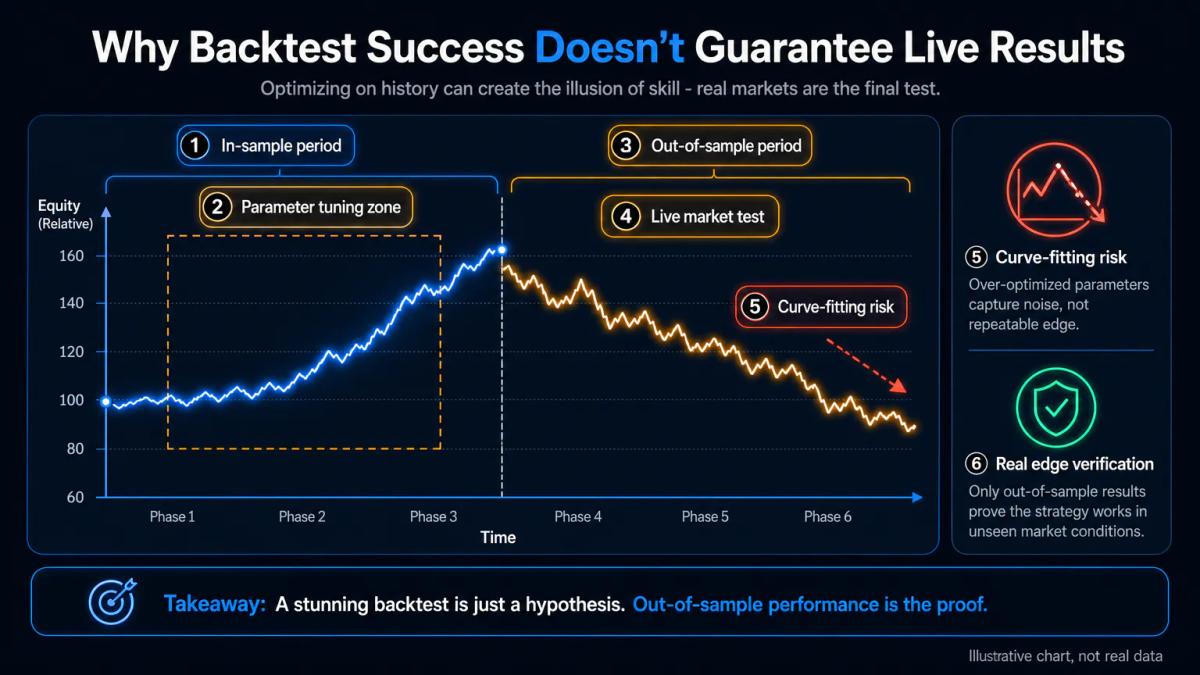
Most EA challenge failures trace back to the same handful of mistakes. Learning them in advance is cheaper than paying repeat fees.
The first mistake is curve-fitting during backtests. You tune parameters until the historical equity curve is beautiful, then the EA fails in live markets because the parameters describe past noise, not a real edge. Defence: split your historical data into an in-sample block for tuning and an out-of-sample block the EA never sees during optimisation. Only trust results that hold on the out-of-sample block.
The second mistake is ignoring spread and slippage. Strategy Tester defaults often assume fixed, low spreads that a live broker never delivers. During volatile hours, gold spreads can widen by a factor of five. Test with real-tick data that includes live spread history, and add a modelled slippage of one to three pips.
The third mistake is running the EA through high-impact news. A single non-farm payrolls release can gap gold thirty dollars in a second, blow through a stop loss, and breach the daily loss rule before the code even reacts. Defence: economic calendar filter, always on.
The fourth mistake is grid and martingale logic, whether visible in the settings or hidden inside a black-box EA. If the code doubles size after losses or opens layered orders without stops, it will eventually violate prop rules or blow the account. If you cannot read the code, do not trust the EA.
The fifth mistake is oversized positions. Risking 3% per trade sounds modest until three losses in a row put you at the daily loss wall. Cap risk at 1% per trade, and cap concurrent open risk across all positions at 2% of balance.
There is a sixth mistake that no code fixes: psychology. Traders who run EAs still panic. They disable the software during a drawdown, restart it after a winning streak on a demo, or add manual trades on top of the automated ones. Each intervention corrupts the statistical edge the EA was built on. Understanding what prop traders actually earn helps you keep perspective: discipline in EA prop trading is the discipline to leave a working system alone, which is harder than it sounds when your equity dips.
Tax, reporting, and regulatory considerations for EA prop traders
Prop firm payouts are taxable income. In the United Kingdom, HMRC generally treats profits from prop firm accounts as trading or miscellaneous income rather than capital gains, because you are not trading your own capital: you are receiving a share of the firm's profits under a contract. That distinction affects the tax rate and the reliefs you can claim. Consult HMRC guidance or a qualified accountant before you file, and keep every payout confirmation, contract, and monthly statement.
Record-keeping is on you, not the firm. Save the MT5 statements, the invoices for challenge fees (which may be deductible against income if you are taxed as a trader), and the bank or wallet records of every withdrawal. Cross-border payouts, especially from firms domiciled outside the UK, may involve withholding or reporting under international information-exchange rules.
Regulation shapes what a UK retail client can access. UK-facing entities of prop firm groups operate under FCA rules where applicable, which cap leverage at 1:30 on major forex, 1:20 on minor forex and major indices, 1:10 on commodities other than gold, 1:20 on gold, and 1:5 on individual equities. Crypto CFDs are prohibited for UK retail by the FCA. Offshore group entities may offer higher leverage and wider product ranges, but you lose the protection of the Financial Ombudsman Service and the Financial Services Compensation Scheme. Before you fund a challenge, check which entity issues the contract and under which licence, and treat the FCA-authorised tier as the gold standard and offshore entities as a flag to investigate.
This content is general information and not advice: every situation needs checking with a licensed professional in the relevant jurisdiction.
Frequently Asked Questions
Can you use any Expert Advisor on a prop firm account, or are there restrictions?
You cannot use any EA. Prop firms publish an allowed-strategies list and ban grid, martingale, latency arbitrage, tick-scalping under a minimum hold time, and copy trading between accounts. Some also require the EA source or vendor name in advance. Check the firm's terms before you attach the software; running a prohibited EA voids the account and forfeits the fee.
How long does it typically take to pass a prop firm challenge with an EA?
A competent EA on gold or a major forex pair usually clears a two-step evaluation in two to eight weeks. Step one, targeting 8% to 10% profit inside 30 days, is the bottleneck; step two, at 4% to 5% with no time limit, is easier. Weak or over-tuned EAs fail on the drawdown rule long before the profit target.
What is the minimum account size you need to start EA prop trading?
The smallest evaluations start at a £5,000 to £10,000 account, with fees of £50 to £100. That tier is fine for testing an EA under live challenge pressure but the payout on a 5% return is modest. Most traders scale up to £50,000 or £100,000 evaluations once a strategy shows consistent forward-test results.
Do prop firms allow you to run multiple EAs on the same account at the same time?
Most firms allow multiple EAs on one account as long as combined exposure respects the daily loss and drawdown limits, and none of the EAs hedge each other. Some firms cap the number of open positions or restrict correlated symbols. Read the terms and use a master risk-monitor EA that watches total equity across every strategy.
What happens if your EA violates prop firm rules during a challenge?
The account is closed and the challenge fee is not refunded. Serious violations, such as latency arbitrage or hedging across accounts, can also ban you from future evaluations with the same firm. Softer breaches, like exceeding daily loss by a small margin, end that specific attempt but let you buy a new challenge and try again.
About the authors


Put this into practice
Related articles

Free Prop Firm Challenge: How Zero-Fee Trader Evaluations Actually Work
A plain-English guide to the free prop firm challenge: what it is, how account sizes and profit splits work, and the rules that will end your evaluation.

High Frequency Trading (HFT): How Speed Became a Market Edge
A grounded look at high frequency trading (HFT): the infrastructure, the strategies, the regulatory guardrails, and what it changes for you at the retail level.

How to Become a Proprietary Trader: Path, Requirements, and Reality
A practical guide to becoming a proprietary trader: institutional versus online routes, evaluation mechanics, risk limits, taxes and a first 90-day plan.
0 comments