



Prop Trading · Beginner · 6 min read
Prop Firm Payouts: How Profit Splits, Thresholds and Withdrawals Work
Prop firm payouts are the withdrawals you receive from a proprietary trading firm after generating profit on the capital it allocates to you. The firm keeps a pre-agreed percentage; you receive the rest. You only become eligible once you clear a minimum profit threshold, respect the risk rules, and pass a compliance review.
What are prop firm payouts and how do they work
A prop firm payout is the cash transfer you get after trading a funded account, which is capital the firm provides in exchange for a share of the profits.
You do not trade your own money on the live account: you have already paid an evaluation fee (or a subscription) to prove you can follow the risk rules. When your account is in profit and the payout cycle opens, you request a withdrawal. The firm checks that you respected the daily loss limit, the overall drawdown (the peak-to-trough fall in account equity) and any consistency rule, then releases your share.
Understanding how long it takes to get funded by a prop firm helps you plan your timeline to first payout eligibility. Payouts are not automatic: you request, they verify, they pay.
See which firms offer the fairest rules in our best prop firms list.
Profit-split percentages and earning structures
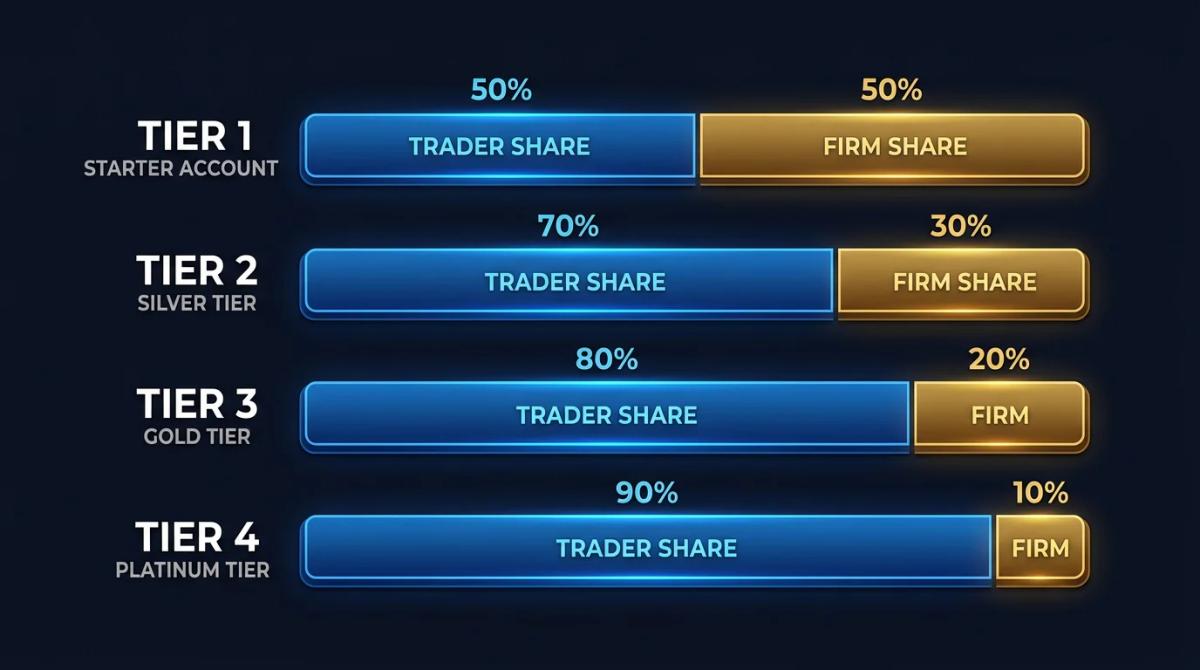
Profit-split percentages describe how the trading gain is divided between you and the firm. An 80/20 split means you keep 80% of the profit and the firm keeps 20%. Splits typically start at 50/50 or 70/30 on entry-level accounts and can scale to 90/10 on higher tiers, on scaled accounts, or after several consecutive profitable payout cycles.
When comparing offers, comparing prop firms side-by-side helps you see which payout structures and scaling paths suit your goals.
| Account tier | Typical split (trader/firm) | Common condition |
|---|---|---|
| Entry evaluation | 70/30 to 80/20 | First payout cycle |
| Standard funded | 80/20 | After 1 to 2 payouts |
| Scaled or pro | 85/15 to 90/10 | Consistency plus scaling target met |
Read the split alongside the account cost, not in isolation.
Minimum profit thresholds and payout eligibility

A minimum profit threshold is the amount of gain you must generate before a withdrawal request is allowed. It exists so the firm does not pay out on random small wins.
Thresholds are usually expressed as a percentage of the account size or a flat figure. On a $50,000 account, a common minimum is around 1% (roughly $500) before the first payout window opens; on larger accounts the flat number rises accordingly.
Some firms also enforce a consistency rule: no single trading day can represent more than a set percentage of your total profit. If one lucky day dominates your P&L, the payout can be reduced or postponed until you distribute gains across more sessions.
Payout speed, settlement timelines, and payment methods
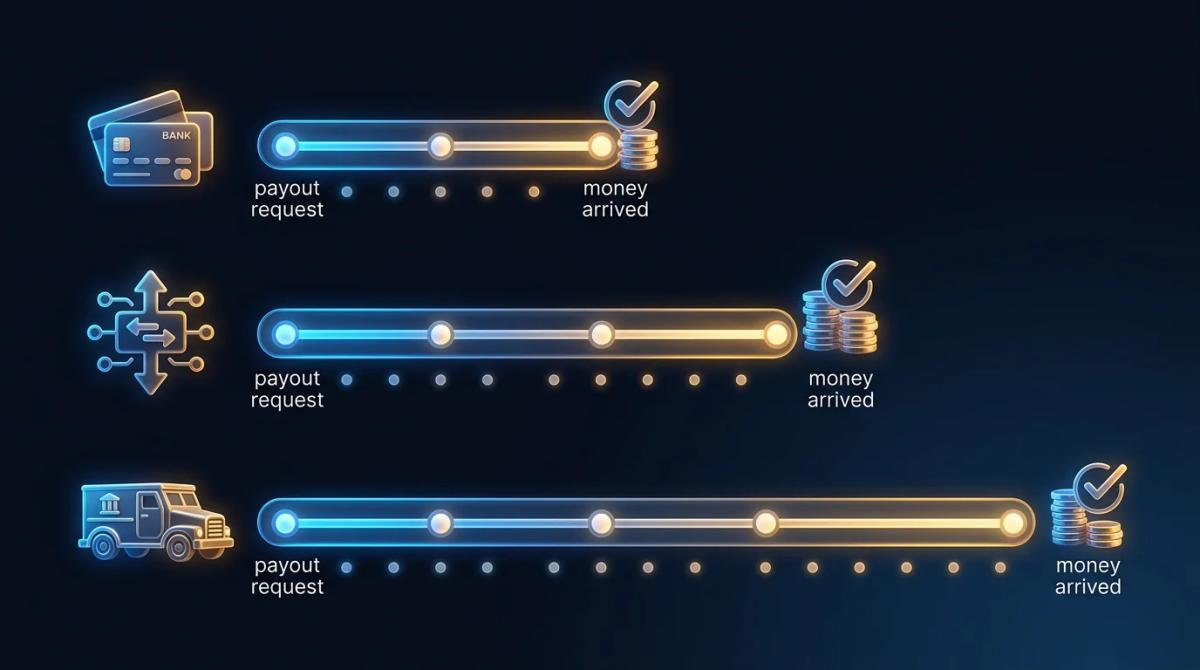
Settlement time is the delay between requesting a payout and the money arriving. Faster is not automatically better: a same-day payout with weak verification can also mean weak protection if something goes wrong. Typical windows range from 1 to 5 business days for firms with mature back offices, up to 2 to 4 weeks for firms that batch requests or run manual checks.
| Method | Typical arrival | Notes |
|---|---|---|
| Bank transfer (SEPA, Faster Payments) | 1 to 3 business days | Standard in the UK and EU |
| International wire (SWIFT) | 2 to 5 business days | Intermediary bank fees apply |
| Stablecoin or cryptocurrency | Minutes to 24 hours | Network fees; verify the wallet address twice |
| Payment processors (Rise, Deel) | 1 to 3 business days | Availability depends on your country |
Check the withdrawal policy in writing before you fund an evaluation.
Compliance checks and payout hold-ups
Compliance checks are the anti-money-laundering (AML) and know-your-customer (KYC) reviews the firm runs before releasing funds. They exist because prop firms handle client money at scale and must verify identity, source of trading activity, and account behaviour.
Delays cluster around a few triggers: trading patterns that look like latency arbitrage or news-scalping outside the rules, a single trade that produced most of the profit, mismatched identity documents, or use of a VPN masking your country of residence. If a payout is paused, the firm should tell you which check is open and what you need to send. Respond with the exact document requested, keep copies, and note dates: this record matters if the case escalates.
Tax reporting and regional payout differences
A prop firm payout is income in most jurisdictions and you, not the firm, are responsible for reporting it.
In the UK, HMRC generally treats regular prop trading income as either self-employment profit or miscellaneous income, reportable via Self Assessment; National Insurance may apply if the activity qualifies as self-employment.
In the EU, treatment varies by country: some tax authorities classify payouts as business income, others as miscellaneous income. Firms domiciled offshore rarely issue a tax form you can hand to your accountant, so keep your own log of every payout: date, amount, currency, and the firm's legal entity. If a firm changes its billing entity between payouts, log that too: it affects how you declare foreign income.
Payout disputes and trader recourse options
Recourse means the formal steps you can take when a payout is delayed, reduced, or refused. Your options depend on where the firm is licensed. A firm operating through an FCA-authorised entity in the UK is subject to complaint-handling rules and, for eligible activities, the Financial Ombudsman Service.
Firms based offshore often sit outside any statutory complaints route, so your leverage is limited to their internal ticketing system and public reputation. Understanding which forex brokers have the most complaints and what regulatory records show gives you insight into how to research a firm's track record before funding.
Before you fund an account, confirm the exact legal entity on the contract, the regulator, and the written payout terms. Save every screenshot of your dashboard, every email, and the full trade history: without evidence, a dispute has no traction.
This content is general information and not advice: every situation needs checking with a licensed professional in the relevant jurisdiction.
Frequently Asked Questions
How long does it take to receive a prop firm payout after I request it?
Between 1 business day and 4 weeks, depending on the firm. Bank transfers inside the UK or EU usually clear in 1 to 3 business days once approved; international wires take 2 to 5 business days; stablecoin transfers can arrive within hours. Firms that batch requests or run manual compliance reviews sit at the slow end of that range. Always confirm the settlement window in the written withdrawal policy before you fund an account.
What is the typical profit split between me and a prop firm?
Entry-level funded accounts commonly start around 70/30 or 80/20 in the trader's favour. After one or two successful payout cycles, or after reaching a scaling target, splits often move to 85/15 or 90/10. Read the split alongside the evaluation fee and the account rules: a headline 90/10 split on an expensive account with tight risk limits is not automatically better than 80/20 on a cheaper, more flexible one.
Do I have to pay tax on prop firm payouts, and how do I report them?
In most jurisdictions, yes. In the UK, HMRC generally treats regular prop trading income as self-employment profit or miscellaneous income, reported through Self Assessment, and National Insurance may apply for self-employment. Rules differ across the EU and other regions. Offshore firms rarely issue tax paperwork, so keep your own record of each payout: date, amount, currency, and the firm's legal entity. Speak to a qualified tax adviser about your specific case.
What happens if my payout is delayed or the firm disputes my withdrawal request?
Ask the firm, in writing, which specific check is open and what document or clarification it needs. Send exactly that, keep copies, and note timestamps. If the firm operates through an FCA-authorised entity, you can escalate through its formal complaints process and, for eligible activities, the Financial Ombudsman Service. If the entity is offshore, your leverage is limited to the firm's internal process and its public reputation, which is why licensing matters before you fund.
Can I withdraw my payout using cryptocurrency or payment methods other than bank transfer?
Some firms offer stablecoin payouts (usually USDC or USDT), international wire, or third-party processors such as Rise or Deel; others restrict you to bank transfer in a specific currency. Availability depends on your country of residence and the firm's payment partners. If crypto payouts matter to you, confirm the exact network supported, the fee structure, and whether the firm allows you to change payment method between payout cycles.
About the authors


Put this into practice
Related articles

Prop Firms That Accept US Clients: What to Check Before You Sign Up
US traders face a narrower shortlist of prop firms than European peers. Here is how to read funding models, drawdown caps, tax reporting, and payout terms before you commit.

Prop Trader Salary: What You Actually Earn at Firms and Funded Accounts
A plain-English breakdown of prop trader pay: base salary, bonuses, profit splits, drawdown rules, tax treatment and how earnings evolve from year one to year ten.

Prop Trading Jobs: Roles, Pay, Hiring, and Career Paths
A plain-English guide to prop trading jobs: what they pay, how firms hire, what background you need, and where the career leads next.
0 comments