



Prop Trading · Beginner · 5 min read
Prop Trading Jobs: Roles, Pay, Hiring, and Career Paths
What prop trading jobs are and who hires for them
Prop trading jobs are positions where you trade a firm's capital directly and keep a share of the profits instead of drawing a fixed salary in full. Proprietary trading, a firm using its own money to trade markets rather than client money, spans small boutiques to large hedge funds and investment banks, each with different strategies, risk tolerance and pay models.
For a retail trader eyeing the jump, the type of shop matters. A boutique in London may hand you a live book on day one; a bank desk will drip-feed responsibility over years. Your role, upside and daily rhythm all shift with the firm's style, and understanding the different types of trading can help you identify which environment suits your strengths.
To trade with a firm's capital, compare the best prop firms and how their evaluations work.
Common prop trading job titles and specializations
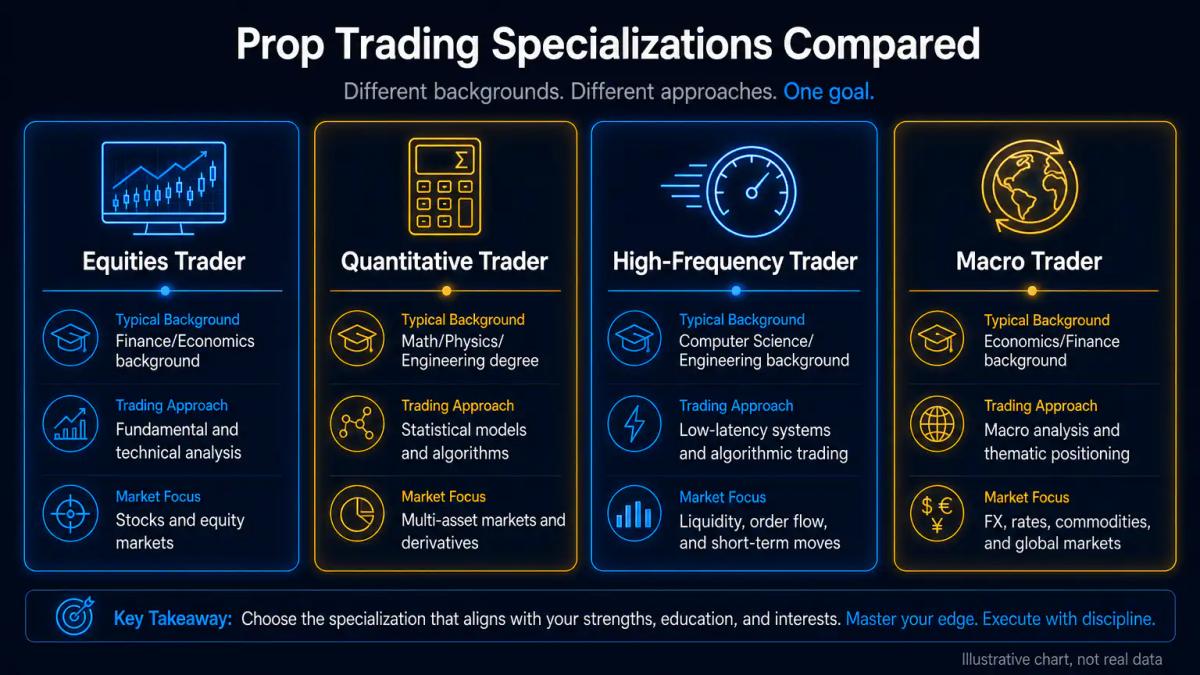
Proprietary trading jobs split into a handful of tracks, and the entry route depends on your background.
- Equities traders often come from finance or economics degrees.
- Quantitative traders, people who build statistical models to find trading edges, usually hold advanced degrees in mathematics, physics or engineering.
- High-frequency roles demand strong coding and low-latency systems knowledge.
| Role | Typical background | Trading style |
|---|---|---|
| Equities trader | Finance, economics | Discretionary, intraday |
| Quantitative trader | Maths, physics, statistics | Model-driven, systematic |
| High-frequency trader | Computer science, engineering | Automated, microsecond |
| Options trader | Finance, maths | Volatility, spreads |
| Algorithmic trader | Computer science, quant finance | Rule-based, automated |
Compensation, profit splits, and earning potential
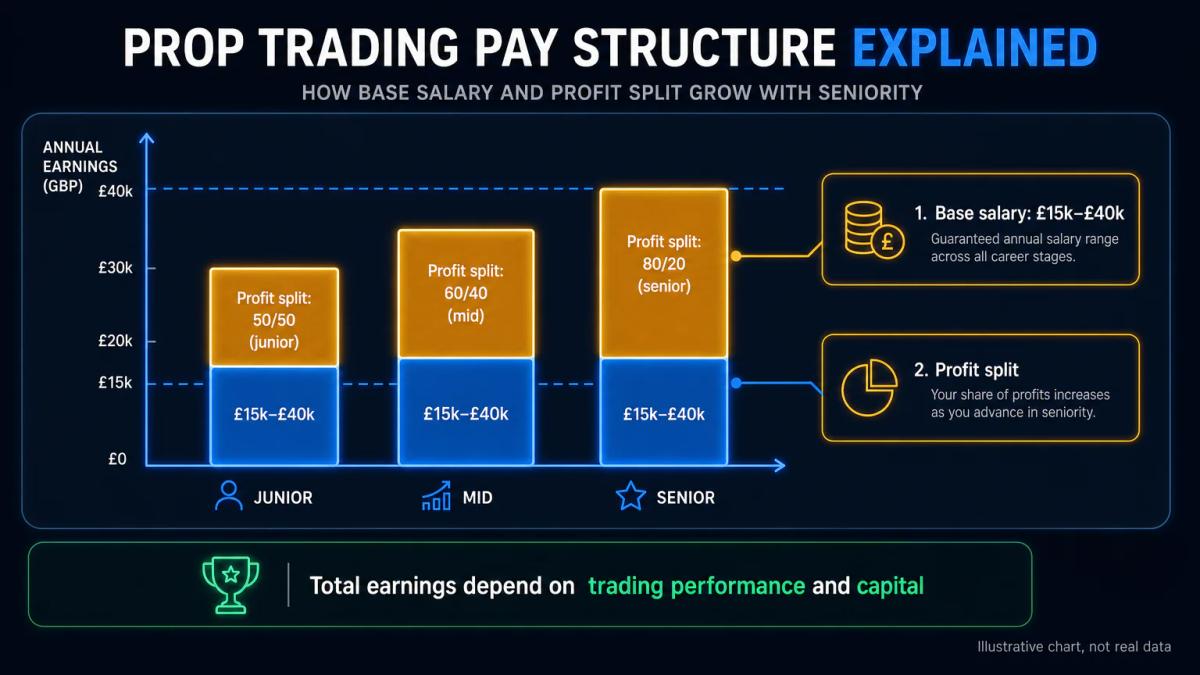
Prop firm jobs pay through a modest base and a profit split.
In the UK, base salaries for junior traders often sit in a £15,000 to £40,000 range, with a profit split, the percentage of your net trading profit you keep, that runs from 50/50 to 80/20 in your favour as you build a track record.
Understanding what a 100K funded trading account entails can give you a sense of the capital and profit expectations at larger firms.
Top performers at established firms can reach six figures; first-year traders often earn less until they prove consistency.
Losses are important: most firms enforce a drawdown limit, a maximum peak-to-trough fall in your account, and hitting it can reduce your payout or suspend your trading entirely.
Educational requirements and certifications
Most prop firms do not require a specific degree, though many prefer candidates with a background in finance, mathematics, engineering or computer science. Certifications such as the CFA, Chartered Financial Analyst, the FRM, Financial Risk Manager, or the US Series 7 licence can strengthen an application, but none are mandatory outside regulated bank desks.
Some firms run in-house training programmes for promising candidates without formal credentials, screening on aptitude tests and simulated trading instead. What weighs more than a degree: evidence of consistent trading performance, disciplined risk management, and the ability to learn quickly under time pressure.
Hiring process, interviews, and what firms look for
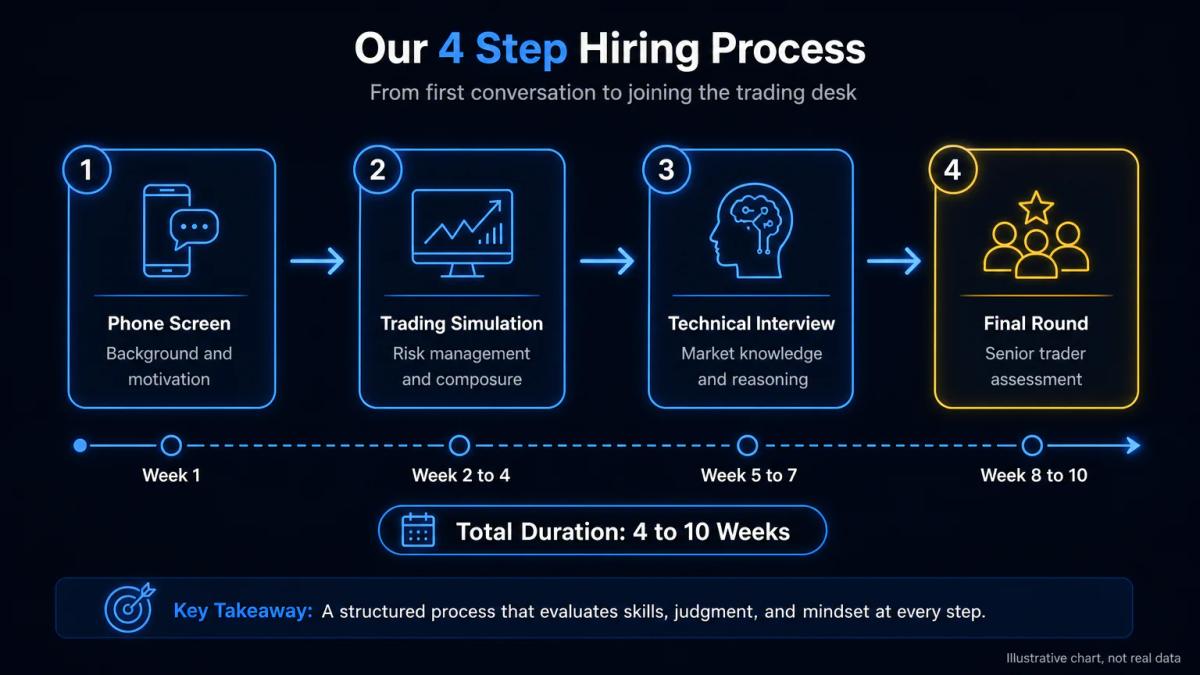
The typical hiring pipeline runs through four stages: a phone screen, a trading simulation or aptitude test, a technical interview, and a final round with senior traders or partners. The whole process usually takes 4 to 10 weeks.
Firms assess three things:
- Your ability to manage risk.
- Your composure under pressure.
- How you adapt when markets turn against you.
Many run a trading challenge, giving you a small simulated account with profit targets and drawdown limits. The interview questions probe your reasoning on past trades: what you did, why, and what you would change.
Recognizing analysis paralysis in trading and how to overcome it can help you demonstrate clear decision-making in these high-pressure moments.
Work-life balance, hours, and lifestyle realities
Prop trading hours track the market you cover.
Equities traders work roughly 8am to 5pm around the London or New York session; high-frequency and crypto traders often keep longer or irregular shifts. The mental load is the real cost: daily profit-and-loss swings, monthly targets, and drawdown thresholds that end careers if breached.
Burnout is common within the first 2 to 3 years for traders who do not manage stress deliberately. Work-life balance is rarely a strength of the role, especially in year one, when you are still proving you belong.
Career progression and exit opportunities after prop trading
Advancement inside a prop firm typically moves from junior trader to senior trader to portfolio manager, with each step bringing larger capital allocation and, often, responsibility for mentoring newer staff. Exit routes include hedge fund seats, investment banking desks, quantitative research roles, or launching your own fund once you have a documented track record.
The transferable skills, risk discipline and market intuition, are valued across finance. The counterweight: a resume gap after leaving prop trading can make re-entry into traditional finance harder, so most traders plan their exit while still on the desk.
How to prepare and increase your chances of landing a role
Build a real track record before you apply. Paper trade, simulated trading with no real money, or trade a small live account for at least 6 to 12 months, keeping a written journal of every position, thesis and outcome. Firms want to see consistent profitability and, more importantly, disciplined risk management.
Understanding how many trades per day you should make helps you develop a sustainable trading frequency that aligns with your strategy.
Study the specific firm before the interview: its strategy, asset classes and public trading philosophy. Network with current or former traders. Practise trading simulations and mock interviews. Read on market microstructure, how orders actually match and prices form, and order flow.
When you are ready to explore opportunities, you can compare prop firms to find one that matches your trading style and goals. Preparation, more than pedigree, is what separates the shortlist.
Frequently Asked Questions
Do you need a finance degree to get a prop trading job?
No. Most prop firms do not require a specific degree; they prefer backgrounds in finance, maths, engineering or computer science, but they hire on aptitude tests, simulated trading results and a documented track record. Bank prop desks are stricter and typically expect a relevant degree plus regulated qualifications.
How much can you earn as a prop trader in the first year?
Junior UK prop traders often earn a base of £15,000 to £40,000 in year one, with limited profit split until they prove consistency. Total pay in the first year usually stays below the base plus a small performance bonus; six-figure earnings typically come after two or three profitable years on a live book.
What is the difference between a prop trading job and retail trading?
In a prop trading job you trade the firm's capital, share the profits on a defined split, and operate under formal risk limits set by a risk manager. In retail trading you fund your own account, keep all profit and loss, and set your own rules. Prop trading offers larger capital and infrastructure; retail trading offers autonomy.
How long does the prop trading hiring process typically take?
From application to offer, expect 4 to 10 weeks at most firms. The pipeline usually covers a phone screen, an aptitude or trading simulation test, one or two technical interviews, and a final round with senior traders. High-frequency and quant roles can run longer because of coding assessments.
What happens if you lose money as a prop trader?
Losses reduce your profit share, and most firms enforce a drawdown limit, a maximum peak-to-trough fall in your allocated capital. Hitting the limit usually suspends your trading until a review; repeated breaches can end the contract. Small drawdowns within limits are treated as part of the job, not a firing offence.
About the authors


Put this into practice
Prop firms we have reviewed
Scored on the same five dimensions, with the rules that decide payouts. Here are three — the full list is on the prop firms page.



Related articles

Prop firms that use TradingView: a trader's guide to platforms and accounts
A plain-English guide to prop firms that support TradingView charting, covering integration, challenge terms, regulation and risk management.

Same Day Payout Prop Firm: How Fast Withdrawals Actually Work
A plain-English guide to same day payout prop firms: profit splits, drawdown rules, withdrawal methods, tax reporting and the checks to run before you fund an account.

The Prop Firm Industry Is Overdue for a Shakeout - Here's What Comes Next
The prop firm model is under pressure. Here is what the industry shakeout means for funded traders and how to stay ahead of it.
0 comments