



Prop Trading · Beginner · 6 min read
100K Funded Trading Account: What You Get and What It Costs
What a 100K funded account actually is
A 100K account is $100,000 of trading capital provided by a proprietary trading firm, or prop firm: a company that funds retail traders in exchange for a share of profits. You can compare different prop firms to understand the market landscape.
Typically, it works like this: You pay an upfront fee to access it, keep a percentage of any profits you generate, and trade under strict rules on drawdown and position sizing.
The capital belongs to the firm rather than to you, so instead of depositing $100,000 you simply pay a much smaller entry fee. In return, you trade a demo-style account that mirrors live pricing while the firm hedges or copies your positions internally, and a drawdown, the fall from a capital peak to the lowest point before a new peak, that breaches a preset limit will close the account.
To trade with a firm's capital, compare the best prop firms and how their evaluations work.
How much does a 100K account cost to access
Entry fees for a 100K funded account usually sit between £150 and £400, depending on the firm and the pricing model, and two structures dominate the market today.
In the challenge model, you pay a one-off fee, often £400 to £600 on refundable plans, to prove your skills on a demo, then receive the funded account after passing one or two phases. Instant funding works differently, asking for a higher upfront fee in exchange for skipping the evaluation altogether, though the profit split and drawdown terms tend to be tighter as a result.
By contrast, a 50K funded account typically costs between £80 and £250. If you are asking how much is a 50K funded account, the honest answer is roughly half the 100K price, with proportionally smaller profit potential per pip, the smallest standard price move in a currency pair. Doubling the fee for double the capital only pays off if your win rate justifies the larger position size.
Profit splits and payout mechanics
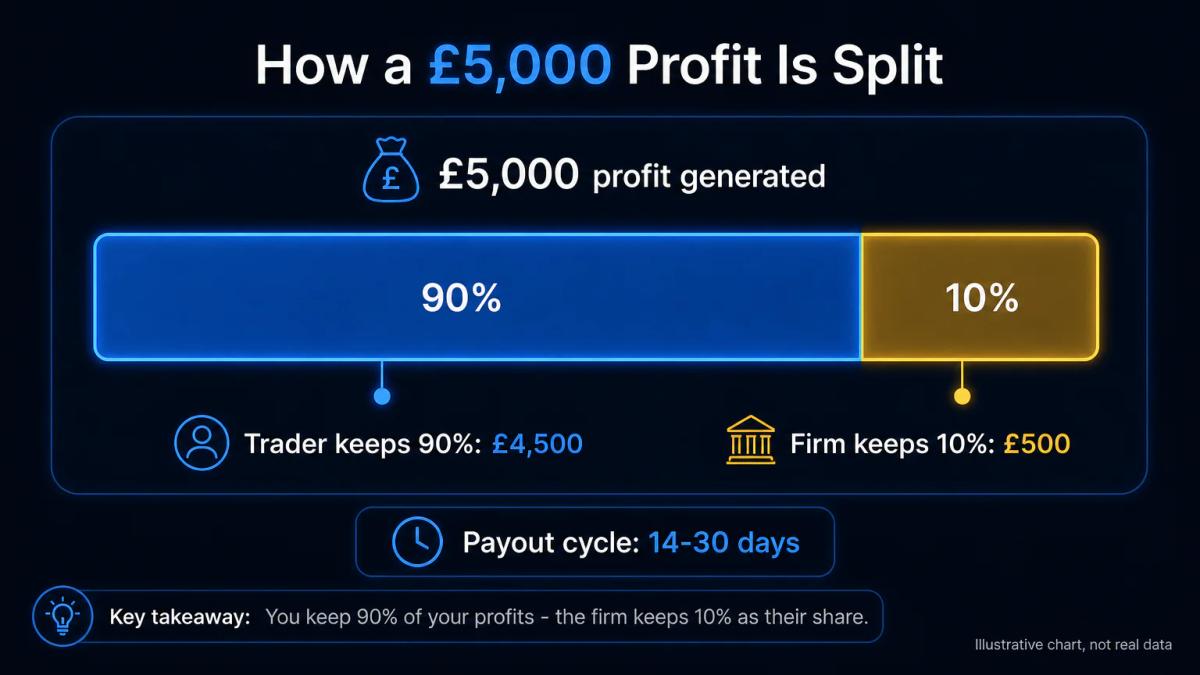
Most prop firms offer profit splits between 50% and 90% in the trader's favour on a 100K account.
On a 90/10 split, if you make $5,000 in a payout cycle you keep $4,500. Payouts are processed on a fixed calendar, usually every 14 days or every 30 days, with some firms allowing on-demand withdrawals after a minimum trading period of five to fourteen days.
Withdrawal times range from same-day via wire, Rise or crypto rails to five business days for bank transfers in unusual currencies, and firms typically impose a minimum profit threshold of around 1% of the account balance before releasing the first payout. It pays to read the payout clause literally, because a firm quoting a 90% split sometimes calibrates it only after a scaling milestone and starts you closer to 70% in the early cycles.
Trading rules and risk limits you need to know
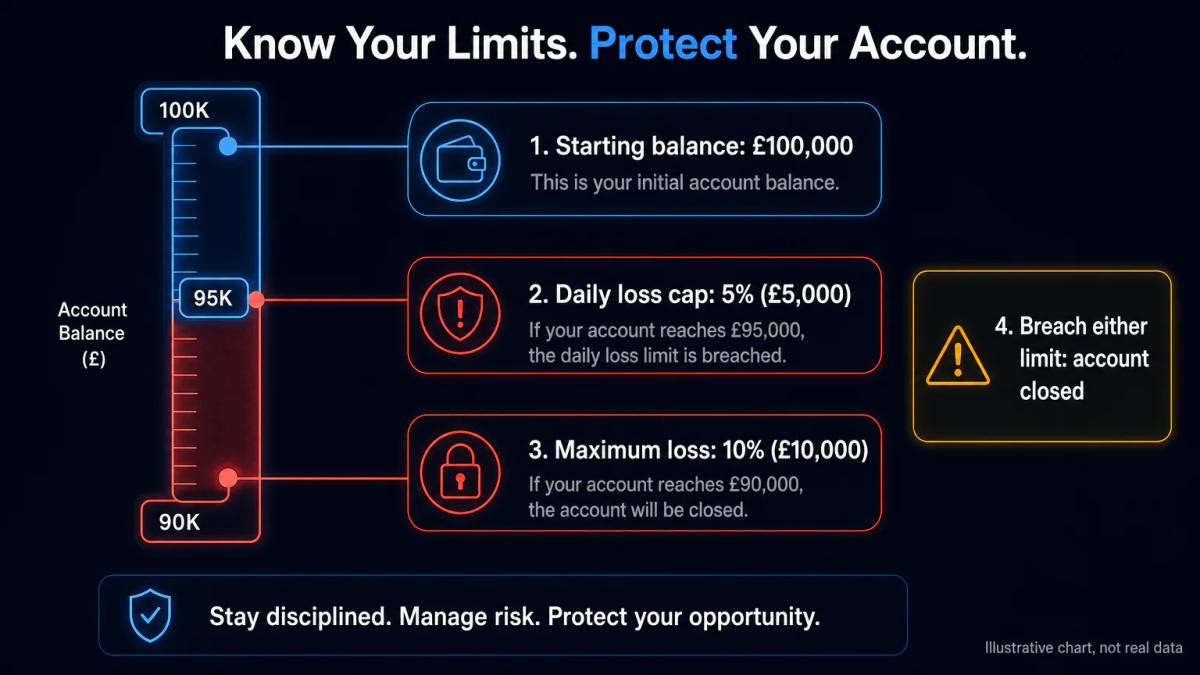
A 100K account comes with hard risk limits: the daily loss cap is typically 5%, or $5,000, and the overall maximum loss is 10%, or $10,000, with a breach of either closing the account and leaving no room for appeal. Some firms measure drawdown from the starting balance, known as static, while others measure it from the peak equity, known as trailing, which is stricter because your safety cushion shrinks as you profit.
Leverage on a 100K account usually caps at 1:100 for major forex pairs and lower on indices, well below what an unregulated retail broker offers but well above the FCA leverage caps that apply to a UK retail client at a regulated broker: 1:30 on major forex, 1:20 on indices, 1:5 on equities, with CFDs on crypto prohibited for UK retail. Most firms exclude crypto entirely and restrict trading around high-impact news releases such as CPI or non-farm payrolls.
On the psychology side, the two mistakes that close 100K accounts fastest are oversizing after a losing streak and violating news-event rules by accident.
Understanding types of trading and position discipline, risking no more than 0.5% to 1% per trade, is the single habit that separates traders who receive payouts from traders who reset.
Platforms, tools, and support included
Most 100K accounts run on MT4, MT5, cTrader, or a proprietary web platform. If you prefer TradingView, you can review prop firms that use TradingView to find compatible options. You get live institutional pricing, a dedicated dashboard showing daily and overall drawdown in real time, and access to a trader community on Discord or Slack. VPS hosting, a remote server that runs your platform 24/7 to reduce latency, is sometimes free above the 100K tier and sometimes billed at $30 to $60 per month.
Tax and regulation: what changes by jurisdiction
Prop trading income is treated differently across jurisdictions.
- In the UK, HMRC generally treats prop firm payouts as self-employment or miscellaneous income rather than capital gains, because you are trading the firm's capital under a contract.
- In the US, the IRS typically treats it as self-employment income subject to self-employment tax.
Keep every payout invoice and every fee receipt: fees paid for challenges are usually deductible against the resulting income. Understanding the difference between taxable brokerage accounts and prop trading structures helps you plan your tax obligations.
Regulation of prop firms themselves remains thin, since most are structured outside the FCA and ESMA perimeters on the basis that clients trade a demo rather than real money, which means the consumer protection rules for CFD brokers simply do not apply, and if the firm fails, there is no compensation scheme to fall back on.
Alternatives if a 100K account does not fit your needs
Smaller accounts remain the practical starting point for most beginners.
A 50K funded account halves the entry fee and eases the psychological pressure of a $5,000 daily loss limit, while a 25K account trims both figures further still. Traders who fail a 100K evaluation twice will often pass a 25K on the third attempt and scale up from there.
Scaling matters just as much as the starting size. Most firms increase your allocated capital by 25% every three or four months you hit profit targets without breaching drawdown, so a disciplined 25K trader can reach 200K or 400K within twelve to eighteen months. You can also explore trading stocks and ETFs under a funded account as an alternative to forex and futures.
Trading your own capital at an FCA-authorised retail broker offers a different path entirely, where there is no profit split to share but every loss lands on you directly and leverage is capped at the FCA levels above.
HMRC: Income from trading activity carried out on behalf of a third party under contract is generally taxable as trading or miscellaneous income, not as capital gains.
This content is general information and not advice: every situation needs checking with a licensed professional in the relevant jurisdiction.
Frequently Asked Questions
What is the difference between a 50K and 100K funded trading account?
The 100K account gives you twice the capital and roughly twice the profit potential per trade, but costs about twice as much (£150 to £400 versus £80 to £250) and enforces a bigger absolute daily loss cap ($5,000 versus $2,500). Profit splits, drawdown percentages and trading rules are usually identical between the two sizes at the same firm.
Can you lose money on a 100K funded account, or is the firm's capital protected?
You only ever risk the entry fee you paid, not the $100,000. The account is a demo mirrored against the firm's own book; if you hit the maximum drawdown, the firm closes it and absorbs the paper loss. You are not liable for the shortfall, but you also do not get the entry fee back unless the firm advertises a refund on first payout.
How long does it take to receive your first payout from a 100K account?
Most firms require a minimum trading period of five to fourteen days and a minimum profit threshold, typically 1% of the balance, before releasing the first payout. Once approved, wire transfers usually clear in one to five business days, while crypto and Rise transfers often settle the same day.
Are there tax implications I should know about when trading a 100K funded account?
Yes. In the UK, HMRC generally treats prop firm payouts as trading or miscellaneous income, not capital gains, so income tax and possibly National Insurance apply. In the US, the IRS typically treats it as self-employment income. Challenge fees, VPS costs and platform subscriptions are usually deductible against that income. Confirm with a qualified accountant for your jurisdiction.
What happens to your 100K account if you hit the maximum drawdown limit?
The account closes immediately, all open positions are flattened, and access is revoked. Most firms offer a paid reset (usually 20% to 50% of the original fee) that restores the account to its starting balance and resets the drawdown clock. Some firms allow only one reset per account; others offer unlimited resets during a promotional window.
About the authors


Put this into practice
Prop firms we have reviewed
Scored on the same five dimensions, with the rules that decide payouts. Here are three — the full list is on the prop firms page.


Related articles

Best Prop Firm Forex EAs: Rules, Platforms and Real Performance
A working guide to choosing forex EAs for funded accounts: rulebooks, VPS setup, backtest hygiene, cost trade-offs and the risk parameters that keep you funded.

Can You Transfer a Funded Account to Someone Else? The Honest Answer
Funded accounts are personal licences issued under KYC rules. You cannot sell, gift, or reassign one, and attempting to do so voids the agreement and the profits.

EA Prop Trading: How Automated Systems Work in Funded Accounts
A practical guide to running Expert Advisors on prop firm accounts: rules, MT5 configuration, backtesting, instruments, fees, tax, and pitfalls.
0 comments