



Prop Trading · Intermediate · 9 min read
Can You Transfer a Funded Account to Someone Else? The Honest Answer
The short answer: most funded accounts cannot be transferred
Across almost every prop trading programme, the funded account you earn is yours alone to trade. It is issued in your name after identity verification and a signed contract that lists you as the only authorised trader, which means reassigning it, selling it, or handing the keyboard to another person all qualify as a direct breach of that contract and will be treated as such by the firm.
The reasoning behind this restriction is structural rather than administrative. Think of a funded account as a trading licence tied to a specific individual, closer in character to a professional credential than to a balance you might hand across. The prop firm underwrites the risk against your verified identity, your evaluation results and your signed consent to the rulebook, so when someone else sits at the keyboard, the assumptions behind that underwriting fall apart, and the firm has grounds to close the account and withhold any payout owed. Occasional exceptions do exist, although they are rare, documented in writing, and granted at the firm's sole discretion.
If a funded account is your goal, our roundup of the best prop firms is the place to start.
Why prop firms lock accounts to individual traders
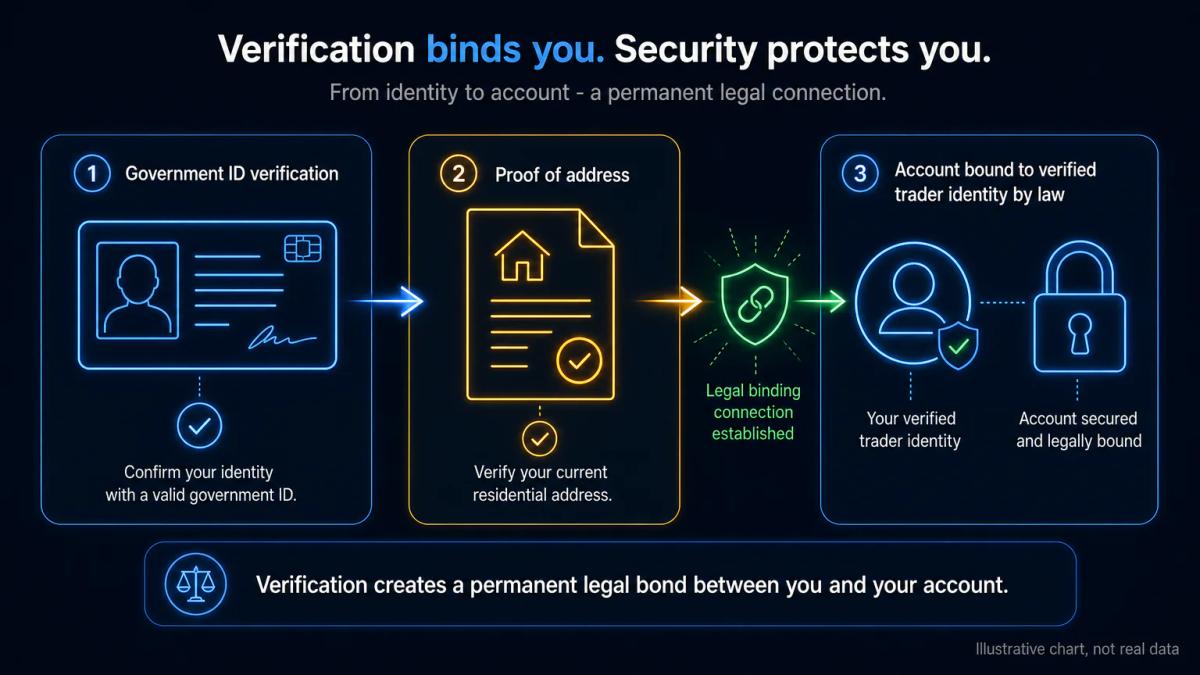
Prop trading firms operate under know-your-customer (KYC) and anti-money-laundering (AML) obligations that apply to any business holding or routing client-linked funds. KYC is the process of verifying a client's identity with government ID, proof of address and sometimes a selfie or video check, while AML rules force firms to monitor who is actually using an account and to report suspicious activity. Once the firm has your file, the account becomes legally bound to that file, regardless of any informal preference either side might have.
That binding is why a quiet handover tends to be treated as fraud rather than as a harmless courtesy. When the person trading the account differs from the person on file, the firm cannot answer basic regulatory questions about the source of funds, the beneficial owner or the trader's suitability. Payouts to a bank account in a different name are a separate red flag that compliance teams filter automatically.
The firm also priced your challenge fee and your profit split against the risk profile it measured during your evaluation. A second trader with different habits, a different drawdown tolerance and a different edge would represent an unmeasured risk the firm never agreed to carry. Locking the account to one named trader keeps the risk model honest and the regulators satisfied.
What the account agreement actually says
The trader agreement is the document that settles the question. Across the major prop firms, the clauses that govern transfer and delegation share the same four points:
- You are the sole authorised user of the login credentials and must not share them.
- You may not sell, assign, gift, lease or sub-licence the account or any rights attached to it.
- You may not allow a third party, including a family member or a signal provider, to place orders on your behalf.
- Breach of any of the above voids the account, cancels pending payouts and forfeits the challenge fee.
The language varies in tone across firms, though the substance stays consistent. Some firms add explicit bans on copy-trading from another funded account, on virtual private server (VPS) access shared with other traders, and on the use of mirror software that routes signals from a third party. A VPS is a remote server traders rent to run automated strategies without keeping their home computer on. The clause is usually drafted broadly so that any arrangement where the registered trader is not the decision-maker falls inside the prohibition. Reading your own contract before you ask about a transfer saves time, because the answer is already written there.
What happens if you try to transfer or share your account
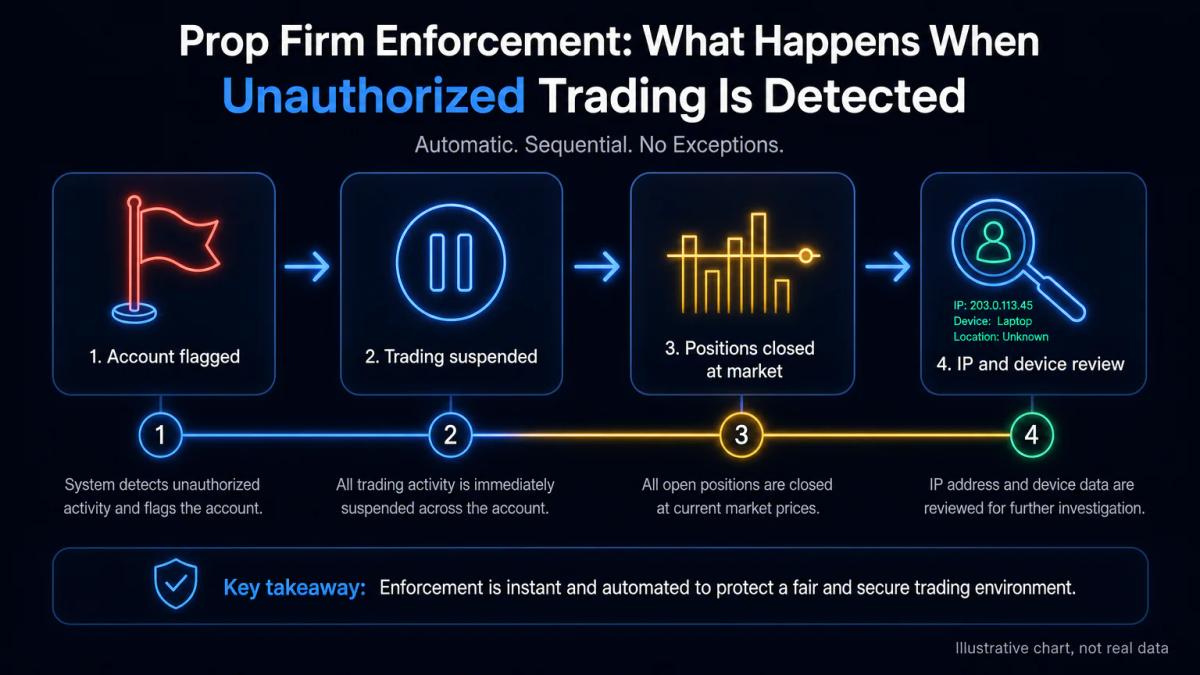
If a prop firm detects that someone other than you is trading, the response is sequential and well rehearsed. The account is flagged, trading is suspended within hours, open positions are closed at market, and an internal review begins. The review looks at login IP addresses, device fingerprints, timing patterns, order sizes and any communications in the firm's support channels. Compliance teams have seen every version of the story and do not need a confession to act.
The outcomes follow a predictable sequence:
- The account is terminated under the breach clause.
- Any unpaid profit split is voided, including profits already requested but not yet wired.
- The challenge fee is not refunded.
- Your name is added to an internal watchlist that blocks future applications under the same identity, address or payment method.
- In serious cases, especially where the second trader was paid, the firm reports the activity under its AML obligations.
Whoever tried to sell a funded account walks away without the money, while the buyer loses the fee paid to the seller and never gains access to anything that would survive compliance, so both sides come out of the arrangement worse than they started. Firms also share breach data informally, which means a ban at one programme often shortens the welcome at the next, and the so-called secondary market for funded accounts is overwhelmingly a space where scammers operate rather than a place where legitimate traders transact.
Legitimate alternatives if you want someone else to trade
If another person wants to trade with firm capital, the only clean route is for that person to apply for their own funded account. The evaluation fee is modest compared to the cost of a breach, and the new trader builds their own track record under their own name, which is the asset that pays out in the long run.
Several intermediate structures are sometimes proposed. Most of them do not survive contact with a prop firm's rulebook. Here is how the common ones compare:
| Arrangement | What it is | Typical prop firm stance |
|---|---|---|
| Account transfer | Reassigning the account to a new named holder | Not permitted; account is personal |
| Selling a funded account | Handing over credentials for a fee | Prohibited; terminates the account |
| Power of attorney | Legal document authorising another to trade | Rejected by most firms; the contract names you alone |
| Copy trading from a master | Automatic mirroring between accounts | Case by case; often banned when the master is external |
| Team account under one name | Multiple traders sharing one login | Prohibited; only the named trader may place orders |
| New funded account per trader | Each person passes their own evaluation | Fully compliant; the intended route |
A genuine trading partnership is structured outside the funded account. The partners agree in writing on how to split profits withdrawn from their individual accounts, each trades only their own account, and the shared capital, if any, sits in a jointly owned bank account where both names appear on the KYC file of the bank itself rather than of the prop firm. That design keeps every account inside its own rulebook and leaves the partnership as a private contract between adults, which is where such arrangements belong.
How to close your account and help someone else start fresh
If you want to step back and let a friend or family member take the opportunity, the cleanest sequence is straightforward:
- Flatten all open positions and let settlement complete.
- Request the final payout under the firm's standard payout schedule.
- Confirm the withdrawal has landed in your verified bank account.
- Email support to close the account on record, keeping the confirmation.
- Have the other person register, pay the evaluation fee under their own identity, and start their own challenge.
No shortcut preserves the capital allocation for the next person. The allocation ends when you close the account, and the new trader earns a fresh one by passing the evaluation on their own merits. What you can hand over, legitimately and valuably, is your accumulated knowledge, which typically includes:
- your risk rules
- your journal
- your post-mortems
- your watchlists
That handover costs nothing, breaks no contract, and gives the next trader a real head start.
Red flags: account transfer scams and what to avoid
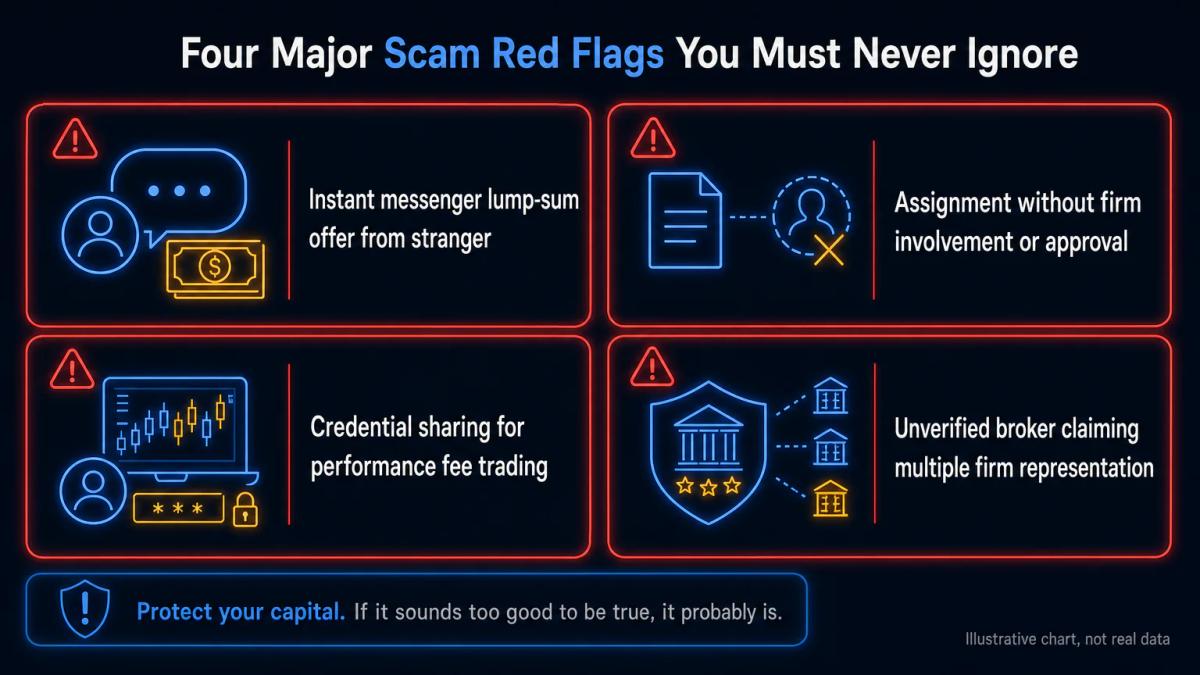
The secondary market for funded accounts runs on fraud, and it uses a short list of recognisable tactics. Treat any of the following as a stop sign:
- A stranger offers to buy your funded account for a lump sum via instant messenger.
- A seller claims to assign a funded account to you after a wire transfer, with no involvement from the firm.
- A service promises to trade your account for a performance fee using your credentials.
- A broker-of-brokers claims to represent several prop firms and can arrange a transfer for a commission.
- A social media profile shows screenshots of balances and offers to split profits if you fund the challenge fee.
Legitimate prop firms will not facilitate transfers, will not endorse third-party traders operating on your account, and tend to avoid private messengers entirely for anything official. Their support addresses are published on their own domains, their payout flows run through verified bank channels, and their compliance teams answer in writing. Should a counterparty insist on speed, secrecy or payment in cryptocurrency to an unfamiliar wallet, you can safely assume the transaction is a scam, and the only outcome is a lost deposit.
Imagine you are offered £2,000 to let a stranger trade your £50,000 funded account for a month. Should the firm detect the breach, your account would be closed, the pending payout you were counting on, say £1,500, would be voided, and the challenge fee you paid, perhaps £300, would not be refunded. You would end the month down £1,800 against the £2,000 you had been promised, and the buyer, unsurprisingly, would have disappeared.
Key takeaway: account ownership is non-transferable
A funded account is a personal trading licence issued to one verified individual under KYC and AML rules, backed by a signed contract that names only that person. It cannot be sold, gifted, leased or reassigned, and firms will almost never grant an exception. If another trader wants firm capital, the clean path is for them to apply for their own account; and if you want to step away, the clean path is to withdraw your profits, close the account on record, and pass along your knowledge rather than your login.
To compare these rules with a real firm's, the FunderPro review lays them out.
Frequently Asked Questions
Can I sell my funded trading account to someone else?
No. The trader agreement names you as the sole authorised user, and any sale, assignment or sub-licence of the account is an explicit breach that terminates the account and forfeits any pending payout. There is no legitimate secondary market for funded accounts.
What happens if I let someone else trade my funded account?
The firm's compliance team can detect it from IP addresses, device fingerprints and trading patterns. Once flagged, the account is suspended, open positions are closed, profits are voided and your identity is added to a watchlist that blocks future applications.
Is there a legal way to transfer a prop trading account?
In practice, no. KYC and AML obligations force the firm to tie the account to the verified individual on file. The only compliant path is to close your account, withdraw your profits, and have the other person apply for their own funded account from scratch.
Can I use power of attorney to let someone trade my funded account?
Most prop firms reject power of attorney for funded accounts. The contract specifies that only the named trader may place orders, and a notarised document does not override that clause. A handful of firms consider case-by-case exceptions, but approval is rare and never automatic.
What should I do if I want to stop trading and give my account to a friend?
Flatten positions, request your final payout, confirm it has settled, and close the account on record. Then have your friend register under their own identity and pay their own evaluation fee. You can hand over your journal and rules, but not the account itself.
About the authors


Put this into practice
Prop firms we have reviewed
Scored on the same five dimensions, with the rules that decide payouts. Here are three — the full list is on the prop firms page.



Related articles

EA Prop Trading: How Automated Systems Work in Funded Accounts
A practical guide to running Expert Advisors on prop firm accounts: rules, MT5 configuration, backtesting, instruments, fees, tax, and pitfalls.

Failed a Prop Firm Challenge? What to Do Next
A practical recovery plan after a failed prop firm evaluation: identify the breach, cost the retry, test the fix and choose the right firm for your next attempt.

Forex Prop Firms for US Traders: CFTC Rules, Capital Tiers and Payouts
A plain-English guide to how forex prop firms serve US traders: CFTC leverage caps, NFA registration, evaluation challenges, drawdown rules and tax reporting.
0 comments