



Prop Trading · Intermediate · 13 min read
Failed a Prop Firm Challenge? What to Do Next
Understanding why your challenge failed and what comes next
Failing a prop firm challenge usually comes down to one of three triggers: hitting a daily loss limit, exceeding a maximum drawdown, or missing the profit target inside the allotted window. The underlying cause tends to involve position sizing errors or emotional decisions under pressure rather than a shortfall in market understanding. Once you know which rule you broke and the reasoning behind the breach, you can judge whether a retry with the same firm is sensible, whether another firm would suit your style better, or whether your whole approach needs rebuilding before another fee leaves your account.
Treat a failed evaluation as a single data point rather than a verdict on your ability. Prop firm challenges are structured as capital allocation filters, with rules designed to screen out traders who cannot keep risk inside a defined envelope, because that envelope is what protects the firm's own capital once you are funded. When your approach survives on a personal account but comes apart inside the challenge box, the explanation is usually a mismatch between your style and the rule set rather than any shortage of raw skill.
The rest of this article walks through the sequence that converts a loss into a usable plan: reading your trade log, splitting technical errors from psychological ones, pricing the next attempt honestly, validating the fix on a smaller scale, comparing the specific rules at different firms, considering non-challenge routes to funded trading, and writing a comeback plan a peer can hold you to. Every stage has one job, which is to make sure that the next challenge fee you pay buys you a tested change rather than a repeat of the last attempt.
If a funded account is your goal, our roundup of the best prop firms is the place to start.
Analyze your trading logs and identify the breaking point

Pull the complete trade history for the challenge period from your broker or platform (MT4, MT5, cTrader, or the firm's dashboard) and map every trade against the three rules that end most evaluations:
- The daily loss limit
- The maximum drawdown threshold
- The profit target
Mark the exact trade or sequence that triggered the failure, then work backward three to five trades earlier, because the breach is almost never the first mistake. It is the final consequence of a chain that started with a decision made under worse conditions than you noticed at the time.
For each trade in that chain, write down four things: the entry reason, the position size as a percentage of starting balance, the planned stop loss distance in pips (a pip is the smallest standard price move in a currency pair, typically the fourth decimal), and the actual exit. A pattern usually appears within ten minutes of honest review, and it tends to fall into one of a handful of recognisable shapes:
- Size kept creeping up after a winning trade.
- The stop loss widened on the third trade of the day.
- Trades were taken outside the planned session.
- The exit was manual rather than at the stop.
A simple log structure forces the pattern into view:
| Trade field | What to record | Why it reveals the breach |
|---|---|---|
| Entry time | Hour and session | Shows if you traded outside your plan |
| Position size | % of account | Reveals size drift after wins or losses |
| Stop distance | Pips, planned vs actual | Flags discipline on stops |
| Reason for entry | Setup name or 'none' | Isolates impulse trades |
| Exit type | Stop, target, manual | Separates plan from reaction |
Suppose your account hit the daily loss limit on a Thursday after four trades. The log shows trades one and two followed your plan, trade three doubled the size after a small loss, and trade four was a reversal trade with no setup, taken 20 minutes after trade three closed. The breach is on trade four, but the decision that caused it is on trade three.
Separate technical mistakes from psychological ones
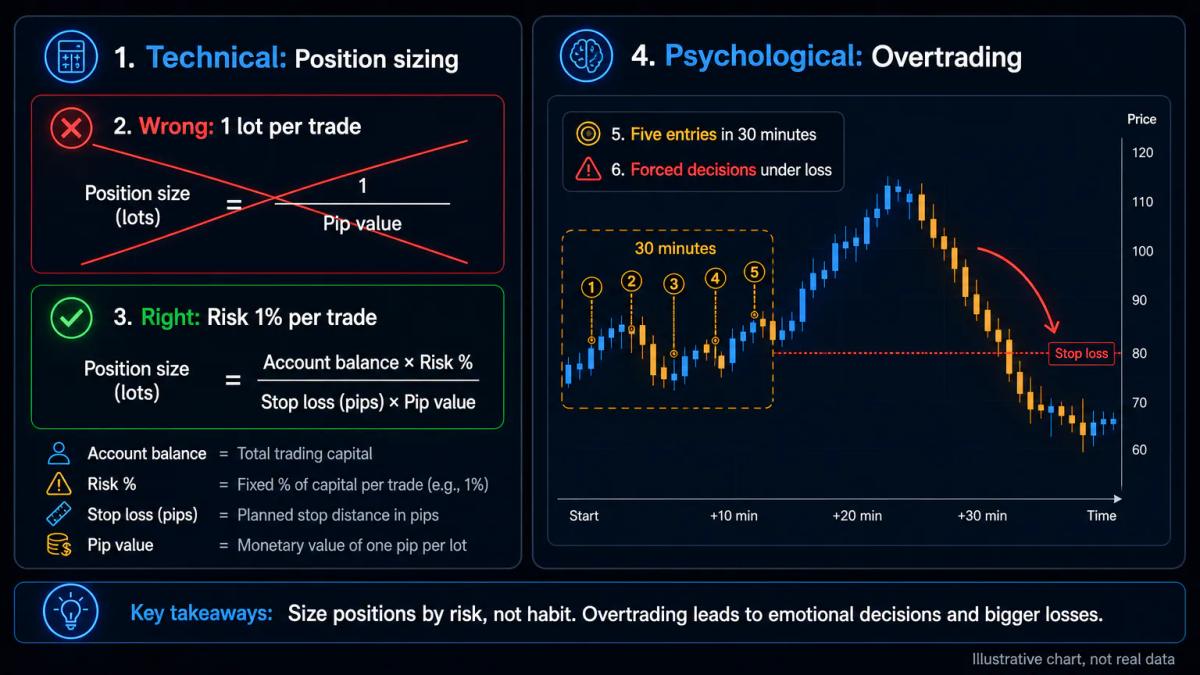
Technical mistakes carry a math or process signature, and they usually show up in one of a few recognisable forms:
- Position sizing was off because the pip value calculation ignored the account currency conversion.
- The stop loss sat inside a visible support or resistance zone, so normal noise took it out.
- The entry triggered outside the setup you had defined in writing.
These errors are fixable with a checklist and a position size calculator, since the underlying problem is a knowledge or workflow gap rather than something behavioural.
Psychological mistakes carry a behavioural signature, and they also tend to follow a few familiar patterns:
- Revenge trading appears as a sudden size increase or a shortened setup filter right after a loss.
- Hope trading appears as a stop loss that was moved further away, or removed entirely, once price went against the position.
- Discipline collapse appears as trades taken outside planned hours, outside planned instruments, or in a session you had already decided to close.
A new indicator will not solve any of these. The fix is rules that remove the choice in the moment, such as a hard daily trade count or a platform that locks after a loss threshold.
To split the two cleanly, go through the chain of trades identified in the previous step and tag each decision with one label:
- Technical: a rule existed, you tried to follow it, the execution or the math was wrong.
- Psychological: a rule existed, you knew it, and you chose to override it.
- Missing rule: no rule existed for that situation, so you improvised.
The third tag is the one most traders miss. A missing rule looks like a psychological failure because the decision was ad hoc, but the fix belongs with technical work: write the rule that was absent, add it to the plan, and the override question disappears next time. Mixing the three labels together is why the same breach repeats across challenges.
Calculate the cost and decide whether to retry
Price the full cost of a retry before you decide, going well beyond the headline challenge fee. The fee itself typically sits in a wide range across the industry, and a second attempt usually comes with the same price unless the firm offers a specific reset at a discount. Add the time cost, since an evaluation runs for a defined number of days during which you cannot trade a personal account the same way, and factor in the opportunity cost of all those hours spent preparing, journaling and reviewing. The real question is whether the fix you have identified is strong enough to justify every one of those costs on the next attempt.
A practical test is to score your fix on three dimensions before paying:
- Specificity: can you describe the fix in one sentence that names the exact rule you will add or change?
- Testability: can you run the fix on 20 to 50 trades in demo or a small live account and see a measurable result?
- Robustness: does the fix hold when you imagine the hardest day of the failed challenge replayed with the new rule in place?
If any one of the three dimensions is weak, the retry is premature. A vague fix will fail the first test, which is the category covering resolutions like 'trade smaller' or 'stay calm'. If you cannot measure it in a sample of trades, it fails the second. And a fix that holds up on an average day but collapses on the worst one fails the third, which happens to be the day that ended the last challenge.
Imagine you failed because your position size was 2% per trade and three correlated losses in a row breached the daily loss limit. A specific fix is: cap size at 1% per trade and stop trading for the day after two consecutive losses. That rule is testable in 30 trades and holds on a bad day because the second loss ends the session before a third can occur.
Rebuild your confidence with a smaller-scale test
Before spending another challenge fee, trade a demo account or a small personal live account under the exact rules of the failed challenge: same daily loss limit as a percentage, same maximum drawdown, same profit target, same minimum trading days. The aim here is less about proving you can win and more about confirming that the specific fix identified earlier survives contact with real decisions. Run 20 to 50 trades under those rules, which is enough to show whether the problem rule gets triggered again under the new plan.
Keep the test honest with a short protocol:
- Trade the same instruments and sessions you plan to use in the real challenge.
- Record every trade with the five fields from the log table above.
- Mark any trade where you considered breaking the fix, even if you did not.
- End the test early if you breach the simulated daily loss limit or drawdown, and start it over only after a written review.
A small live account changes the test more than most traders expect. Demo trading with no money attached rarely reproduces the exact pressure that caused the original breach, because loss aversion is weaker when the loss is notional. If the budget allows, a live account of a size where a single stop loss costs the equivalent of a coffee, around $5 to $10, is enough to reintroduce the emotional component without risking a meaningful amount. The test passes when you hit the simulated profit target without breaching either loss rule, and when the behavioural tag count from the previous section drops close to zero across the sample.
Compare prop firms and their specific rules before your next attempt
Prop firms are not interchangeable, and the rule that ended your last challenge may be significantly looser or stricter at the next firm. The variables that differ across firms include:
- Daily loss limits
- Maximum drawdown thresholds
- Evaluation duration
- Profit target size
- Scaling plans
- Consistency rules
- Payout schedules
If your failure was triggered by a 4% daily loss limit on a volatile instrument, moving to a firm with a 5% limit or a trailing drawdown structured differently can change the probability of the same breach on identical trades.
The comparison that decides whether your plan survives has to happen at the rule level, going deeper than any marketing copy. Build a short table of three to five firms whose structure fits your style and your trading hours. The fields below are the ones that actually determine whether your plan survives inside the box:
| Rule field | Why it matters for a retry |
|---|---|
| Daily loss limit (%) | Sets the ceiling on a bad day; the single most common breach |
| Max drawdown (%) | Static or trailing changes risk completely |
| Drawdown type | Trailing from peak equity is tighter than static from start |
| Evaluation duration | A longer window reduces pressure to force trades |
| Profit target (%) | A high target forces size, a low target rewards patience |
| Minimum trading days | Can trap you into trading on days you would otherwise skip |
| Consistency rule | Caps the share of profit any single day can represent |
| News trading rules | Restricts a style some traders depend on |
| Instruments allowed | Determines whether your edge is even on the menu |
| Reset fee | The real cost of a second attempt after a breach |
Fill the table from each firm's official terms rather than from summaries elsewhere, because the clauses that end challenges usually sit buried in the detail. A firm that advertises a 5% daily loss limit but calculates it on starting balance behaves very differently from one that calculates it on previous day equity, and only the full rulebook makes that clear. When choosing where to retry, pick the firm whose rules fit your worst day, not just the ones that look comfortable on an average one.
Explore alternative funding routes if prop challenges stall
If two or more evaluations have ended on the same type of breach, the model itself may not fit your trading style, and the sensible move is to compare funded trading to the alternatives before paying a third fee. Trading your own capital, even a modest amount, removes the time pressure of an evaluation window and the hard daily loss limit, which are the two features that produce the most forced decisions. The trade-off is that returns scale with your own balance, so the capital efficiency of a funded account is lost.
The practical alternatives sit on a spectrum of cost, risk and ceiling:
- A personal live account with written risk rules: lowest external pressure, no fee cycle, but limited by your capital.
- A prop firm with an instant funding model: higher upfront cost, no evaluation, and usually tighter rules on the funded account.
- A longer evaluation at a firm with a lower profit target: reduces the pressure to force trades, at the cost of slower progression.
- A trading group or pooled account structure: shared capital and shared accountability, with shared drawdown too, and legal structure varies by jurisdiction.
Each route carries its own failure mode, and the point of comparing them is to pick the one whose weakness sits furthest from the behaviour that ended your last challenge, so the same problem does not reappear under a different label:
- A personal account can quietly erode discipline, since there is no external rule enforcing a stop.
- An instant funding product can feel like a shortcut, but the rules on the live account are often where traders break next.
- A pooled structure can expose you to decisions made by others, which adds a layer of risk you do not control.
Document your lessons and build a comeback plan
Write the comeback plan on a single page before anything else. It names the rule you broke on the failed evaluation, the trades that led to the breach, the single change you will make to prevent it, and the test that proves the change works. One page is enough because a plan longer than that becomes advice you no longer read. The point is to have a document you can hand to a trading peer or a mentor and ask one question: does this fix address the specific failure, or is it a general resolution.
A usable plan has these sections, in order:
- The breach: which rule ended the challenge, which trade triggered it, which earlier decision made that trade possible.
- The classification: technical, psychological, or missing rule, using the tags from the earlier log review.
- The fix: one sentence that names the new rule, the trigger that activates it, and the action it forces.
- The test: the sample size, the account type, and the pass criteria you will use before paying another fee.
- The firm choice: the specific firm and rule set you will retry at, with the reason tied to the fix.
- The abandon condition: the result that tells you to stop retrying challenges and pursue an alternative route.
The sixth section is the one most traders skip and the one that saves the most money. A pre-committed abandon condition, written when you are calm, prevents the sequence of attempts that drains thousands with no measurable progress. A reasonable condition is concrete: if the test from section four fails twice in a row, or if a retried challenge breaches on the same rule for a third time, the plan ends and the funds go into a personal account instead. A written plan with a stop condition is the difference between a failed evaluation that becomes a lesson and one that becomes a pattern.
To compare these rules with a real firm's, the Blueberry Funded review lays them out.
Frequently Asked Questions
Can you retry a prop firm challenge after failing it?
Yes, most prop firms allow you to retry a failed evaluation, either by paying the full fee again or by using a reset option at a discount when the firm offers one. The more useful question is whether a retry is a good idea at all. A retry only pays off once you have identified the specific rule that was breached, written down the exact change you will make to prevent it, and tested that change on 20 to 50 trades in demo or a small live account before committing the fee.
How much does a prop firm challenge cost, and is it worth retrying after failure?
Challenge fees vary widely across firms and account sizes. A retry is worth the fee only when the fix you have identified is specific, testable and robust to a bad day. Vague resolutions to trade smaller or stay disciplined do not count as a fix. A written rule that caps size, stops trading after a defined number of losses, or removes a specific setup is something you can actually test. When that test passes on a sample of trades before you retry, the fee buys a validated change rather than a repeat attempt.
What is the most common reason traders fail prop firm challenges?
The common pattern across failed evaluations is a position sizing or discipline error that compounds into a daily loss limit or drawdown breach, rather than a shortfall in trading knowledge. The trigger is usually a sequence: a small loss, a size increase to recover it, a second loss, then a trade taken outside the normal setup. The breach appears on the final trade, but the decision that caused it is two or three trades earlier, which is why working a trade log backward tends to reveal far more than reviewing only the losing trade.
Should I switch to a different prop firm after failing a challenge?
Switching makes sense when the rule that ended your challenge is significantly stricter at that firm than elsewhere, and when a different rule set fits your trading style better. Compare firms at the rule level: daily loss limit, drawdown type (static or trailing), evaluation duration, profit target, consistency rules and instruments allowed. If your failure was triggered by a trailing drawdown on a volatile instrument, a firm with a static drawdown or a looser daily limit can change the probability of the same breach on identical trades.
How long should I wait before retrying a prop firm challenge?
Wait long enough to complete three steps: a full log review of the failed challenge, a written fix that names the specific rule change, and a test of that fix on at least 20 to 50 trades under the same rules as the challenge. For most traders this takes two to six weeks, depending on how actively they trade. Retrying within days of a failure, before any analysis or testing is complete, usually reproduces the same breach because the behaviour that caused it has not been addressed.
About the authors


Put this into practice
Prop firms we have reviewed
Scored on the same five dimensions, with the rules that decide payouts. Here are three — the full list is on the prop firms page.



Related articles

Forex Prop Firms for US Traders: CFTC Rules, Capital Tiers and Payouts
A plain-English guide to how forex prop firms serve US traders: CFTC leverage caps, NFA registration, evaluation challenges, drawdown rules and tax reporting.

Free Prop Firm Challenge: How Zero-Fee Trader Evaluations Actually Work
A plain-English guide to the free prop firm challenge: what it is, how account sizes and profit splits work, and the rules that will end your evaluation.

Funded Trading Account UK: Complete Guide for Retail Traders
A plain-English guide to funded trading accounts in the UK: how the challenge works, what profit splits and drawdown limits mean, which firms are FCA-regulated and how HMRC treats your profits.
0 comments