



Prop Trading · Beginner · 6 min read
Funded Trading Account UK: Complete Guide for Retail Traders
What a funded trading account is and how it differs from self-funded trading
The appeal of this model lies in asymmetry: your maximum loss is the evaluation fee, while a successful run opens the door to position sizes most retail traders would never fund themselves. Proprietary firms screen candidates through a paid evaluation, and clearing the rulebook unlocks access to the firm's capital under contractual terms. Imagine that you have just passed the evaluation. You would place trades on the firm's balance sheet, share a percentage of the net result at the end of each payout cycle, and carry no financial exposure beyond the fee you originally handed over.
A self-funded retail account at a regulated UK broker sits inside a very different framework. Your own cash funds the account, FCA rules govern how it is held, and leverage is capped by the retail regime. In a prop firm arrangement, commercial contract terms do the work instead: the fee buys you the right to prove your skill against defined targets, the firm sets every risk parameter, and the fee itself represents the ceiling on what you can lose through the challenge.
If a funded account is your goal, our roundup of the best prop firms is the place to start.
The evaluation challenge: what you need to prove
Most UK-facing prop firms gate access to capital behind a one-step or two-step evaluation, and the structure tends to look similar across firms. A typical rulebook asks you to:
- Hit a profit target inside a maximum loss envelope.
- Respect a daily loss limit measured from the day's opening equity.
- Avoid prohibited behaviour such as holding positions over the weekend or trading through scheduled news releases, where the rulebook forbids it.
A profit target is the gain, measured as a percentage of the starting balance, you must reach before being promoted to a funded account. Challenge formats generally fall into two shapes:
- One-step challenge: a 10% target inside a set window, with a daily loss limit around 5% and an overall drawdown of roughly 10%.
- Two-step challenge: 8% on step one and 5% on step two, usually sharing the same daily loss limit and overall drawdown figures.
Consistency sits at the heart of what firms screen for during the evaluation. Accounts that hit the target through a single oversized trade get filtered out, because that pattern tends to correlate with blow-ups once real capital is on the line. Expect additional rules covering:
- A minimum number of trading days before the account is eligible for promotion.
- A maximum lot size per position.
- A consistency ratio, used by many firms, that caps how much of your total profit can come from a single trading day.
Account sizes, profit splits, and withdrawal timelines
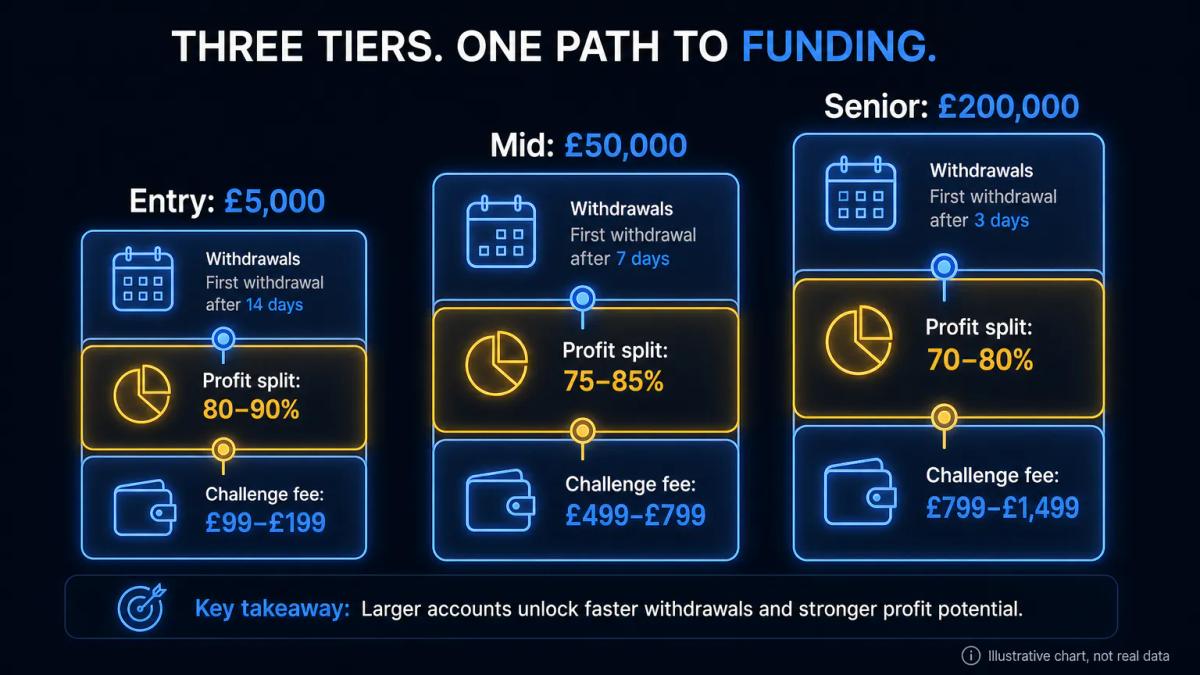
Funded accounts offered to UK clients tend to begin around £5,000 and scale up to £200,000, with several firms advertising progression plans that reach £1 million for traders who perform consistently over a run of payout cycles. Because the fee tracks the size of the account, a £10,000 evaluation generally costs noticeably less than a £100,000 one.
The table below compares the main parameters across common tiers, with figures that reflect indicative market ranges rather than guarantees from any specific firm.
| Parameter | Entry tier | Mid tier | Senior tier |
|---|---|---|---|
| Account size | £5,000 to £10,000 | £25,000 to £50,000 | £100,000 to £200,000 |
| Typical challenge fee | £40 to £90 | £150 to £300 | £500 to £1,000 |
| Profit target (one-step) | 10% | 10% | 10% |
| Profit split to trader | 70% to 80% | 80% | 80% to 90% |
| Payout window | 14 to 30 days | 7 to 14 days | 5 to 14 days |
Payouts are usually requested through a trader dashboard and then processed by bank transfer, crypto or a payment processor. Once your account qualifies for payouts after the first mandatory holding period, you can generally expect the funds to arrive between 5 and 10 business days from the request.
Risk management rules and drawdown limits you must follow
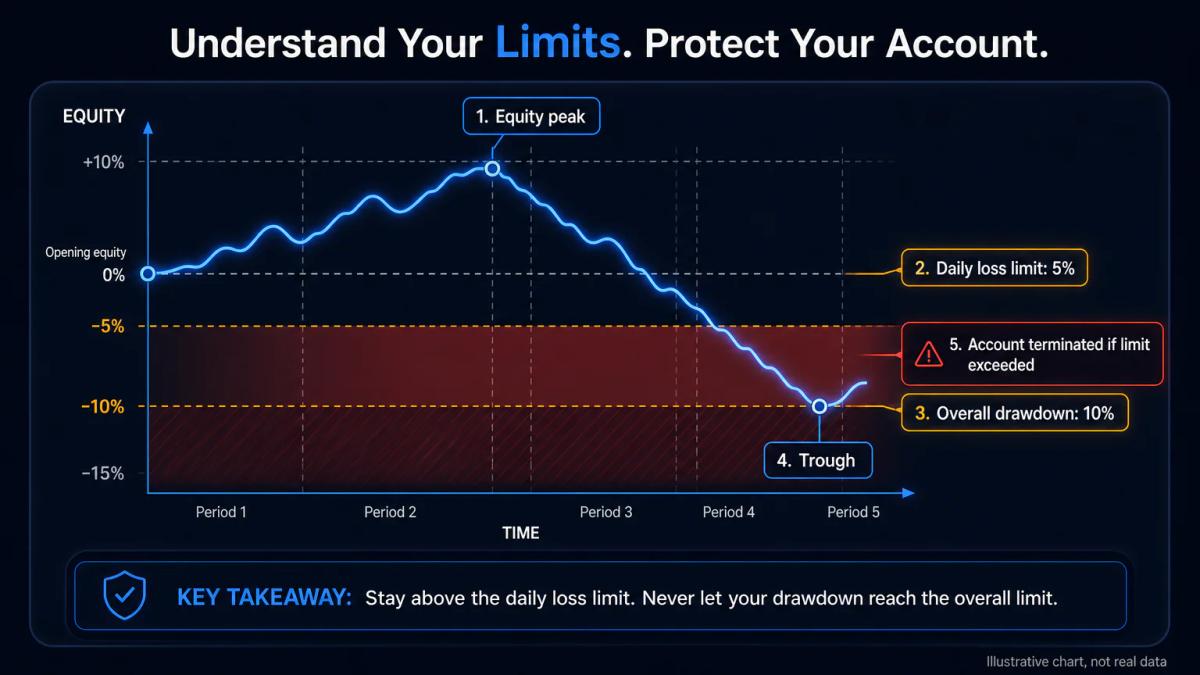
Drawdown, which measures the fall from a capital peak down to the trough before a new peak forms, acts as the main trigger behind account terminations at UK-facing prop firms. Most rulebooks layer two separate limits on top of each other:
- A daily loss limit, often 5% of starting balance, measured from the day's opening equity.
- An overall drawdown, often 10%, either static (fixed from the initial balance) or trailing (moving up with new equity highs).
Trailing drawdown applies a stricter version of the overall limit, because the floor climbs with every new equity high, so giving back a large unrealised profit can breach the account even while your balance remains above the starting figure. Firms also hand out instant terminations when a trader breaks rule-based limits such as maximum lot size or forbidden instruments, which is why working through the specific rulebook before paying the fee carries so much weight.
UK regulatory framework and FCA compliance for prop firms
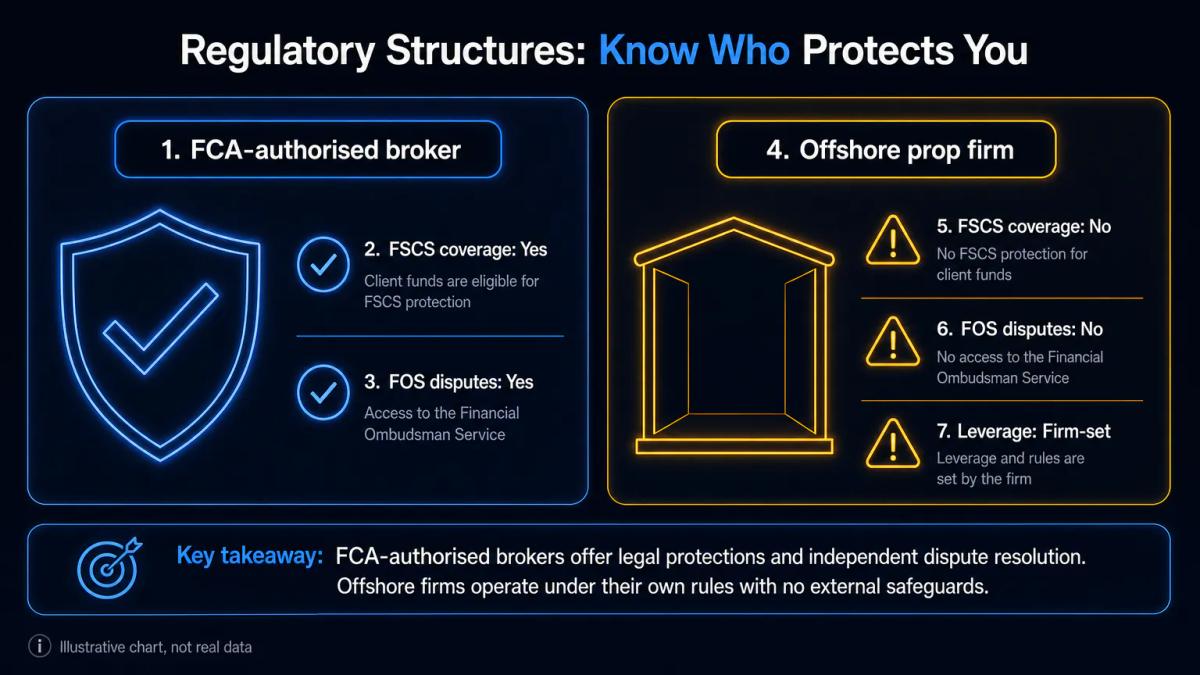
The majority of prop firms serving UK retail clients operate outside the FCA perimeter. A common structure involves an offshore entity offering a simulated account under a commercial contract, with the parent group typically based in one of the following jurisdictions:
- The UAE
- The Caribbean
- Eastern Europe
Three concrete consequences follow from that structure:
- No Financial Services Compensation Scheme coverage if the firm fails.
- No Financial Ombudsman Service route for disputes.
- Leverage and instrument rules are set by the firm, not by the FCA retail regime, which caps retail CFD leverage at 30:1 on major forex, 20:1 on major indices, 5:1 on single equities and prohibits CFDs on crypto for UK retail.
Before paying a challenge fee, run checks on three things:
- The Companies House registration of the UK-facing entity, where one exists.
- The parent group's licence in its home jurisdiction.
- Whether the trader contract is governed by English law or by the law of an offshore court.
That contractual governing-law question will shape your options should you later find yourself chasing an unpaid payout.
Tax implications and reporting requirements for UK traders
This section offers general information for context, and it should not be treated as tax advice; verify your position with a UK-licensed accountant or tax adviser before filing.
HMRC generally treats funded trading payouts as taxable UK income. The payout reaches you as a performance fee under contract with the prop firm, which places it inside the income regime; the capital gains regime that typically applies to market gains on your own capital does not come into play. The usual classifications include:
- Self-employment or trading income, reported on the Self Assessment SA103 pages, with class 2 and class 4 National Insurance where thresholds are met.
- Miscellaneous income under ITTOIA 2005, for occasional or non-habitual activity.
Keep records of:
- every challenge fee paid
- every payout received
- platform costs
- currency conversion charges
HMRC rules on trading in and developing UK land, in force from 5 July 2016 according to HM Revenue & Customs, apply equally to residents and non-residents in that specific area, and the broader principle of taxing UK-source trading income regardless of residence runs right through the tax system. Non-UK tax residents trading with a UK-facing prop firm should check both their home jurisdiction and any UK withholding rules before withdrawing funds.
To compare these rules with a real firm's, the FTMO review lays them out.
Frequently Asked Questions
How long does it take to get approved for a funded trading account in the UK?
From the day you pay the challenge fee, timings depend on the firm's model. A one-step challenge with a minimum of 5 trading days and a 10% target can realistically be passed in two to four weeks of active trading. Two-step evaluations usually take four to eight weeks across both phases. After passing, firms typically take 1 to 5 business days to issue the funded account credentials.
What happens if you breach the drawdown limit on a funded account?
A breach of the drawdown limit brings the account to an immediate end: open positions get closed, access to the dashboard is revoked, and any unpaid profits sitting above the breach are usually forfeited under the trader contract. Most firms sell a paid reset or a fresh challenge, and a handful bundle one free reset into the original fee. Hitting the daily loss limit on its own, even without touching the overall drawdown, is treated the same way and ends the account.
Can you trade crypto on a UK funded trading account?
Crypto trading is often available, because most prop firms use offshore entities and their own rulebooks instead of operating under the FCA retail regime. While the FCA prohibits CFDs on crypto for UK retail clients at authorised brokers, a prop firm's simulated account on an offshore platform sits under separate contractual arrangements. It is best to treat crypto availability as a feature of the firm's commercial model and to read nothing into it about UK regulatory coverage.
Do you need trading experience to apply for a funded account challenge?
Formal experience is not a requirement to pay the fee and begin a challenge, though passing one without prior screen time is genuinely uncommon in practice. The drawdown and consistency rules are purpose-built to filter out undisciplined trading, so treating the challenge as your first exposure to live-conditions pressure tends to become an expensive way to learn the basics. Most traders who do clear the evaluation arrive with months, and often years, of self-funded practice already behind them.
What fees or costs are involved in getting a funded trading account?
The main outlay is the one-off challenge fee, which scales with account size from roughly £40 for a £5,000 evaluation up to around £1,000 for a £200,000 evaluation. Beyond that headline figure, several extras can add up over time: resets after a breach, platform data feeds charged by some firms, payment processor fees on withdrawals, currency conversion costs where the account is denominated in dollars, and your own infrastructure spending such as a VPS when running automated strategies.
About the authors


Put this into practice
Prop firms we have reviewed
Scored on the same five dimensions, with the rules that decide payouts. Here are three — the full list is on the prop firms page.



Related articles

High Frequency Trading (HFT): How Speed Became a Market Edge
A grounded look at high frequency trading (HFT): the infrastructure, the strategies, the regulatory guardrails, and what it changes for you at the retail level.

How to Become a Proprietary Trader: Path, Requirements, and Reality
A practical guide to becoming a proprietary trader: institutional versus online routes, evaluation mechanics, risk limits, taxes and a first 90-day plan.

Kraken Crypto Prop Trading Explained: How It Works and How to Get Started
A plain-English explanation of Kraken's funded trader model, plus the five steps to getting started: verify your account, pick a tier that fits your risk, rehearse the rules, pass the evaluation, then trade funded.
0 comments