



Prop Trading · Intermediate · 11 min read
Kraken Crypto Prop Trading Explained: How It Works and How to Get Started
What Kraken Crypto Prop Trading Is
Kraken crypto prop trading is a funded account programme where you pass an evaluation, trade Kraken's capital under defined risk rules, and keep a percentage of the profits you generate. The firm retains the remainder and enforces daily loss limits.
The structure mirrors the funded trader model that spread from forex prop firms into equities and futures, now adapted to a crypto-native venue. Instead of risking your own balance to size up, you pay an evaluation fee, prove consistency against a profit target without breaching drawdown rules, and, if successful, receive a simulated or live account backed by Kraken's balance sheet. Payouts follow a preset split. To understand how this compares to traditional proprietary trading desks, see the explainer on proprietary trading firms.
If you are new to the funded model in general, the Monkeytrade guide to funded account risks covers the mechanics that apply across providers, not just Kraken.
To trade with a firm's capital, compare the best prop firms and how their evaluations work.
How Kraken's Prop Trading Program Works
Kraken's prop trading programme operates through a two-stage funded account model: you pick an account size, accept the risk rules, complete an evaluation against a profit target, and, if you pass without breaching the drawdown, unlock a funded account with a profit-sharing agreement.
The workflow is compact and can be summarised in four steps:
| Step | Action | What is measured |
|---|---|---|
| 1 | Choose account size | Evaluation fee and target capital |
| 2 | Accept rules | Daily loss limit, max drawdown, minimum trading days |
| 3 | Trade evaluation | Reach profit target without breaching risk rules |
| 4 | Access funded account | Trade Kraken capital, request payouts under the split |
Before reading the table, focus on step 2: the risk rules define whether the account is realistically tradable for your style, not the headline capital number. A tight daily loss limit favours scalpers, a wider maximum drawdown suits swing traders.
Evaluation phases are typically time-boxed with a minimum number of trading days, so you cannot pass the profit target in a single leveraged trade and be funded the next morning. The design filters out pure gamblers and rewards traders who compound smaller edges. Position size (the notional exposure of a single trade relative to account equity) and stop loss placement (the price at which the trade auto-closes) are the two variables under most scrutiny.
Once funded, you trade a live or shadow account and request payouts according to the schedule set by the tier.
Eligibility and Getting Started
Eligibility rests on three filters: your country of residence, your account status at Kraken, and your ability to pay the evaluation fee and pass the trading rules. You will typically need a verified Kraken account with identity checks completed, residence in a country the programme accepts, and agreement to the specific prop terms of service.
Minimum trading experience is not usually gated by a formal test, but the evaluation itself acts as the filter. Traders new to crypto derivatives should paper-trade the ruleset before paying for an evaluation, because breaching a daily loss limit on day one is a common and expensive mistake. For a primer on sizing, guidance on how notional exposure and margin interact can help you avoid costly mistakes.
KYC (know-your-customer) checks apply. Some jurisdictions are excluded entirely from crypto derivatives access, which is covered below.
How to Get Started, Step by Step
Getting onto a funded account is a sequence, not a single purchase. Work through the five steps below in order; each one removes a way of losing money before you have traded a single position.
Step 1: Open and verify your Kraken account
Create a standard Kraken account and complete identity verification (KYC) first. The prop programme sits on top of an existing verified account, so an unverified profile or a residence in an excluded country will stop the application before the evaluation stage. Check which entity onboards traders in your country, because that determines whether you get spot markets only or spot plus futures.
Step 2: Read the rulebook and pick a tier you can actually trade
For each tier, write down three numbers: the profit target, the daily loss limit and the maximum drawdown. Then divide the daily loss limit by your normal per-trade risk. If the result is fewer than three or four trades, the tier is too tight for your style and a single bad session will end the evaluation. Choose the smallest account whose risk parameters match how you already trade, not the largest one you can afford.
Step 3: Rehearse the ruleset on a demo or small live account
Before paying anything, trade the same instruments with the same position sizes for the minimum number of trading days the evaluation requires. Track whether you would have breached the daily loss limit on any single day. This dry run costs nothing and is the cheapest way to discover that your usual size is incompatible with the drawdown rules.
Step 4: Pay the evaluation fee and complete the challenge
Once you start, the objective is narrow: reach the profit target within the allowed window, respect the minimum trading days, and never let a single day breach the loss limit. Practical habits that keep traders inside the rules include placing a stop loss with every entry, halving size after two losing days in a row, and stopping for the session once you have used roughly half of the daily allowance.
Step 5: Trade the funded account and schedule your first payout
After passing, you receive the funded account with the profit-split agreement attached. Exchange costs (spreads, taker fees and, on perpetual futures, funding rates) are deducted from your P&L before the split, so model your expected return net of those costs. Note the payout schedule for your tier, request payouts on that cadence rather than ad hoc, and keep the same risk discipline: the drawdown rules continue to apply after funding, and breaching them can close the account.
Risks and Regulatory Considerations
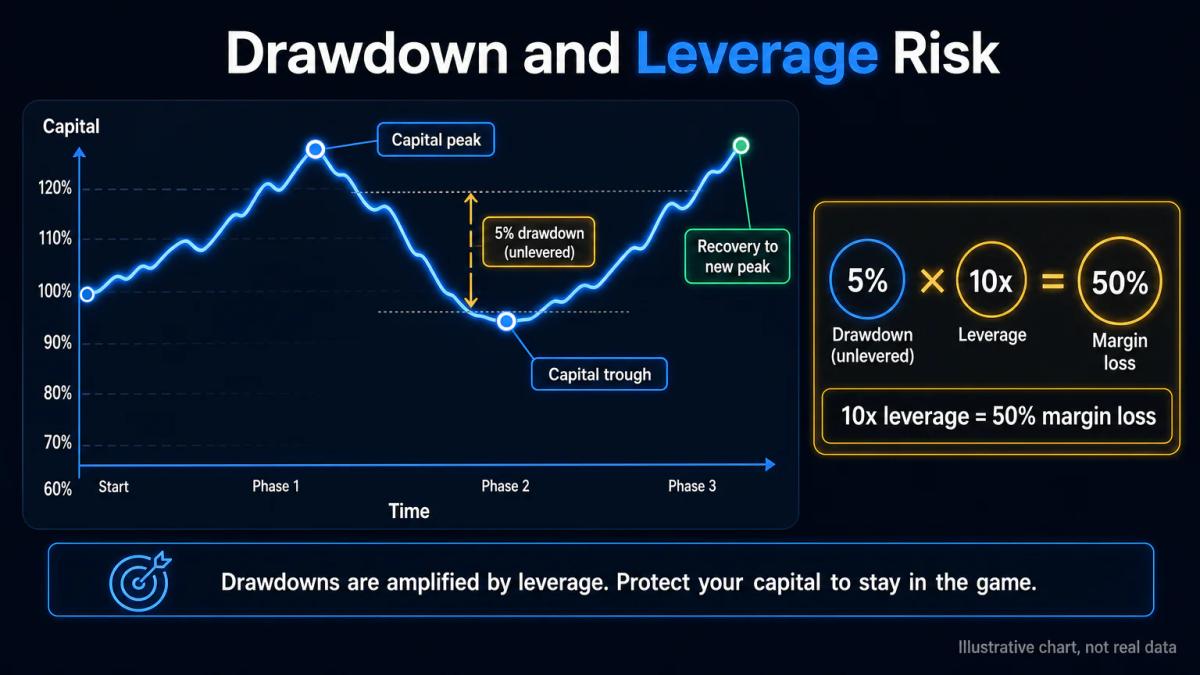
Prop trading on Kraken concentrates two categories of risk: the market and platform risks that apply to any leveraged crypto trader, and the regulatory risks that decide whether you can legally access the product from your country of residence. Treat them as separate problems with separate mitigations.
Market and Platform Risks
Leverage magnifies both directions. A drawdown (the fall from a capital peak to the trough before a new peak) of 5% on a 10x leveraged position translates to a 50% loss on posted margin, and a single overnight gap in a thin altcoin market can breach a daily loss limit before you have the chance to intervene. Platform risk sits alongside market risk: outages, order-routing delays, and API failures during volatile sessions have historically affected every major crypto venue, Kraken included. Sizing positions so that a worst-case slippage event still leaves you inside the daily loss limit is the practical defence.
Regulatory Restrictions by Country
Jurisdiction is decisive. In the UK, the FCA has banned the sale of crypto derivatives, including CFDs and futures on cryptoassets, to retail consumers since January 2021, so a UK retail trader cannot legally access a crypto-derivatives prop product regardless of the exchange offering it.
FCA Policy Statement PS20/10: From 6 January 2021, the FCA prohibited the sale, marketing and distribution to UK retail consumers of derivatives and exchange-traded notes referencing certain cryptoassets.
In the EU, MiCA sets the licensing perimeter for crypto-asset service providers. In the US, the CFTC regulates crypto futures and treats bitcoin and ether futures as commodity derivatives under its jurisdiction. In Australia, ASIC requires an Australian Financial Services Licence for crypto-derivatives issuers and has enforced product intervention orders on high-leverage retail crypto CFDs.
How Kraken's Model Differs From Other Funded Programmes
Kraken crypto prop trading competes with two groups: dedicated crypto funded-account firms that are not exchanges, and legacy multi-asset prop firms that offer forex, indices and, in some cases, crypto CFDs on the side. The trade-off is between exchange integration and instrument breadth. If you are evaluating prop firms more broadly, see the guide to evaluating a prop firm before you buy a challenge.
| Provider type | Instruments | Execution venue | Typical edge |
|---|---|---|---|
| Kraken crypto prop | Spot and futures on Kraken | Native exchange | Deep crypto liquidity, one platform |
| Crypto-only funded firm | CFDs or synthetic crypto | Broker or MM | Lower entry fees, more altcoins |
| Legacy forex prop firm | FX, indices, some crypto | Multi-broker | Established rulesets, wider markets |
The structural difference to understand is where your orders end up. On an exchange-run programme, funded orders hit the same order book as the rest of the venue's flow, so the fills you see in the evaluation are the fills you get once funded. Forex-first programmes usually route crypto exposure through CFDs built on aggregated broker liquidity, which means quotes can widen or slip during volatility spikes even when the underlying market is liquid. Knowing which of the two you are trading tells you how much slippage to budget for when you size positions against the daily loss limit.
Frequently Asked Questions
Is Kraken crypto prop trading available to UK retail traders?
Access depends on whether the product involves crypto derivatives. The FCA has banned the sale of crypto derivatives to UK retail consumers since January 2021, so a UK retail client cannot lawfully be onboarded to a crypto-derivatives prop account. Spot-only variants may be accessible via the FCA-registered UK entity Payward Ltd, but scope is narrower than for non-UK residents.
What is the minimum capital or experience required to join Kraken's prop trading program?
There is no formal experience test. The gating factors are a verified Kraken account with completed KYC, residence in an accepted jurisdiction, and the evaluation fee for the tier you choose. The evaluation itself filters trading skill by requiring you to hit a profit target without breaching the daily loss limit or maximum drawdown.
How much of your profits do you keep in Kraken's prop trading program?
The trader keeps the majority of profits under the funded account, with Kraken retaining a minority share that varies by tier and performance. Higher tiers and consistent payout history tend to unlock better splits. Confirm the exact percentages on kraken.com/prop before paying an evaluation fee.
Can you trade spot crypto or only derivatives on Kraken's prop account?
Both are possible depending on the entity that onboards you and your jurisdiction. Some regions have access to spot markets only, others to spot plus perpetual and dated futures. The prop rules apply the same way in both cases: the profit target, daily loss limit and maximum drawdown are what you are measured against.
What happens if you hit the daily loss limit on a Kraken prop trading account?
Breaching the daily loss limit typically ends the evaluation or, on a funded account, results in immediate closure or reset of the account under the programme's rules. You forfeit the evaluation fee if you were still in the challenge stage. Sizing positions so that worst-case slippage stays inside the limit is the practical defence.
About the authors


Put this into practice
Related articles

No Minimum Trading Days Prop Firm: What It Means and How to Choose
A no minimum trading days prop firm lets you pass the challenge on your own schedule. Here is what changes: drawdown mechanics, regulation, execution and self-discipline.

Options Prop Firms Explained: Evaluation, Profit Splits, and What to Expect
A plain-English guide to how options prop firms allocate capital, structure evaluations, split profits, and enforce risk rules on funded traders.

Phoenix Instant Challenge at Moneta Funded: What Is It and How It Compares
A breakdown of Moneta Funded's Phoenix Instant challenge, its rules, how it compares to Instant Funding, Instant Pro, and Moneta's other challenges, and how to start one.
0 comments