



Phoenix Instant Challenge at Moneta Funded: What Is It and How It Compares
Moneta Funded added the Phoenix Instant to its lineup as a funded-from-day-one option built around a scaling ladder that runs all the way to $2,000,000.
It sits alongside two other instant options (Instant Funding and Instant Pro) and Moneta's evaluation-based challenges (1-Step, 2-Step, and Sprint).
This article covers what the Phoenix Instant actually requires, how it stacks up against the other instant challenges, where it fits relative to the evaluation-based challenges, and what the process looks like if you want to start one.
What Is the Phoenix Instant Challenge?
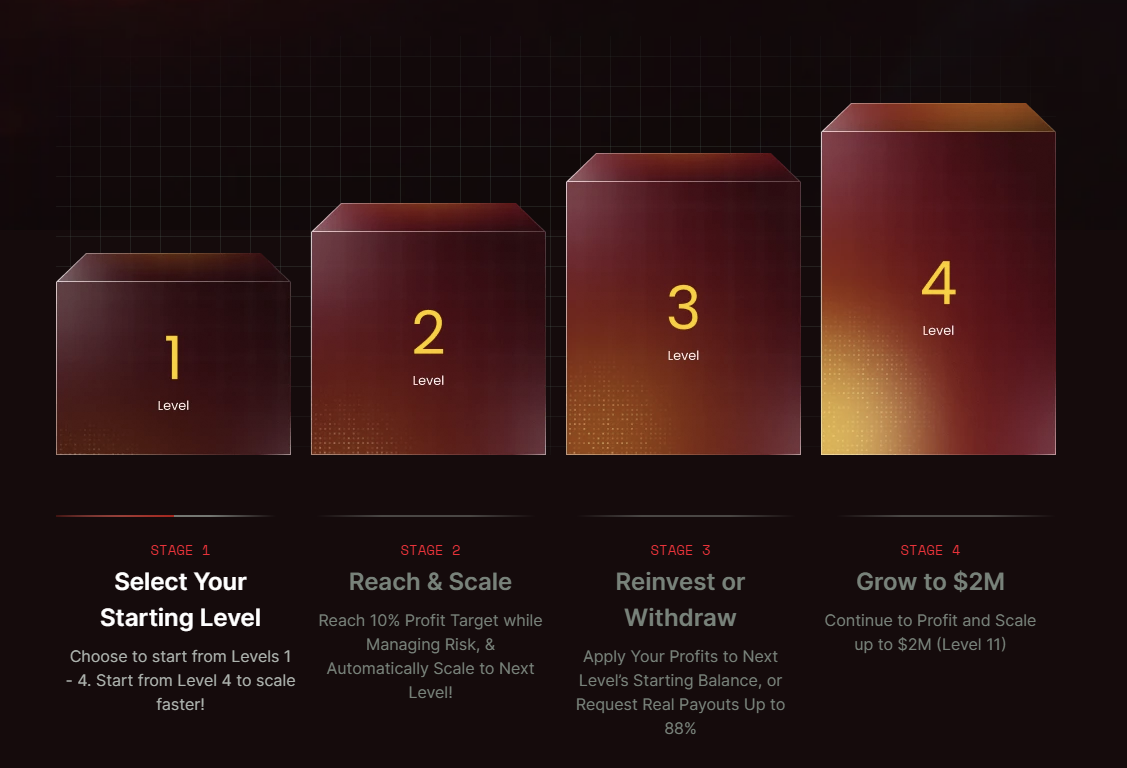
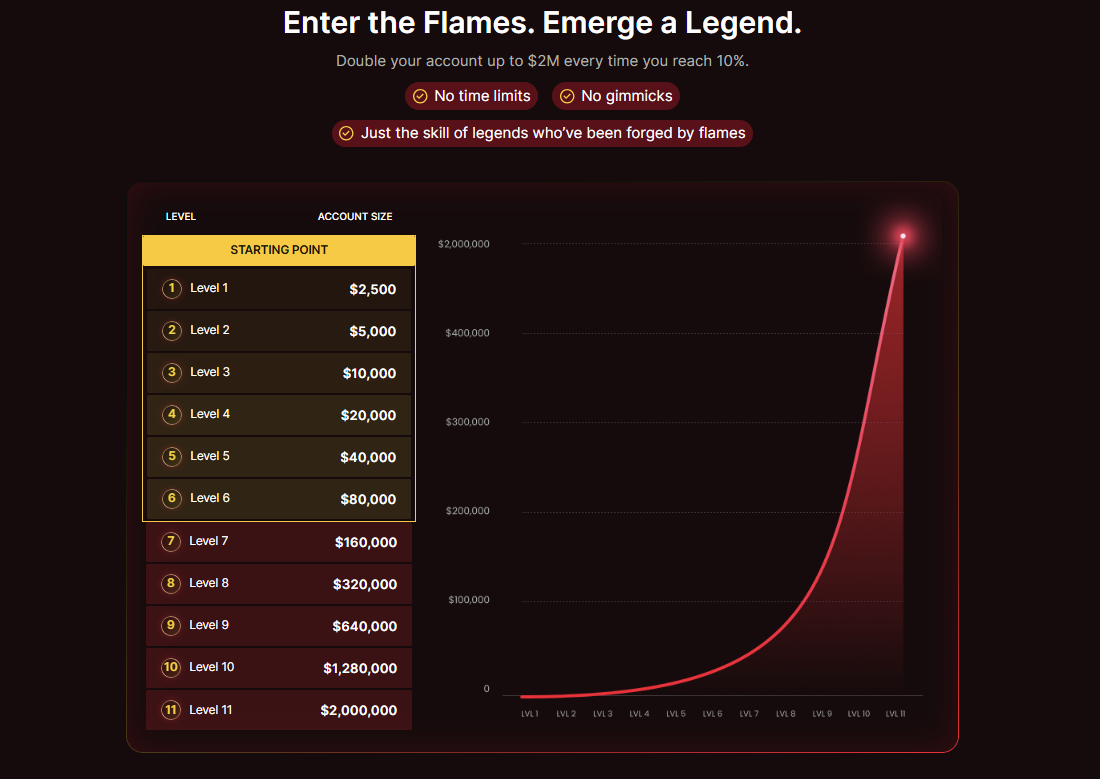
Phoenix is an instant funding account, meaning there's no evaluation phase to pass before you're trading with Moneta's capital. You pick a starting level between Level 1 and Level 4, each tied to a specific account size: Level 1 starts at $2,500, Level 2 at $5,000, Level 3 at $10,000, and Level 4 at $20,000. Starting higher costs more upfront but positions you closer to the larger account sizes further up the ladder.
The rules on a Phoenix account are: a 3% daily loss limit, a 6% max loss that is static rather than trailing, and a requirement to post at least 3 profitable days of 0.5% or more before you can progress. There's no separate consistency rule layered on top of that, which is a rule that appears on Moneta's standard Instant Funding account.
The scaling mechanic is what defines Phoenix. Every time you hit a 10% profit target, your account automatically moves to the next level. At that point you can withdraw your profits, provided they're $100 or more, or apply them toward the starting balance of the next level. The ladder runs from Level 1 ($2,500) through Level 11, which unlocks $2,000,000 in trading capital. Profit split on Phoenix is fixed at 88%, and payouts run on a 14-day cycle. There's no time limit attached to any stage, so the pace at which you climb the ladder is entirely up to how you trade.
You can trade Phoenix on MT5 or MatchTrader, with the caveat that MT5 isn't available to clients from the US or Canada. Leverage caps at 1:30, and holding positions overnight or over the weekend is allowed.
If a funded account is your goal, our roundup of the best prop firms is the place to start.
How Does Phoenix Compare to Moneta's Other Instant Challenges?
Moneta runs three instant options, and the differences between them come down to risk structure, cost of flexibility, and what happens after you're funded.
Standard Instant Funding uses a trailing max loss of 5%, rather than the static 6% on Phoenix. A trailing drawdown moves with your equity peak, so it can tighten as you bank profits.
Static drawdown, which Phoenix uses, stays fixed at the original account size regardless of how much you've made. That makes Phoenix's 6% ceiling more predictable to plan around, even though the percentage itself is slightly higher.
Standard Instant Funding also carries a 15-20% consistency rule, something Phoenix drops entirely in favor of the 3-day minimum profitable days requirement. Profit split on standard Instant Funding ranges from 60% to 88%, depending on the account terms selected, while Phoenix is a flat 88%.
Instant Pro takes the risk allowances further: a 4% daily loss limit, an 8% max loss, and a 4% max profit per day cap, alongside news trading being explicitly allowed. That last point is notable, since news trading isn't listed as a feature on either Instant Funding or Phoenix. Instant Pro's payout structure is also different, running on demand initially and then settling into the standard 14-day cycle. Profit split matches Phoenix at 88%.
What separates Phoenix from both of these is the growth mechanism. Neither Instant Funding nor Instant Pro is built around an explicit ladder of account sizes with automatic scaling. Phoenix ties every 10% profit target directly to account growth, with a defined endpoint at $2,000,000 across 11 levels. If the appeal of an instant account is trading real capital without an evaluation, and the goal is to grow that capital methodically rather than just draw a payout, Phoenix is the one built for that specific path. If news trading matters to your strategy, or you want a slightly higher daily loss buffer without the scaling structure, Instant Pro fits better. And if a lower-cost entry with a range of profit split options is the priority, standard Instant Funding covers that.
How Does Phoenix Compare to Moneta's Other Challenges?
The 1-Step and 2-Step challenges work on a fundamentally different premise: you prove yourself in an evaluation phase before capital is allocated, rather than trading funded capital from the outset.
The 1-Step requires hitting a 10% profit target and 3 minimum profitable days in a single phase before moving to a funded account, with a static 6% max loss and the same 88% profit split Phoenix offers once funded.
The 2-Step splits that into two phases, a 5% target followed by a 10% target, and offers leverage up to 1:100, compared to the 1:30 cap on Phoenix and both other instant options. That higher leverage is one of the clearer trade-offs: you get more buying power on the 2-Step, but only after clearing two separate evaluation phases first.
Sprint is a different format entirely. It's time-based, running in windows as short as one hour and as long as eight, with multipliers of 2x or 5x applied to results and a 100% profit split. News trading, gap trading, and trading around market open and close are all restricted on Sprint. It's built for a fast, contained trading session rather than the open-ended, multi-level growth path Phoenix offers.
Positioned against all of these, Phoenix occupies a specific spot: instant capital access without an evaluation phase, paired with a long-term scaling structure that the other instant accounts don't have, and without the leverage ceiling being pushed as high as it goes on the 2-Step. It suits traders who want to start earning and scaling immediately rather than clearing a phase-based test first, and who are planning for account growth over multiple levels rather than a single payout event.
How Do You Get Started With the Phoenix Instant Challenge?
Starting a Phoenix Instant account begins with choosing your starting level, from Level 1 at $2,500 up to Level 4 at $20,000. Starting at Level 4 puts you closer to the larger account sizes on the ladder faster, though it comes at a higher upfront cost than Level 1.
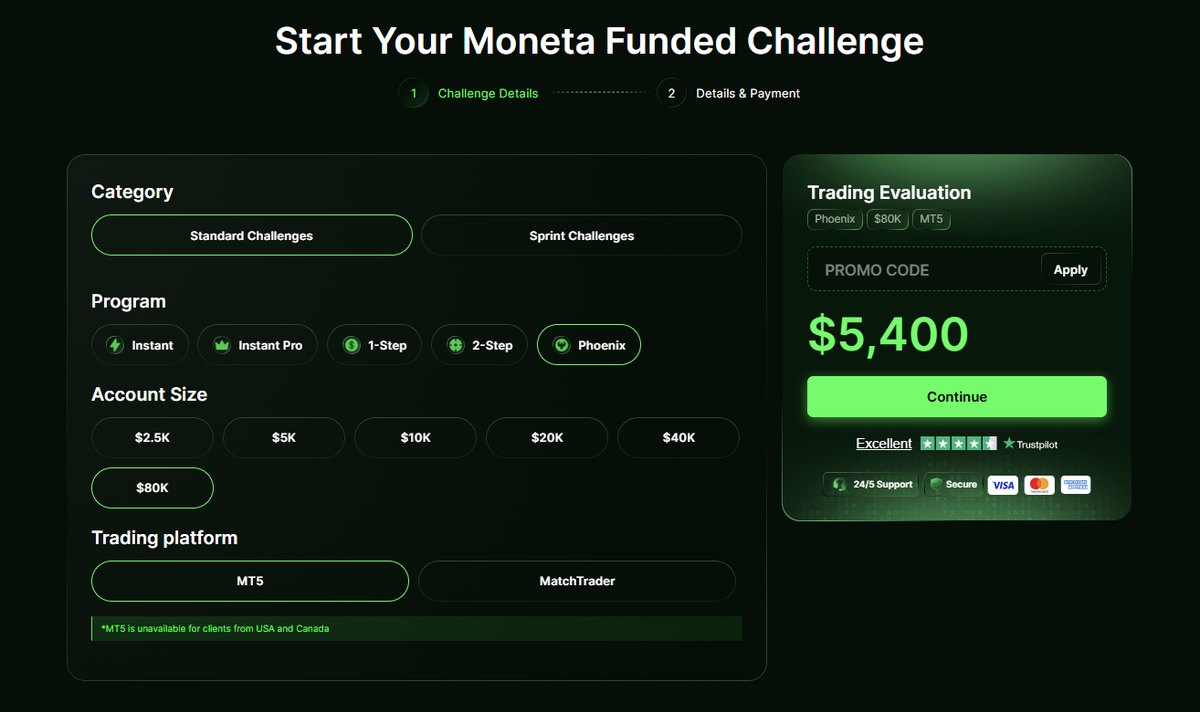
From there, you select a trading platform, either MT5 or MatchTrader, keeping in mind that MT5 isn't offered to traders based in the US or Canada. Once the account is purchased through Moneta's checkout page, you begin trading under the account's rules: staying within the 3% daily loss limit and the 6% static max loss, and posting at least 3 profitable trading days of 0.5% or more.
When you reach the 10% profit target, the account automatically scales to the next level. At that point you choose whether to withdraw profits of $100 or more, or roll them into the starting balance for the next level. That cycle repeats through each level, all the way to Level 11 and the $2,000,000 account size, with no time limit on how long any of it takes.
About the authors


Put this into practice
Related articles

Prop Firm Payouts: How Profit Splits, Thresholds and Withdrawals Work
A plain-English guide to prop firm payouts: how profit splits are calculated, when you can withdraw, how long settlement takes, and what to do if a firm holds your funds.

Prop Firms That Accept US Clients: What to Check Before You Sign Up
US traders face a narrower shortlist of prop firms than European peers. Here is how to read funding models, drawdown caps, tax reporting, and payout terms before you commit.

Prop Firms with No Evaluation Accounts: How Instant Funding Really Works
A plain-English breakdown of no-evaluation prop firms: how instant funding works, what rules apply from day one, and the trade-offs before you pay a fee.
0 comments